Contents8 sections
- What is ZIG Finance? From Zignaly to ZIGChain to ZIG Finance
- How ZIG Finance is structured and how the ZIG 2.0 buyback works
- What #1 on CoinGecko trending really tells you
- Why ZIG token supply figures don't match
- ZIG token checklist before you buy
- Key risks of ZIG Finance
- Frequently asked questions
- Sources and references
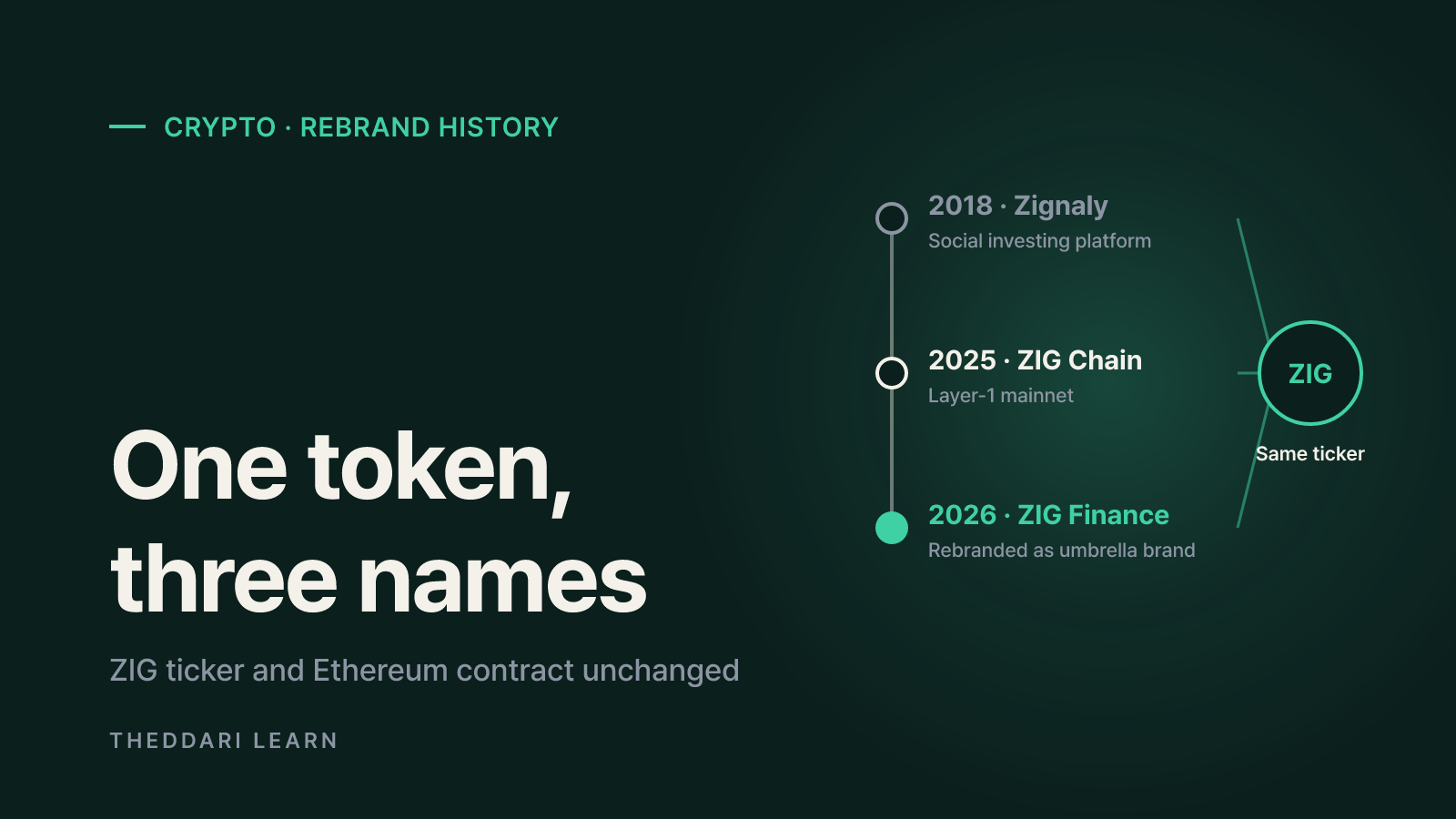
ZIG Finance is the new name, adopted in September 2026, for the ecosystem previously known as ZIGChain, which itself grew out of Zignaly, a social investing platform launched in 2018. The ZIG token, its ticker and its Ethereum contract stayed the same through the rebrand. ZIG hit #1 on CoinGecko's trending list on November 11-12, 2026 (UTC), but at the same moment its price was down 35.6% over 30 days. A trending rank tells you people are looking, not that the token is rising.
This guide is based on the official ZIG Finance site, CoinGecko data and exchange notices as of November 12, 2026. Prices and supply figures move constantly, so re-check them before you trade.
What is ZIG Finance? From Zignaly to ZIGChain to ZIG Finance
ZIG started life as the token of Zignaly. According to the official About page, Zignaly connected more than 600,000 users with over 150 professional portfolio managers. The team then built ZIG Chain, a layer-1 blockchain aimed at financial products, and in September 2026 introduced ZIG Finance as an umbrella brand over the chain, a product distribution business and an ecosystem investment arm. The official FAQ notes that the ecosystem went by ZIGChain until September 2026, while the blockchain keeps its own name, written ZIG Chain.
2018
- Milestone
- Zignaly launches
- What the project says
- 600,000+ users linked with 150+ portfolio managers
June 2025
- Milestone
- ZIG Chain mainnet
- What the project says
- Purpose-built layer 1 with settlement in under five seconds
July 2025
- Milestone
- Apex Group alliance
- What the project says
- Fund administrator overseeing about $3.4 trillion; onchain fund infrastructure
July 2026
- Milestone
- $ZIG 2.0 goes live
- What the project says
- Part of ZIG Markets revenue funds monthly open-market buys
September 2026
- Milestone
- Rebrand to ZIG Finance
- What the project says
- Chain, ticker and token mechanics unchanged
Exchanges confirmed the change was cosmetic. A KuCoin notice dated September 25, 2026 says the rebrand only touched the project name, the token contract and ticker remain the same, and trading, deposits and withdrawals were not affected.
Rebrands attract scammers. If you see a site or direct message telling you to swap to a new ZIG or connect your wallet for a migration, assume it is fake until zig.finance or the official @ZIGFinance account says otherwise. Nothing published so far calls for a token swap.
Why the names get mixed up
CoinGecko still files the token under the URL slug zignaly, displays it as ZIG Finance and uses zigchain in part of its web path. The linked Telegram channel is still called ZignalyHQ. So charts, forums and older articles may use any of the three names. Search all of them, and confirm you are looking at the right asset by contract address rather than by name.
How ZIG Finance is structured and how the ZIG 2.0 buyback works
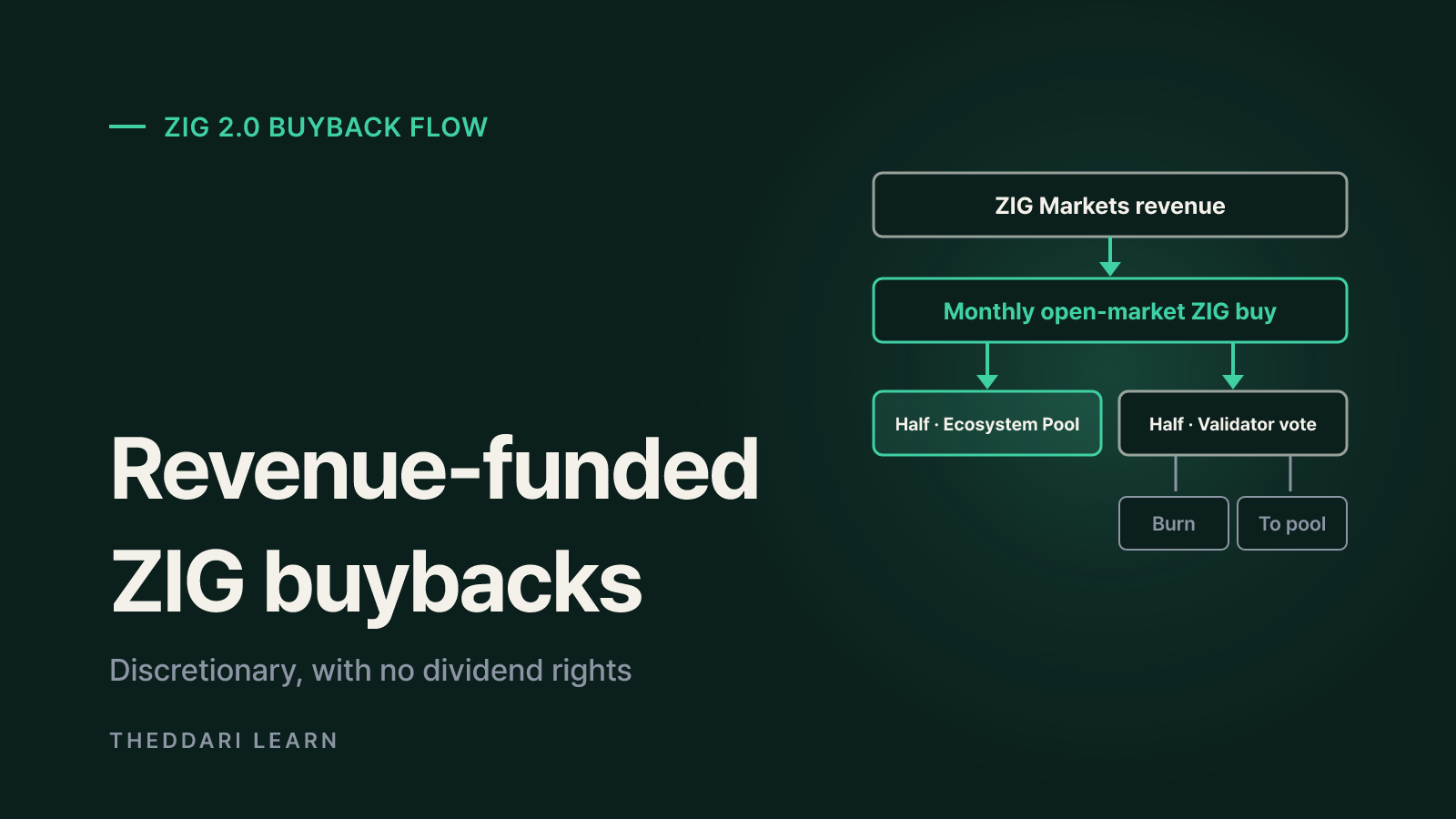
The project describes itself as three operating layers plus one token. The pitch is to bring regulated, institutional-style investment products onchain and open them to smaller investors, with ZIG sitting at the economic centre.
- ZIG Chain: the layer-1 blockchain for institutional financial products and real-world asset management. ZIG is used for gas, staking and governance.
- ZIG Markets: the distribution business that structures and sells regulated products such as private credit, equities, real estate and structured products. Its product list includes Gulf-region invoice factoring and SME lending.
- ZIG Labs: backs founders building financial applications on ZIG Chain.
- $ZIG: a utility and governance token the project says is designed to track growth across the whole ecosystem.
The ZIG 2.0 value flow
The official $ZIG page lays out the mechanism that has applied since July 1, 2026. The official FAQ gives a cumulative purchase target of 500 million ZIG.
- ZIG Markets earns fees for structuring, distributing and servicing products.
- A portion of that revenue buys ZIG on the open market each month.
- Half of the purchased ZIG goes automatically to the Ecosystem Pool.
- Validators vote on the other half: burn it permanently or send it to the pool too.
- The Foundation proposes uses for the pool roughly every three months, and holders vote on grants, partner incentives, liquidity programs and similar spending.
Two caveats matter. First, the project calls the purchases discretionary, so there is no fixed monthly amount; you need the monthly disclosures and the on-chain governance proposals to see what actually happened. Second, the official site states that ZIG is not a security, share or investment contract and carries no right to profits, dividends or distributions. Tokens sent to the Ecosystem Pool can also flow back into the market later.
What regulation does and does not cover
The official FAQ is explicit that ZIG Finance is not itself a regulated firm. The entities building ZIG Chain are technology providers, and ZIG Markets' regulated activity runs through two South African companies supervised by the Financial Sector Conduct Authority (FSCA). For the token, the project cites a legal opinion from the British Virgin Islands. If you are in the US, UK, EU or elsewhere, none of that amounts to a local licence or investor protection for token buyers.
What #1 on CoinGecko trending really tells you
CoinGecko's trending list reflects search and page-view interest on CoinGecko. It is not a ranking of price gains or volume. ZIG's numbers at the time make the gap obvious. The figures below are CoinGecko data as of 04:57 UTC on November 12, 2026.
Price
- Value
- about $0.0375
- How to read it
- -1.49% over 24 hours
7-day / 30-day change
- Value
- -12.2% / -35.6%
- How to read it
- Falling while trending
Market cap
- Value
- about $52.8 million
- How to read it
- Ranked #413 on CoinGecko
Fully diluted valuation
- Value
- about $73.2 million
- How to read it
- Based on total supply
24-hour volume
- Value
- about $7.34 million
- How to read it
- About 13.9% of market cap
All-time high
- Value
- about $0.2242 (April 15, 2021)
- How to read it
- Current price is about 83% below the peak
Daily volume near 13.9% of market cap means roughly one-seventh of the token's value changed hands in a day. That is common for small caps under a spotlight, but if the volume sits on one or two venues, a large order can move the price sharply. To see whether chatter is about a rally, a dump or the rebrand, the Telegram crypto trends page shows what crypto channels are discussing.

Why ZIG token supply figures don't match
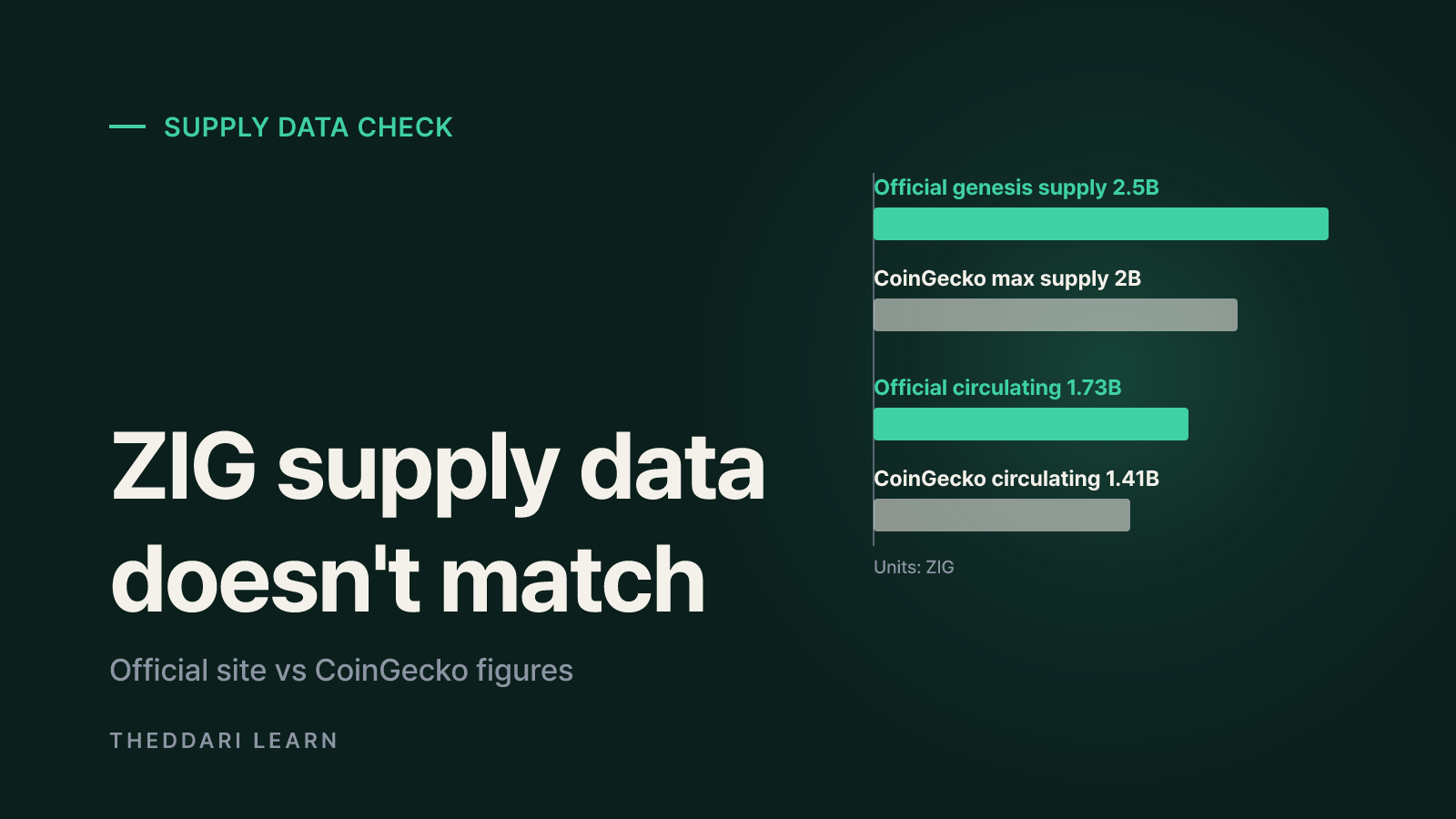
The official $ZIG page lists a genesis supply of 2.5 billion ZIG and circulating supply at mainnet of 1,726,440,444 ZIG (about 1.73 billion, or 69.06%). CoinGecko instead shows a 2 billion max supply, about 1.95 billion total supply and about 1.41 billion circulating.
Cap / starting supply
- Official site
- Genesis supply 2.5 billion ZIG
- CoinGecko (Nov 12, 2026)
- Max supply 2 billion ZIG
Circulating
- Official site
- About 1.73 billion ZIG (at mainnet, 69.06%)
- CoinGecko (Nov 12, 2026)
- About 1.41 billion ZIG
Total supply
- Official site
- Not listed
- CoinGecko (Nov 12, 2026)
- About 1.95 billion ZIG
We did not find an official explanation for the gap. Plausible causes include different reference dates (the June 2025 mainnet versus today), different definitions (native ZIG Chain issuance versus the legacy ERC-20 cap), burns and pool transfers, and how bridged tokens on several chains are de-duplicated. The choice matters: $0.0375 times 2.5 billion is about $93.7 million, well above CoinGecko's fully diluted figure of about $73.2 million.
Rather than picking whichever number looks best, compare the allocation table in the tokenomics paper with live supply on a block explorer, and ask the team publicly if the figures still don't reconcile.
Founder vesting and staking rewards
The official page says founder tokens vest linearly over 30 months starting January 2026, which means new tokens can reach the market every month until around mid-2028. If monthly buybacks are smaller than those unlocks, net supply still grows. The page also quotes a 7.2% staking APR as of June 2026; that rate changes, and staking rewards are themselves new supply.
ZIG token checklist before you buy
- 1
Confirm official channels
Use zig.finance, the @ZIGFinance X account and the CoinGecko page at /coins/zignaly as your reference points. Check domain spelling on anything reached through ads or DMs.
- 2
Match the contract address
CoinGecko lists the Ethereum ERC-20 contract as 0xb2617246d0c6c0087f18703d576831899ca94f01. There are also BNB Chain, Polygon, Solana and Injective versions, plus native ZIG Chain (uzig). Check which version you are actually receiving.
- 3
Check exchange and deposit network
Confirm your exchange lists ZIG and which networks it accepts for deposits. Sending on the wrong network can mean permanent loss. Price gaps between venues show up on the cross-exchange arbitrage page.
- 4
Look at liquidity, not just volume
Use CoinGecko's markets tab to see which exchanges and pairs carry the volume, then estimate how far your order would walk the order book.
- 5
Track unlocks and buybacks
Compare founder vesting, Ecosystem Pool proposals and monthly buyback and burn votes. On-chain records are more reliable than announcements.
- 6
Find out why it is trending
Read official notices and news to see whether interest comes from a pump, a sell-off or rebrand confusion. If you can't tell, waiting is a valid option.
Key risks of ZIG Finance
- Price trend: down 35.6% over 30 days while trending and about 83% below its 2021 high.
- Buyback uncertainty: purchases are discretionary and depend on ZIG Markets revenue, which outsiders cannot easily audit.
- Supply data conflicts: official and CoinGecko numbers differ, which changes any market cap or valuation math.
- Limited regulatory cover: ZIG Finance is not regulated as a whole; licences apply only to South African entities' activities.
- Phishing: three names in a few years leave plenty of room for fake swap sites and airdrops.
- Multichain mix-ups: several chain versions exist, and wrong-network transfers can be unrecoverable.
In short, ZIG is an older token that has been repositioned around real-world financial product distribution and a revenue-linked buyback. The business plan is documented on the official site, but buyback size, true supply and regulatory scope are things a buyer has to verify with numbers. Check the contract address, real liquidity and monthly buyback records before you let a trending badge drive the decision.