Hyperliquid vs Lighter vs Variational: Perp DEX Comparison
Compare Hyperliquid, Lighter and Variational Omni as of November 2026: order book vs RFQ, fees, funding intervals, liquidations, vault risk and what to check.
Contents8 sections
- Perp DEX comparison: three different execution models
- Fees and funding: zero fees still cost something
- Liquidations and who absorbs losses: HLP vs LLP vs OLP
- Tokens and points: what the docs actually say
- Checklist before you deposit
- Risks that remain even on a DEX
- Frequently asked questions
- Sources and references
Key takeaways
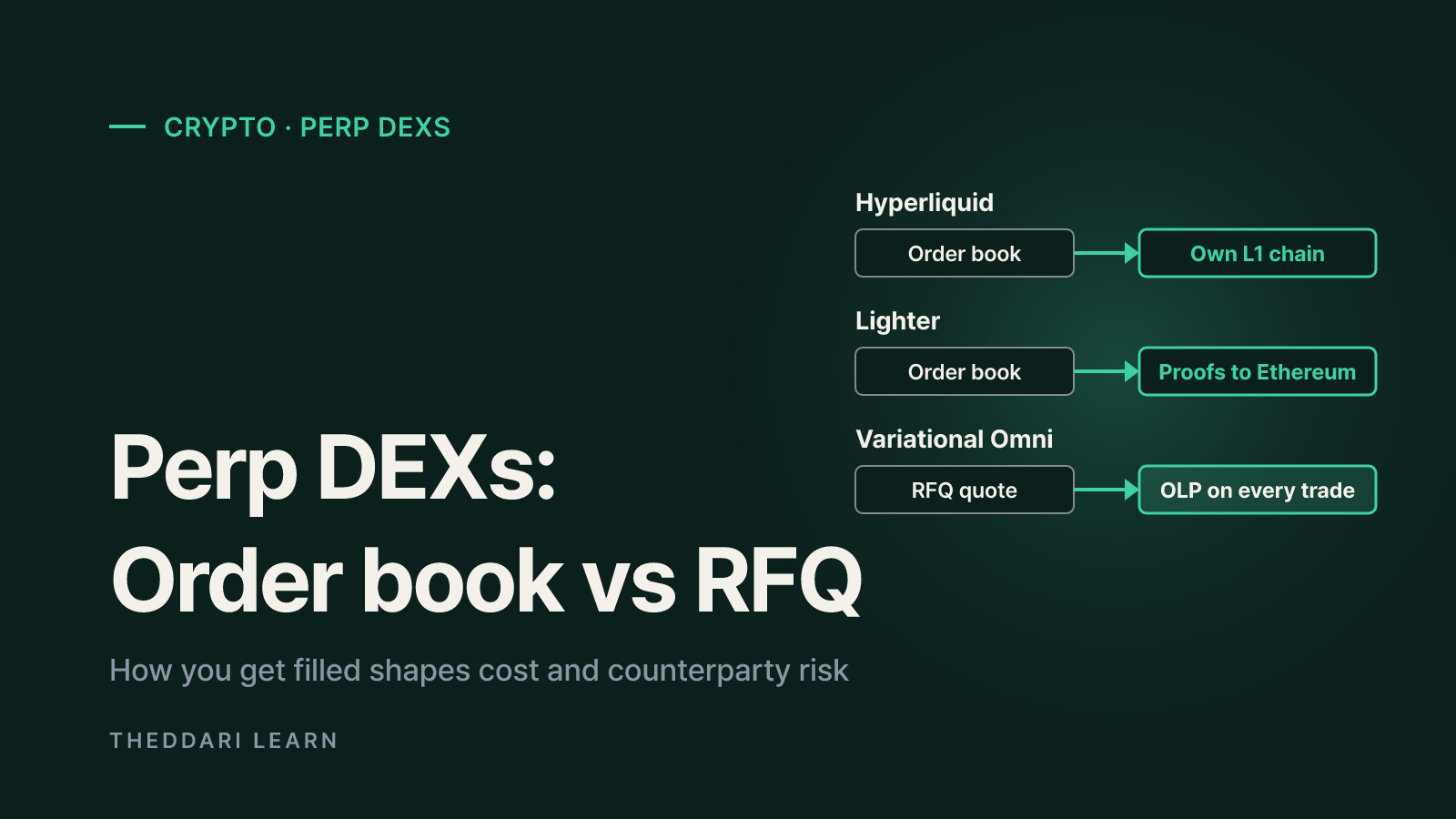
- All three list perpetual futures, but execution differs: Hyperliquid and Lighter match on order books, while Variational Omni uses RFQ with OLP as the only market maker.
- As of November 2026, Hyperliquid's base perp taker fee is 0.045%; Lighter Standard accounts and Omni charge 0% trading fees on regular orders. Spread, latency and funding still cost money.
- Hyperliquid settles funding every hour with a 0.5% per hour cap; Omni uses a 1 to 8 hour window depending on the market, capped at 2% per hour.
- The backstop vaults differ. Omni's docs state that if OLP became insolvent, PnL accrued afterward could become bad debt and go unpaid.
- Trending tokens such as HYPE, LIT or Variational X are a separate decision from using the venue. Verify contracts and token utility in official docs first.
The short answer to any perp DEX comparison between Hyperliquid, Lighter and Variational is that they differ less in what you can trade and more in how your order gets filled and who absorbs losses when things go wrong. Hyperliquid runs an on-chain order book on its own layer 1, Lighter runs an order book whose matching is proven to Ethereum, and Variational's first app, Omni, has no order book at all: a single liquidity provider called OLP quotes every trade. This guide compares fees, funding, liquidations and vault design using each project's official documentation as checked in November 2026.
All three appeared on CoinGecko's trending list at the same time, which is why traders are asking which one is cheaper or safer. The honest answer is that a headline fee number tells you very little. Costs and risks move around depending on the design, so start with the questions that match how you trade.
Perp DEX comparison: three different execution models
A perpetual future (perp) is a futures contract with no expiry. Instead of settling on a date, it uses periodic funding payments to keep the contract price near the spot price. Decentralized perpetuals exchanges offer these contracts through wallets and smart contracts (or a dedicated chain) rather than a custodial account, and where the matching engine lives shapes almost everything else.
Hyperliquid: an order book on its own chain
Hyperliquid's validators run the chain that hosts the order book, so orders, fills and liquidations are recorded on-chain. The oracle price is a weighted median of spot prices from major centralized exchanges, computed by each validator (Hyperliquid funding docs). Trading fees go to the HLP vault, the assistance fund and HIP-3 market deployers, and the assistance fund converts fees into HYPE that is burned (Hyperliquid fee docs).
Lighter: an order book with proofs posted to Ethereum
Lighter describes itself in its official docs as running order matching and liquidations off Ethereum, then submitting zero-knowledge proofs that the price-time priority matching was done correctly. That verifiability is its main pitch. A sequencer still orders transactions and proofs are posted afterward, so it is worth reading how the escape hatch for withdrawals works before you deposit.
Variational Omni: RFQ against a single provider
Omni replaces the order book with request-for-quote. You enter an order, OLP (the Omni Liquidity Provider) returns a price, and the trade books if you accept. OLP is the counterparty to every trade and hedges its exposure on centralized exchanges, DEXs and traditional dealers. That design lets Omni list 500+ crypto and traditional markets, including commodities and equities, with zero trading fees (About Omni). The protocol earns a share of the spread OLP collects, currently 20% according to the docs and subject to change, sent to a treasury wallet published on Arbiscan, the Arbitrum block explorer (OLP docs).
Execution
- Hyperliquid
- Order book, price-time priority
- Lighter
- Order book, price-time priority
- Variational Omni
- RFQ, OLP quotes every trade
Where it runs
- Hyperliquid
- Own layer 1
- Lighter
- Off-chain engine, proofs to Ethereum
- Variational Omni
- Variational protocol settlement pools
Your counterparty
- Hyperliquid
- Other traders and makers
- Lighter
- Other traders and makers
- Variational Omni
- Always OLP
Base trading fee
- Hyperliquid
- 0.045% taker / 0.015% maker (tier 0)
- Lighter
- 0% on Standard regular orders
- Variational Omni
- 0% maker and taker
Funding
- Hyperliquid
- Hourly, cap 0.5% per hour
- Lighter
- Check official docs
- Variational Omni
- 1 to 8 hour window, cap 2% per hour
Related token
- Hyperliquid
- HYPE (staking fee discounts)
- Lighter
- LIT (staking fee discounts)
- Variational Omni
- Not covered in docs reviewed
Fees and funding: zero fees still cost something
Trading fees
Hyperliquid's base perp tier charges 0.045% taker and 0.015% maker, falling with 14-day volume. Staking HYPE adds a discount of up to 40% for more than 500,000 HYPE staked (fee docs). Opening a $10,000 notional market order at the base tier therefore costs about $4.50.
Lighter has three account types. The default Standard account pays nothing on regular perp and spot orders, but taker orders have 300 ms of added latency and TWAP, advanced orders and RFQ cost 1 bp (0.01%). Premium accounts pay 0.0040% maker and 0.0280% taker with 140 ms taker latency, discounted by up to 30% through LIT staking (Lighter fee docs). For latency-sensitive strategies, the delay can cost more than the fee you avoid.
Omni charges no maker or taker fee. Instead, OLP sets a spread per market and builds it into the quote. The price you see first is indicative; clicking buy or sell produces a firm quote, which can be better or worse if the market moved. Setting a slippage limit is effectively your cost ceiling.
Funding intervals and caps
Hyperliquid calculates an 8-hour funding rate but pays one eighth of it every hour, with the interest component fixed at 0.01% per 8 hours and a cap of 0.5% per hour, which the docs note is less aggressive than centralized venues. Omni follows Bybit's funding window if the market trades there, then Binance's, otherwise one hour, with a 2% per hour cap that can be manually overridden in special circumstances (Omni funding docs). On an 8-hour market, hours one to seven pay zero and the whole amount lands in hour eight.
Different schedules create opportunities and traps for cross-venue strategies. You can compare live rates on the theddari funding rate arbitrage tool, but remember that settlement timing and caps differ between venues.

Liquidations and who absorbs losses: HLP vs LLP vs OLP
With leverage, the bigger risk is not the fee but how much you lose in a liquidation and who covers the venue's losses. This is where the three designs differ most.
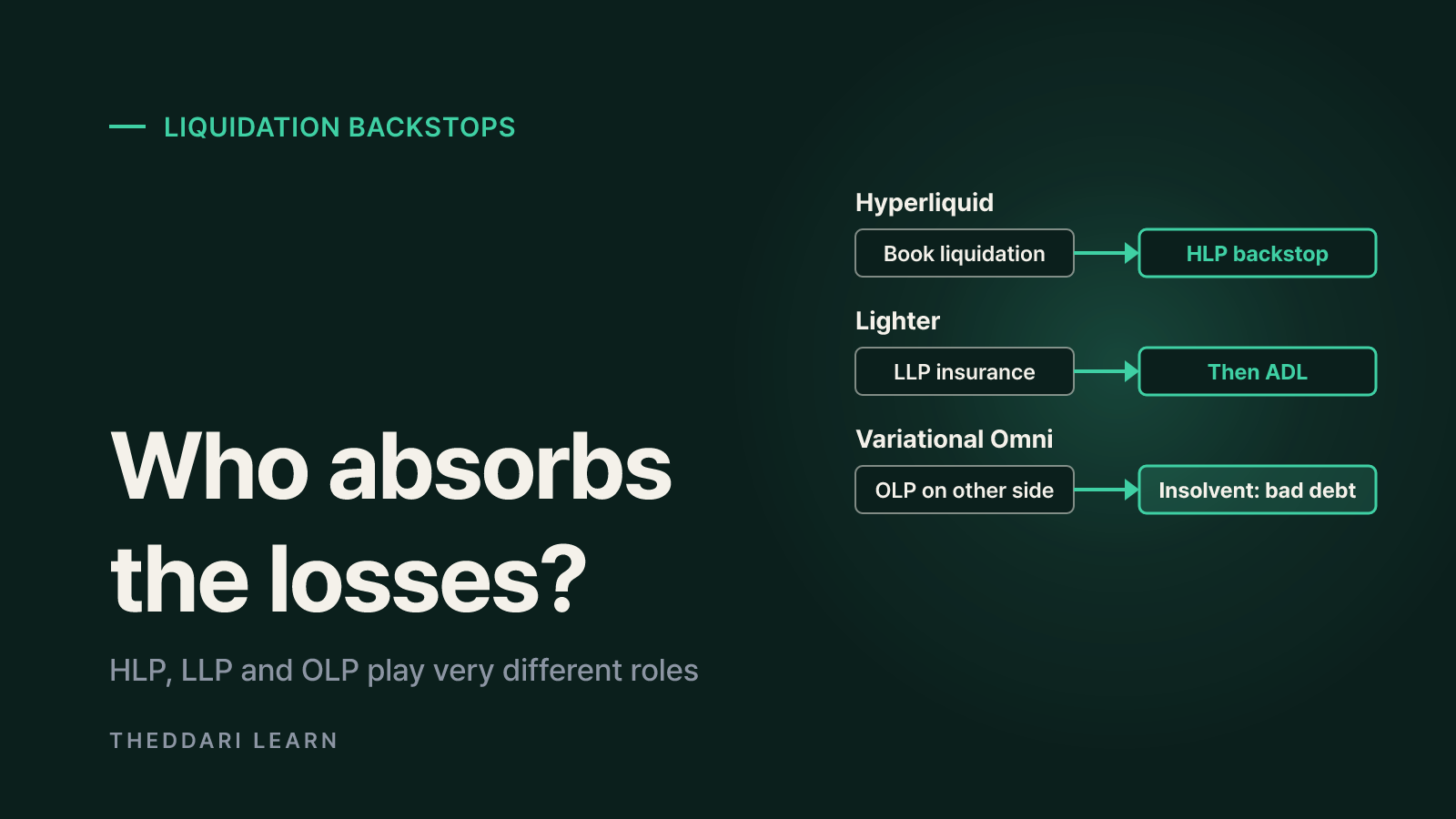
Hyperliquid: book liquidation first, then the HLP backstop
Maintenance margin is half the initial margin at max leverage, so it ranges from 1.25% (40x assets) to 16.7% (3x assets). When equity falls below it, Hyperliquid first sends market orders to the book, and any margin left after a partial close stays with you. Positions above 100k USDC are liquidated 20% at a time. If equity drops below two thirds of maintenance margin, the liquidator vault inside HLP takes over the position, and the maintenance margin is not returned (liquidation docs).
Lighter: LLP and auto-deleveraging
Lighter's docs describe the LLP (Lighter Liquidity Pool) as its liquidation backstop and insurance fund. If the LLP cannot absorb a bankrupt account's losses, auto-deleveraging (ADL) closes opposing positions, which can include profitable ones. The theddari ADL tool explains how ADL ranking works and what to monitor.
Variational Omni: OLP is the other side
On Omni, both you and OLP post margin into a settlement pool, and either side can be liquidated. The docs say trader funds stay in segregated pools and are never sent to outside exchanges. They also state plainly that if OLP became insolvent, any realized or unrealized PnL accrued afterward would be bad debt and might not be paid. OLP was seeded by the Variational team, with plans to open a community vault later. Fund segregation protects your deposit; it does not guarantee your profits.
Tokens and points: what the docs actually say
Much of the trending interest mixes venue usage with token speculation. Those are separate decisions. Here is what the official docs reviewed confirm about each token's role:
- HYPE: staking unlocks Hyperliquid fee discounts of up to 40%, and the assistance fund burns HYPE bought with fees.
- LIT: staking reduces Lighter Premium account fees by up to 30%.
- Variational X: the Omni, OLP and funding pages reviewed do not mention a token. Do not treat a CoinGecko listing as proof that it is official.
Farming points or airdrops by inflating volume can cost more in spread, funding and liquidation losses than any reward pays back. Reward rules can change without notice, so check the date on official announcements.
Checklist before you deposit
- 1
Verify official URLs
Find the app link and token contracts in official docs or verified accounts. Search ads and DMs are common phishing routes.
- 2
Know your counterparty
Is it an order book or RFQ? Are you trading against other users or a single vault such as OLP?
- 3
Add up total cost
Combine fees, spread, slippage, funding schedule and cap, and withdrawal costs on the same notional size.
- 4
Read the liquidation rules
Check maintenance margin, partial liquidation, whether margin is returned in a backstop, and ADL exposure. Use stop losses.
- 5
Test with a small amount
Make a small deposit and withdrawal through the actual bridge first, and confirm the network you are sending on.
If you want to see how much the same coin's price varies across venues, the theddari cross-exchange arbitrage tool shows spot price gaps. Keep in mind that perp prices follow mark price and funding, so they can drift from spot.
Risks that remain even on a DEX
- Smart contract and bridge risk: bugs in deposit contracts or bridges can lose funds, audits or not.
- Oracle and mark price risk: liquidations use mark price, and Hyperliquid's docs warn mark and book prices can diverge sharply in volatile markets.
- Single counterparty risk: when one vault such as OLP takes every trade, a hedging failure or an incident at an outside exchange can affect its ability to pay.
- Parameter changes: fee rates, Omni's 20% spread share and funding caps can change under the docs' own terms.
- Regulation and tax: venues do not decide your eligibility or tax position for you; check your jurisdiction.
In short, Hyperliquid trades a visible fee for deep on-chain order books, Lighter trades latency on free Standard accounts for proof-based verifiability, and Omni trades single-counterparty exposure to OLP for broad market coverage and zero fees. Match those trade-offs to how often you trade, how long you hold, and how much leverage you use.
Frequently asked questions
Is a zero-fee perp DEX actually cheaper?
What is the difference between HLP, LLP and OLP?
How often is funding paid on each venue?
Is the trending Variational X token the same as Omni?
Can US or other restricted users trade on these DEXs?
Sources and references
- 1Hyperliquid Docs – Liquidations(opens in a new tab)hyperliquid.gitbook.io
- 2Hyperliquid Docs – Funding(opens in a new tab)hyperliquid.gitbook.io
- 3Hyperliquid Docs – Fees(opens in a new tab)hyperliquid.gitbook.io
- 4Lighter Docs – Trading Fees(opens in a new tab)docs.lighter.xyz
- 5Variational Docs – About Omni(opens in a new tab)docs.variational.io
- 6Variational Docs – The Omni Liquidity Provider (OLP)(opens in a new tab)docs.variational.io
- 7Variational Docs – Funding Rates(opens in a new tab)docs.variational.io
Related articles
 Crypto
Derive Crypto Explained: DRV Token, Options Exchange, Risks
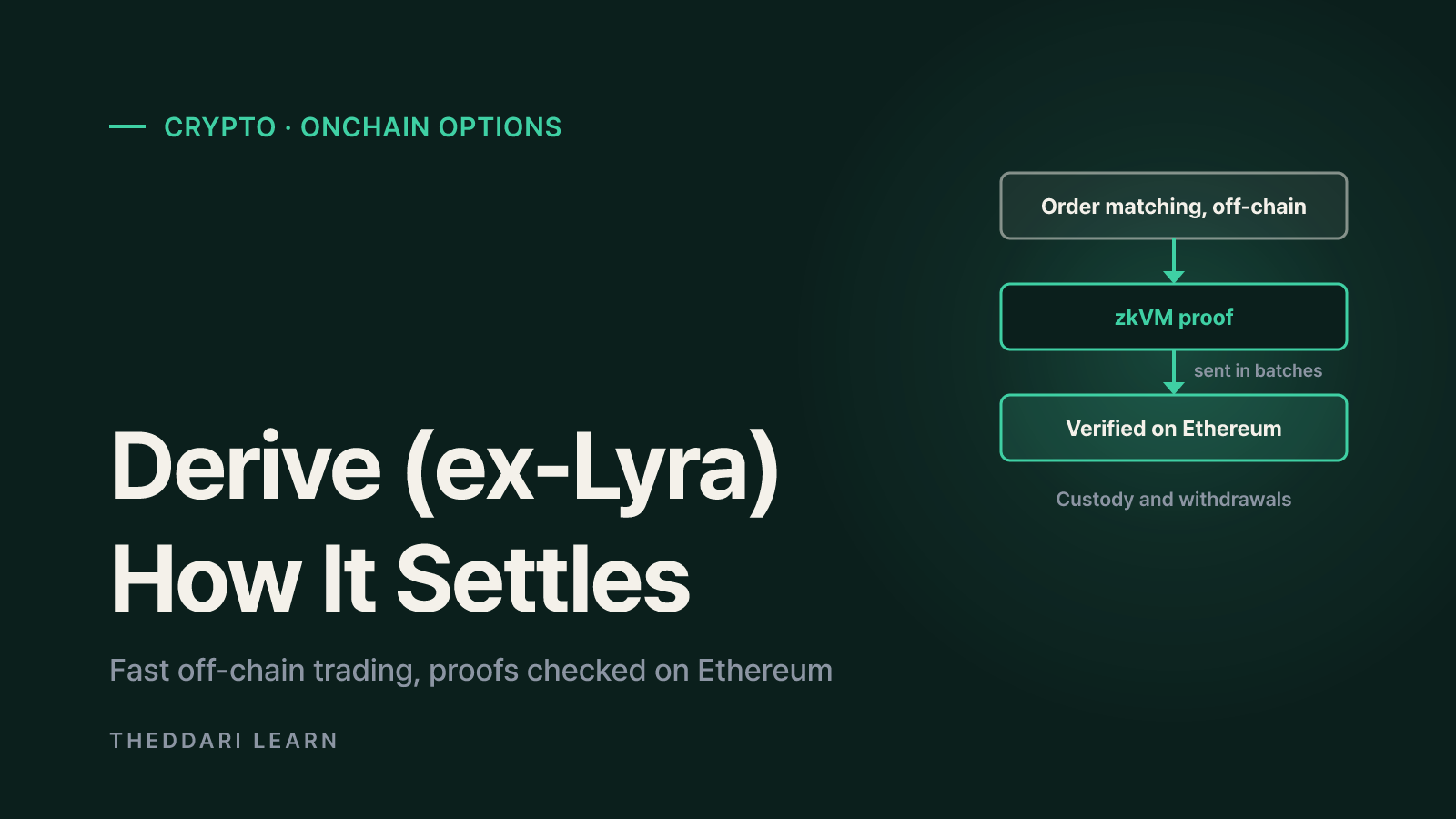
Derive, the exchange formerly known as Lyra Finance, matches orders off-chain and verifies margin and settlement on Ethereum. Here is how its options and perps work, what DRV does, and where the risks sit.
 Crypto
What Is Pepe Intelligence (PEI)? Checks Before You Buy
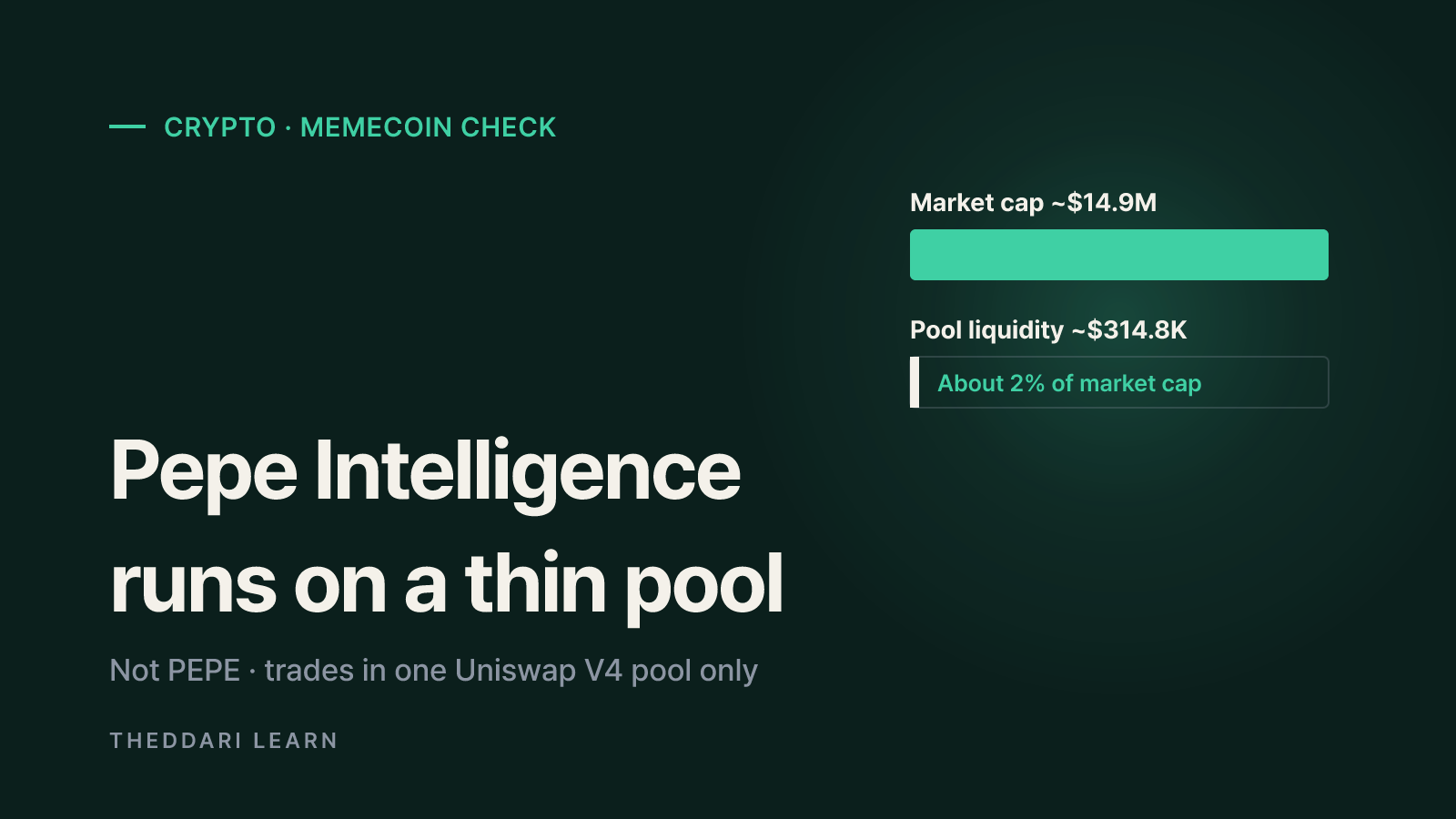
Pepe Intelligence hit the top of CoinGecko's trending list, but it is a separate day-old Ethereum token, not the original PEPE. Here is what on-chain data showed as of November 24, 2026.
 Crypto
Minelius (MINELIUS) Token: What to Check Before Buying
Minelius hit #1 on CoinGecko trending. Here is how its private-mine launchpad works, what the on-chain numbers showed on November 24, 2026, how to spot the same-name copycat, and the checks to run first.