BIGTIME Token Explained: Big Time Game Economy and Risks
What the BIGTIME token does in the Big Time game, how its 5 billion supply and unlocks work, and what to check before trading it while it trends on CoinGecko.
Contents7 sections
Key takeaways
- BIGTIME is an Ethereum ERC-20 utility token used inside the free-to-play PC action RPG Big Time for crafting, upgrading, speeding up timers and entering Prestige Portals.
- Supply is fixed at 5 billion tokens: 60% player rewards, 20% ecosystem/treasury and 20% community/marketing. Holding it gives no dividend, ownership or governance rights.
- After an all-time low of $0.003827 on November 23, 2026, BIGTIME jumped about 67% within two days and reached #1 on CoinGecko trending, with no project announcement found.
- Roughly 60% of the spike's 24-hour volume came from Upbit's Korean won market, and futures open interest rose 153% in a day.
- Unlock trackers disagree on the next large release (December 2026 vs January 2027), so cross-check more than one source.
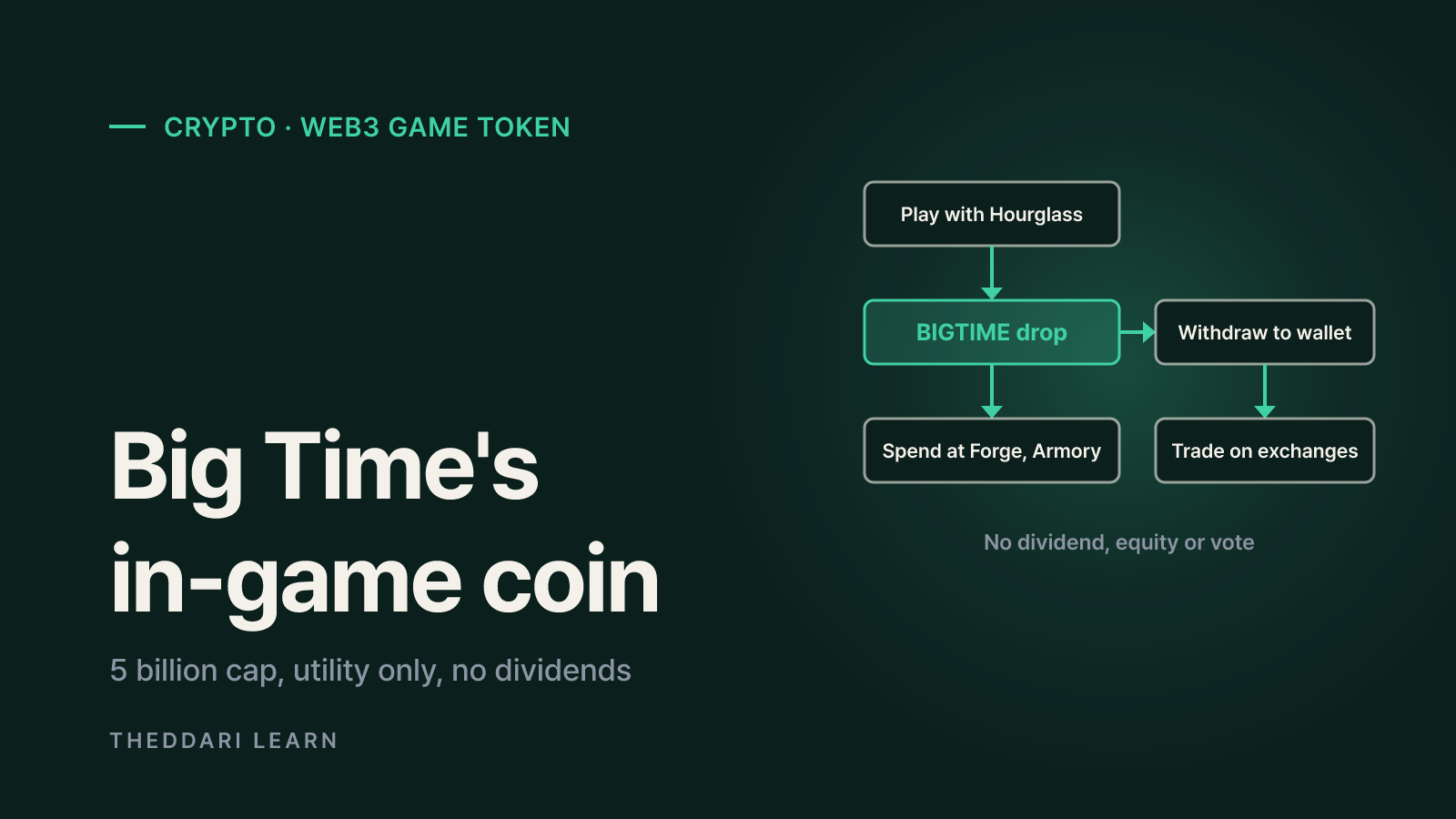
The BIGTIME token is the in-game currency of Big Time, a free-to-play multiplayer action RPG for PC. Players spend it to craft and upgrade cosmetic items, speed up crafting timers and enter Prestige Portals. It is an ERC-20 token on Ethereum with a fixed supply of 5 billion, and it gives holders no dividend, equity or voting rights. This guide reflects the official white paper, the game wiki, unlock trackers and market data checked on November 25, 2026, the day BIGTIME topped CoinGecko's trending list after a sharp rebound from a record low. No official announcement explained the move, which is exactly why the token's structure and the data behind the spike deserve a closer look.
What is the BIGTIME token and what does it do?
Big Time is developed and operated by Time and Space Ltd., a Cayman Islands company whose parent, OL Ltd., also owns the Open Loot marketplace. The MiCA white paper names Decentraland founder Ari Meilich as CEO and dates the token generation event to October 10, 2023. There was no public token sale: the issuer says BIGTIME listed on exchanges at a fully diluted valuation of $72.5 million and has been distributed through gameplay and community programs. The company reports more than $190 million in revenue since launch, mostly from in-game item sales, but as a private firm it does not publish audited financial statements, a limitation the white paper itself flags.
How players earn and spend it
The official wiki describes random token drops during combat, quests and dungeons, but only while an Hourglass is equipped. Earned tokens sit in the player's Open Loot account and cannot be traded inside the game or the marketplace. To sell them, a player withdraws to an external wallet and uses an exchange like any other crypto asset.
Earning
- How it works
- Random drops with an Hourglass equipped
- What to keep in mind
- Not a fixed income; Hourglasses cost something to obtain
Spending
- How it works
- Refining, crafting and upgrading at Forges and Armories, timer speed-ups, Prestige Portals
- What to keep in mind
- Demand depends on active players
Production
- How it works
- SPACE NFTs and workshops such as Forges, Armories and Time Wardens
- What to keep in mind
- The economy centres on NFT owners
Custody
- How it works
- Off-chain Open Loot balance backed 1:1 by a vault contract
- What to keep in mind
- Withdrawals require KYC and face country limits
Rights
- How it works
- No ownership, dividends, profit share, governance or redemption
- What to keep in mind
- Do not value it like a company share
That off-chain design lets players act quickly without paying gas, but it also means balances live in a centralized database run by the operator. Unlike a fully on-chain token, everyday use depends on the game servers and Open Loot staying online and on terms the white paper says the company can amend at its discretion.
Supply, allocation and the unlock schedule
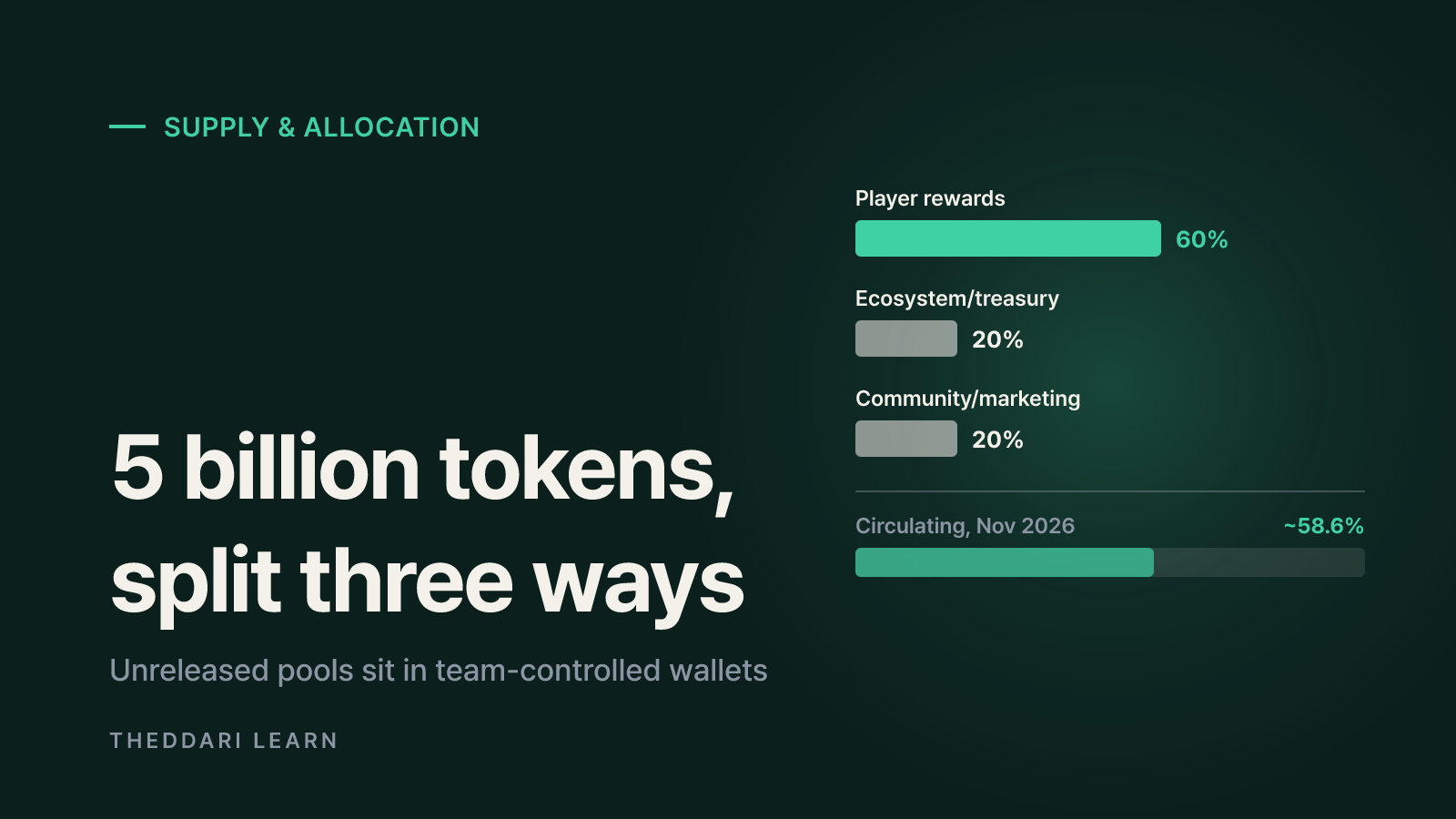
Total supply is capped at 5 billion BIGTIME, and the white paper states there is no mechanism to increase or decrease it. The wiki splits the supply into 60% player rewards, 20% ecosystem/treasury and 20% community/marketing, and calls the launch fair because no tokens went to the team or investors. Still, the white paper lists the treasury, marketing and player-reward pools as team-controlled wallets and publishes their addresses. There is no insider allocation, but the operator decides when and how unreleased tokens enter the market.
CoinGecko showed about 2.93 billion tokens in circulation in November 2026, roughly 58.6% of supply. Tokenomics.com models linear vesting of 60 months for player rewards, 71 months for community/marketing and 10 months for the treasury, with the final release on September 11, 2029. Its next listed unlock is about 64.1 million tokens on December 11, 2026. The same site calculates that across the last seven monthly unlocks, the average worst drop within 14 days was -14.7%. That is a historical pattern, not proof that unlocks caused the declines.
Unlock trackers do not agree. According to MABOnChain, DefiLlama shows a 600 million token release on December 3, 2026, about 20.5% of circulating supply, while Tokenomist places the same 600 million in January 2027. Linear and cliff models produce very different calendars, so treat any single countdown with caution and watch the disclosed wallets for actual transfers.
There is also a sink. The same report says Open Loot stated in August 2026 that in-game spending and withdrawal fees had absorbed 464.8 million BIGTIME cumulatively. That figure is second-hand, and the sources do not say whether absorbed tokens were burned or returned to a treasury pool. Given the white paper's statement that supply cannot be adjusted, do not assume those tokens are gone for good.
Why Big Time crypto trended on CoinGecko in November 2026
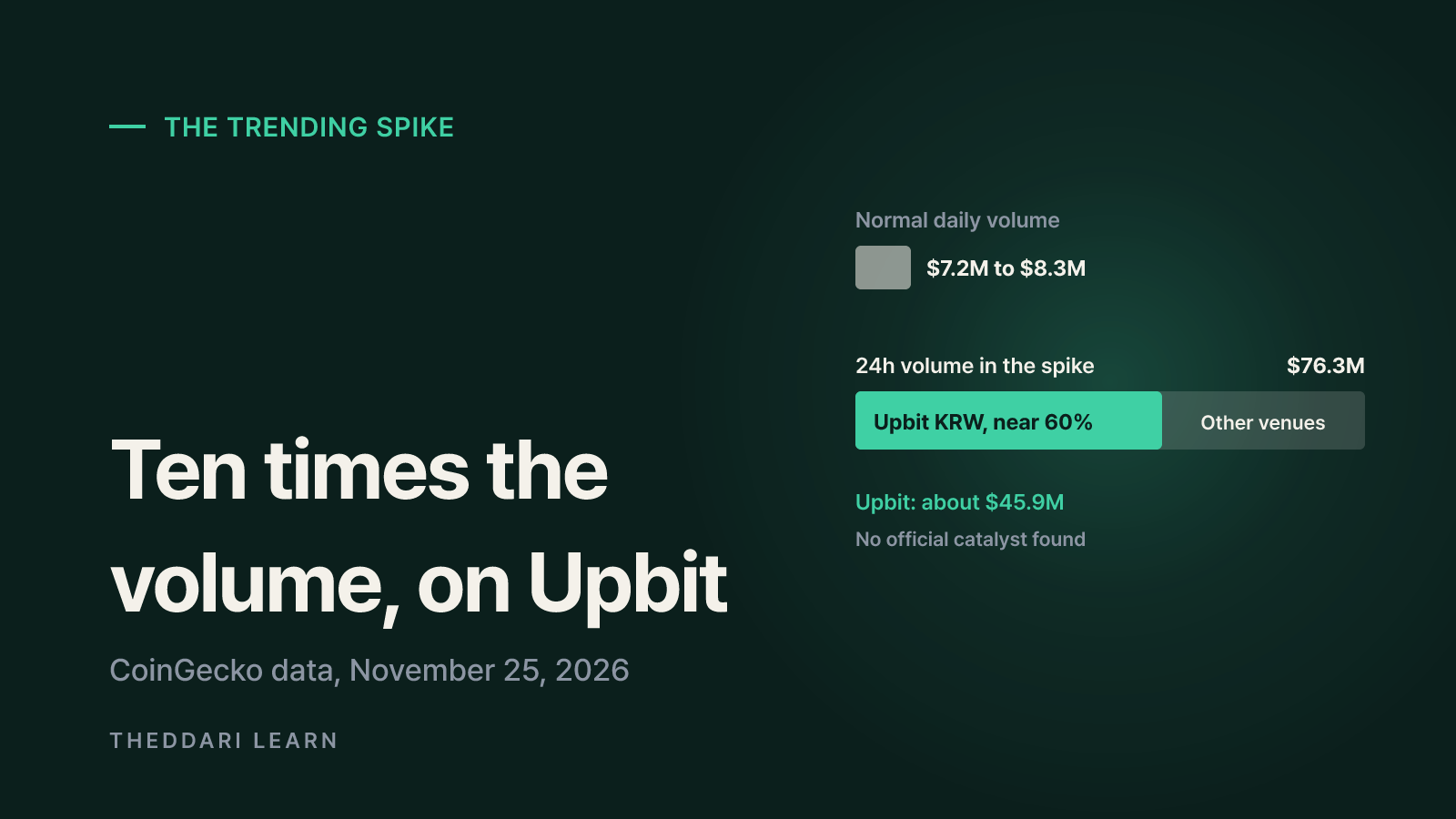
Citing CoinGecko API data, LC Insight reported an all-time low of $0.003827 on November 23, 2026. By 12:39 a.m. ET on November 25, the price was $0.0068, up 67.2% in 24 hours, with a market value near $19.9 million and the top spot on CoinGecko's trending list. Most of the gain came in a single 15-minute window late on November 24, when the price moved from $0.00449 to $0.00659. Even so, BIGTIME remained about 99.3% below its $0.977 peak from December 5, 2023.
Price
- Before
- Record low $0.003827 (Nov 23)
- During the spike
- $0.0068 (Nov 25)
- What it suggests
- Still about 99.3% below the 2023 high
24h volume
- Before
- $7.2M to $8.3M a day (Nov 12 to 24)
- During the spike
- About $76.3M
- What it suggests
- Roughly ten times normal
Upbit KRW share
- Before
- —
- During the spike
- About $45.9M, near 60%
- What it suggests
- One venue drove much of the move
Futures open interest
- Before
- —
- During the spike
- $6.43M, up 153% in 24h
- What it suggests
- Leverage built up quickly
Upbit's BIGTIME/KRW pair, priced in Korean won, handled about 60% of the volume, and its price ran about 1.7% above Binance at the same minute. MABOnChain, citing CoinGlass, reported futures open interest of $6.43 million and funding of -0.975%, meaning shorts were paying longs. Neither outlet found a game update, listing or partnership in the 24 hours before the jump. The data fit a flow-driven event, a burst of Korean spot buying combined with a squeeze on crowded shorts, better than a fundamental catalyst.
You can compare the won-market premium on theddari's Kimchi premium tracker and see cross-exchange funding rates on the funding arbitrage page. Both show current gaps, not where the price goes next.

What to check before trading a trending gaming token
- 1
Verify the contract
Trending coins attract lookalike tokens. The white paper lists the Ethereum mainnet contract as 0x64Bc2cA1Be492bE7185FAA2c8835d9b824c8a194. Match it exactly before swapping on a DEX or adding the token to a wallet.
- 2
See where the volume comes from
Open the markets tab on CoinGecko or CoinMarketCap. If one exchange carries more than half the volume, the price can unwind fast when that venue cools. Volume several times larger than market cap signals extremely fast turnover.
- 3
Check derivatives positioning
Rapidly rising open interest and lopsided funding mean leverage, not spot demand, may be setting the price. Gains from a short squeeze can reverse once positions close.
- 4
Compare unlock calendars
Look at at least two trackers. For a token worth around $20 million, a release measured in hundreds of millions of tokens is a major supply variable.
- 5
Look for an official reason
Check Big Time's news page, its official X account and Open Loot announcements. If no cause can be confirmed, treat the move as unexplained instead of accepting forum or Telegram speculation.
To see when chatter about BIGTIME started rising across Telegram channels, use theddari's Telegram crypto trends. Mention counts show attention, not the cause or durability of a rally.
Structural risks of web3 gaming tokens
A gaming token is only as strong as the demand to spend it in the game. Big Time's own white paper warns that falling player numbers could limit the token's utility and that an imbalance between rewards and in-game spending could cause inflation. With 60% of supply reserved for player rewards, play itself keeps creating tokens that can reach the market, and if players cash out rather than spend, that adds steady selling pressure.
- Player dependence: fewer active players means less crafting and upgrading, and weaker token sinks.
- Reward spiral: when rewards are paid in a fixed number of tokens, a falling price shrinks their value and can push players away.
- Operator dependence: balances sit in Open Loot's database, and the terms of use can change at the company's discretion.
- Withdrawal limits: KYC and sanctioned-country rules can delay moving tokens when you need to.
- Limited disclosure: as a private company, the issuer does not publish audited financials.
Big Time is not an anonymous memecoin: the token has a real role in a live game, a published supply cap and a disclosed allocation. But the November 2026 rally began more than 99% below the all-time high, had no confirmed catalyst, concentrated in one won market and in futures, and arrived with conflicting unlock calendars. If you are considering a trade, check the contract, the volume by exchange, funding, the unlock schedule and official channels, and size any position to an amount you can afford to lose. Tax treatment depends on where you live, so confirm the rules in your own jurisdiction.
Frequently asked questions
Is Big Time a play-to-earn game?
Does holding BIGTIME give me a share of Big Time's revenue?
Where can I buy BIGTIME?
When is the next BIGTIME unlock?
Sources and references
- 1Big Time: $BIGTIME Crypto-Asset White Paper (MiCA)(opens in a new tab)www.bigtime.gg
- 2Big Time Wiki: $BIGTIME Tokens(opens in a new tab)wiki.bigtime.gg
- 3Tokenomics.com: Big Time (BIGTIME) Token Unlock Schedule(opens in a new tab)app.tokenomics.com
- 4LC Insight: Big Time jumped 67% a day after its record low, with Upbit taking 60% of the trading(opens in a new tab)lcinsight.net
- 5MABOnChain: Big Time (BIGTIME) Surges 50% Off Its All-Time Low as Futures Bets More Than Double(opens in a new tab)mabonchain.com
- 6CoinGecko: Big Time (BIGTIME)(opens in a new tab)www.coingecko.com
Related articles
 Crypto
What Is Canton Network (CC)? Token, Structure and Risks
Canton Network is a privacy-focused blockchain built for regulated finance, and Canton Coin (CC) pays for and rewards use of its shared Global Synchronizer. Here is how the structure, burn-and-mint tokenomics, market data and key risks fit together.
 Crypto
Hyperliquid vs Lighter vs Variational: Perp DEX Comparison
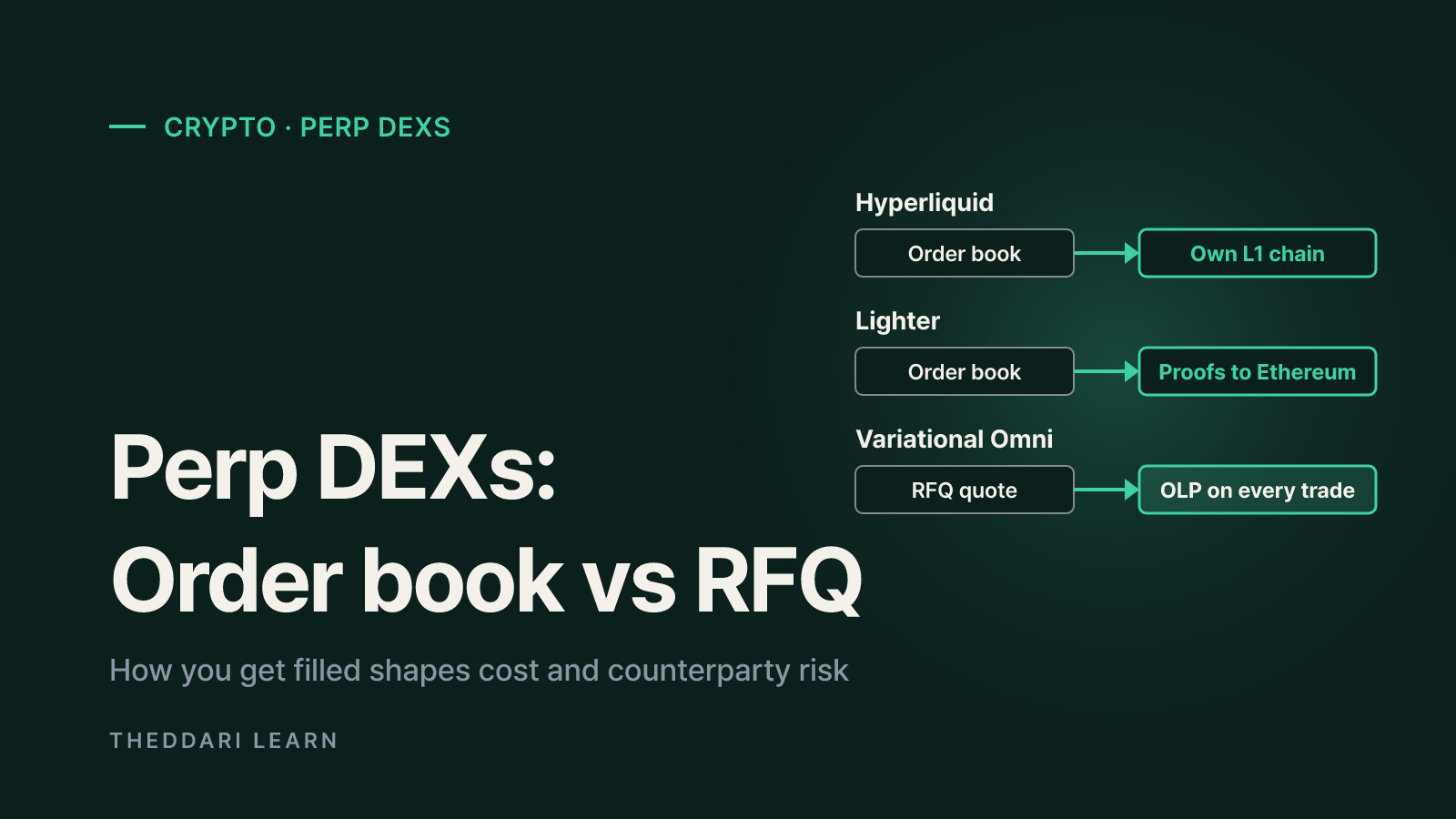
Hyperliquid runs an order book on its own L1, Lighter proves its order book matching to Ethereum, and Variational Omni quotes every trade from a single liquidity provider. Here is how fees, funding, liquidations and counterparty risk differ.
 Crypto
Derive Crypto Explained: DRV Token, Options Exchange, Risks
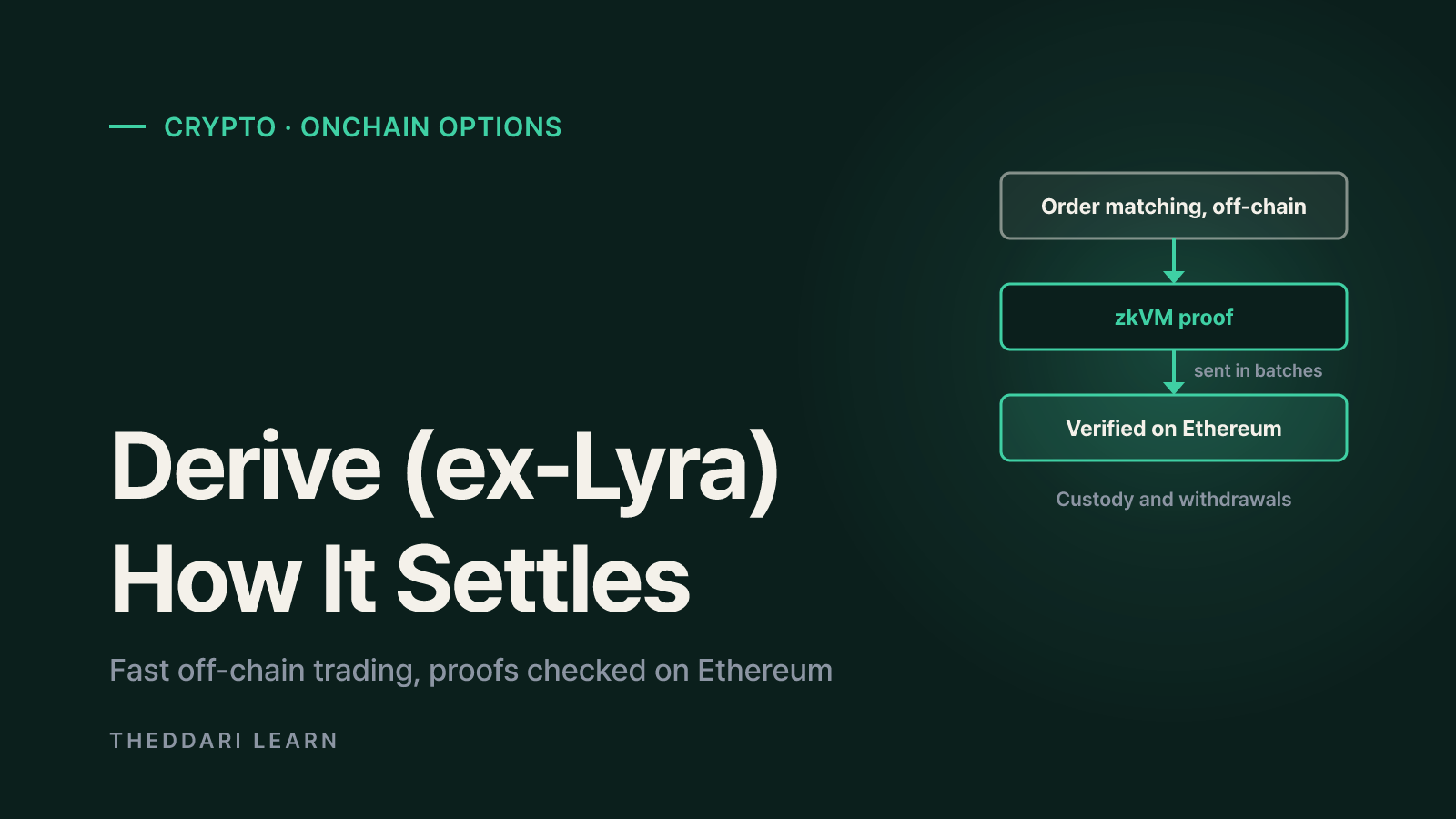
Derive, the exchange formerly known as Lyra Finance, matches orders off-chain and verifies margin and settlement on Ethereum. Here is how its options and perps work, what DRV does, and where the risks sit.