Contents8 sections
- OpenAI losses by line item: the 2025 income statement
- Two kinds of AI compute costs: training and inference
- Where OpenAI revenue comes from
- How to read annualized revenue run-rate headlines
- AI company profitability: a metrics checklist
- Bottom line: separate the kinds of loss
- Frequently asked questions
- Sources and references
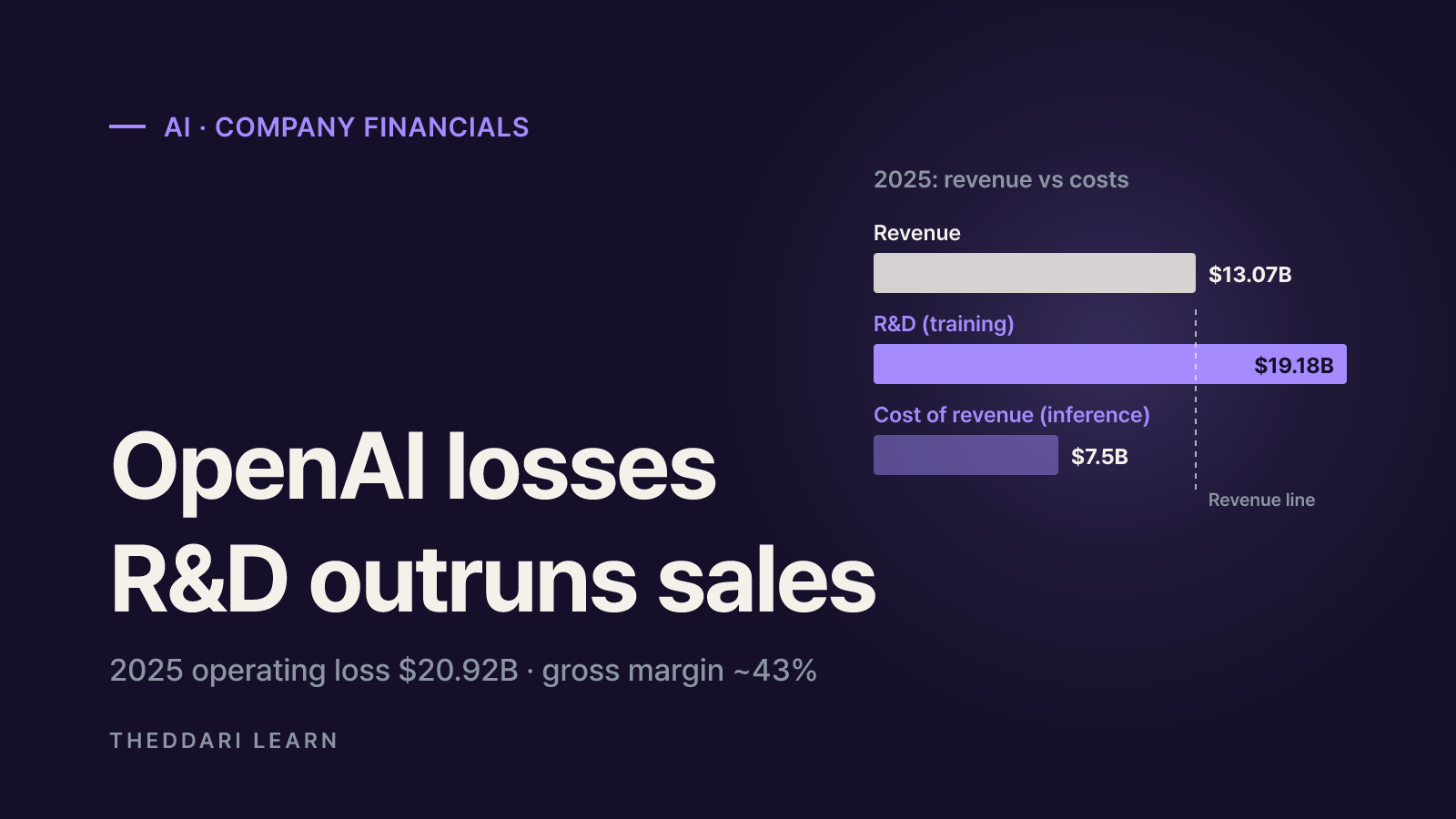
OpenAI losses come down to one mismatch: compute spending is growing faster than revenue. As of October 2026, the most detailed public view is reporting on OpenAI's audited 2025 statements. They show $13.07 billion in revenue, $19.18 billion in research and development, and a $20.92 billion loss from operations, according to Ars Technica. This guide breaks those numbers down and explains how to read revenue and compute costs at any frontier AI company.
The 2025 figures here are not an official OpenAI filing. They come from audited statements obtained by journalist Ed Zitron, reviewed by the Financial Times and reported by Ars Technica on June 16, 2026. OpenAI is preparing for a possible IPO, and a public prospectus could add detail or restate how items are grouped.
OpenAI losses by line item: the 2025 income statement
Revenue more than tripled, from $3.7 billion in 2024 to $13.07 billion in 2025. Costs grew by even more in dollar terms. The last column below is simple division of the reported figures, not a number OpenAI published.
Revenue
- 2024
- $3.7B
- 2025
- $13.07B
- Share of 2025 revenue
- 100%
Cost of revenue (serving/inference)
- 2024
- $2.65B
- 2025
- $7.5B
- Share of 2025 revenue
- ~57%
Research and development (incl. training)
- 2024
- $7.81B
- 2025
- $19.18B
- Share of 2025 revenue
- ~147%
Sales and marketing
- 2024
- $1.11B
- 2025
- $5.73B
- Share of 2025 revenue
- ~44%
Loss from operations
- 2024
- $8.78B
- 2025
- $20.92B
- Share of 2025 revenue
- ~160%
Adding revenue and the operating loss implies total 2025 costs and expenses of about $34 billion; general and administrative costs make up most of the remainder not shown. The striking point is that R&D alone exceeded total revenue in both years. Ars Technica notes that the R&D line includes $10.59 billion paid to Microsoft in 2025 and appears to reflect the cost of training new models.
Net loss vs. operating loss
The widely shared headline of a roughly $38.5 billion loss is the net loss. According to the FT, as relayed by Ars Technica, it includes a non-recurring charge of about $30 billion tied to shifting investor valuations during the 2025 for-profit conversion. Without it, the net loss would be about $8 billion. That charge is an accounting remeasurement, not cash leaving the building, so the operating loss and its trend are a better gauge of the underlying business.
Two kinds of AI compute costs: training and inference
To read any AI lab's financials, split compute into two buckets. They land in different parts of the income statement and behave differently as the business grows.
Running large GPU clusters for weeks or months to build the next model. It mostly sits in R&D, has to be spent before the model earns anything, and tends to grow with each generation.
The cost of generating every answer a user requests. It mostly sits in cost of revenue and scales with usage. Lowering cost per token through better chips and algorithms is the main lever.
Using the reported figures, OpenAI's gross margin (revenue minus cost of revenue, divided by revenue) rose from about 28% in 2024 to about 43% in 2025. That suggests serving efficiency improved. In its March 2026 funding announcement, OpenAI said algorithmic and hardware improvements reduce the cost to serve each token (OpenAI). Over the same period, though, R&D grew about 2.5 times, which swamped those gains.
Compute is not the only cost. Sales and marketing jumped about fivefold, to $5.73 billion. Researcher compensation, enterprise sales teams and consumer marketing are spread across these lines, and the leaked statements as reported do not separate payroll from GPU spending.
Where OpenAI revenue comes from
When OpenAI announced $122 billion in committed capital at an $852 billion post-money valuation on March 31, 2026, it said it was generating $2 billion in revenue per month. It also reported more than 900 million weekly ChatGPT users, over 50 million subscribers, enterprise at more than 40% of revenue, and an ads pilot that passed $100 million in annualized revenue in under six weeks.
- Consumer subscriptions: paid ChatGPT plans. Huge reach, but roughly 50 million paying out of 900 million weekly users.
- Enterprise and API: ChatGPT for business, developer APIs and the Codex coding agent. Usage-based pricing ties revenue directly to inference costs.
- Newer streams: ads and commerce, still small, aimed at monetizing free users.
This is where AI differs from classic software. A new user of a typical SaaS product costs almost nothing to serve. In AI, every prompt carries a GPU cost, so a large free tier and heavy users on flat-rate plans both press on margins.
How to read annualized revenue run-rate headlines
Run rates dominate AI funding news. Reuters reported on October 8, 2026 that OpenAI told investors its September annualized revenue was almost $50 billion, below a figure approaching $70 billion signaled earlier. The gap came from trying to match Anthropic's method, which counts sales through cloud partners such as AWS and Google Cloud on a gross basis.
- 1
Check the period
A run rate is a speed, not a total. About $50 billion at the end of September 2026 does not mean $50 billion of 2026 revenue.
- 2
Check gross vs. net
Ask whether partner sales are counted in full or only the company's share. The same business can produce numbers about $20 billion apart.
- 3
Check the source
Most run rates come from people familiar with investor presentations. Separate them from audited results and official announcements, and note the date.
Reuters also reported that OpenAI started 2026 at a $20 billion run rate and that its second-quarter 2026 revenue of $6.7 billion was overtaken by Anthropic's $11.5 billion, a reminder that fast growth does not lock in market position.
AI company profitability: a metrics checklist
Gross margin
- Formula
- (Revenue - cost of revenue) / revenue
- OpenAI 2025 (reported)
- ~43%
- What to watch
- Is inference getting cheaper per dollar earned?
R&D intensity
- Formula
- R&D / revenue
- OpenAI 2025 (reported)
- ~147%
- What to watch
- Is training spend outpacing sales?
Operating loss ratio
- Formula
- Operating loss / revenue
- OpenAI 2025 (reported)
- ~160% (237% in 2024)
- What to watch
- Is the loss shrinking relative to sales?
Revenue growth
- Formula
- Year-over-year change
- OpenAI 2025 (reported)
- ~253%
- What to watch
- Is it faster than cost growth?
Revenue mix
- Formula
- Share by segment
- OpenAI 2025 (reported)
- Enterprise 40%+ (March 2026)
- What to watch
- Usage-based exposure and customer concentration
Risks deserve equal weight. Ars Technica points to enterprise customers balking at token-based pricing and demanding measurable returns, plus pricing pressure from Anthropic. Set those against OpenAI's own flywheel argument, that more compute yields better models, better products and more revenue, rather than taking either side on faith.
OpenAI's suppliers, including Microsoft, Nvidia and Oracle, discuss AI demand on their quarterly calls. You can track report dates on the earnings calendar and follow AI industry chatter on AI Telegram trends. These tools organize dates and topics; they do not forecast results or prices.

Bottom line: separate the kinds of loss
In one sentence: OpenAI's serving margins are improving, but spending on training the next generation of models is growing faster than revenue. When you read the next headline, separate net loss from operating loss, split R&D (training) from cost of revenue (inference), and check how any run rate was calculated and who supplied it.