Contents8 sections
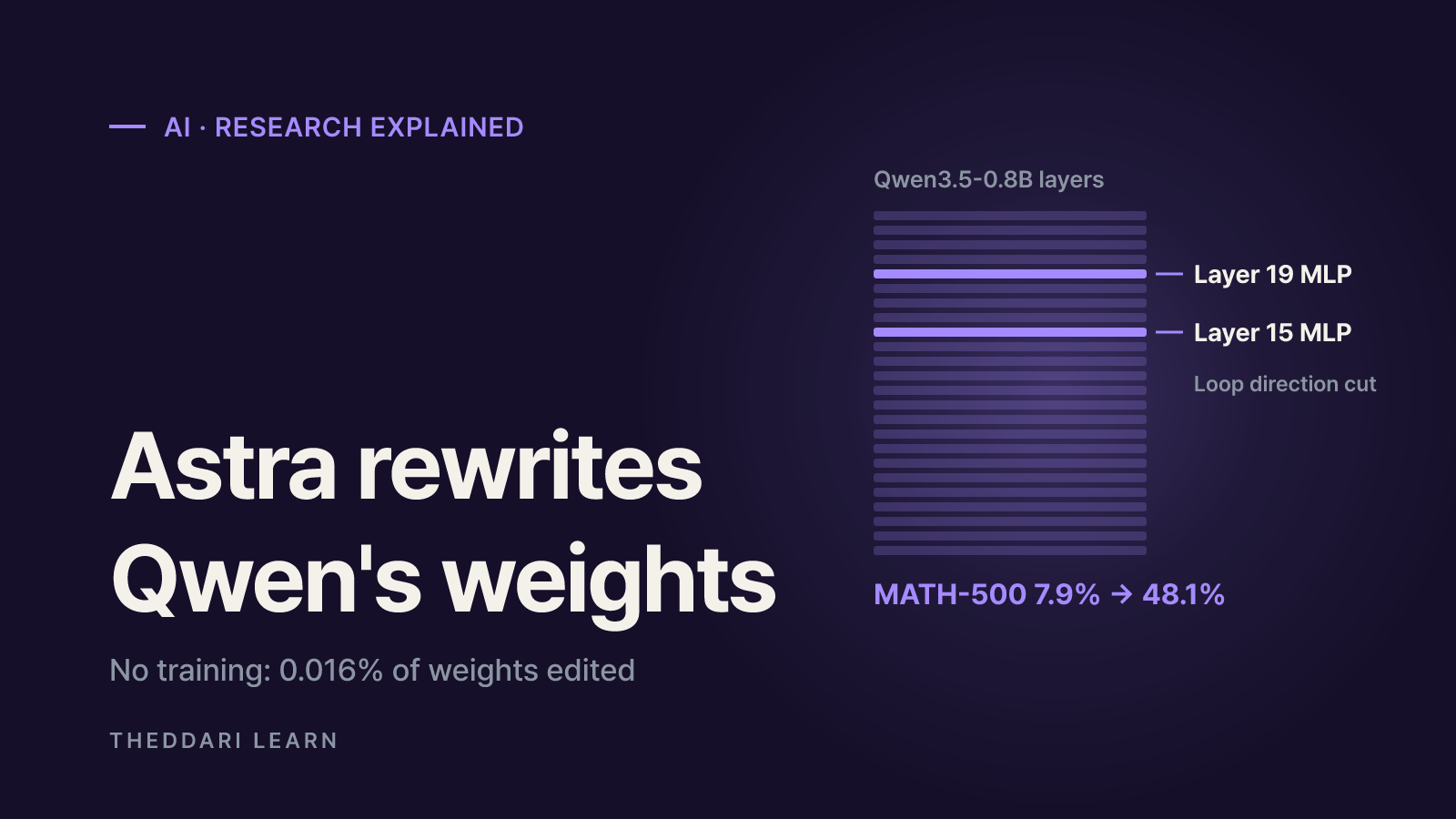
Astra weight-space programming is an approach where a general-purpose large language model reads and rewrites another neural network's weights directly, instead of training it with gradient descent. In a blog post published on November 2, 2026, MIT CSAIL researchers report that a frontier model they call "GPT-6 Astra" changed 0.016% of Qwen3.5-0.8B's weights and lifted its MATH-500 accuracy from 7.9% to 48.1%. The short answer to the headline question: yes, in a controlled setting, but the jump mostly came from fixing a looping failure, the work is not peer reviewed, and it has only been shown on small models. This explainer is based on the original post and the public checkpoint as of November 2026.
What is Astra weight-space programming?
Normally, weights are written by an optimizer such as Adam, nudged step by step along the gradient of a loss function computed on training data. No human can stare at millions of numbers and fix them by hand. The researchers argue that frontier LLMs are starting to do exactly that: given a plain-English goal like "make this model better at math", the LLM reasons about what each part of the network computes and edits the numbers accordingly.
The rules matter. Astra was not allowed to write training loops, compute gradients or fit weights to data. In some experiments it got no tools at all; in larger ones it got a Python sandbox to inspect tensors, plus a capped budget of forward passes to see how the network behaved.
Three kinds of tasks
- Read: look at raw weights and say what a network was trained to do, such as which game it plays or which language it models.
- Fix: diagnose a failing network and edit a fraction of its weights to repair it, from a car-control policy to Qwen3.5-0.8B.
- Write: fill an all-zero network with weights from scratch so it plays MinAtar games or 9×9 Go, with no training.
The post does not explain how outside users can access Astra, so treat this as a research report about frontier-model capability, not a feature you can switch on today.
How it differs from fine-tuning and model editing
Changing a model's behavior is not new. What changes here is who decides which weights to touch, and based on what.
Fine-tuning
- Who changes the weights
- An optimizer (gradient descent)
- What it needs
- Training data, a loss, GPU compute
- Scope of change
- All weights or adapter weights
ROME-style model editing
- Who changes the weights
- A purpose-built algorithm
- What it needs
- A target fact and causal tracing
- Scope of change
- Part of a mid-layer feed-forward module (rank-one update)
Weight-space programming
- Who changes the weights
- A general LLM's reasoning
- What it needs
- A natural-language goal, the weights, optional forward passes
- Scope of change
- Varies; 0.016% in the Qwen test
The 2022 ROME paper found evidence that factual associations in GPT-style models live in mid-layer feed-forward modules and changed specific facts with a rank-one edit. That line of mechanistic interpretability research relies on tools humans designed for a narrow job. The new claim is that an off-the-shelf frontier LLM, not a model trained to read weights, can do the analysis and the editing itself.
How Qwen3.5-0.8B's math score jumped
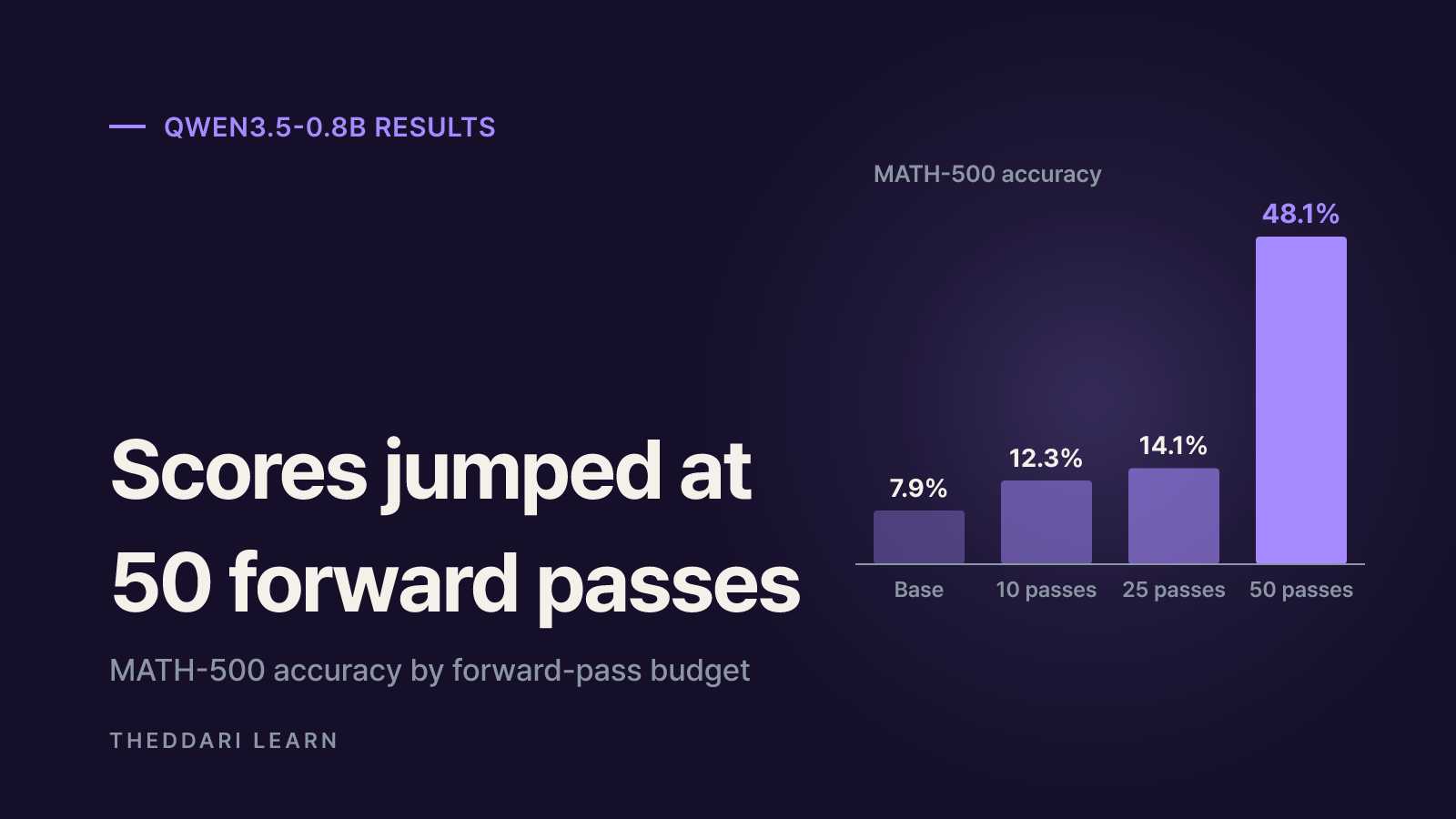
Experiment 8 is the one most people quote. Astra received a CPU-only Python kernel with the weights loaded, practice problems from the GSM8K and MATH training sets, and a budget of 10, 25 or 50 forward passes. It never saw the test benchmarks.
It found a common failure in tiny reasoning models: thinking loops. The base model kept repeating itself until it hit the 32,768-token limit. Astra traced the loop to one direction written by the MLPs in layers 15 and 19 and subtracted it from 64 output columns in each layer, touching 131,072 weights in total.
Base
- MATH-500
- 7.9%
- GSM8K
- 13.8%
- IFEval
- 21.0%
- Hit token limit
- 93.0%
Edited, 10 passes
- MATH-500
- 12.3%
- GSM8K
- 25.7%
- IFEval
- 49.0%
- Hit token limit
- 87.2%
Edited, 25 passes
- MATH-500
- 14.1%
- GSM8K
- 25.1%
- IFEval
- 39.9%
- Hit token limit
- 86.4%
Edited, 50 passes
- MATH-500
- 48.1%
- GSM8K
- 67.1%
- IFEval
- 62.3%
- Hit token limit
- 33.1%
Two things stand out. Loops barely went away until the 50-pass budget, and because loops are not specific to math, instruction following (IFEval) improved too. Results also did not rise smoothly with budget: IFEval was higher at 10 passes than at 25.
Does the checkpoint hold up?
The edited model is public on Hugging Face under Apache 2.0. Its card says only the layer 15 and 19 down_proj tensors differ from the original, verified by SHA-256 hashes. A re-run of the full MATH-500 set (500 problems × 4 samples) with the post's settings scored 51.0%, with 31.6% of answers hitting the token limit. That confirms the checkpoint's score, not that Astra would find the same edit again.
What the eight experiments showed, and where they failed
1. Which game?
- Scale
- 17,253 weights
- Result
- Named all four games
- Caveat
- No tools, no game list given
2. Which shape?
- Scale
- 23,824 weights
- Result
- Right shapes, but drawn as outlines
- Caveat
- No forward passes
3. Which language?
- Scale
- 7.16M weights
- Result
- All three languages and copying heads found
- Caveat
- Input and output layers removed
4. Fix a car policy
- Scale
- 171,664 weights
- Result
- Edited 3.5%; succeeded in all 1,024 episodes
- Caveat
- One reply, no tools
5. Write game networks
- Scale
- All weights start at 0
- Result
- Breakout 517.4 vs 25.3 for PPO at 500M steps
- Caveat
- Below 500M-step PPO in Seaquest and Asterix
6. 9×9 Go
- Scale
- 1,480,274 weights
- Result
- Beat an equal-size PPO net with 50 passes
- Caveat
- No search, no training
7. Spot the sycophant
- Scale
- Gemma 3 270M
- Result
- Failed all four tries from weights alone
- Caveat
- Succeeded on all three pairs with attention patterns
8. Better at math
- Scale
- Qwen3.5-0.8B
- Result
- MATH-500 7.9% to 48.1%
- Caveat
- 50 forward passes
The most telling result is a failure. On Gemma 3 270M, which rarely loops (8.5% of answers hit its limit), Astra could not raise math scores: MATH-500 went from 6.8% to a best of 7.7%. It found ordinary arithmetic and algebra mistakes with no single component to switch off. In the authors' words, editing could remove an obstacle hiding an ability, but could not add an ability the model lacked.
Limits: baselines, scale and safety
A weak baseline
Qwen's own model card warns that the 0.8B model is more prone to thinking loops than other Qwen3.5 sizes and suggests tuning sampling and stopping runaway generations during streaming. The card reports a thinking-mode IFEval of 44.0, while the experiment's base model scored 21.0%. Different prompts, sample counts and token limits can move numbers a lot, so read 7.9% to 48.1% as a comparison inside this setup only. The post does not show how far sampling tweaks alone would lift the baseline.
Scale and reproducibility
- Real language-model tests stop at 0.8B parameters; nothing is reported for models tens of billions of parameters large.
- The authors say context length and harness inefficiencies still limit the method, and they are building a benchmark and harness.
- Full logs are on GitHub, but third parties have not yet shown similar success on other models or tasks.
Safety cuts both ways
The authors pitch weight-only audits for hidden backdoors, data-free capability removal and even recursive self-improvement. The same skill could weaken safeguards or produce look-alike checkpoints that differ from the original in a handful of tensors. If you download edited models, check provenance, hashes and evaluation logs before trusting them.
How to read claims like this
- 1
Go to the primary source
Compare headline numbers with the tables in the November 2, 2026 post rather than social media summaries.
- 2
Check the baseline setup
Look at sampling settings, token limits and sample counts, and compare them with the official model card.
- 3
See what actually changed
Count edited weights, note their location and look for published diffs and hashes.
- 4
Read the failures
The Gemma 3 270M math result and the weights-only sycophancy test define the method's current boundary.
- 5
Watch for follow-ups
A public benchmark, independent reproductions and results on larger models are what would turn sparks into evidence.
Research claims like this spread fast through community channels and blogs. You can follow how the topic is being discussed in Theddari's Telegram AI trends and blog trends.
 theddari.comTrendsBlog PostsSummarized Naver blog posts
Bottom line: the Astra experiments are early evidence that a general LLM can interpret small networks and repair a specific defect in a small language model without training. The headline math gain came from removing one failure mode, and scaling, independent reproduction of the editing process and safety evaluation are still open.