Contents7 sections
VWCE is Vanguard's FTSE All-World UCITS ETF in its accumulating share class: a single Irish-domiciled fund that holds large and mid-cap companies across developed and emerging markets and reinvests the dividends it receives. As of October 2026 its ongoing charge is 0.14% a year. In August 2026 Vanguard launched VALL, a broader all-cap fund charging 0.07%, and European investors have been asking whether to stay in VWCE or move. The short answer depends on who you are. A new investor can simply compare the funds side by side. An existing holder with large unrealised gains in a taxable account faces a one-off tax and trading cost that a 0.07-point annual saving may take many years to recover. This guide covers funds listed on European exchanges and uses figures from the issuers' own pages checked in October 2026.
What is VWCE and what does the name tell you?
The full name is Vanguard FTSE All-World UCITS ETF (USD) Accumulating, ISIN IE00BK5BQT80. UCITS is the EU framework for retail investment funds, which is why European brokers can offer it to private investors. Accumulating means dividends are reinvested rather than paid out; the distributing twin is VWRL. USD is the fund's base currency. Buying the euro line on Xetra or Borsa Italiana does not hedge the currency exposure.
According to Vanguard's VWCE product page, the share class launched on 23 July 2019. As of 31 August 2026 the fund held 3,784 stocks against 4,263 in the benchmark, because it uses optimised sampling rather than buying every constituent. The United States made up 61.68% of the portfolio. "All-world" is accurate, but the fund is still dominated by large US technology companies.
What TER and OCF actually cover
The total expense ratio, which Vanguard reports as the ongoing charges figure, is deducted from fund assets continuously and is already reflected in the price. Vanguard says it covers administration, audit, depositary, legal, registration and regulatory expenses. It does not include your broker's commission, the bid-ask spread you cross when trading, or currency conversion fees. A lower TER therefore does not automatically mean a lower all-in cost.
All-world ETF TER comparison: VWCE, VALL and WEBN
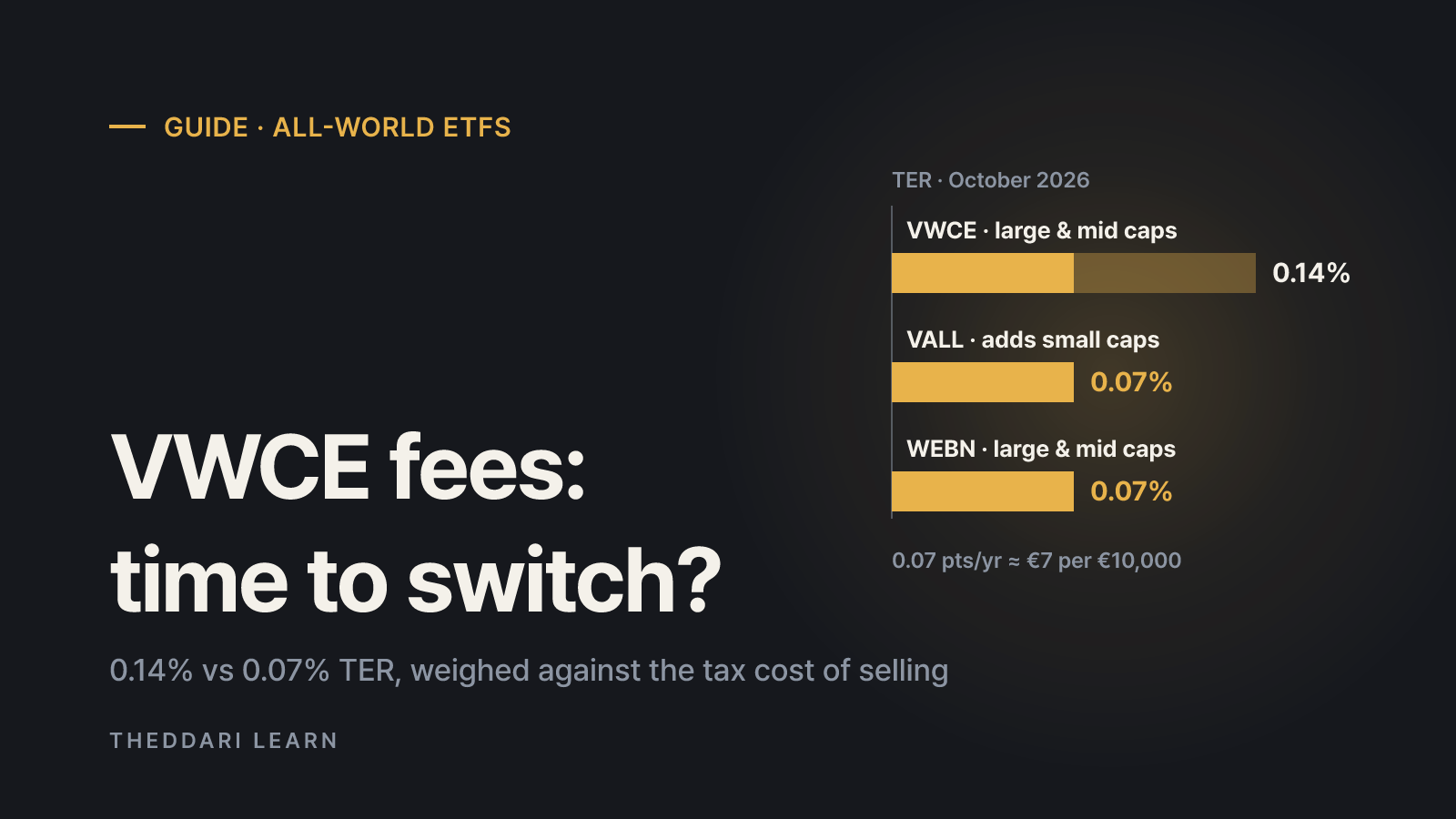
VWCE's charge fell from 0.19% to 0.14% on 28 July 2026, and Vanguard's announcement states the cut applies to new and existing investors alike. A few weeks later, Vanguard's VALL page shows the FTSE Global All-Cap UCITS ETF launched on 18 August 2026 and listed on 20 August 2026. The fund most often cited as the low-cost alternative, Amundi's WEBN, also charges 0.07% according to its justETF profile.
Index
- VWCE (Vanguard)
- FTSE All-World
- VALL (Vanguard)
- FTSE Global All Cap
- WEBN (Amundi)
- Solactive GBS Global Markets Large & Mid Cap
Size coverage
- VWCE (Vanguard)
- Large and mid caps
- VALL (Vanguard)
- Large, mid and small caps
- WEBN (Amundi)
- Large and mid caps
TER / OCF
- VWCE (Vanguard)
- 0.14%
- VALL (Vanguard)
- 0.07%
- WEBN (Amundi)
- 0.07%
Holdings
- VWCE (Vanguard)
- 3,784 (31 Aug 2026)
- VALL (Vanguard)
- 6,429 (31 Aug 2026)
- WEBN (Amundi)
- 3,393 (per justETF)
Replication
- VWCE (Vanguard)
- Physical, sampling
- VALL (Vanguard)
- Physical, sampling
- WEBN (Amundi)
- Physical, full
Launched
- VWCE (Vanguard)
- July 2019
- VALL (Vanguard)
- August 2026
- WEBN (Amundi)
- June 2024
Dividends
- VWCE (Vanguard)
- Accumulating
- VALL (Vanguard)
- Accumulating
- WEBN (Amundi)
- Accumulating
Notice that VALL and WEBN share a fee but not an index. If you want VWCE-like exposure for less, compare large and mid-cap indices with each other. If you want to add small caps, compare all-cap funds. Tickers also vary by venue: VALL trades as VGLA on Xetra and VALC on SIX in Swiss francs, so confirm the ISIN (IE000VAHT5T0) before placing an order.
Turning the fee gap into money
The difference between 0.14% and 0.07% is 0.07 percentage points a year. That is about €7 on €10,000 and about €70 on €100,000. The saving is certain and recurs every year regardless of market direction, so it compounds over a long holding period. Still, in any single year it is small. Keep that number in euros, because you will compare it with one-off costs in the next sections.
Costs and risks beyond the headline fee
- Tracking error: Vanguard reports VWCE's annualised tracking error as 0.07% over one and three years and 0.08% over five years (as of 31 August 2026). VALL's risk statistics will only appear once it has a year of history.
- Bid-ask spread: VWCE's share class holds about $60.19 billion, while VALL's total assets were about $2.57 billion. Smaller, newer funds can trade with wider spreads, so check live quotes on your venue.
- Track record: VALL launched in August 2026. Read the prospectus for what happens if a fund fails to gather assets, including possible mergers or closure.
- Index differences: adding small caps changes returns from year to year. That is an exposure choice, not a cost, so keep it out of your fee arithmetic.
- Securities lending: justETF lists WEBN as lending securities. Check the fund documents for how lending revenue is shared and what counterparty safeguards apply.
Currency matters too. All three funds have a US dollar base and are unhedged, so a euro or sterling investor's return includes exchange-rate movements. Central bank decisions and inflation releases can move both currencies and equity markets. The theddari economic calendar is a convenient way to see when those releases are scheduled; it shows timing, not the direction prices will take.

Should you switch from VWCE? A four-step check
- 1
Identify the account's tax treatment
In a taxable account, selling VWCE realises any gain. That tax would usually be due eventually, so the true cost of switching is the growth you give up on money paid to the tax authority years early. In a tax-sheltered wrapper this issue largely disappears. Rules and rates depend on your country and account type, so check your local tax guidance.
- 2
Put annual savings and one-off costs in the same currency
Write down the yearly saving (holding × 0.07%) next to commissions on both trades, the spread on both sides, any FX fee and the opportunity cost of tax paid early. With €100,000 the saving is about €70 a year, so one-off costs in the thousands could take decades to recover.
- 3
Decide whether you want the different exposure
Moving to VALL adds small caps. Decide whether that is a change you actually want, or whether you only want VWCE-like exposure at a lower fee. Keep the exposure decision separate from the cost decision.
- 4
Consider redirecting only new contributions
Leaving existing VWCE units untouched and sending future monthly contributions to a cheaper fund lowers your blended fee over time without triggering a sale. The trade-off is managing two lines and, if the indices differ, monitoring the overall mix.
Which funds other investors are discussing can be useful context, and the theddari stock Telegram trend page collects that chatter. Popularity is not suitability, so treat it as a list of names to research rather than a signal.
Bottom line for new and existing investors
If you are choosing an all-world ETF for the first time, compare VWCE at 0.14%, VALL at 0.07% and WEBN at 0.07% on index coverage, track record, fund size and the spread you actually see on your exchange, as of October 2026. If you already hold a large VWCE position in a taxable account, first test whether 0.07% a year outweighs the opportunity cost of early tax plus trading costs. If it does not, keeping the existing units and redirecting new money is a reasonable middle path. Either way, re-check the latest fee and risk sections in each fund's KID and product page before acting, and note the date you checked them.