Stock Market Circuit Breakers and Sidecars: US vs Korea
How stock market circuit breakers work as of November 2026: S&P 500 halts at 7%, 13% and 20%, LULD pauses, and Korea's KOSPI 8-15-20% breakers and sidecars.
Contents7 sections
Key takeaways
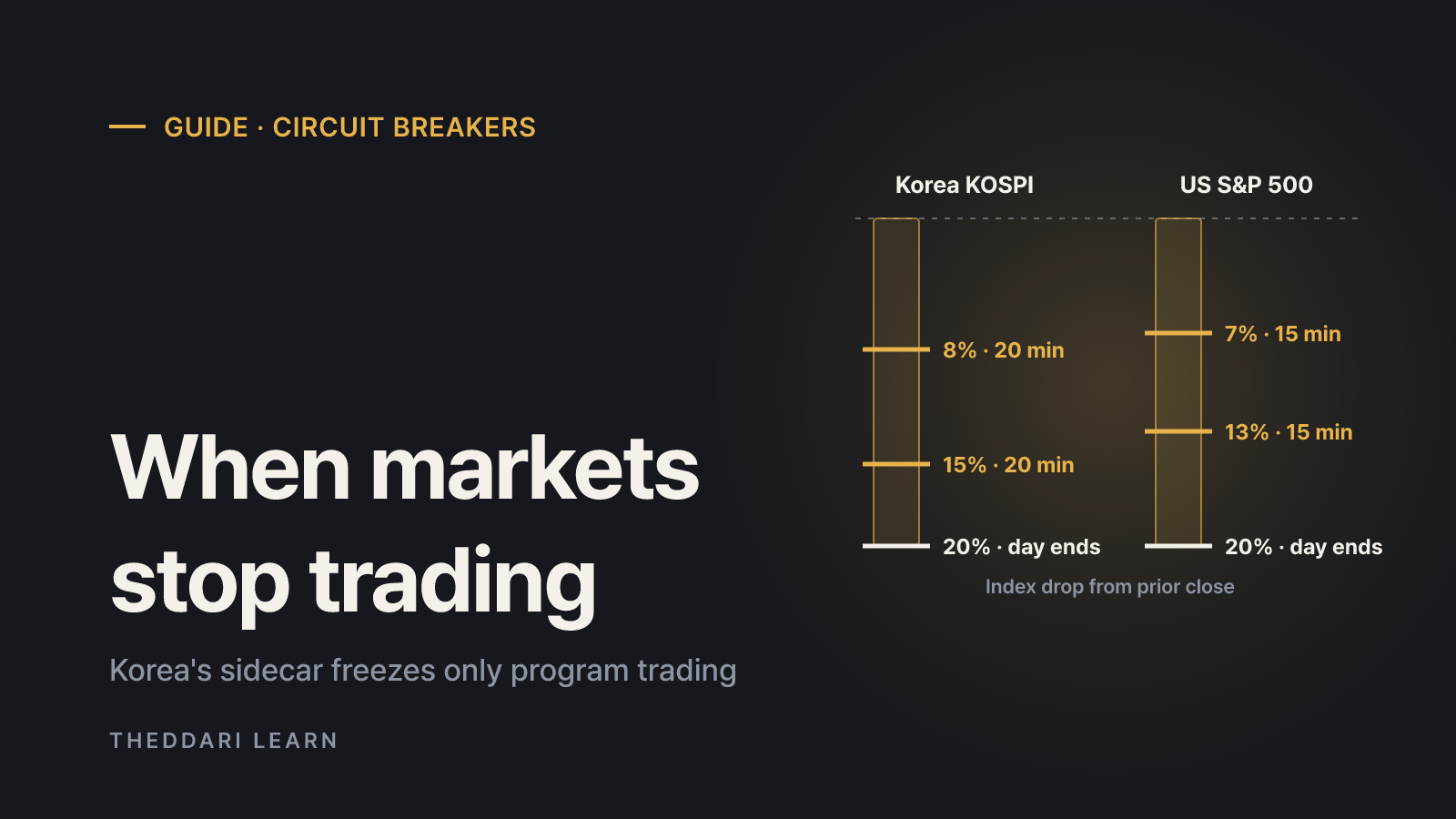
- US market-wide circuit breakers are triggered by an S&P 500 decline from the prior day's close: 7% (Level 1), 13% (Level 2) and 20% (Level 3).
- Level 1 and Level 2 halt trading for 15 minutes only if triggered before 3:25 p.m. Eastern Time; Level 3 halts trading for the rest of the day at any time.
- Korea measures the KOSPI and KOSDAQ separately: an 8%, 15% or 20% drop that lasts one minute triggers a 20-minute halt or, at stage 3, ends the session.
- A Korean sidecar is narrower: it suspends program-trading orders for five minutes, while ordinary orders keep flowing.
- Single-stock LULD pauses are separate from market-wide halts, so a paused ticker does not mean the whole market stopped.
Stock market circuit breakers are pre-set rules that pause or end trading across an entire market when a benchmark index falls too far in a single day. In the United States, as of November 2026, the trigger is a decline in the S&P 500 from the prior day's close: 7% for Level 1, 13% for Level 2 and 20% for Level 3, according to the SEC's Investor.gov glossary. South Korea runs a similar system with different numbers, and it adds a narrower tool called a sidecar that freezes only computer-driven program trading. This guide explains both, side by side, and what a halt means for an ordinary order.
Searches for "stock market crash" and "Black Monday" tend to spike after a rough session, and the question that follows is usually the same: at what point does the market actually stop? The short answer is that halts are speed bumps, not floors. They give buyers and sellers time to absorb information; they do not promise that prices will recover once trading resumes.
How US stock market circuit breakers work
The US equity, options and futures markets coordinate their halts, so a market-wide circuit breaker stops trading on every exchange at once. FINRA's investor guide adds that the halt also covers listed stocks traded over the counter. The trigger levels are converted into S&P 500 index points every day, using the prior day's closing price, so the thresholds are known before the open.
Level 1
- S&P 500 decline
- 7%
- Before 3:25 p.m. ET
- 15-minute halt
- At or after 3:25 p.m. ET
- No halt
Level 2
- S&P 500 decline
- 13%
- Before 3:25 p.m. ET
- 15-minute halt
- At or after 3:25 p.m. ET
- No halt
Level 3
- S&P 500 decline
- 20%
- Before 3:25 p.m. ET
- Halt for the rest of the day
- At or after 3:25 p.m. ET
- Halt for the rest of the day
The 3:25 p.m. cutoff matters. A 7% or 13% slide late in the session does not stop trading, because the closing process needs to run. Only a 20% decline ends the day in that window. If you follow US markets from Asia, convert the cutoff carefully: 3:25 p.m. ET falls in the early morning of the next day in Seoul.
What changes with 23-hour trading
Several US exchanges plan to open overnight sessions from 9:00 p.m. to 4:00 a.m. ET starting December 6, 2026. Under the old wording, a Level 3 halt lasting "for the remainder of the trading day" could have allowed trading to restart at 9:00 p.m. the same evening. A FINRA filing published in the Federal Register amends the rule so that trading after a Level 3 halt cannot resume before 4:00 a.m. ET on the following trading day, effective December 6, 2026. FINRA said the goal is to preserve the cooling-off period and to avoid price discovery in hours when institutional participation is thin.
Single-stock pauses: limit up-limit down
Most trading halts you see on a volatile day are not market-wide. The Limit Up-Limit Down (LULD) mechanism sets a price band around each stock's average price over the preceding five minutes. If a stock reaches the band and does not move back inside within 15 seconds, trading in that stock pauses for five minutes. FINRA notes that the listing market can extend the pause by another five minutes if buy and sell orders are badly imbalanced.
- Tier 1 stocks (S&P 500, Russell 1000 and some ETPs) priced above $3.00 use a 5% band.
- Tier 2 stocks priced above $3.00 use a 10% band.
- Stocks priced from $0.75 to $3.00 use 20%; below $0.75 the band is the lesser of $0.15 or 75%.
- Bands double between 3:35 p.m. and 4:00 p.m. ET for Tier 1 stocks and for Tier 2 stocks at or below $3.00.
The practical takeaway: a single ticker showing a halt icon is usually an LULD pause or a news-related halt, not a market-wide circuit breaker. Check which mechanism applies before assuming the whole market has stopped.
Korea's circuit breakers and sidecars explained
The Korea Exchange applies its circuit breakers separately to the KOSPI (main board) and the KOSDAQ (growth board), so one market can halt while the other keeps trading. According to the exchange's rule page, each stage requires the decline to last one minute, and stages 2 and 3 also require a further 1% drop from the index level at which the previous stage fired.
Stage 1
- Condition (lasting one minute)
- Index down 8% or more from prior close
- Result
- 20-minute halt, then trading resumes
Stage 2
- Condition (lasting one minute)
- Down 15% or more and at least 1% below the stage 1 trigger level
- Result
- 20-minute halt, then trading resumes
Stage 3
- Condition (lasting one minute)
- Down 20% or more and at least 1% below the stage 2 trigger level
- Result
- Trading ends for the day
Stages 1 and 2 do not trigger in the last 40 minutes before the close, while stage 3 can trigger at any time. During a stage 1 or 2 halt, new orders are rejected but existing orders can be cancelled; after stage 3, no orders, including cancellations, are accepted. Linked stock futures and options halt too. Halts apply only in the regular session, not in Korea's after-market session.
The sidecar: a five-minute freeze on program trading
A sidecar suspends program-trading orders, not the market. On the KOSPI it applies when the KOSPI 200 futures price moves 5% or more and holds there for one minute. On the KOSDAQ, the exchange rule requires the KOSDAQ 150 futures to move 6% or more from the base price and the KOSDAQ 150 index to move 3% or more in the same direction, both for one minute. Program buy orders are frozen on the way up and program sell orders on the way down, for five minutes, after which they are matched in the order received.
Sidecars have become frequent. Money Today reported on November 16, 2026 that they had fired 58 times on the KOSPI and 38 times on the KOSDAQ so far this year, and that Korea's Financial Services Commission is reviewing whether the tool actually dampens volatility, including the option of abolishing it. Critics cite a magnet effect as futures approach the threshold and a burst of queued orders when the freeze lifts. The same report said the US dropped its own sidecar in 1999 and now relies on market-wide circuit breakers and LULD.
US vs Korea circuit breakers at a glance
Benchmark
- United States
- S&P 500 only
- South Korea
- KOSPI and KOSDAQ separately
Thresholds
- United States
- 7% / 13% / 20%
- South Korea
- 8% / 15% / 20%
Extra conditions
- United States
- Level reached, per SEC and FINRA summaries
- South Korea
- One-minute duration; 1% further drop for stages 2 and 3
Level 1-2 halt length
- United States
- 15 minutes
- South Korea
- 20 minutes
Late-day cutoff
- United States
- No Level 1-2 halt at or after 3:25 p.m. ET
- South Korea
- No stage 1-2 halt in the last 40 minutes
Top level
- United States
- Rest of day; earliest restart 4:00 a.m. ET next trading day
- South Korea
- Trading ends for the day
Program-trading tool
- United States
- None
- South Korea
- Sidecar, five minutes
Single-stock tool
- United States
- LULD
- South Korea
- Volatility interruption (VI)
Both countries stop everything at 20%, but US Level 1 and 2 trigger on a smaller decline and pause for a shorter time. Korea's one-minute rule filters out a momentary dip. If you hold Korean shares from the US, remember that Korea's regular session runs during the US evening and night, so a Korean halt can happen while US markets are closed.
What a halt means for your orders
A halt does not cancel your exposure. When trading reopens, the first price is set by the orders that piled up during the pause, and it can be far from the last trade. A market order queued during the halt may fill at an unexpected price; a limit order sets a price condition but does not guarantee a fill. Leveraged and inverse ETFs, margin positions and options can be hit hardest because you cannot adjust them while the market is closed, and hedges in linked futures may be frozen too. Read your broker's procedures for open orders and margin calls before a stressful session, not during one.
- 1
Identify the mechanism
Decide whether the headline describes a market-wide circuit breaker, a single-stock LULD pause or a Korean sidecar. The effect on your orders differs sharply.
- 2
Check the benchmark and the clock
In the US, compare the S&P 500 decline with the 3:25 p.m. ET cutoff. For Korea, check which board is affected and whether the last 40 minutes of the session have begun.
- 3
Review open orders and leverage
List pending market orders, margin balances and leveraged products, and plan for a volatile reopening price.
- 4
Cross-check the schedule and official notices
Look for the scheduled data release or earnings report behind the move, and rely on exchange and broker notices over social posts.
Big moves often cluster around scheduled events. The theddari economic calendar and earnings calendar help you see which releases are due and in which time zone, which is useful context when a sell-off starts. They do not predict where prices go next.

In short: the US halts on S&P 500 declines of 7%, 13% and 20%, Korea on KOSPI or KOSDAQ declines of 8%, 15% and 20% that last a minute, and Korea's sidecar freezes only program trading for five minutes. Rules are being updated on both sides, with overnight US trading starting in December 2026 and Korea reviewing its sidecar, so confirm the current text on the exchange and FINRA pages before relying on any threshold.
Frequently asked questions
How many times has the market-wide circuit breaker been triggered?
Can I cancel orders during a market-wide halt?
Does a 7% drop late in the day still stop US trading?
What is a sidecar in the Korean stock market?
Sources and references
- 1Investor.gov (SEC): Stock Market Circuit Breakers(opens in a new tab)www.investor.gov
- 2FINRA: Guardrails for Market Volatility(opens in a new tab)www.finra.org
- 3Federal Register: FINRA proposed rule change SR-FINRA-2026-025(opens in a new tab)www.federalregister.gov
- 4Korea Exchange: Circuit Breakers (KOSPI market rules, Korean)(opens in a new tab)regulation.krx.co.kr
- 5Korea Exchange: KOSDAQ Sidecar rules (Korean)(opens in a new tab)regulation.krx.co.kr
- 6Money Today: Sidecar triggered 96 times this year, regulators review the system (Korean)(opens in a new tab)www.mt.co.kr
Related articles
 Investing
Pension Withdrawal Order in Korea: How IRP Money Is Taxed
When you take part of the money out of a Korean pension savings account or IRP, the law decides which money left first, and each part is taxed differently. A November 2026 guide to the withdrawal order, rates and exceptions for Korean tax residents.
 Investing
How to Buy ETFs in Singapore: CDP vs Custodian and Fees
A practical guide for Singapore residents: how SGX-listed and US-listed ETFs are held, what the CDP rule changes of July 2026 mean for custodian accounts, and what a trade really costs at different order sizes.
 Investing
KOSPI 200 Covered Call ETF Tax: Tax-Free Option Premiums
Korean managers pitch KOSPI 200 covered call ETFs as offering tax-free option premiums. What the rule covers for Korean residents, how payouts split between taxable dividends and exempt premiums, and why Korea-listed US-index covered call ETFs differ.