Pension Withdrawal Order in Korea: How IRP Money Is Taxed
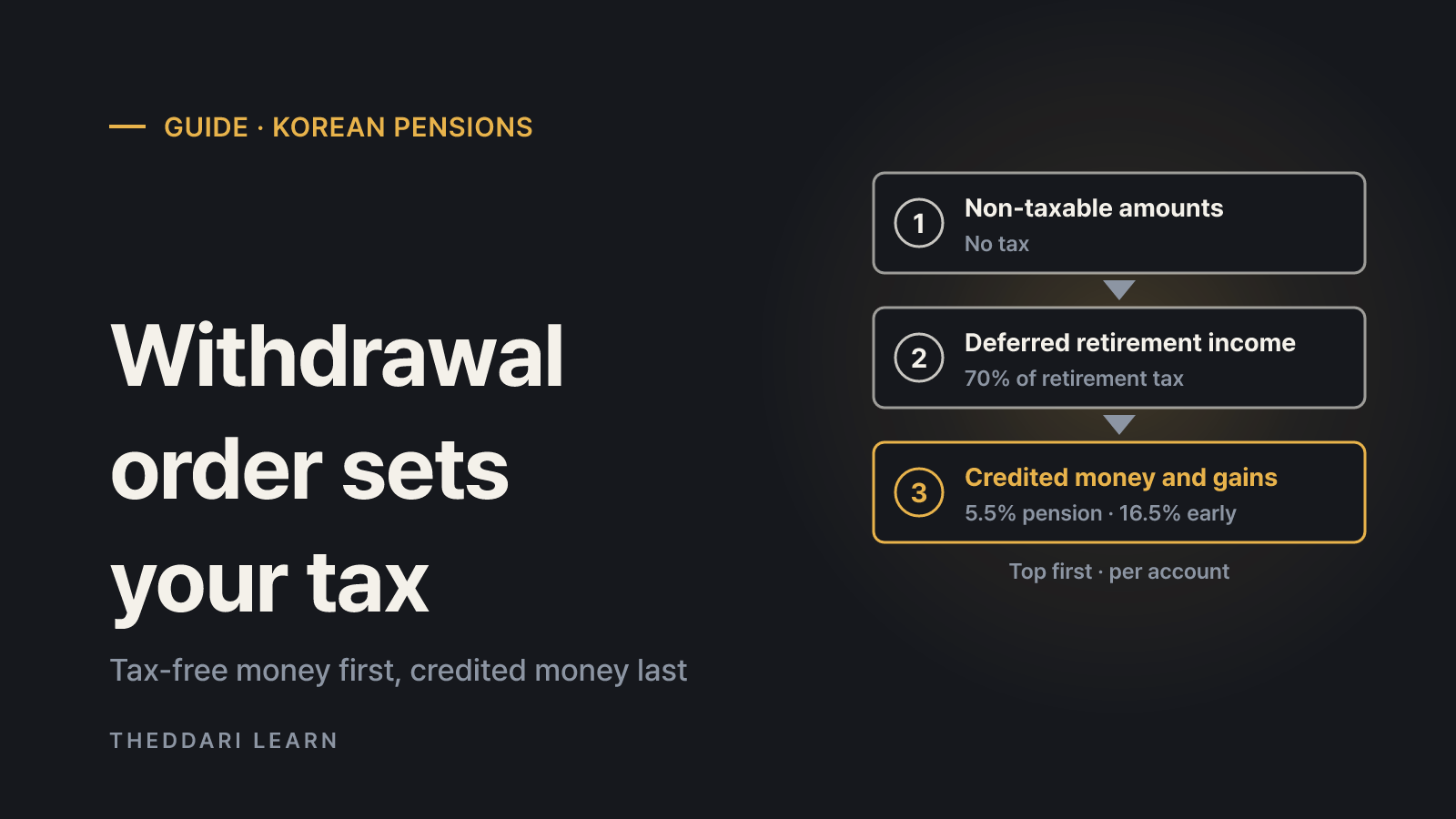
Korean pension savings and IRP withdrawals follow a fixed legal order: non-taxed principal, deferred retirement income, then credited contributions and gains.
Contents8 sections
Key takeaways
- Article 40-3 of Korea's Income Tax Act decree sets the order: non-taxable amounts, then deferred retirement income, then tax-credited contributions and gains.
- Uncredited contributions come out tax-free, but in-limit contributions you never claimed must be confirmed with an NTS certificate.
- Severance pay drawn as an IRP pension is taxed at 70% of the original retirement tax, 60% after 10 payout years and 50% after 20 (payouts from 2026).
- Credited money and gains are taxed at 5%, 4% or 3% by age as a pension, versus 15% other-income tax (16.5% with local tax) when withdrawn early.
- The order applies to each account separately, and if an account is below its principal, losses are deducted in the reverse order.
If you hold a Korean pension savings account (yeongeum jeochuk) or an Individual Retirement Pension account (IRP) and take out part of the balance, the pension withdrawal order is set by law, not by you. Under Article 40-3 of the Enforcement Decree of the Income Tax Act, money is deemed to leave in this order: (1) non-taxable amounts that never received a tax credit, (2) deferred retirement income, meaning severance pay rolled into the account, and (3) tax-credited contributions plus investment gains. Tax-free money goes first and the most heavily taxed money goes last. This guide reflects Korean law and National Tax Service (NTS) guidance as checked in November 2026 and applies to Korean tax residents. It does not cover US 401(k) or IRA rules, which work differently.
Why does this matter? The same 10 million won withdrawal can carry no tax at all or a 16.5% withholding, depending on which bucket the law says it came from. Knowing the order lets you estimate tax before deciding when, from which account and how much to withdraw.
How the pension withdrawal order works
A Korean pension account mixes money with different tax histories. Some contributions earned a year-end tax credit, some did not, severance pay may have been transferred in without paying retirement income tax, and all of it can generate investment returns. The account shows one balance, but the tax system tracks each source separately and applies a fixed sequence on every partial withdrawal.
- Non-taxable amounts. Contributions that never received a tax credit. Because you got no tax break going in, there is no tax coming out.
- Contributions made in the same tax year as the withdrawal
- Conversion amounts paid in that same year (such as matured ISA funds transferred under Article 59-3(3) of the Act)
- Contributions above the annual tax credit limit, measured as if this were your only pension account
- Other contributions confirmed as never credited
- Deferred retirement income. Severance pay moved into an IRP, on which retirement income tax was postponed.
- Tax-credited contributions and investment gains. Money that already gave you a tax benefit or has never been taxed, so it is taxed on the way out.
Paragraph 4 of the same article adds a timing rule: contributions within the credit limit are treated as tax-credited money from January 1 of the year after you paid them in. Until then they sit at the front of the non-taxable queue. Paragraph 3 adds that if a withdrawal exceeds the annual pension payout limit, the portion within the limit is treated as pension receipt first and only the excess as a non-pension withdrawal.
Tax by source: pension payout vs. early withdrawal
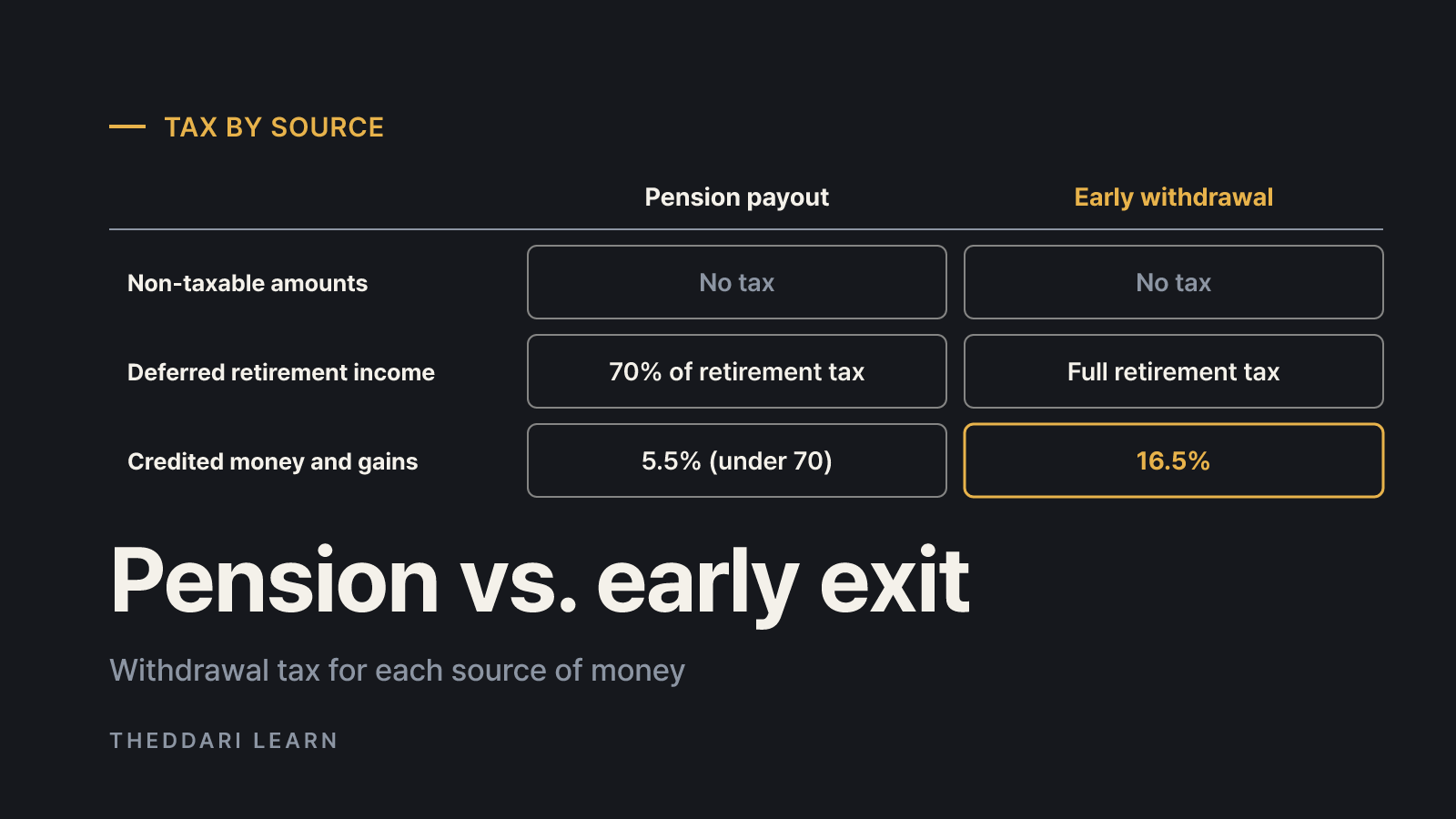
The table summarizes rates from the NTS pension withholding guide and Article 129 of the Income Tax Act. Figures in brackets include Korean local income tax, which adds 10% of the national tax.
1. Non-taxable amounts
- Pension payout (age 55+, within limit)
- Not taxed
- Non-pension withdrawal (early or over limit)
- Not taxed
2. Deferred retirement income
- Pension payout (age 55+, within limit)
- 70% of the original retirement income tax; 60% after 10 actual payout years; 50% after 20
- Non-pension withdrawal (early or over limit)
- Full original retirement income tax
3. Credited contributions and gains
- Pension payout (age 55+, within limit)
- Under 70: 5% (5.5%); 70 to 79: 4% (4.4%); 80+: 3% (3.3%); life annuity: 3% (3.3%)
- Non-pension withdrawal (early or over limit)
- Other income tax 15% (16.5%), taxed separately
According to the NTS, the 60% and 50% tiers for deferred retirement income and the 3% rate for qualifying life annuities apply to payouts received on or after January 1, 2026; the life annuity rate was previously 4%. If you meet both the age and the life annuity condition, the lower rate applies.
The 15 million won threshold only applies to bucket 3
Private pension income above 15 million won a year can no longer be settled by withholding alone. The test, however, excludes deferred retirement income and withdrawals for unavoidable reasons, and non-taxable amounts are not income at all. At or below 15 million won you may treat the 3% to 5% withholding as final; above it you choose comprehensive taxation or a 15% separate tax when filing in May. Because the early years of payouts are drawn from non-taxable money and severance pay first, the amount that counts toward the threshold can be lower than the cash you actually receive.
Worked example: how the order changes the tax bill
This is a simplified illustration, not a tax calculation for your case. Assume a 62-year-old with an IRP holding 10 million won of uncredited contributions, 60 million won of deferred retirement income, 20 million won of credited contributions and 10 million won of investment gains, and who meets the pension payout conditions.
- 1
First 10 million won
Treated as non-taxable amounts, so no tax is withheld, provided any unclaimed in-limit contributions were confirmed with an NTS certificate beforehand.
- 2
Next withdrawals
Drawn from the 60 million won of deferred retirement income. As a pension payout, 70% of the original retirement income tax is withheld (60% for portions after 10 actual payout years), and none of it counts toward the 15 million won test.
- 3
Last 30 million won
Credited contributions and gains. At age 62 a pension payout is withheld at 5.5%; an early lump sum is withheld at 16.5%. On 1 million won from this bucket, that is 55,000 won versus 165,000 won.
An accounting firm's commentary on Article 40-3 gives a contribution-limit example: put 9 million won into a pension savings account in one year when its credit limit is 6 million won, and the 3 million won excess becomes non-taxable. Withdraw 4 million won later and 3 million won leaves tax-free while only 1 million won is taxable.
Exceptions that change the result
The order is applied per account
An NTS ruling reported by Joseilbo (Seomyeon-2023-Wonchun-4016) confirms that the withdrawal order runs separately within each pension account rather than across all of a taxpayer's accounts. Someone with severance pay in one IRP and credited contributions in a separate pension savings account will see different tax depending on which account they draw from first.
Losses are deducted in reverse
When investment losses push an account below its principal, Paragraph 5 treats the principal as reduced in the reverse order: credited money first, then deferred retirement income, and non-taxable amounts last. That preserves the tax-free share of what remains.
Uncredited contributions need proof
The Financial Supervisory Service pension portal tells savers to submit a pension contribution deduction certificate, issued through the NTS Hometax site, to their financial institution before cancelling or withdrawing. Without it, contributions you never claimed may be treated as credited and taxed. Institutions are also expected to explain the account's fund composition (non-taxable, deferred retirement income, other) before a pre-retirement withdrawal.
An early withdrawal reduces both your retirement savings and their future growth, and, unless it qualifies as an unavoidable reason, it is taxed at a higher rate than a pension payout. Weigh the effect on retirement cash flow, not just the withholding.
A checklist before you withdraw
- Ask each institution for the account's breakdown: non-taxable amounts, deferred retirement income, credited contributions and gains.
- If you skipped claiming the credit in any year, get the deduction certificate from Hometax and submit it first.
- Confirm the payout conditions: payout started at age 55 or later, account at least five years old (waived when it holds deferred retirement income) and withdrawal within the annual payout limit.
- Estimate whether bucket 3 payouts will exceed 15 million won this year and plan for the May filing choice if so.
- If you must sell ETFs or funds inside the account to raise cash, check scheduled rate decisions and inflation releases so you are not selling into a known event.

For a quick read on market news that may affect the stocks and ETFs held inside a pension account, the stock channel digest can help. It is background for investment decisions and does not replace a tax calculation.
Key takeaways
The pension withdrawal order in Korea is fixed: non-taxable amounts, then deferred retirement income, then credited contributions and gains. You cannot change the sequence, but because it runs per account, you can choose which account to draw from and when. Rates and effective dates here reflect laws checked in November 2026; confirm them with your financial institution and the NTS before a large withdrawal.
Frequently asked questions
Can I choose which money comes out of my Korean pension account first?
Is an early withdrawal from an IRP always taxed at 16.5%?
Does the 15 million won annual threshold include my severance pay?
What happens to the withdrawal order if my pension account has lost money?
Sources and references
- 1Enforcement Decree of the Income Tax Act, Article 40-3 (Withdrawal order of pension accounts) - Korea Law Information Center(opens in a new tab)www.law.go.kr
- 2Income Tax Act, Article 129 (Withholding tax rates) - Korea Law Information Center(opens in a new tab)law.go.kr
- 3Pension income withholding method - National Tax Service (Korean)(opens in a new tab)www.nts.go.kr
- 4Pension savings: cautions when maintaining or cancelling - Financial Supervisory Service(opens in a new tab)www.fss.or.kr
- 5NTS ruling: withdrawal order applies per pension account - Joseilbo(opens in a new tab)www.joseilbo.com
- 6Pension account withdrawal order and non-taxable excess contributions - Refined Accounting(opens in a new tab)refinedacc.com
Related articles
 Investing
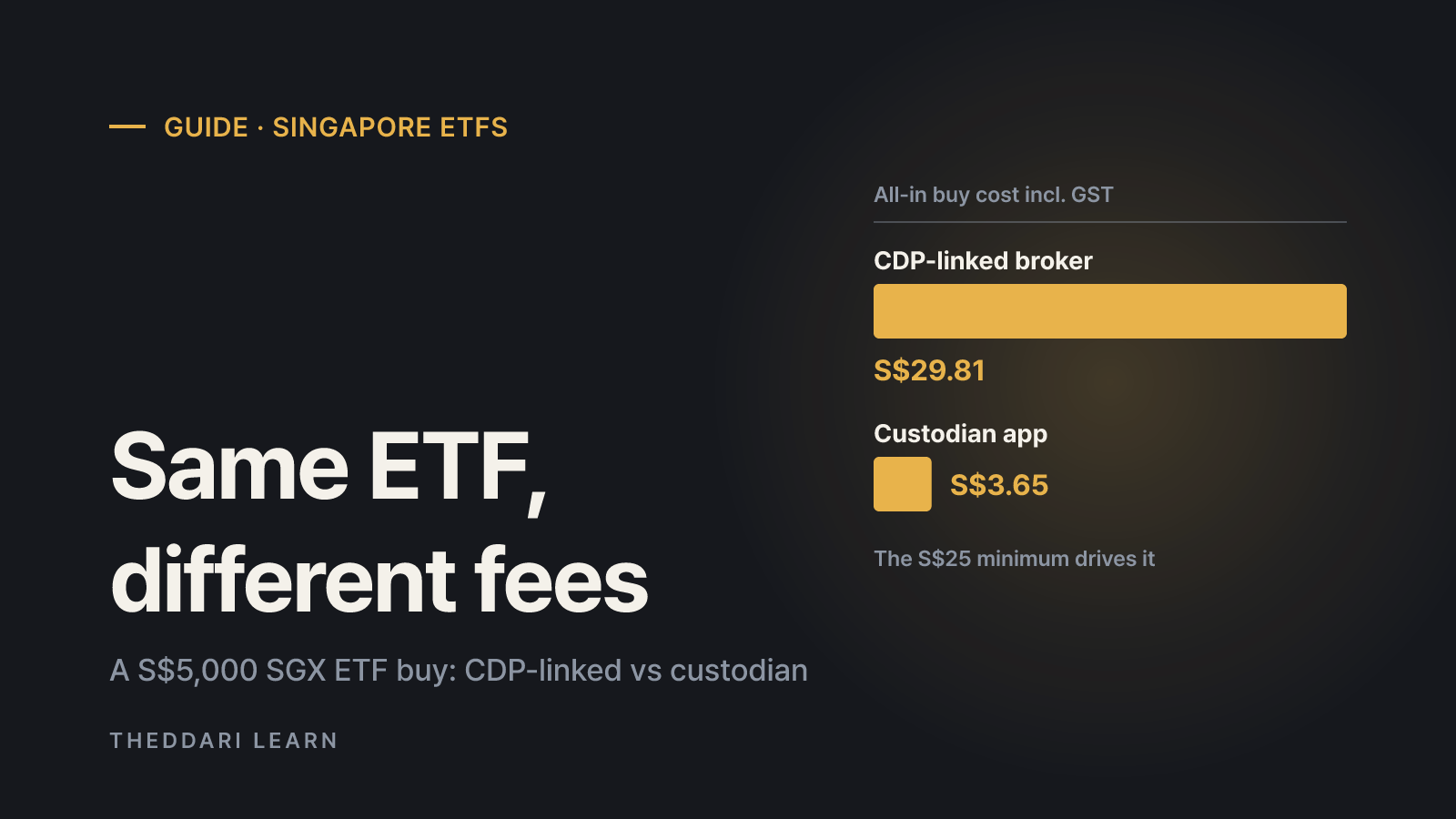
How to Buy ETFs in Singapore: CDP vs Custodian and Fees
A practical guide for Singapore residents: how SGX-listed and US-listed ETFs are held, what the CDP rule changes of July 2026 mean for custodian accounts, and what a trade really costs at different order sizes.
 Investing
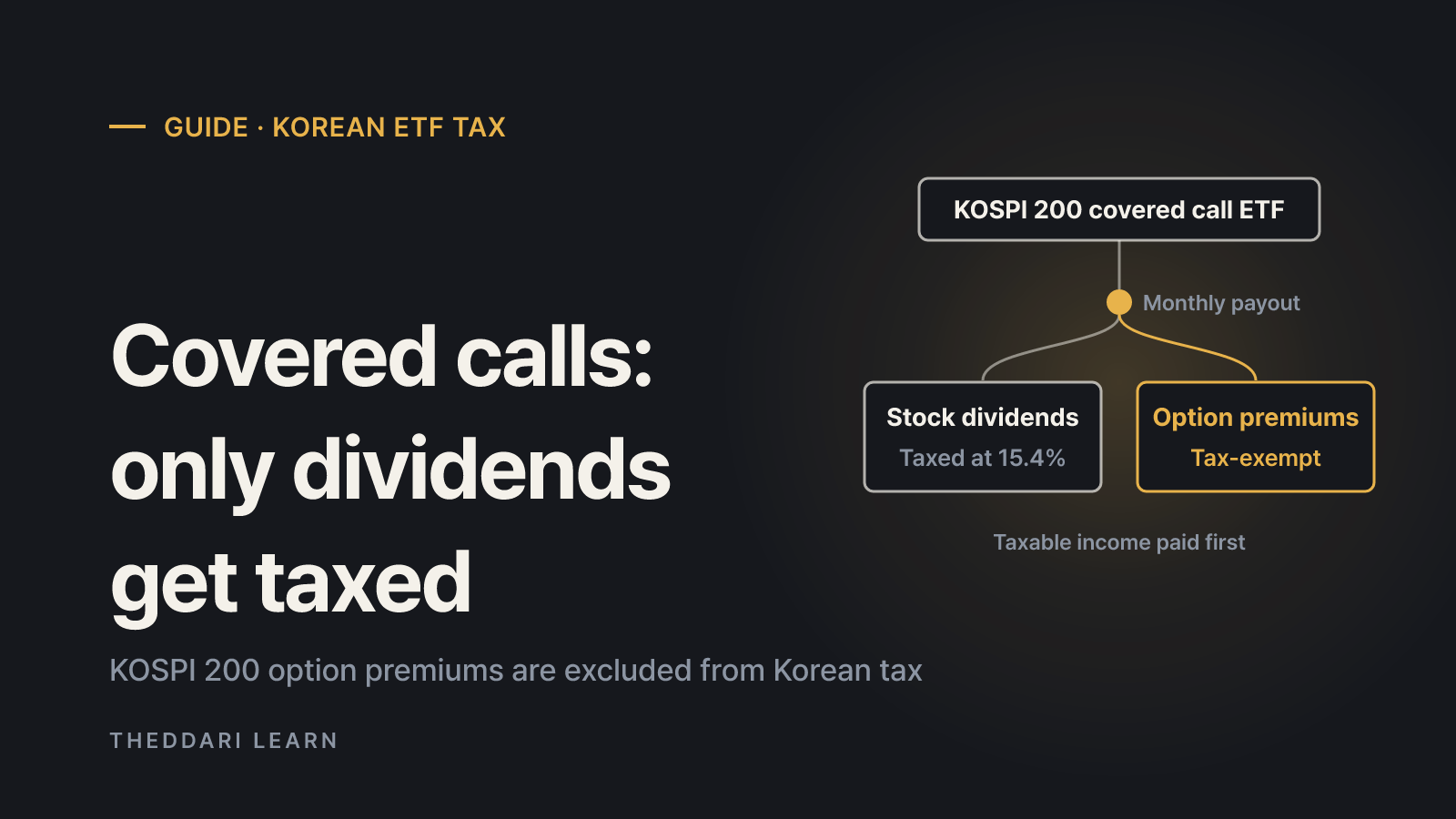
KOSPI 200 Covered Call ETF Tax: Tax-Free Option Premiums
Korean managers pitch KOSPI 200 covered call ETFs as offering tax-free option premiums. What the rule covers for Korean residents, how payouts split between taxable dividends and exempt premiums, and why Korea-listed US-index covered call ETFs differ.
 Investing
Dollar-Cost Averaging Losses: Keep Buying ETFs or Bitcoin?
A red DCA account is not automatically a reason to stop or to double down. Check your average cost, why you own the asset, your cash cushion and your position size before changing the plan.