Contents7 sections
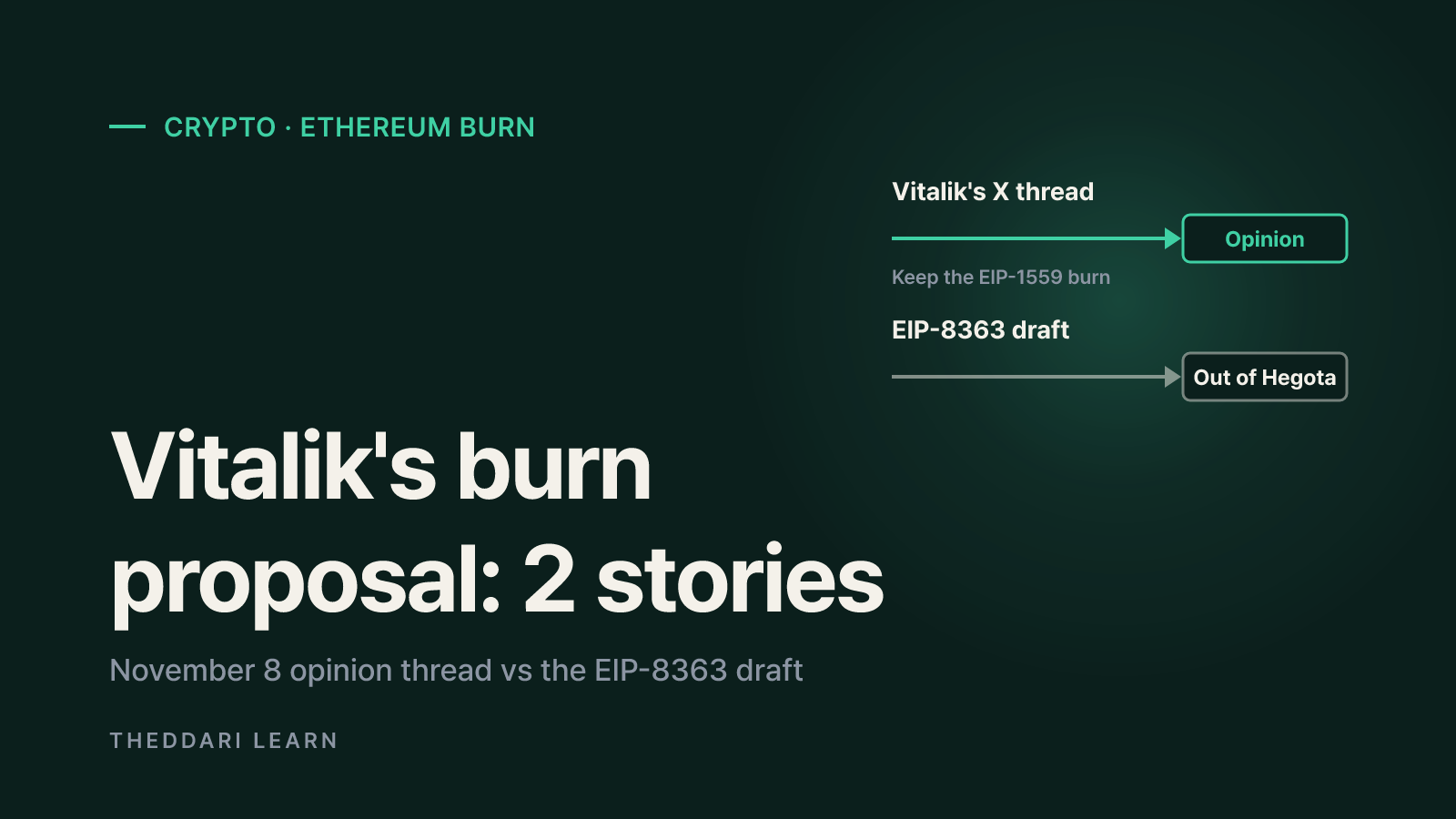
If you searched for the Ethereum burn proposal attributed to Vitalik Buterin, you probably found two different stories blended together. The first is Vitalik's X thread from November 8, 2026, an opinion arguing that ETH should be valued as a store of value rather than as a fee-burning token. The second is EIP-8363, a draft protocol change written by Justin Drake and other researchers, not by Vitalik, that would burn part of validator rewards as the staking ratio rises. That draft was pulled from consideration for the Hegota upgrade on October 1, 2026. This guide, current as of November 13, 2026, separates the two, explains how EIP-1559 fee burning actually works, and shows how to check a proposal's status and test price claims.
How EIP-1559 fee burning works
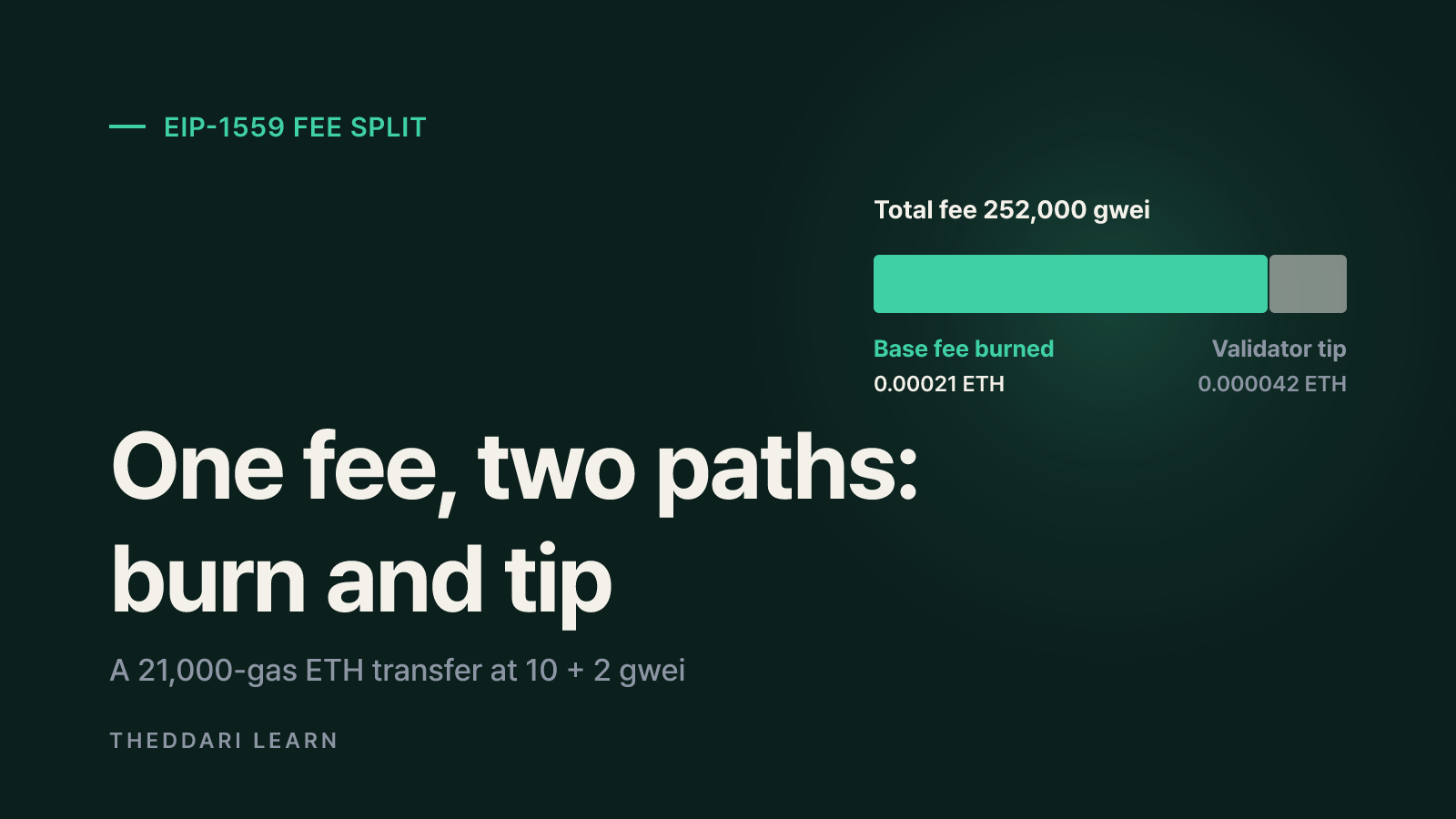
Ethereum's burn is built into its fee market. EIP-1559, activated in 2021, split every transaction fee into two parts. The base fee is set by the protocol and destroyed. The optional priority fee, or tip, goes to the validator that proposes the block. The EIP's authors, including Vitalik, explained that keeping the base fee away from block producers removes their incentive to manipulate fees and ensures that only ETH can pay for transactions on Ethereum.
The base fee adjusts automatically. According to the ethereum.org gas documentation, each block targets half of the gas limit. When the previous block used more than the target, the base fee rises; when it used less, the fee falls, by at most 12.5% per block. Busy periods therefore burn more ETH and quiet periods burn less. In practice the burn is a running measure of demand for mainnet block space.
Base fee
- Set by
- Protocol, based on the prior block
- Where it goes
- Burned and removed from supply
Priority fee (tip)
- Set by
- User or wallet
- Where it goes
- Validator that proposed the block
Max fee
- Set by
- User or wallet
- Where it goes
- Unused difference refunded to the user
ethereum.org gives a worked example. A simple ETH transfer uses 21,000 gas. With a 10 gwei base fee and a 2 gwei tip, the total is 21,000 × (10 + 2) = 252,000 gwei, or 0.000252 ETH. Of that, 0.00021 ETH is burned and 0.000042 ETH goes to the validator. The EIP-1559 text also warns that the burn means ETH supply can no longer be fixed: if more is burned than issued, supply shrinks, and if less, it grows.
The Ethereum burn proposal: Vitalik's thread vs EIP-8363
The word proposal covers very different objects here. A thread or blog post has no effect on code. An EIP only becomes a rule after client teams implement it and it ships in a hard fork.
Author
- Vitalik's Nov 8 thread
- Vitalik Buterin
- EIP-8363 Tapered Issuance Burn
- pintail, Jérôme de Tychey, Justin Drake and others
Type
- Vitalik's Nov 8 thread
- Opinion posted on X
- EIP-8363 Tapered Issuance Burn
- Standards Track Core EIP
What gets burned
- Vitalik's Nov 8 thread
- Nothing new; keep EIP-1559
- EIP-8363 Tapered Issuance Burn
- A share of validator rewards
Status (Nov 13, 2026)
- Vitalik's Nov 8 thread
- No protocol change
- EIP-8363 Tapered Issuance Burn
- Draft; out of Hegota scope
What Vitalik actually said
As reported by The Block, Vitalik wrote that the fee-burning case for ETH 'never was as strong as it seemed.' He walked through the valuation model in which market cap equals annual burn divided by a discount rate: $1 billion burned per year at a 4% rate implies a $25 billion floor. The problem, he argued, is that most burns from 2021 to 2023 came from crypto-internal activity, such as an NFT land sale that burned $180 million in fees in one day, and that revenue would have shrunk alongside the ETH price. A floor only works when the revenue backing it is external.
He added that justifying a market cap of roughly $270 billion through burns alone would require Ethereum to behave like a large corporation, funding about 700,000 ETH a year in-protocol and cutting validator revenue by about two-thirds. Optimizing for burn would also mean pushing gas prices up, which could price out the users who most need privacy and security. His conclusion: keep EIP-1559 and its burn, but do not be sad if the burn stays below 10% of breakeven indefinitely.
What EIP-8363 would change
EIP-8363, created on July 14, 2026, would deduct and burn a fraction of each validator's rewards every epoch. The fraction rises with the amount staked and reaches 100% at a saturation balance of about 60.25 million ETH, roughly half of supply, so issuance would stop rewarding stake beyond that point. To avoid a sudden yield cliff, it phases in over about 18 months. The authors argue that a very high staking ratio concentrates stake in large operators and weakens ETH's role as money.
The Block reported that at the roughly 34% staking ratio seen in mid-August, annual consensus yield would have dropped from about 2.6% to 1.2%. SharpLink's CEO and Aave's founder publicly opposed it. On October 1, 2026, co-author Jérôme de Tychey withdrew it from Hegota consideration, accepting feedback that fork scoping is the wrong venue for issuance policy. A separate process is planned from Devcon in November 2026 through EthCC in April 2027.
Reading ETH supply: issuance minus burn
ETH has no fixed supply cap. Under proof of stake, new ETH is issued as validator rewards and existing ETH is burned through base fees. Over any period, net supply change equals issuance minus burn. Breakeven, the term Vitalik used, is the point where the two are equal and supply stays flat.
The burn side has shrunk sharply. The Block's data shows about 1.48 million ETH burned in 2022, worth roughly $3.6 billion then, compared with about 19,200 ETH, or $43 million, in 2026 through November 8. Cheaper activity on layer 2 networks and less speculative mainnet demand both play a part. With burns this low, most of the change in supply comes from issuance, which depends on how much ETH is staked. That is exactly the lever EIP-8363 tried to pull.
- Burn side: tracks mainnet demand (base fee times gas used) and falls when fees fall.
- Issuance side: under the current reward curve, total issuance rises as more ETH is staked; the EIP-8363 text says today's curve keeps a yield floor of roughly 1.5%.
- Net change: subtract the two over the same period and in the same unit. A big burn number on its own does not mean ETH is deflationary.
How to test claims about ETH price impact
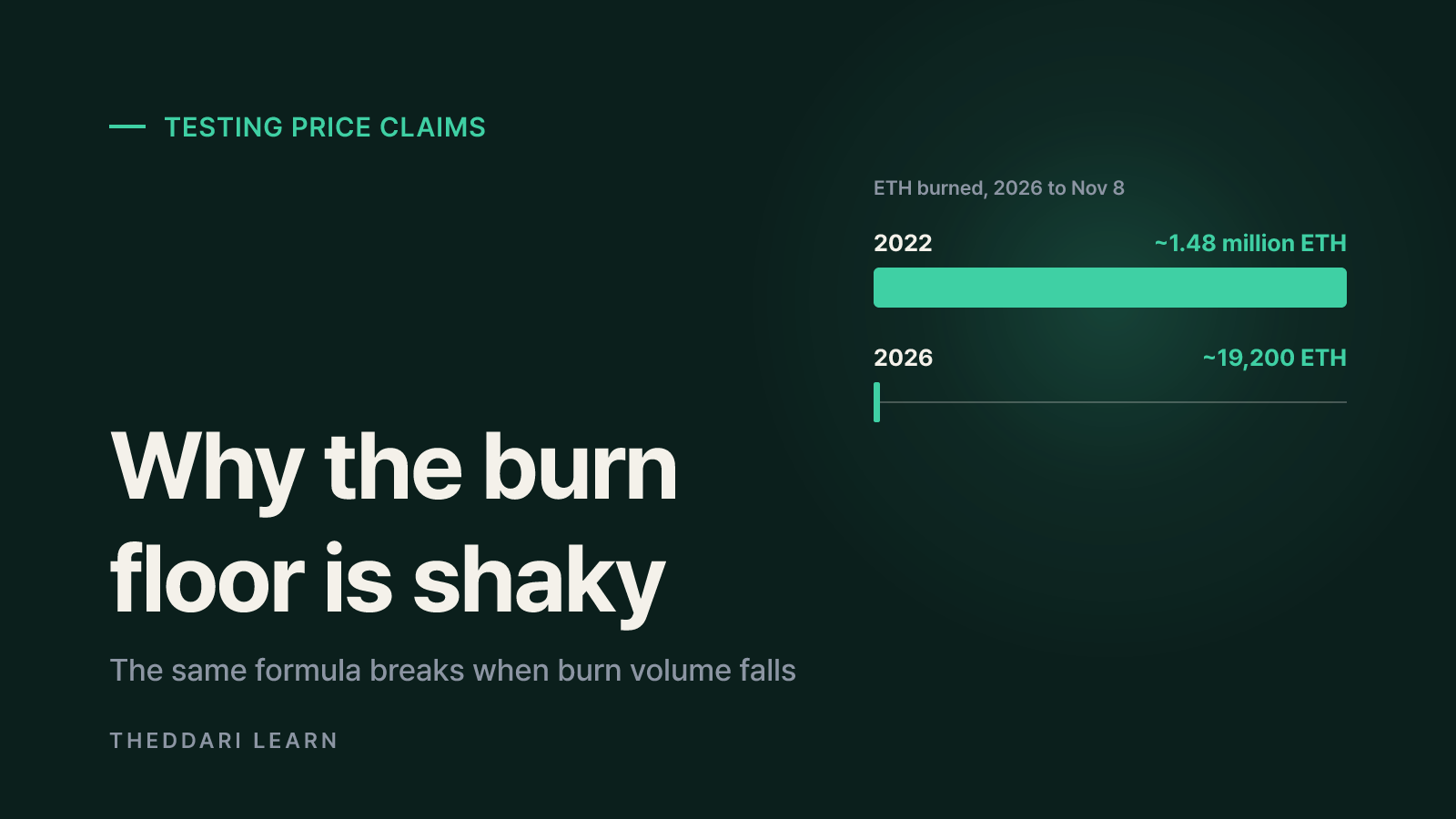
Headlines that link a burn proposal to an ETH price move usually rely on a one-step story: less supply, more scarcity, higher price. Vitalik's own thread is a useful counterweight. Burn-based valuation is very sensitive to the discount rate and burn assumptions, and when the activity creating the burn rises and falls with ETH itself, it fails as a floor exactly when holders need one. With 2026 burns in the tens of millions of dollars, the same formula produces a figure far below ETH's market cap.
- Separate opinion from proposal. Threads, interviews and blog posts change nothing on-chain. Look for an EIP number and its status.
- Check the authors. A famous name in a headline does not mean authorship. Vitalik is not listed on EIP-8363.
- Normalize the numbers. Confirm whether burn figures are in ETH or dollars and which period they cover; 2022 and 2026 inputs give wildly different results.
- Isolate the price move. If bitcoin fell or a macro event hit the same week, the burn story cannot explain the move alone. Look at derivatives positioning such as funding rates and open interest.
- Watch narrative spread. Track when and where the story circulated before assuming it moved the market.
Two theddari tools help with the last two steps. The Telegram crypto trends page shows which channels picked up a story and when, and the funding-rate page shows whether futures traders were crowded on one side. Neither tool predicts the next price move; they help you separate the narrative from positioning.

How to check an Ethereum update's status
Two questions decide whether an Ethereum update is real: what is the EIP's status, and is it scheduled into a hard fork? EIP-1 defines the path Idea, Draft, Review, Last Call and Final. A Draft, Review or Last Call EIP inactive for six months becomes Stagnant. Withdrawn is final, so reviving the idea requires a new EIP number. Core EIPs also need client implementations, which are coordinated on AllCoreDevs calls.
- 1
Find the EIP and read the source
Search eips.ethereum.org by number and note the title, authors, creation date and type. If a news story gives no number, follow the Ethereum Magicians discussion link.
- 2
Read the status badge
Draft means the text can still change. Even a Final core EIP matters only once you know which fork activated it. As of November 13, 2026, EIP-8363 shows Draft.
- 3
Check fork scoping
Upgrades move candidates through stages such as Considered for Inclusion (CFI) and Scheduled for Inclusion (SFI). An EIP can remain a Draft while being dropped from a specific fork, as EIP-8363 was for Hegota.
- 4
Confirm timelines
Hegota follows Glamsterdam, which has slipped behind schedule. Use the Ethereum Foundation blog and core developer call notes for dates, and treat any undated forecast as speculation.
Be wary of posts that use phrases like 'burn proposal approved' to push a token swap, sign-up or airdrop claim. Protocol changes arrive only through hard forks and never require you to exchange or register your ETH.
Bottom line as of November 13, 2026: Ethereum's burn rules have not changed. The EIP-1559 base-fee burn works as before, Vitalik's thread reframes where ETH's value should come from, and EIP-8363 remains a Draft outside Hegota's scope while its authors run a separate issuance debate into 2027. The signals worth watching are a revised issuance proposal, any burn or issuance EIP entering fork scoping, and the trend in both burn volume and the staking ratio.