Contents7 sections
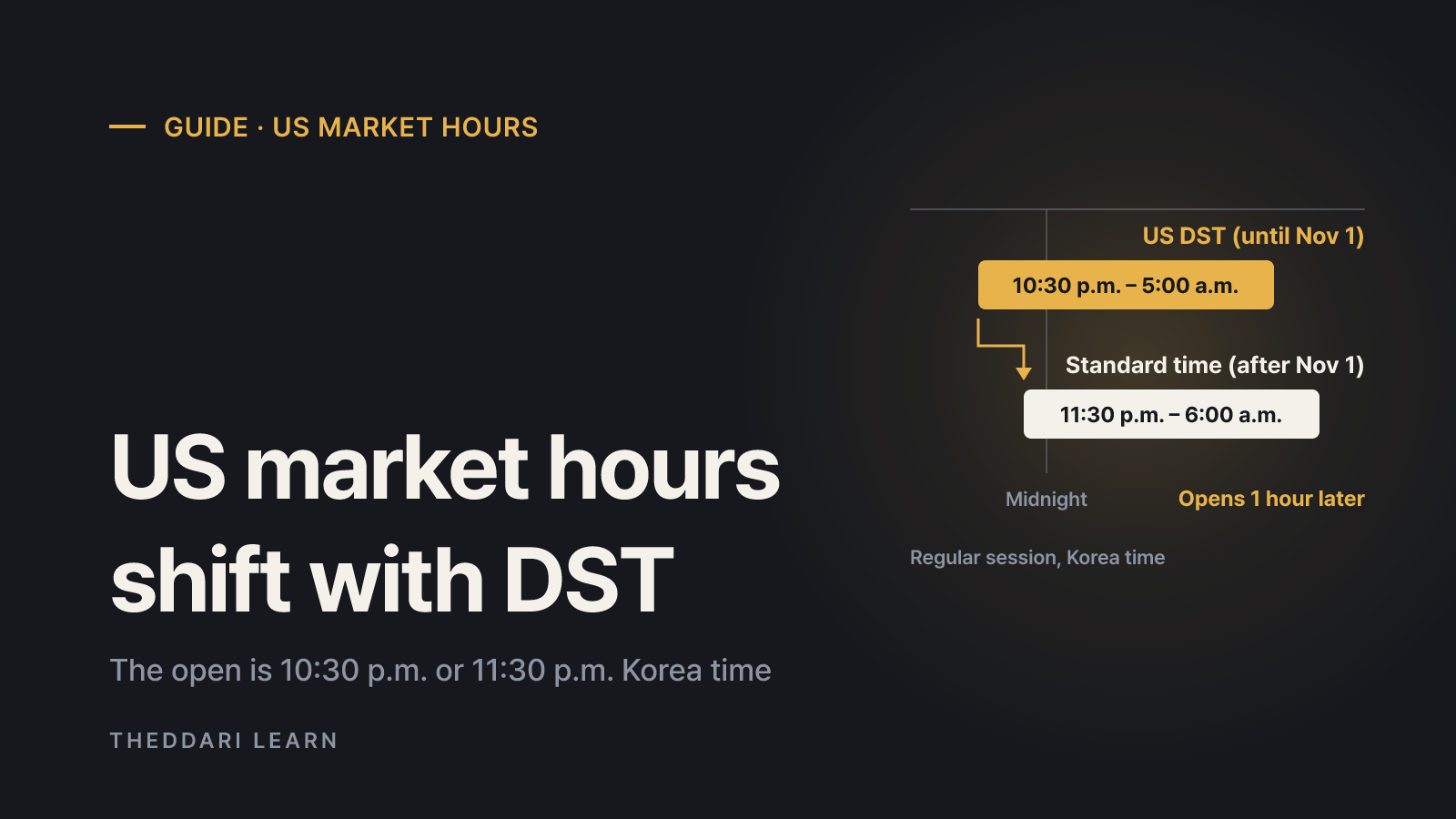
US stock market hours for both the NYSE and Nasdaq are 9:30 a.m. to 4:00 p.m. Eastern Time (ET), Monday through Friday. If you live in South Korea, that converts to 10:30 p.m. to 5:00 a.m. KST while the US is on daylight saving time, and 11:30 p.m. to 6:00 a.m. KST for the rest of the year. As of October 2026 the US is still on daylight saving time, and according to NIST it ends at 2:00 a.m. local time on November 1, 2026. This guide covers regular, pre-market and after-hours sessions in Korea time, the daylight saving switch, and the official 2026 and 2027 holiday calendars.
The math behind the conversion is simple. Korea Standard Time is UTC+9 all year because Korea does not observe daylight saving time. New York uses UTC-4 (EDT) in summer and UTC-5 (EST) in winter. That makes the gap 13 hours in summer and 14 hours in winter, which is why the US market seems to open an hour later in Korea every November.
US stock market hours converted to Korea time
Nasdaq's official schedule lists the regular session at 9:30 a.m. to 4:00 p.m. ET, pre-market at 4:00 to 9:30 a.m. ET, and after-hours at 4:00 to 8:00 p.m. ET. The NYSE trading hours page shows the same 9:30 a.m. to 4:00 p.m. core session. Here is how those times look from Seoul.
Pre-market (Nasdaq)
- New York (ET)
- 4:00–9:30 a.m.
- Korea time, US DST in effect
- 5:00–10:30 p.m.
- Korea time, US standard time
- 6:00–11:30 p.m.
Regular session
- New York (ET)
- 9:30 a.m.–4:00 p.m.
- Korea time, US DST in effect
- 10:30 p.m.–5:00 a.m.
- Korea time, US standard time
- 11:30 p.m.–6:00 a.m.
After-hours (Nasdaq)
- New York (ET)
- 4:00–8:00 p.m.
- Korea time, US DST in effect
- 5:00–9:00 a.m.
- Korea time, US standard time
- 6:00–10:00 a.m.
Early-close regular session
- New York (ET)
- 9:30 a.m.–1:00 p.m.
- Korea time, US DST in effect
- 10:30 p.m.–2:00 a.m.
- Korea time, US standard time
- 11:30 p.m.–3:00 a.m.
Because the session crosses midnight in Korea, dates get confusing. A Tuesday session in New York starts on Tuesday night in Seoul and ends early Wednesday morning. When you read trade confirmations or earnings release times, check whether the app shows US or Korean dates.
Pre-market hours differ by venue and broker
Extended sessions are not uniform. NYSE says NYSE Arca opens its early trading session at 4:00 a.m. ET, while NYSE American and NYSE National start early trading at 7:00 a.m. ET and run late trading from 4:00 to 8:00 p.m. ET. The hours your broker actually accepts orders can be narrower, depending on which venues it routes to. Nasdaq also warns that extended sessions usually have less liquidity and higher volatility than the regular session.
When daylight saving time moves the US market open
Under the rule described by NIST, US daylight saving time begins at 2:00 a.m. on the second Sunday in March and ends at 2:00 a.m. on the first Sunday in November. In 2026 it runs from March 8 to November 1. Only the US clock moves, so only the Korean view of the session shifts.
- 1
Sunday, November 1, 2026: DST ends
Clocks in New York fall back one hour. The Monday, November 2 session opens at 11:30 p.m. KST that night.
- 2
Sunday, March 14, 2027: DST starts
This date follows from the second-Sunday rule. From the Monday, March 15 session, the open returns to 10:30 p.m. KST.
- 3
Sunday, November 7, 2027: DST ends again
That is the first Sunday in November under the same rule. Congress can change the law, so confirm each year.
Add New York to your phone's world clock. Your operating system applies US time zone rules automatically, so you never have to do the DST math by hand.
US stock market holidays 2026 and 2027
The NYSE and Nasdaq close on the same days. The table below combines the NYSE holiday calendar with Nasdaq's 2026 schedule. All dates are US dates; from Korea, read each one as "no session that night."
New Year's Day
- 2026
- Thu, Jan 1
- 2027
- Fri, Jan 1
Martin Luther King Jr. Day
- 2026
- Mon, Jan 19
- 2027
- Mon, Jan 18
Washington's Birthday
- 2026
- Mon, Feb 16
- 2027
- Mon, Feb 15
Good Friday
- 2026
- Fri, Apr 3
- 2027
- Fri, Mar 26
Memorial Day
- 2026
- Mon, May 25
- 2027
- Mon, May 31
Juneteenth
- 2026
- Fri, Jun 19
- 2027
- Fri, Jun 18 (observed)
Independence Day
- 2026
- Fri, Jul 3 (observed)
- 2027
- Mon, Jul 5 (observed)
Labor Day
- 2026
- Mon, Sep 7
- 2027
- Mon, Sep 6
Thanksgiving Day
- 2026
- Thu, Nov 26
- 2027
- Thu, Nov 25
Christmas Day
- 2026
- Fri, Dec 25
- 2027
- Fri, Dec 24 (observed)
Early closes
NYSE lists 1:00 p.m. ET early closes on Friday, November 27, 2026 (the day after Thanksgiving) and Thursday, December 24, 2026, plus Friday, November 26, 2027. Both 2026 dates fall in US standard time, so the regular session ends at 3:00 a.m. KST on November 28 and December 25. Orders placed close to the bell, or scheduled orders, may not behave as usual on these days.
Federal holidays are not the same as market holidays
Columbus Day (the second Monday in October) and Veterans Day (November 11) are missing from the NYSE list, so stocks trade on those days. Good Friday works the other way: it is not a federal holiday, yet the exchanges close.
A practical checklist for trading from Korea
- Check whether US daylight saving time is in effect. In 2026 it lasts until November 1; in 2027 it starts March 14.
- Check the US date against the official holiday and early-close list.
- Check your broker's extended-hours window and allowed order types, which may be narrower than the exchange schedule.
- Check the time of major US data releases. Jobs and inflation reports usually come out before the open and can move pre-market prices.
- Check whether earnings come before the open or after the close. After-close reports hit the after-hours session, which is early morning in Korea.
The theddari economic calendar and earnings calendar list scheduled releases so you can see what lands in your trading window. They show timing, not price direction.

Risks and exceptions in extended-hours trading
- Thin liquidity means wider bid-ask spreads, and small orders can move prices sharply.
- Pre-market prices can differ a lot from the regular-session open, so treat them as indicative.
- Brokers often restrict extended-hours orders, for example to limit orders only.
- Exchanges can halt trading or announce unscheduled closures during unusual events; those are published as exchange notices.
- Broker-run services outside exchange hours, such as overnight or Korean daytime trading for US stocks, follow their own schedules and can be suspended.
In short: the regular session is 9:30 a.m. to 4:00 p.m. ET, which starts at 10:30 p.m. KST during US daylight saving time and 11:30 p.m. KST otherwise. Holidays and early closes are set by US dates. Your broker's own schedule is the final word on when you can actually place an order.