Contents8 sections
UnitedHealth Group (NYSE: UNH) runs the largest US health insurer, UnitedHealthcare, alongside Optum, a group of care delivery, pharmacy benefit and health data businesses. If you want to understand UnitedHealth stock, start with one number: the medical care ratio, the share of premium dollars paid out as medical costs. This guide uses the company's Q3 2026 results, released October 13, 2026, and official CMS and HealthCare.gov material to explain what drives the stock and the wider group of health insurer stocks.
On October 13, 2026, UNH ranked first and Oscar Health (OSCR) 23rd on Yahoo Finance's trending tickers list. UnitedHealth reported earnings before the open that same morning, but the data does not show why either ticker trended, so treat the timing as context rather than a cause.
How UnitedHealth stock is built: UnitedHealthcare plus Optum
UnitedHealthcare collects premiums from employers, individuals and government programs and pays members' medical bills. Optum sells care delivery, analytics and pharmacy benefit management, both to UnitedHealthcare and to outside clients. In Q2 2026, consolidated revenue was $112.0 billion: UnitedHealthcare brought in $86.0 billion and Optum $65.7 billion. The pieces add up to more than the total because services Optum sells to UnitedHealthcare are eliminated on consolidation.
UHC Employer & Individual
- What it does
- Employer group and individual plans
- Q2 2026 revenue
- $20.0B
UHC Medicare & Retirement
- What it does
- Medicare Advantage and other senior plans
- Q2 2026 revenue
- $42.4B
UHC Community & State
- What it does
- State-contracted Medicaid plans
- Q2 2026 revenue
- $23.6B
Optum Health
- What it does
- Physician care and value-based care
- Q2 2026 revenue
- $23.5B
Optum Insight
- What it does
- Data, analytics and claims technology
- Q2 2026 revenue
- $5.4B
Optum Rx
- What it does
- Pharmacy benefit management
- Q2 2026 revenue
- $38.3B
Medicare & Retirement is about half of insurance revenue. That is why federal payment policy matters so much to this stock: a change in how CMS pays Medicare Advantage plans flows straight into next year's margin.
What the medical loss ratio measures
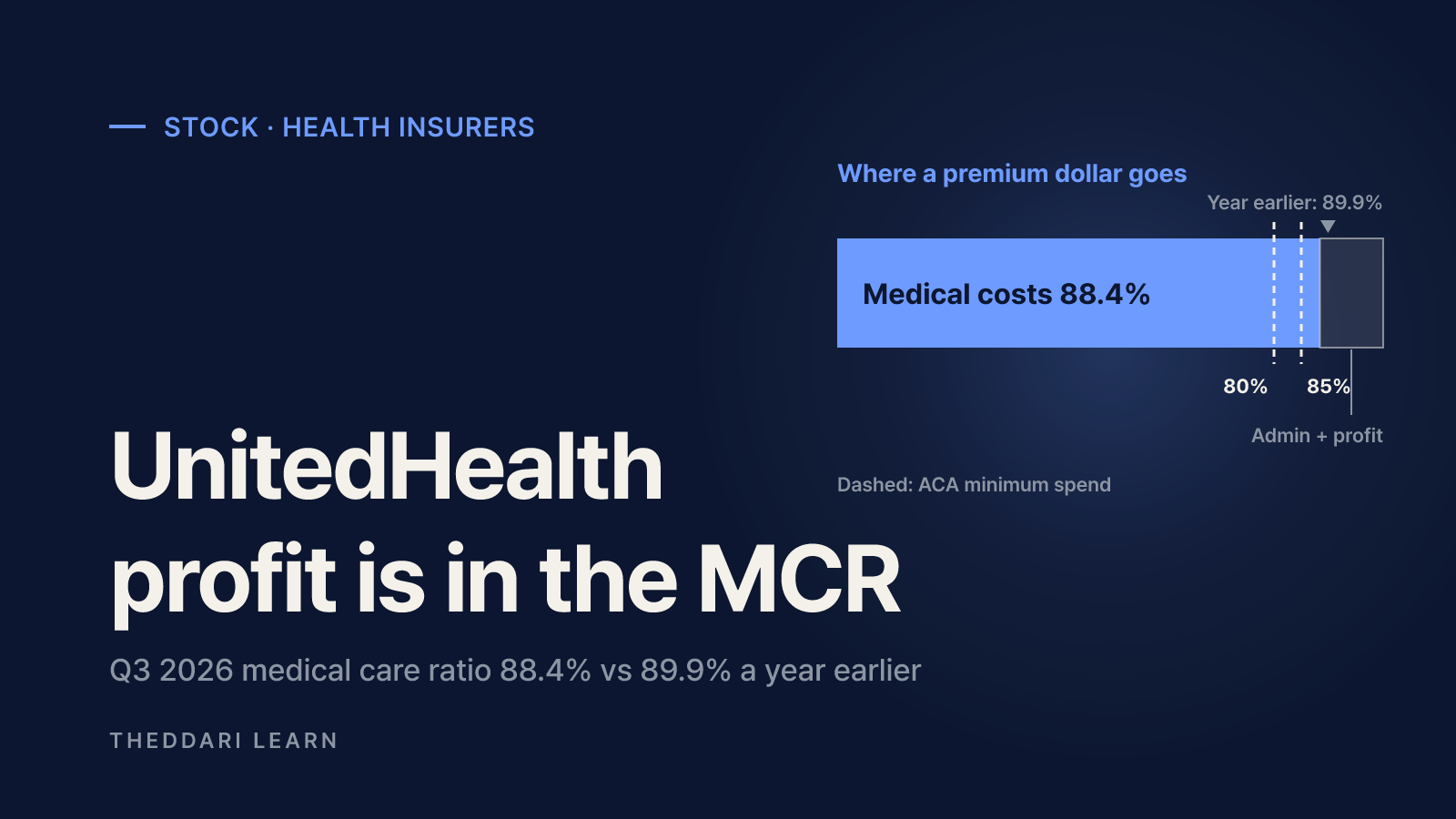
HealthCare.gov gives the plain-English version: if an insurer spends 80 cents of every premium dollar on medical claims and quality improvement, its medical loss ratio is 80%. Whatever is left covers salaries, marketing, technology and profit. When the ratio rises, margin shrinks almost one for one.
The ACA floor: the 80/20 and 85/15 rules
The Affordable Care Act generally requires insurers to spend at least 80% of premiums on care and quality improvement in the individual and small-group markets, and at least 85% for large groups (usually more than 50 employees). Insurers that fall short must rebate the difference, and affected customers must be notified by August 1. The rebate rules do not apply where an insurer has fewer than 1,000 enrollees in a given state and market. The practical result: insurers cannot push the ratio down indefinitely, so profit lives in a narrow band.
Company MCR versus regulatory MLR
UnitedHealth reports a medical care ratio (MCR) each quarter. It is a company metric, medical costs over premium revenue, and it is not calculated the same way as the regulatory MLR. Track the MCR for earnings analysis; use the regulatory rule to understand the floor.
Rule of thumb: on a hypothetical $80 billion of quarterly premiums, one percentage point of MCR equals $800 million. UnitedHealthcare earned $2.8 billion from operations in Q3 2026, so a single point is a large share of segment profit. The $80 billion figure is illustrative, not reported.
UnitedHealth Q3 2026 by the numbers
The Q3 2026 release shows how the MCR drives profit. Revenue was roughly flat, yet operating earnings jumped.
Consolidated revenue
- Q3 2026
- $112.7B
- Q3 2025
- $113.2B
Earnings from operations
- Q3 2026
- $6.6B
- Q3 2025
- $4.3B
Medical care ratio
- Q3 2026
- 88.4%
- Q3 2025
- 89.9%
Operating cost ratio
- Q3 2026
- 12.8%
- Q3 2025
- 13.5%
UnitedHealthcare operating margin
- Q3 2026
- 3.3%
- Q3 2025
- 2.1%
Adjusted EPS
- Q3 2026
- $4.69
- Q3 2025
- n/a
- Management credited medical cost management, benefit design changes, pricing discipline and value-based care for the lower MCR.
- The ratio included $610 million of favorable prior-period reserve development, meaning earlier cost estimates proved too high. That may not repeat.
- Full-year 2026 adjusted EPS guidance rose to at least $20.50, up from $19.50 to $20.00 in July. GAAP EPS guidance is at least $19.50.
- Q2 2026 MCR was 86.7%, including $860 million of favorable development. Medical costs are seasonal, so compare with the same quarter last year and with full-year guidance rather than the prior quarter.
Membership tells the other half of the story. UnitedHealthcare served 48.3 million people in Q3, and Medicare Advantage enrollment was down 935,000 since the end of 2025. Exiting unprofitable products improves the ratio but shrinks the revenue base. The company also said at least 69% of its members are in plans rated 4 stars or higher for 2027, which matters because star ratings feed quality bonus payments.

What moves health insurer stocks
- Utilization surprises. Faster growth in hospital visits, specialty drugs or outpatient procedures pushes the MCR above guidance. One company's cost warning often drags the whole group.
- Medicare Advantage rates. CMS finalized an average 2.48% payment increase for 2027 (over $13 billion), up from 0.09% proposed in January; including risk score trend it is 4.98%. CMS also finalized excluding most unlinked chart review diagnoses from risk scores, an estimated -1.53% impact, which pressures coding-driven revenue.
- Policy and politics. Prior authorization, pharmacy benefit manager fees and ACA subsidies are politically sensitive. UnitedHealth has pledged to cut 30% of prior approval volume by the end of 2026 and pass through 100% of drug manufacturer rebates by January 1, 2028, steps that may help trust but can also trim fee income.
- Rates and jobs. Insurers earn investment income on premiums held before claims are paid, and employment trends affect employer plan enrollment. Fed decisions and payroll data are worth tracking.
Earnings-day checklist for health insurer stocks
- 1
Compare MCR with guidance
Check the quarterly MCR against the full-year range and the same quarter last year.
- 2
Strip out reserve development
Look for prior-period development. Large favorable releases flatter the headline ratio.
- 3
Check days claims payable
This shows how conservatively reserves are set. UnitedHealth reported 47.0 days in Q3 2026, unchanged from Q2.
- 4
Read membership by product
Medicare Advantage, Medicaid and employer membership trends reveal whether shrinkage is deliberate repricing or lost share.
- 5
Watch Optum and guidance
Optum margins and any change to full-year EPS guidance usually explain the share price reaction best.
For a quick read on how traders are discussing a print, the stock-focused Telegram trend board can help. Treat channel commentary as opinion and confirm every figure against the company release.
Bottom line
For UnitedHealth and its peers, revenue growth matters less than three questions: where is the medical care ratio landing versus guidance, can the improvement repeat without reserve releases or membership losses, and how will next year's government rates reset margins? Q3 2026 delivered a lower ratio and higher guidance, with caveats attached. Apply the same lens to the next report and to the 2028 Medicare Advantage advance notice, typically published in January. Remember that adjusted EPS ($4.69) and GAAP EPS ($4.56) differ, and that a single stock can move sharply on one policy announcement, so size positions with that event risk in mind.