Nvidia Options Explained: Calls, Puts and Big Stock Moves
How Nvidia call and put options work, why premiums swing on sharp stock moves, and the implied volatility, time decay and Korean rules to check.
Contents7 sections
Key takeaways
- Nvidia options let the buyer buy (call) or sell (put) NVDA shares at a fixed strike price before expiration; one listed stock option contract generally covers 100 shares.
- An option premium is intrinsic value plus time value, and it is driven mainly by the stock price, strike, time to expiration and implied volatility.
- Around big events, implied volatility can lift both call and put premiums; once the event passes, time value can shrink quickly even if you guessed the direction right.
- Option buyers can lose the entire premium, while some option sellers face losses with no fixed limit.
- Since December 15, 2025, Korean retail investors new to overseas derivatives need at least 1 hour of training and 3 hours of mock trading; gains face Korean capital gains tax.
Nvidia options are listed contracts that let the buyer purchase (a call) or sell (a put) Nvidia (NVDA) shares at a set strike price until expiration. When the stock makes a big move, option prices react to more than direction: time remaining and implied volatility also shift, so premiums can rise or collapse far faster than the share price. This guide, current as of November 2026, draws on the SEC's investor education material, the Options Industry Council (OIC) and, for readers in Korea, a broker notice and the National Tax Service. It does not quote live Nvidia option prices. The worked numbers come from the SEC's hypothetical example so the mechanics are easy to follow.
Nvidia options basics: what calls and puts are
The SEC's options bulletin defines options as contracts giving the owner the right to buy or sell an underlying asset at a fixed price on or before a specified date. A typical quote such as "ABC December 70 Call $2.20" contains the ticker, expiration, strike, type and premium. For Nvidia options, the underlying is NVDA stock.
Call
- Meaning
- Right to buy at the strike
- Watch for
- The seller must deliver shares if assigned
Put
- Meaning
- Right to sell at the strike
- Watch for
- The seller must buy shares if assigned
Strike price
- Meaning
- Per-share exercise price
- Watch for
- Distance from the stock price drives value
Expiration
- Meaning
- Date the right ends
- Watch for
- Weekly and quarterly series exist too
Premium
- Meaning
- Price per share of the option
- Watch for
- One contract is generally 100 shares
Because a contract generally represents 100 shares, a $2.20 premium costs $220 per contract before fees. That payment goes to the seller up front and is not refundable. A call is in the money when the stock trades above the strike; a put is in the money when the stock trades below it. The opposite cases are out of the money, and a strike equal to the stock price is at the money.
Holders and writers carry very different risks
There are four basic positions: buying calls, selling calls, buying puts and selling puts. A holder's maximum loss is the premium paid. A writer collects the premium but can receive an assignment notice and must then buy or sell shares at the strike. The SEC notes that certain written options can expose sellers to unlimited potential losses, which is why many brokers restrict who may sell options.
What sets an option premium: intrinsic value and time value
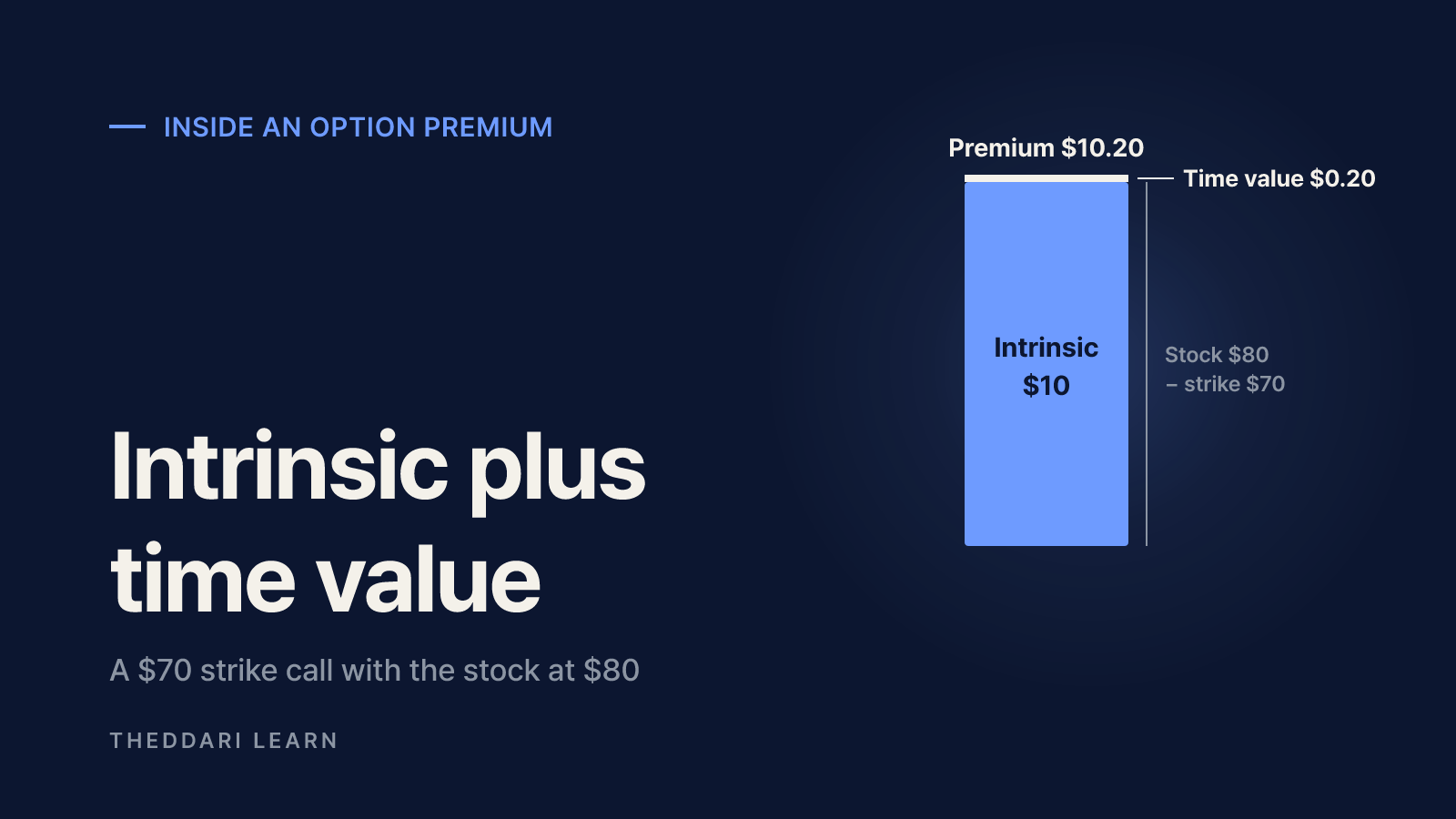
The OIC's pricing guide splits a premium into intrinsic value and time value (also called extrinsic value). Intrinsic value is what the option would be worth if exercised now, and only in-the-money options have it. Time value is everything above that, reflecting the chance of a favorable move before expiration.
The SEC example makes this concrete. With the stock at $68, an investor buys a 70-strike call for $2.20. Two weeks later the stock is at $80 and the same call trades at $10.20. Intrinsic value is $80 minus $70, or $10, leaving $0.20 of time value. Per contract, the position is worth $1,020, an $800 gain over the $220 paid, before commissions. Had the stock finished at $65 on expiration, the call would have expired worthless and the full $220 would be gone.
Stock rises
- Effect on calls
- Usually up
- Effect on puts
- Usually down
Stock falls
- Effect on calls
- Usually down
- Effect on puts
- Usually up
Less time to expiration
- Effect on calls
- Time value erodes
- Effect on puts
- Time value erodes
Implied volatility rises
- Effect on calls
- Usually up
- Effect on puts
- Usually up
Dividends and rates
- Effect on calls
- Smaller effect
- Effect on puts
- Smaller effect
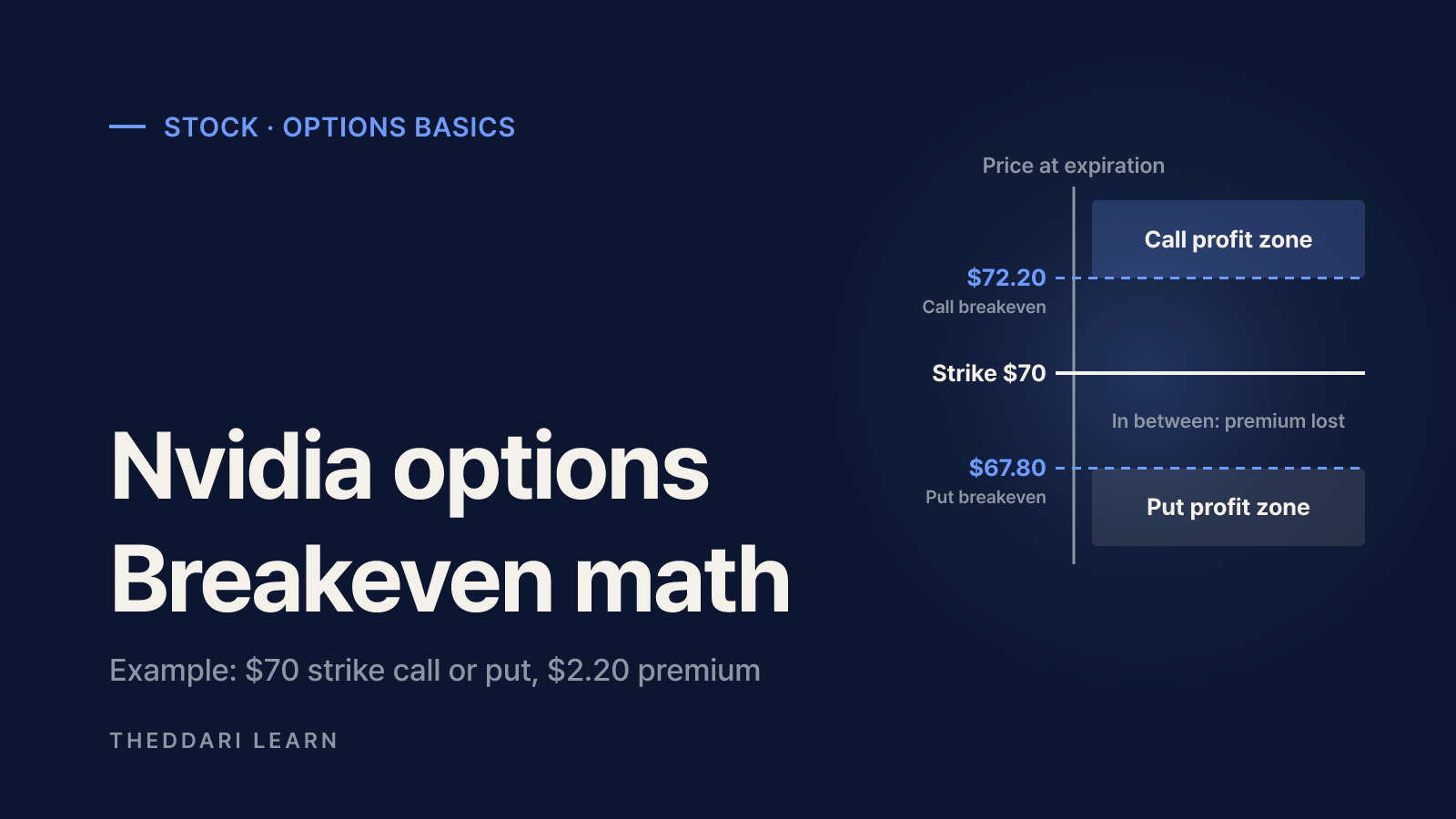
Always work out the breakeven. For the 70-strike call bought at $2.20, the stock must reach $72.20 at expiration to break even. For a 70-strike put bought at the same premium, the stock must fall to $67.80. Commissions, spreads and, for overseas investors, currency conversion push those levels further away.
Why options react so strongly to big stock moves
Nvidia shares can jump or slide sharply on earnings, leadership headlines or export-control news. On those days, three forces hit option prices at once. Direction comes first: calls generally gain and puts lose when the stock rises, and the reverse when it falls. Implied volatility comes second: the OIC explains that higher volatility estimates signal larger expected swings in either direction, which tends to raise premiums for calls and puts alike, most visibly at the money. Time is the third force, because time value erodes for both calls and puts as expiration approaches.
The volatility build-up and the post-event drop
Ahead of a major announcement, traders often price in a large move, so implied volatility climbs and both calls and puts get more expensive. Once the news is out and uncertainty fades, implied volatility can fall and time value can drain quickly. That is how a trader can be right about direction and still lose money: if the actual move is smaller than what the premium already assumed, the option may barely gain or even drop. Checking the earnings calendar shows when that kind of repricing is likely.

Leverage cuts both ways
In the SEC example, the stock rose about 18% from $68 to $80, yet the call went from $220 to $1,020. The same leverage works against a buyer when the stock stalls below the strike, and the whole premium can disappear within weeks. The SEC warns that extreme volatility near expiration can leave an option worthless. Market-wide events such as central bank decisions and jobs data also move implied volatility; the economic calendar lists those dates.
Rules for Korean investors trading US stock options
For Korean residents, US stock options count as overseas derivatives and sit outside a regular overseas stock account. Under investor protection measures from the Korea Financial Investment Association and the Financial Supervisory Service, retail investors who start trading overseas derivatives on or after December 15, 2025 must first complete at least 1 hour of pre-trading education and at least 3 hours of mock trading. Brokers may require more depending on age, risk profile and experience; one large broker sets 10 hours of each for investors aged 65 or older. Investors with derivatives trading experience before that date, or certain qualifications, may be exempt.
Brokers also differ on whether they offer US stock options at all, whether they support exercise, whether clients may sell options, and when they force-close positions near expiration. Read the broker's overseas derivatives disclosure before opening an account.
On tax, Korea's National Tax Service treats exchange-traded overseas derivatives as subject to capital gains tax regardless of the underlying. The statutory rate is 20%, with a temporary 10% rate in effect, and an annual deduction of 2.5 million won applies across domestic and overseas derivatives combined. Results are not netted against stock gains, losses do not carry forward, and amounts are converted to won at the settlement-date reference rate. Returns are filed in May of the following year, and local income tax is filed separately. Investors outside Korea should follow their own jurisdiction's rules.
Options risk checklist before you trade
- 1
Know which side you are on
Confirm whether you are buying or writing a call or put. Buyers risk the premium; some writers face open-ended losses and assignment.
- 2
Calculate breakeven and dates
Add or subtract the premium from the strike, note the expiration, and list any earnings dates in between. Include fees and conversion costs.
- 3
Check whether implied volatility is elevated
Right before a major event or just after a sharp move, the premium may already price in a big swing. Plan for time value to fall afterward.
- 4
Look at the quote and liquidity
Volume and bid-ask spreads vary by strike and expiration. A wide spread means a round trip costs more even if the stock does not move.
- 5
Read broker rules and tax obligations
Check training requirements, exercise support, forced-close times and how gains are reported in your jurisdiction.
Nvidia options can double or go nearly to zero on a single big day because direction, implied volatility and time decay act together. Before trading, write down your maximum loss, breakeven, expiration and the broker and tax rules that apply. If you follow how stock stories spread on Telegram, the stock trend page shows which tickers are drawing attention, but popularity says nothing about whether an option is fairly priced.
Frequently asked questions
Are Nvidia options American-style, and can I exercise them early?
Why did my call lose value even though Nvidia stock went up?
Is buying a put a good way to protect Nvidia shares in a crash?
Do Korean residents pay tax on US stock option gains?
Sources and references
- 1Investor.gov: An Introduction to Options – Investor Bulletin(opens in a new tab)www.investor.gov
- 2Options Industry Council: Options Pricing(opens in a new tab)www.optionseducation.org
- 3Korea Investment & Securities: Overseas derivatives training and mock trading notice (Korean)(opens in a new tab)securities.koreainvestment.com
- 4National Tax Service of Korea: Capital gains tax on derivatives (Korean)(opens in a new tab)www.nts.go.kr
Related articles
 Stocks
Real-Time US Stock Quotes for Free: Delayed vs Live Prices
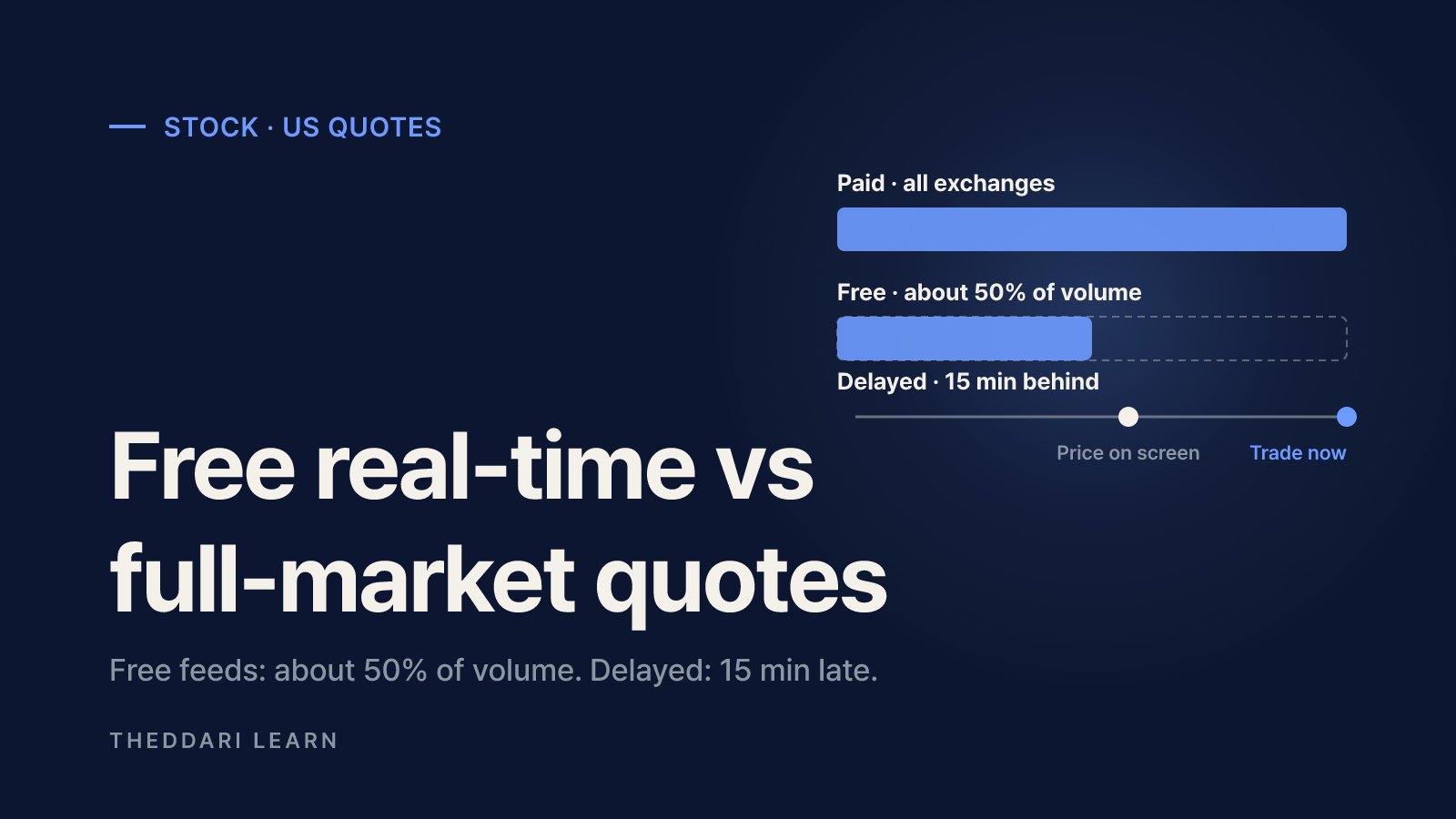
Free 'real-time' US stock prices usually come from Nasdaq venues plus FINRA-reported trades, not the whole market. Learn how to spot delayed quotes, read a site's delay table, and decide when paid full-market data is worth it.
 Stocks
AI PCB Stocks: Substrates vs Server Boards, Traps to Avoid
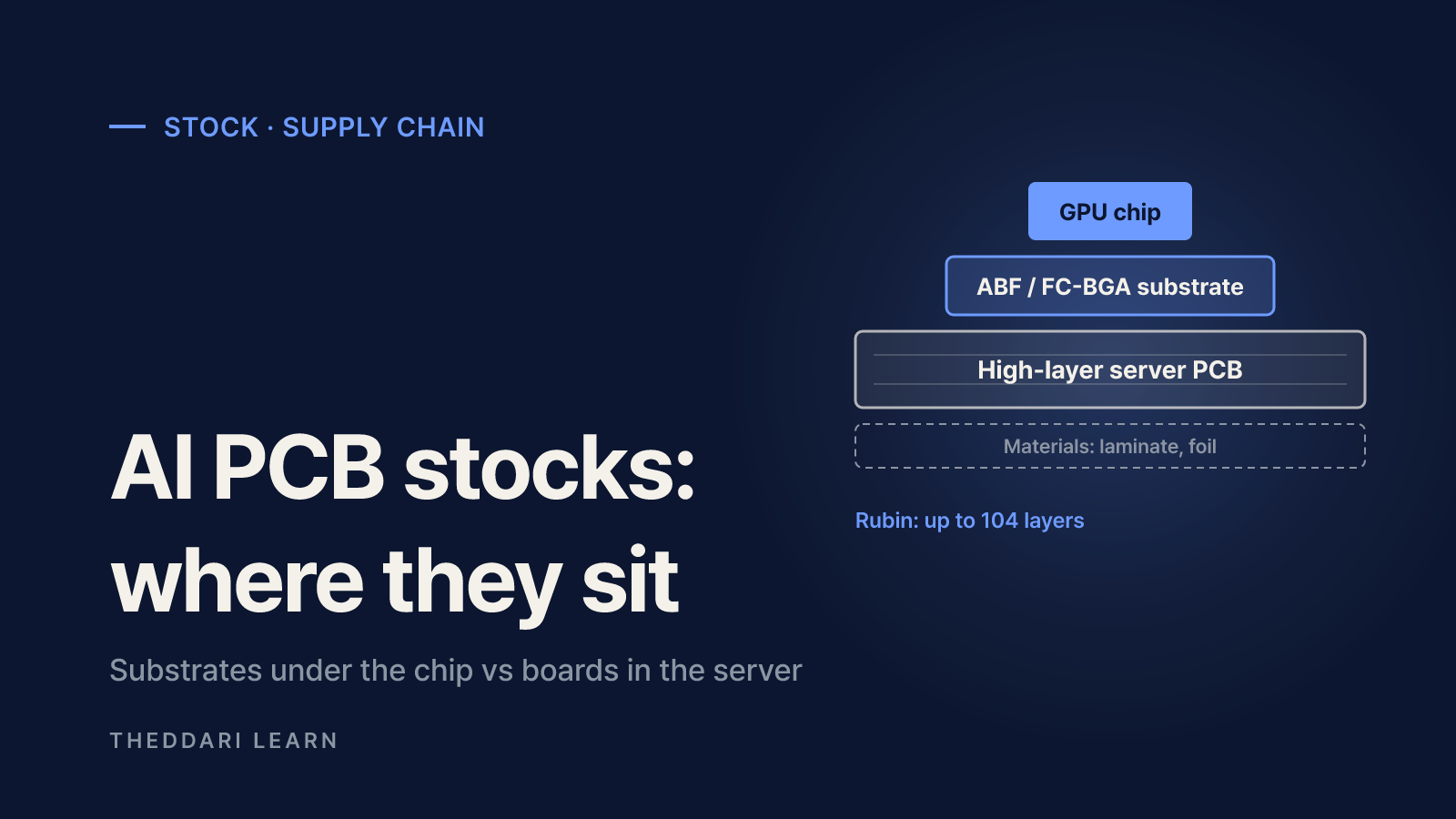
Not every circuit board company gets the same slice of AI server spending. Here is how the substrate and PCB supply chain breaks down, and the filings-based metrics that expose AI stock traps, as of November 2026.
 Stocks
Why the Anthropic IPO Didn't Stop the AI Stock Selloff
Anthropic raised $81bn in the largest IPO on record, yet the Nasdaq wiped out its 2026 gains the next day. Here is how a blockbuster listing and an AI selloff can happen at once.