Contents7 sections
- What an uncensored AI model and the heretic tag actually mean
- How refusals are removed: abliteration and Heretic
- How uncensored models differ from the original
- Risks to check before using fine-tuned model derivatives
- A checklist for vetting Hugging Face derivatives
- Frequently asked questions
- Sources and references
An uncensored AI model on Hugging Face is a community derivative of an existing model whose refusal behavior, the part of safety training that makes it say "I can't help with that", has been deliberately weakened or removed. Names ending in UNCENSORED, heretic or abliterated almost always mean someone downloaded open weights, edited them to refuse less and re-uploaded the result. As of November 2026 several of these models sit near the top of Hugging Face's trending list. This guide is based on the Heretic repository, a widely cited abliteration tutorial, a real trending model card and Hugging Face's own policy and security documentation, all read in November 2026.
The short answer: treat these models as experimental derivatives with the original safety layer stripped out, not as better or 'unlocked' versions. They can be useful for research, such as studying over-refusal, but plugging one straight into a work tool or a public product creates licensing, security and liability problems at the same time.
What an uncensored AI model and the heretic tag actually mean
Most chat models go through instruction tuning and safety training after pre-training, which teaches them to decline requests that look harmful. Labels such as uncensored or decensored are claims by the uploader that this tendency has been reduced. They are not an official Hugging Face category, so two models with the same word in their names can be built in very different ways and behave very differently.
Heretic is an open-source tool published by developer Philipp Emanuel Weidmann (GitHub user p-e-w). According to the Heretic repository, its default action is refusal suppression, done without expensive training by steering behavior with contrasting example prompts and scoring functions. The project is licensed under AGPL-3.0, had roughly 40,000 GitHub stars when checked in November 2026, and says the community has published thousands of models made with it. A -heretic suffix therefore usually means: refusals were reduced with this tool.
Abliterated, a blend of ablate and obliterate, refers to abliteration, a technique that erases the internal direction associated with refusing from the model's weights. Heretic includes this technique, which is why one repository often carries heretic, uncensored and abliterated tags together. Some trending names stack even more descriptors, such as merges, quantization formats and coding labels. The longer the name, the more carefully you should trace how many steps the file is from the original release.
Reading a trending model card
The xtools-at/DeepSeek-V4-Pro-Qwen3.5-9B-UNCENSORED-heretic model card is a good example. It states that the model is a decensored version of Jackrong/DeepSeek-V4-Pro-Qwen3.5-9B made with Heretic v2.0.0.dev0. Its model tree runs from Qwen3.5-9B-Base to Qwen3.5-9B, then an Unsloth copy, then Jackrong's fine-tune, then this model. Despite the DeepSeek name, these are not DeepSeek weights: the card explains that Qwen3.5-9B was distilled on reasoning traces generated by DeepSeek-V4-Pro. A name alone could easily suggest an uncensored copy of a much larger DeepSeek model.
How refusals are removed: abliteration and Heretic
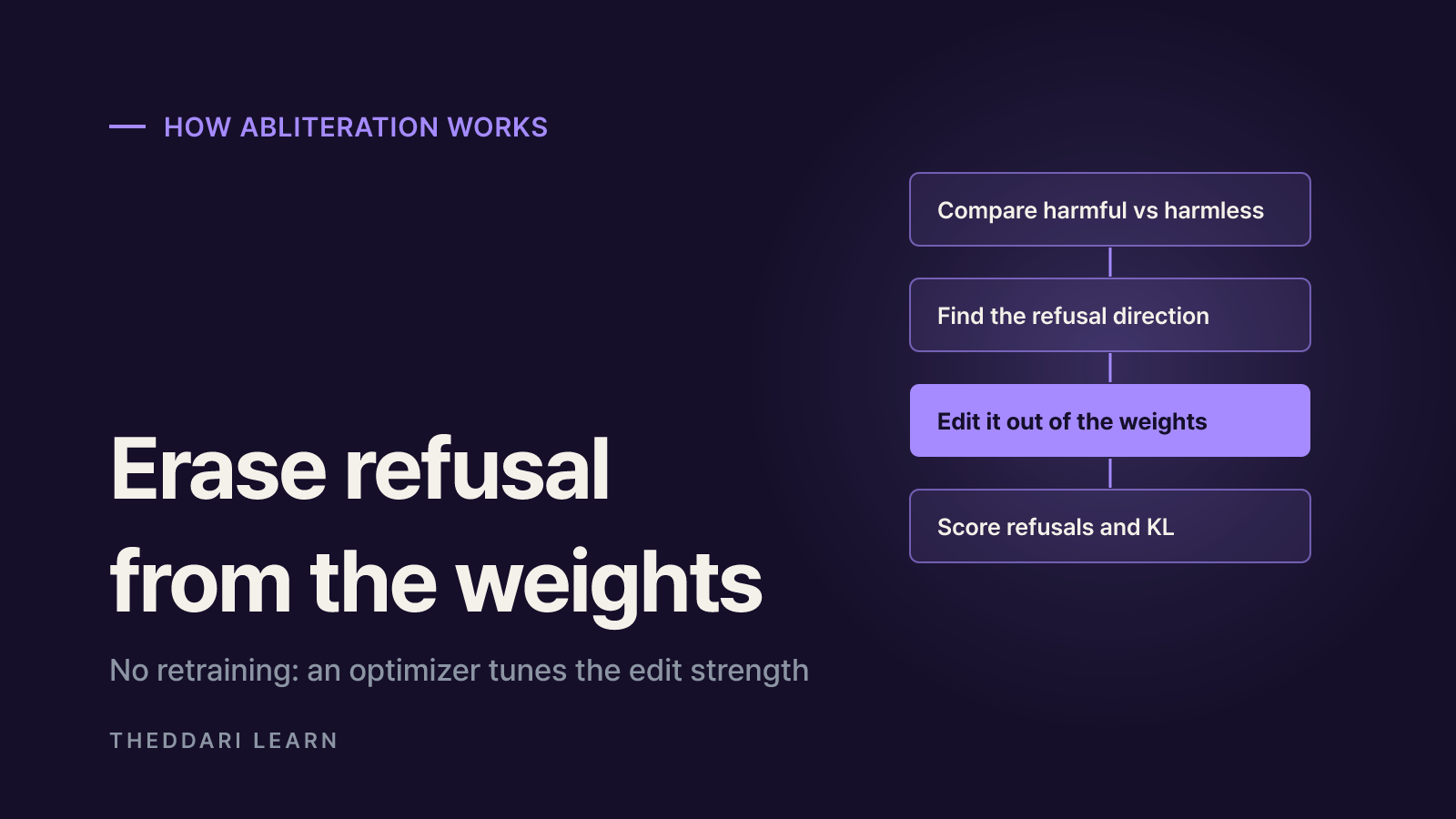
Abliteration builds on 2024 research by Arditi and colleagues, who reported that refusal in several open chat models is mediated by a single direction in the residual stream. Maxime Labonne's Hugging Face tutorial summarizes the recipe: run the model on harmful and harmless instructions, record activations, take the difference of the means as a refusal direction, then orthogonalize the weights so no layer can write along that direction. The model loses its ability to refuse. Adding the direction back does the opposite and makes the model refuse harmless requests.
Heretic automates the search. Its default modifier is Arbitrary-Rank Ablation, developed for the project, with classic directional ablation available as an option. An Optuna-based optimizer tries different parameter sets and, by default, scores each result on two things: refusal rate and KL divergence, a measure of how far the edited model's outputs drift from the original on harmless prompts. The goal is to minimize refusals while keeping everyday answers close to the original. The README says processing Qwen3-4B-Instruct-2507 on an RTX 3090 takes about 30 to 40 minutes, after which the user can save the model, upload it to Hugging Face, chat with it or run benchmarks. That low barrier explains how quickly derivatives multiply.
Heretic can also be configured to reduce sycophancy, humor or response length, and it can attach reproducibility files (a reproduce folder with a reproduce.json manifest) when uploading. Models that include this information are easier to audit. Models without it leave you with nothing but the uploader's description.
How uncensored models differ from the original
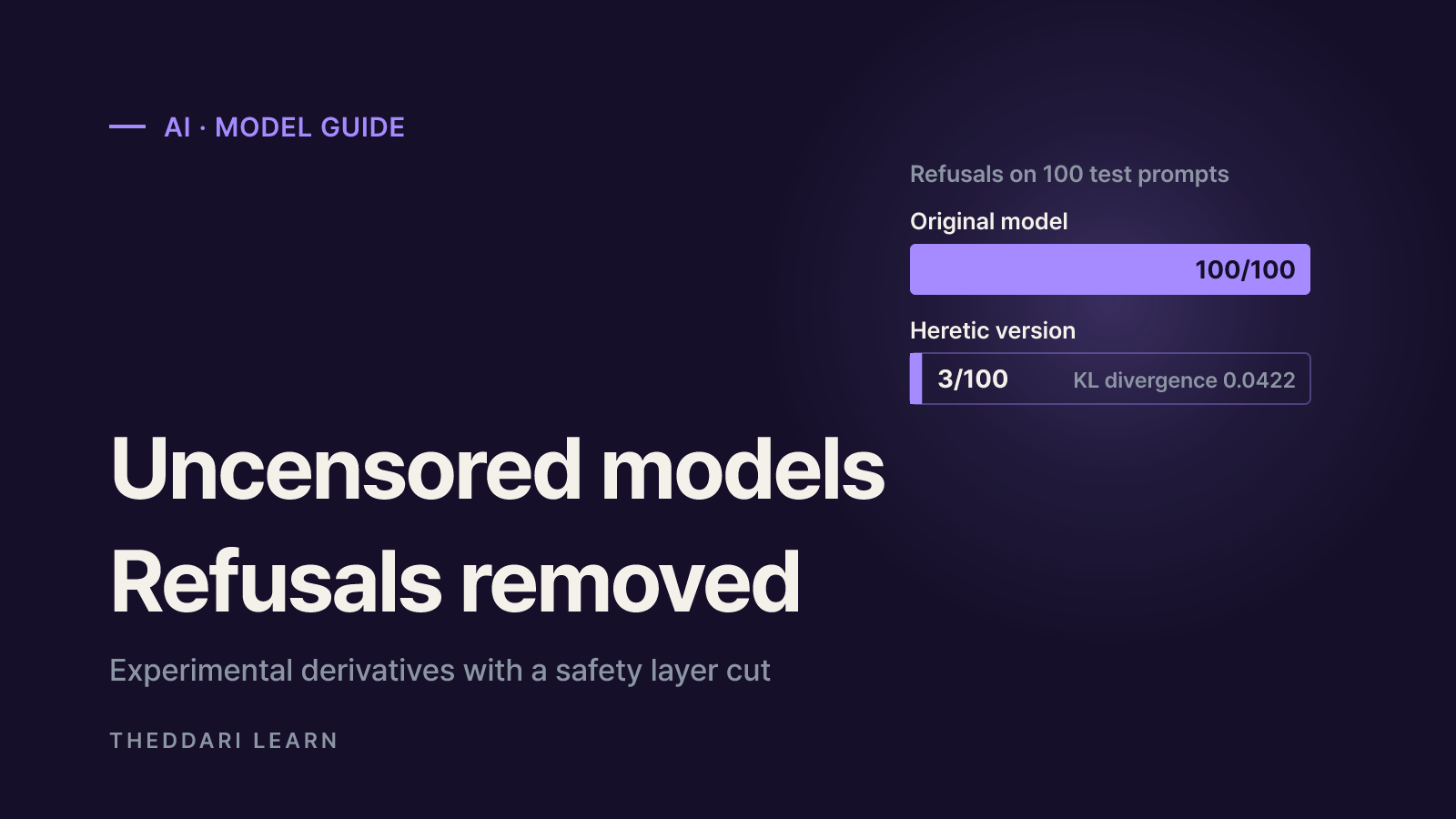
The example card shows the table Heretic generates automatically: refusals on 100 harmful prompts fell from 100/100 for the original to 3/100, with a KL divergence of 0.0422 versus the original. In other words, the uploader measured near-total refusal removal with little drift on normal prompts. That is a self-reported automated test, not a broad evaluation of accuracy or safety.
Refusals
- Original instruct model
- Trained to decline risky requests
- Uncensored or heretic derivative
- Weights edited to lower refusal rate
Knowledge and accuracy
- Original instruct model
- Baseline
- Uncensored or heretic derivative
- No new knowledge; may degrade
Who evaluated it
- Original instruct model
- Original developer's docs and evals
- Uncensored or heretic derivative
- Usually the individual uploader
License
- Original instruct model
- Upstream license
- Uncensored or heretic derivative
- Inherits upstream terms, whatever the card says
Updates and security notices
- Original instruct model
- Developer channels
- Uncensored or heretic derivative
- Irregular or none
Sensible use
- Original instruct model
- General work and product candidates
- Uncensored or heretic derivative
- Research and testing; production needs extra controls
Matching the original is the best case. In Labonne's experiment, the abliterated model dropped on every benchmark; extra DPO training recovered most of the loss, but GSM8K math did not improve. Heretic tries to limit damage by keeping KL divergence low, yet you still need to check whether a card's benchmark tables were measured on the derivative or copied from the parent. On the example card, the original model's distillation and benchmark sections follow the Heretic table, and its limitations section says the results are not a comprehensive capability or safety evaluation.
Fewer refusals also does not mean more honesty. Refusal counts are often based on matching phrases, so a model that dodges a topic or invents a confident answer may still be scored as compliant. A bolder-sounding answer is not evidence of a more accurate one.
Risks to check before using fine-tuned model derivatives
License terms follow the derivative
A permissive tag such as apache-2.0 on a derivative does not cancel upstream terms. The Gemma Prohibited Use Policy, last modified February 21, 2024, forbids using Gemma or Model Derivatives for attempts to override or circumvent safety filters. Deploying a Gemma-based uncensored model could therefore conflict with Google's terms. Even where the base license is permissive, using outputs to facilitate crimes or infringe rights carries legal exposure under the laws where you operate.
Being on the Hub is not an endorsement
Hugging Face's Content Policy, effective April 10, 2025, lists content promoting high-risk illegal activities such as weapons development, and content designed to generate malicious code, as restricted. Reported repositories are reviewed case by case, with possible unranking, a Not For All Audiences tag, disabled access or account suspension. The same page notes that trending is influenced by likes over the past few days, so a trending slot reflects attention, not a safety review.
The files themselves can be a security risk
Hugging Face's pickle scanning documentation warns that loading pickle files, the default PyTorch format, can enable arbitrary code execution. It recommends loading models from users and organizations you trust and considering safer formats such as safetensors, and it states that the Hub scanner is not 100% foolproof. Uncensored models are not inherently malicious, but you are still running files from an unverified uploader on your machine.
Do not connect an uncensored model directly to a customer chatbot, an internal agent with tool access or an automated pipeline. Without the original refusal layer, prompt injection and abusive requests are not filtered at the model level, and the operator remains responsible for outputs.
When a new derivative trends, community chatter usually arrives before careful evaluation. theddari's AI Telegram trends and blog trends pages can help you see which models people are discussing and why, but popularity is not verification. Use the checklist below on the primary sources.
 theddari.comTrendsBlog PostsSummarized Naver blog posts
A checklist for vetting Hugging Face derivatives
- 1
Trace the base model
Open the model tree and count the steps from the base model to the file you are considering. Confirm whether a famous name in the title refers to the actual weights or only to a source of training data.
- 2
Identify the method and reproducibility
Find out whether the uploader used Heretic, abliteration, further fine-tuning or merging, and whether the tool version and parameters are published. For Heretic models, look for a reproduce folder. Drop undocumented models from production shortlists.
- 3
Read the license chain
Read the derivative's license and the upstream developer's license and acceptable use policy. Check clauses on safety-filter circumvention, commercial use and restricted domains with your legal team.
- 4
Separate the numbers
Refusal counts and KL divergence only show how much refusal was suppressed. Confirm whether benchmarks were re-run on the derivative, then test on your own task data.
- 5
Control files and runtime
Prefer safetensors. If a repository ships pickle files, check the Hub's import scan for flagged items. Run first tests in an isolated environment with limited network access and permissions.
- 6
Add safety outside the model
If you proceed, add input and output moderation, least-privilege tool access, human approval for sensitive actions and audit logging. If your real problem is over-refusal, try adjusting the original model's system prompt or official settings first.
Uncensored and heretic models show how easily refusal training in open-weight models can be changed after release. They are worth studying, but the UNCENSORED label is better read as a warning that a safety layer was removed than as a quality badge. If you cannot confirm the base model, the method, the license chain and the file format, the model is not ready for work use.