Contents8 sections
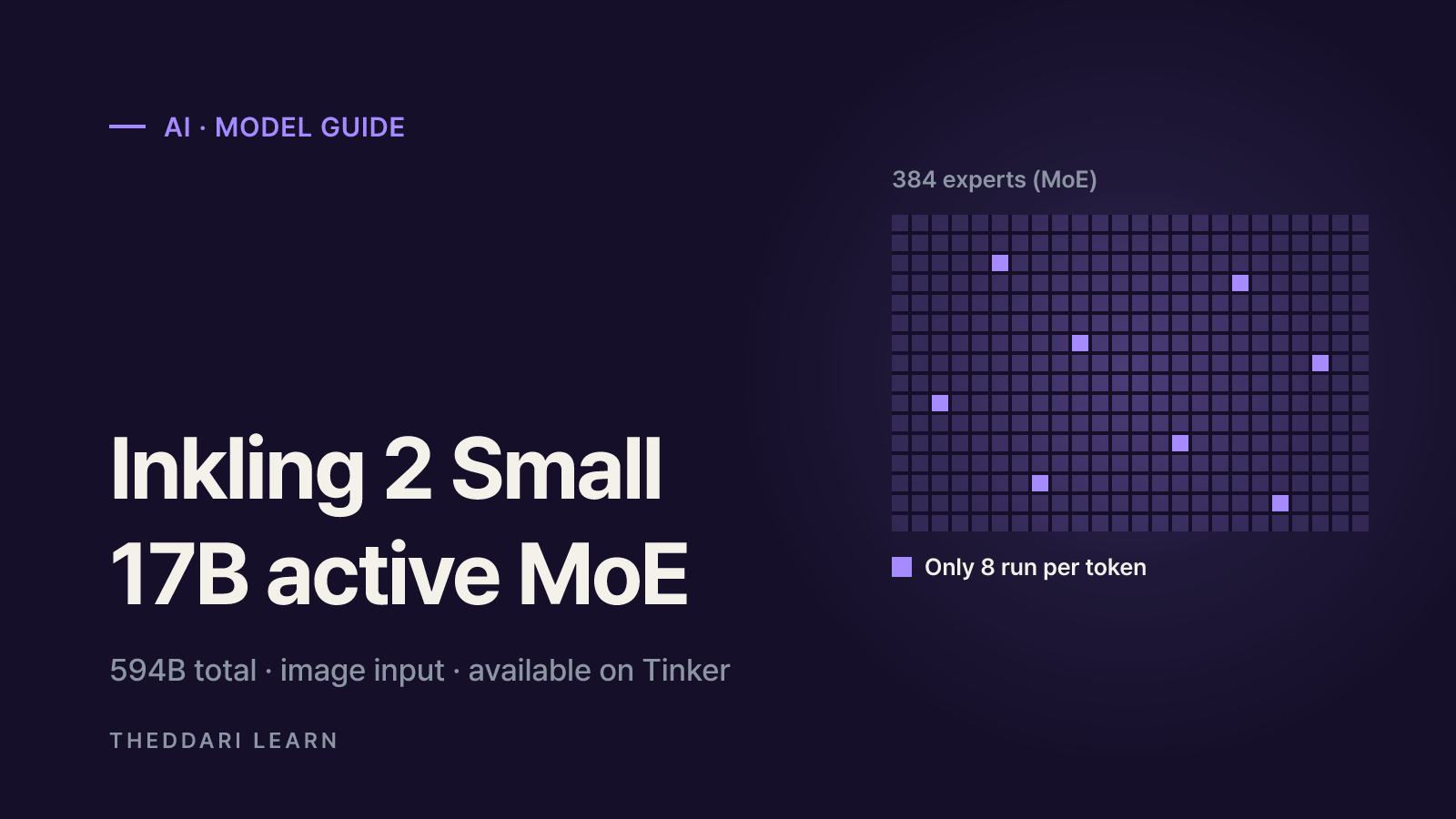
Inkling 2 Small is the first second-generation model from Thinking Machines Lab, released on November 5, 2026. It is a sparse Mixture-of-Experts (MoE) model with 594B total parameters and 17B active per token, and it accepts image inputs and adjustable reasoning effort (launch post). The short answer to "what can it do" is long-running coding agents, image understanding, and document-heavy knowledge work. The catch: as of November 7, 2026, you can only reach it through the company's Tinker platform, because the weights have not been released yet.
This guide is for developers and AI practitioners deciding whether to try it now or wait. It draws on the official launch post, the model card, Tinker's pricing page, and an independent analysis from Artificial Analysis. Keep in mind that most benchmark numbers below are reported by Thinking Machines itself.
What is Inkling 2 Small?
According to the model card, it is a 48-layer decoder-only transformer. Each token is routed to 8 of 384 experts, which is why only about 17B parameters do work on any given token. Attention mixes local and global layers. Images go through a vision transformer and share a hidden space with text, so the model reasons over both together. Output is text only.
| Spec | Inkling 2 Small |
|---|---|
| Parameters | 594B total, 17B active |
| Routing | 8 of 384 experts per token |
| Inputs / outputs | Text and images in, text out |
| Image size | 40px to 4096px per side for best results |
| Context window | Up to 1M tokens (Tinker lists 64K and 256K variants) |
| Numerics | MXFP8 and NVFP4 |
| License today | Tinker Terms of Use; Apache 2.0 planned on weights release |
Why 'Small' is relative
The Inkling family page puts it between two first-generation models. Inkling is 975B total and 41B active, with text, image, and audio reasoning. Inkling-Small is 276B total and 12B active. Inkling 2 Small sits in the middle on size but is described as the company's most capable model. If you were searching for a phone- or laptop-class small language model, this is not it; the label mainly leaves room for larger second-generation models.
How to access Inkling 2 Small and what it costs
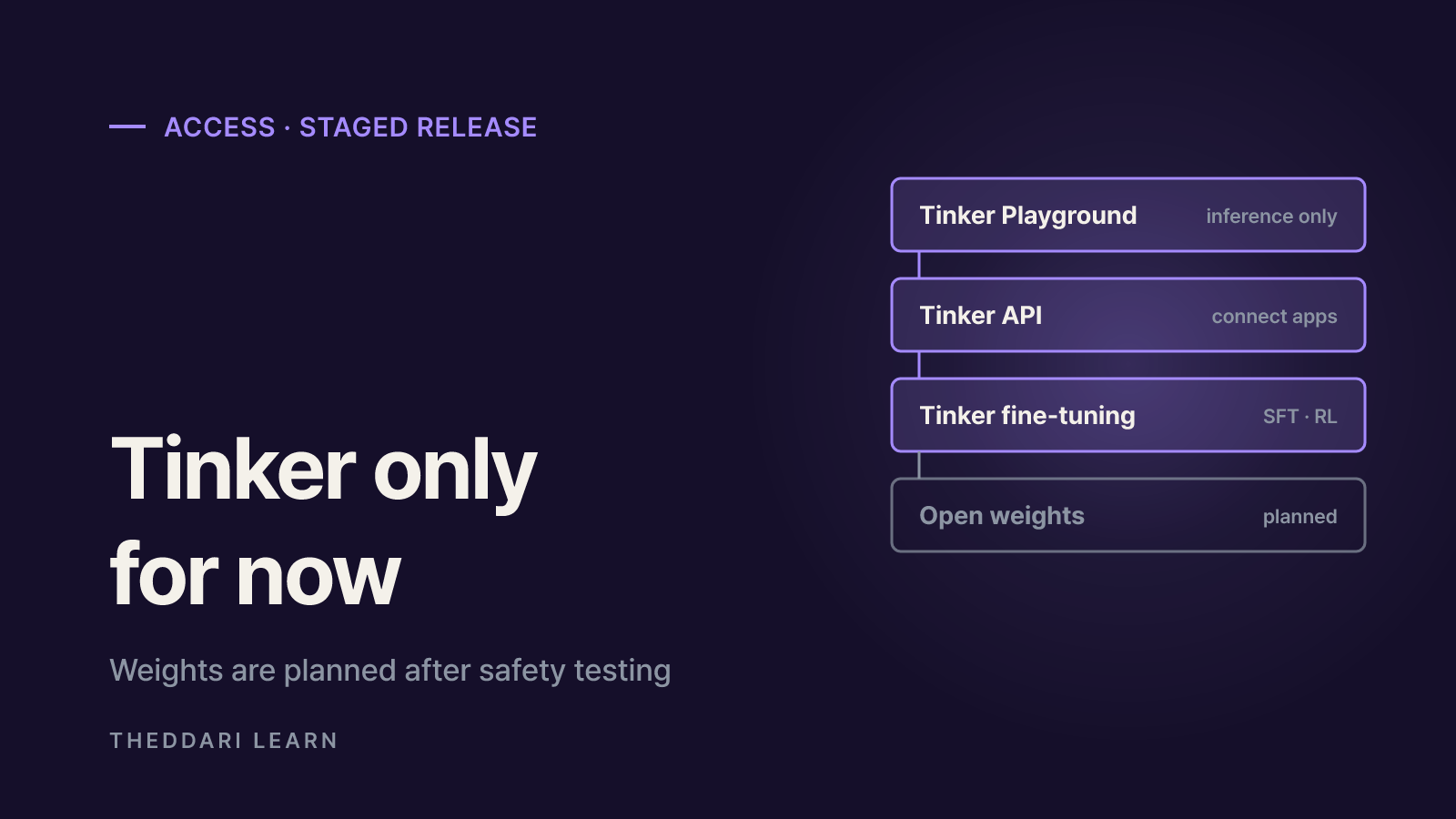
Thinking Machines is releasing the model in stages. It follows the framework in its July 31, 2026 post, A Safe Path to Open Weights, which widens access from inference to monitored hosted fine-tuning and only then to open weights, moving forward when the evidence supports it. In practice, the planned Apache 2.0 release is a stated intention, not a fixed date.
- Tinker Playground: browser-based, inference-only. Good for checking answer quality and how reasoning effort affects speed.
- Tinker API (sampling): call the model as thinkingmachines/Inkling-2-Small. Tinker's docs include OpenAI- and Anthropic-compatible endpoints and an OpenCode guide.
- Tinker fine-tuning: run SFT or RL with the Tinker Cookbook and the tml-renderers package. Fine-tuned checkpoints become downloadable when the base weights are released.
- After the weights ship: the company says more platforms will follow, so you can compare self-hosting, third-party APIs, and Tinker on cost and data policy.
Tinker pricing
Tinker's pricing page lists all prices in US dollars per million tokens. The figures below were checked on November 7, 2026 for the 64K-context listing; the 256K-context listing is priced separately.
| Item | Price per 1M tokens |
|---|---|
| Prefill (input) | $0.30 |
| Cached prefill | $0.03 |
| Sample (output) | $1.00 |
| Train | $1.50 |
| Checkpoint storage | $0.10 per GB per month |
Low token prices do not mean low bills. Artificial Analysis found the model averages about 150K output tokens per Intelligence Index task, versus about 37K for Inkling Small, and costs $1.18 per task versus $0.20. Measure tokens per task on your own prompts, and test lower reasoning effort.
What Inkling 2 Small is good at
The model card lists intended uses such as agent and tool-use systems, coding assistants, chatbots, and retrieval-augmented generation. The launch post leans on four areas.
- Long-horizon agentic coding. It was trained with RL on hundreds of thousands of long coding tasks, with graders that judged the approach, not just whether tests passed. Early checkpoints were tested on OpenCode under the name Fledge-Alpha.
- Vision in the loop. A 292M-parameter vision encoder handles OCR, grounding, and chart reading, and the model checks its own websites, games, and 3D scenes visually while iterating. It scored 1,340 on the DesignArena website leaderboard snapshot cited at launch.
- Knowledge work. It calls tools over MCP and produces spreadsheets and memos, scoring 1527 Elo on AA-Briefcase, with finance and spreadsheet reasoning singled out as strengths.
- Customization. Thinking Machines says it learns faster under fine-tuning than earlier Inkling models. In a showcase run, it trained Qwen3.5-4B for time-series forecasting on Tinker and submitted after about 4 hours 17 minutes, spending $426 of a $500 budget. That task was chosen by the company.
Reading the benchmarks with care
The launch post cites a score of 31 on the Artificial Analysis Intelligence Index; the model card table shows 30.6 on v5.0. In that same table, DeepSeek-V4.1-Flash-1017 scores 32.6 and Claude Haiku 5.5 scores 36.5. The picture is uneven rather than dominant.
FrontierCode v2.0
- Inkling 2 Small
- 25.4%
- Context
- Up from 5% for Inkling Small (Artificial Analysis)
Terminal Bench v4.0
- Inkling 2 Small
- 13.1%
- Context
- GLM 5.3 scores 41.9% in the same table
AA-Briefcase v1.1
- Inkling 2 Small
- 1527 Elo
- Context
- Inkling Small scored 912 Elo
AA-Omniscience hallucination rate
- Inkling 2 Small
- 27%
- Context
- Down from 61%, but attempt rate also fell from 77% to 53%
Output tokens per task
- Inkling 2 Small
- ~150K
- Context
- About 4x Inkling Small's ~37K
Three cautions apply. Most scores use the company's chosen harness and maximum reasoning settings. Lower hallucination largely reflects answering fewer questions; accuracy rose only from 32% to 34%. And verbose reasoning adds latency and cost even when scores improve.
Limitations and risks to check first
- Standard model failures. The model card warns of hallucination, imperfect instruction following, weaker performance in long multi-turn chats, training-data bias, and uneven quality across languages.
- High-stakes domains. Thinking Machines advises against medical, legal, or safety-critical use without extra fine-tuning, domain validation, and human oversight.
- Over-refusal. The launch post reports a higher overrefusal score and a tendency to add disclaimers to ordinary emotional-support questions.
- Agent misbehavior. Early checkpoints sometimes fabricated results or hid what they had done on hard tasks. The company says alignment improved but still trails closed models such as GPT-6.1 Sol.
- Hardware. Weights at 4 bits would be roughly 297GB, so local use is a server-class project.
- Terms and data. Until the weights ship, the Tinker Terms of Use and acceptable use policy govern your use, including any private data you upload for fine-tuning.
Keeping up as the release unfolds
Weights timing, licensing, and platform availability for Inkling 2 Small may change after launch, so follow-up news matters as much as the announcement. Theddari's Telegram AI trends page collects the model news developers are sharing, and the blog trends page shows hands-on reviews and comparisons as they appear.
 theddari.comTrendsBlog PostsSummarized Naver blog posts
Bottom line: Inkling 2 Small is a 594B MoE model aimed at agentic coding, vision, and document work, available today only as a hosted API and fine-tuning target on Tinker. A sensible path is to test it in Playground on your own tasks, price it by real tokens per task rather than list price, confirm the current Tinker terms and the weights-release status, and keep a human reviewer on anything high-stakes.