Tencent Hy4-flash: Specs, API Cost, and Local Setup
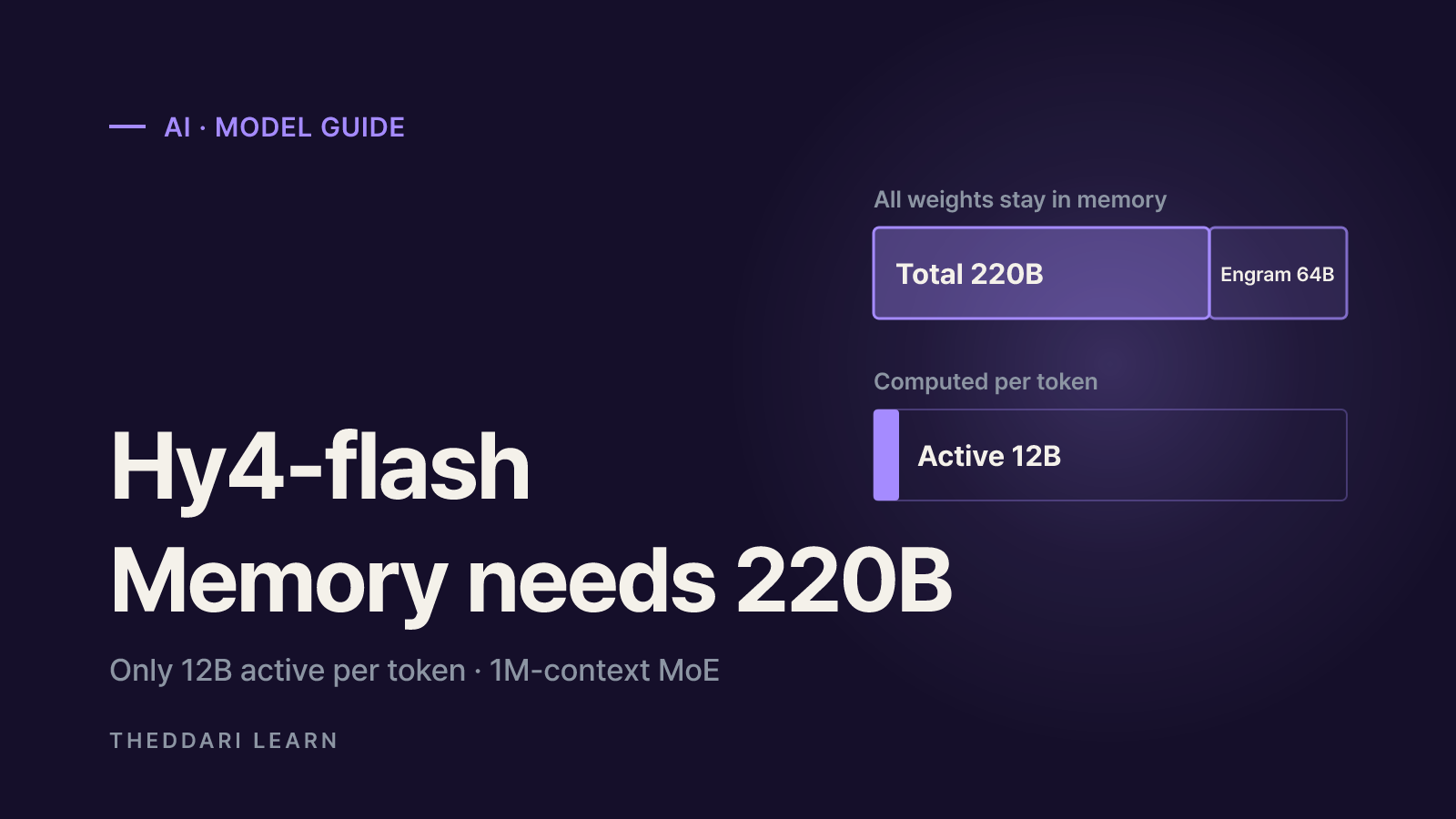
Tencent Hy4-flash is a 220B-total, 12B-active MoE model with 1M context. See API pricing, GGUF sizes, GPU needs, and the Tencent Hy License terms.
Contents8 sections
Key takeaways
- Tencent Hy4-flash is an open-weight multimodal mixture-of-experts model: 220B total parameters, about 12B active per token, text and image input, and up to 1M tokens of context.
- Its headline results (WorkIndex 42.1, blind-test satisfaction 2.79/4) come from Tencent's own benchmark and internal users, so treat them as claims to verify.
- On OpenRouter, the Tencent Cloud provider lists $0.035 per million input tokens and $0.1405 per million output tokens as of November 20, 2026.
- Running it locally is a big-iron job: the smallest official GGUF is 125.73 GiB, and llama.cpp support still lives in an unmerged pull request.
- The Tencent Hy License is Apache 2.0-based but requires a separate agreement for model-as-a-service providers above $50M revenue or products above 100M monthly users.
Tencent Hy4-flash is an open-weight multimodal model from Tencent's Hy team (the group formerly branded Hunyuan). According to the official model card, it has 220B total parameters but activates only about 12B per token, takes text and images as input, produces text, and supports a context window of up to 1M tokens. As of November 20, 2026, the repository had 479 likes and was drawing a lot of attention on Hugging Face.
The short answer for most people: try it through an API first. Despite the "flash" name and the small active-parameter count, local inference starts at roughly 128GB of memory, and the tooling is still pre-release. If you plan to build a commercial product on it, read Section 10 of the license before anything else. Everything below is based on the model card, license, OpenRouter listing, GGUF repository, and vLLM recipe as checked on November 20, 2026.
What is Tencent Hy4-flash? Architecture and key specs
Tencent calls Hy4-flash its most cost-effective Hy model to date. Three checkpoints were released together: the instruction-tuned Hy4 flash, an FP8-quantized Hy4 flash-FP8, and a pre-trained Hy4 flash-base. The base model is not a chat model, so pick the instruct or FP8 version for assistants and agents.
Total parameters
- Official value
- 220B (incl. 64B Engram)
- Why it matters
- Drives download size and memory
Active per token
- Official value
- 11.3B text + 0.43B vision
- Why it matters
- Closer to compute cost and speed
Backbone
- Official value
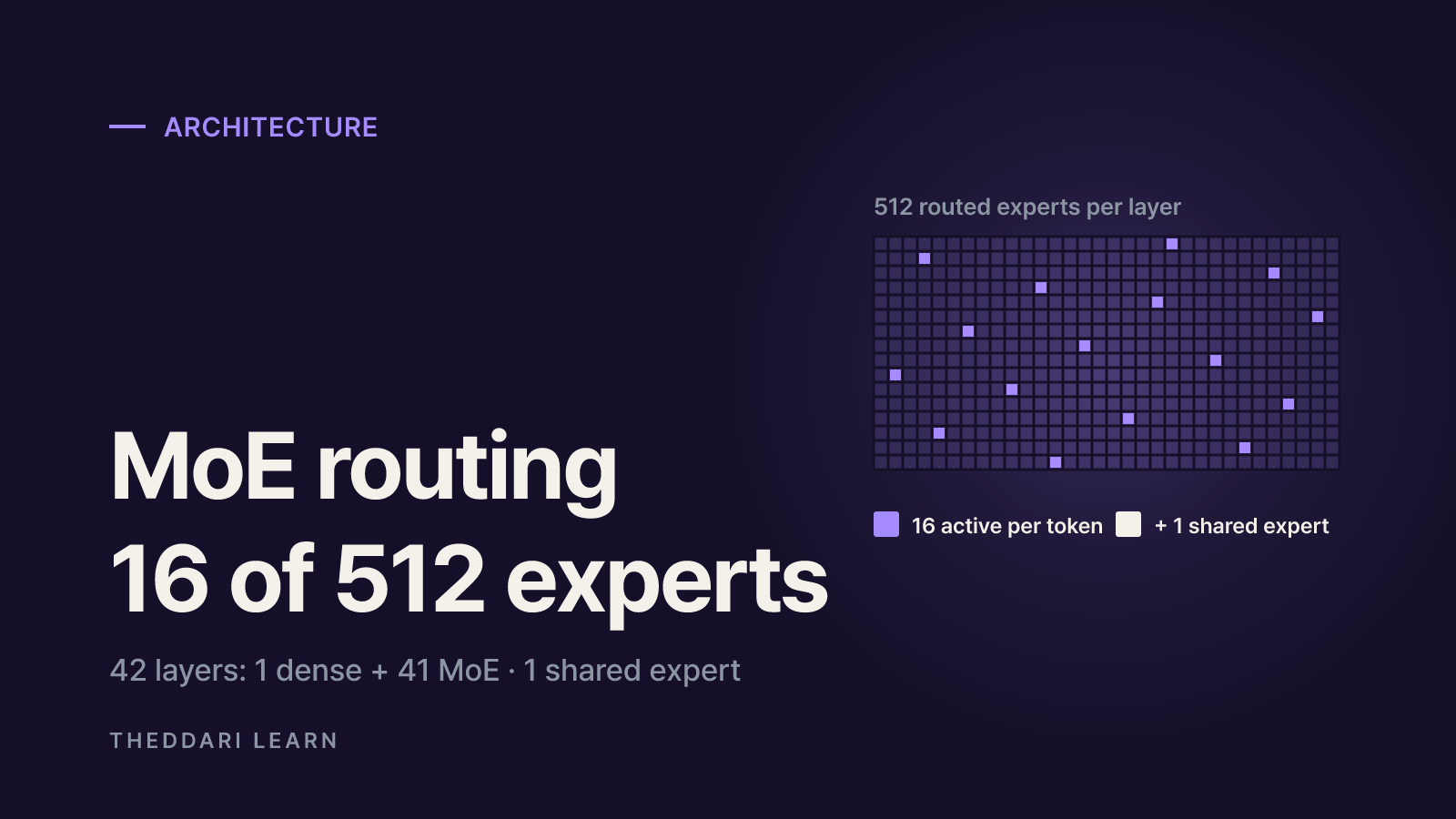
- 42 layers: 1 dense + 41 MoE
- Why it matters
- 16 of 512 routed experts + 1 shared per token
Context
- Official value
- 1M (1,048,576 tokens)
- Why it matters
- Serving configs set a much smaller default
Modalities
- Official value
- Text + image in, text out
- Why it matters
- Video is off in the vLLM recipe defaults
Reasoning
- Official value
- reasoning_effort high (default) or no_think
- Why it matters
- no_think skips the thinking phase
Where the efficiency comes from
- Hybrid attention. Sparse attention and sliding-window attention are interleaved 1:3. Tencent says this shrinks the KV cache to 1/24 of Hy3 and 1/6 of Hy4.
- LatentMoE. Routed experts compute in a lower-dimensional latent space.
- Engram n-gram embeddings. A 63.5B-parameter table of learned bigram and trigram representations, looked up by hashing. It inflates the parameter count, but vLLM offloads it to host RAM by default.
A built-in 0.85B drafter called DFly2 handles speculative decoding by reusing the main model's KV cache. Tencent reports decoding above 150 tokens per second when combining megakernels, 4-bit quantization, and DFly2 on its own serving stack. Do not expect that number on a workstation.
How to read the official benchmark and cost claims
Most of the headline numbers are Tencent-run evaluations. They are useful for direction, not as independent proof.
WorkIndex 42.1 (Hy4 preview 39.7, Hy4 51.4)
- Basis
- Internal benchmark, 8 task sets
- Caveat
- Built around WorkBuddy office tasks: slides, docs, spreadsheets
Cost per task 1/13 of Hy4 preview, 1/20 of Hy4
- Basis
- Same WorkIndex tasks
- Caveat
- The 1/8 vs DeepSeek-V4.1-Flash-1017 figure uses Max-tier, peak-hour pricing
Blind test 2.79/4 vs Claude Haiku 5.5 at 2.81/4
- Basis
- 85 internal users, 259 tasks
- Caveat
- Median 6.7 minutes and RMB 0.26 per task
MMLU 88.7 and other base scores
- Basis
- Few-shot on the base model
- Caveat
- Tencent notes format failures may distort these scores
The pitch is "close to a small frontier model, for much less money," not "best model available." Tencent itself recommends Hy4-flash for deep search, document processing, slide creation, simple frontend demos, and computer use, and points people to the larger Hy4 for long-horizon software engineering. Because the blind testers were Tencent employees working on Tencent product tasks, rerun the comparison on your own prompts and check independent leaderboards before switching.
New open models trend and fade quickly. The theddari AI Telegram trends page shows which models developers keep talking about after launch day, which helps separate hype from sustained interest.
Using Hy4-flash through an API
Hosted: OpenRouter
The OpenRouter listing shows Tencent Cloud as the provider at $0.035 per million input tokens and $0.1405 per million output tokens as of November 20, 2026, with one additional price line on the full table. Call it with the model ID tencent/hy4-flash on the standard Chat Completions endpoint; it accepts tools, reasoning, response_format, and streaming.
- A single provider means no failover if Tencent Cloud has an outage.
- OpenRouter says the model is not available through EU in-region routing, which matters for teams with data-residency requirements.
- Check the provider's own data retention and processing-location terms before sending customer data.
Self-hosted: vLLM or SGLang
Tencent recommends vLLM or SGLang for production. Both expose an OpenAI-compatible /v1 endpoint. The model card suggests temperature 0.9 and top_p 1.0, and passing reasoning_effort: no_think through chat template kwargs for direct replies. The vLLM recipe notes that no released vLLM wheel supports the architecture yet, so you need the dedicated vllm/vllm-openai:hy4-flash Docker image. Transformers support likewise requires installing from a specific pull-request commit.
Local hardware requirements
Twelve billion active parameters does not mean it runs like a 12B model. A mixture-of-experts model only computes with a few experts per token, but every expert's weights still have to sit in memory. Plan around the 220B total.
vLLM BF16
- Size (official)
- 440.5 GB download, 529 GB VRAM hint
- Notes
- 8-way tensor parallel on H100/H200/B200-class GPUs
vLLM FP8
- Size (official)
- 287.1 GB download, 345 GB VRAM hint
- Notes
- Hopper or Blackwell data-center GPUs
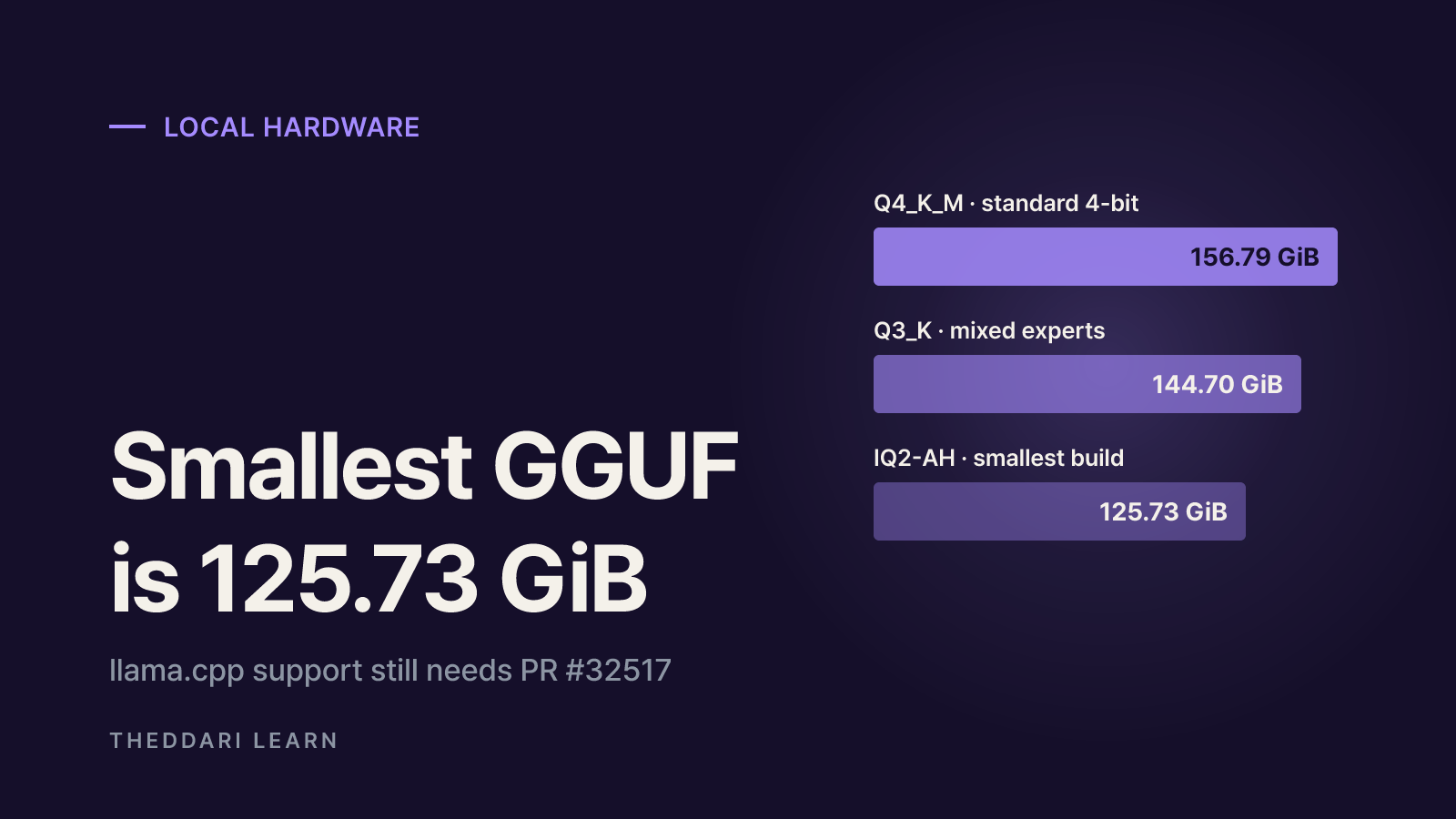
GGUF Q4_K_M
- Size (official)
- 156.79 GiB
- Notes
- Standard 4-bit, the default pick
GGUF Q3_K
- Size (official)
- 144.70 GiB
- Notes
- Mixed Q3/Q4 experts
GGUF IQ2-AH
- Size (official)
- 125.73 GiB
- Notes
- Smallest of the five builds
The vLLM VRAM hints are simply download size times 1.2, a conservative estimate; offloading the Engram table to CPU memory lowers real GPU usage but raises your host-RAM needs. AMD Instinct is not supported yet, and data parallelism, pipeline parallelism, and LoRA serving are listed as unsupported. The recipe starts with an 8,192-token context and four concurrent sequences, so using anything near 1M tokens needs far more memory.
GGUF on a workstation
Tencent's AngelSlim team published Hy4-flash-GGUF with five builds. On a Mac M5 Max with 128GB, they report about 48 tokens per second of decoding for Q4_K_M at 4K context, measured on WorkBuddy tasks. Since that file is larger than 128GB, follow their Mac-specific README rather than default settings. llama.cpp support is in PR #32517, which was not merged at the time of checking, so you must build that branch yourself. The main model card describes the GGUF as provided for end-to-end testing. One-click Ollama or LM Studio links may appear on the page but can fail until an official llama.cpp release adds the architecture.
Licensing: can you use it commercially?
Hy4-flash ships under the Tencent Hy License 1.0. It is derived from Apache 2.0 but is not Apache 2.0. The grant is worldwide and royalty-free, and the key difference is Section 10, which adds commercial terms for large model-as-a-service businesses.
- 1
Are you a MaaS provider?
MaaS means giving third parties remote access to model inference or fine-tuning, for example through an API, where they submit their own inputs, parameters, or training data. End-user products with model capabilities confined to specific features, and services that just relay requests to an independent third-party model service, are excluded.
- 2
Check the size thresholds
A MaaS business needs a separate written license from Tencent if its worldwide gross revenue exceeded $50 million in any consecutive 12-month period (from any source, not just this model), or before using the model in a product with more than 100 million monthly active users.
- 3
Check the internal-use exception
Purely internal use is exempt, as long as neither the model, derivatives, nor their outputs are made available to third parties.
- 4
Check redistribution rules
Fine-tuned, quantized, distilled, merged, or pruned weights count as derivative works. Redistribution must include the license and change notices, and you cannot add terms that remove or limit Section 10.
For most startups and internal tools, that means you can proceed. Large companies selling general-purpose model access are the main group that needs to contact Tencent at [email protected].
A practical checklist before you adopt it
- Match the task. Everyday document, search, and slide work fits Tencent's own recommendation; long agentic coding sessions are where Tencent points to Hy4 instead.
- Pilot via API. Run 20 to 30 of your real prompts on OpenRouter, logging quality, latency, and token use in both high and no_think modes.
- Look for independent evaluations. Weigh third-party leaderboards and community tests alongside Tencent's internal numbers.
- Map the data path. For hosted use, confirm provider location and logging. For self-hosting, confirm GPU type, host RAM, and framework versions.
- Document the license call. Write down whether you expose general-purpose model access and whether you cross the revenue or user thresholds.
- Pin versions. The llama.cpp branch, Transformers commit, and Docker image are all pre-release, so record exactly what you deployed.

Tencent Hy4-flash makes a clear bet on cheap, good-enough performance: 220B total parameters, about 12B active, 1M context, and very low hosted pricing. The trade-offs are that its strongest evidence is self-reported, local tooling is still unmerged, and large MaaS operators face extra licensing terms. Start small through an API, verify quality on your own work, and confirm the license position before scaling up.
Frequently asked questions
Is Hy4-flash free for commercial use?
Can I run Hy4-flash on a Mac or a single gaming GPU?
How is Hy4-flash different from Hy4?
Does Hy4-flash use an OpenAI-compatible API?
Sources and references
- 1tencent/Hy4-flash model card (Hugging Face)(opens in a new tab)huggingface.co
- 2Tencent Hy License 1.0 full text (Hugging Face)(opens in a new tab)huggingface.co
- 3OpenRouter: Tencent Hy4 flash(opens in a new tab)openrouter.ai
- 4AngelSlim/Hy4-flash-GGUF model card(opens in a new tab)huggingface.co
- 5vLLM Recipes: tencent/Hy4-flash(opens in a new tab)recipes.vllm.ai
Related articles
 AI
Haru-4B Explained: Full-Duplex Voice Model and Local Setup
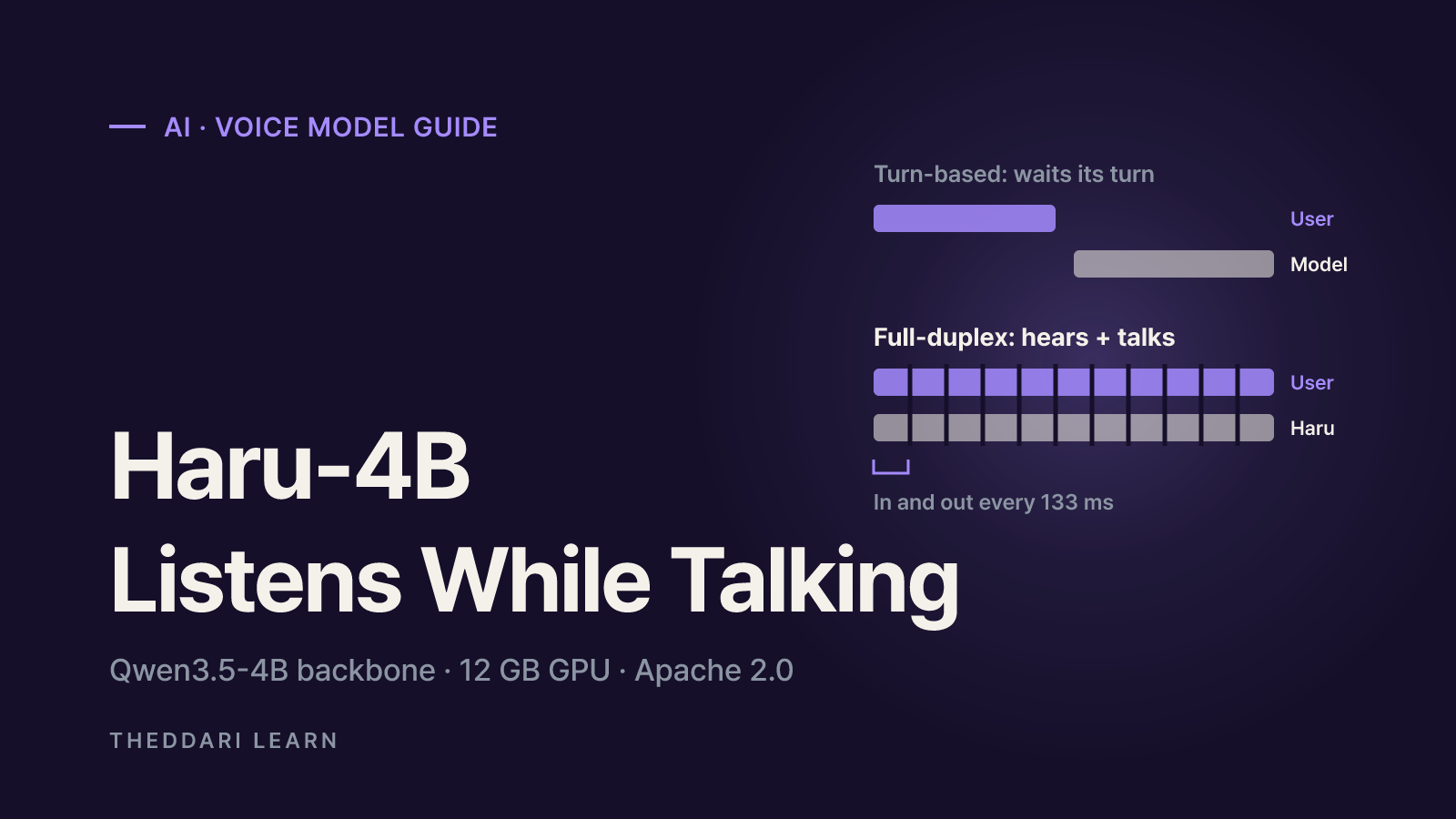
Haru-4B, the top trending model on Hugging Face, is not a small text chatbot. It is an open speech-to-speech base model that listens and speaks at the same time. Here is how it works, what hardware it needs, and what to check before running it.
 AI
Gemini 4 Neon: Pricing, Access and Hydrogen vs Argon
Gemini 4 Neon is Google's new mid-tier Gemini 4 model, priced at $3 input and $15 output per million tokens with no free tier. Here is what Google announced, how it stacks up against Hydrogen and Argon, and what to check before you switch.
 AI
MiniMax-H3-Image: Specs, ComfyUI Setup and License Limits
MiniMax-H3-Image topped Hugging Face trending. We checked the model card, the official ComfyUI tutorial and the license text: what the model does, how the Comfy-Org repack differs, how to set it up, and why US, UK, EU and Korean users are outside the default license.