Haru-4B Explained: Full-Duplex Voice Model and Local Setup
Haru-4B is a full-duplex speech model that listens and talks at once. How it differs from text LLMs, 12 GB GPU or Mac setup, and voice-cloning risks.
Contents8 sections
Key takeaways
- Haru-4B is a full-duplex spoken dialogue base model released by Japan's higurashi on November 13, 2026. It takes speech in and produces speech out; it is not a text chatbot.
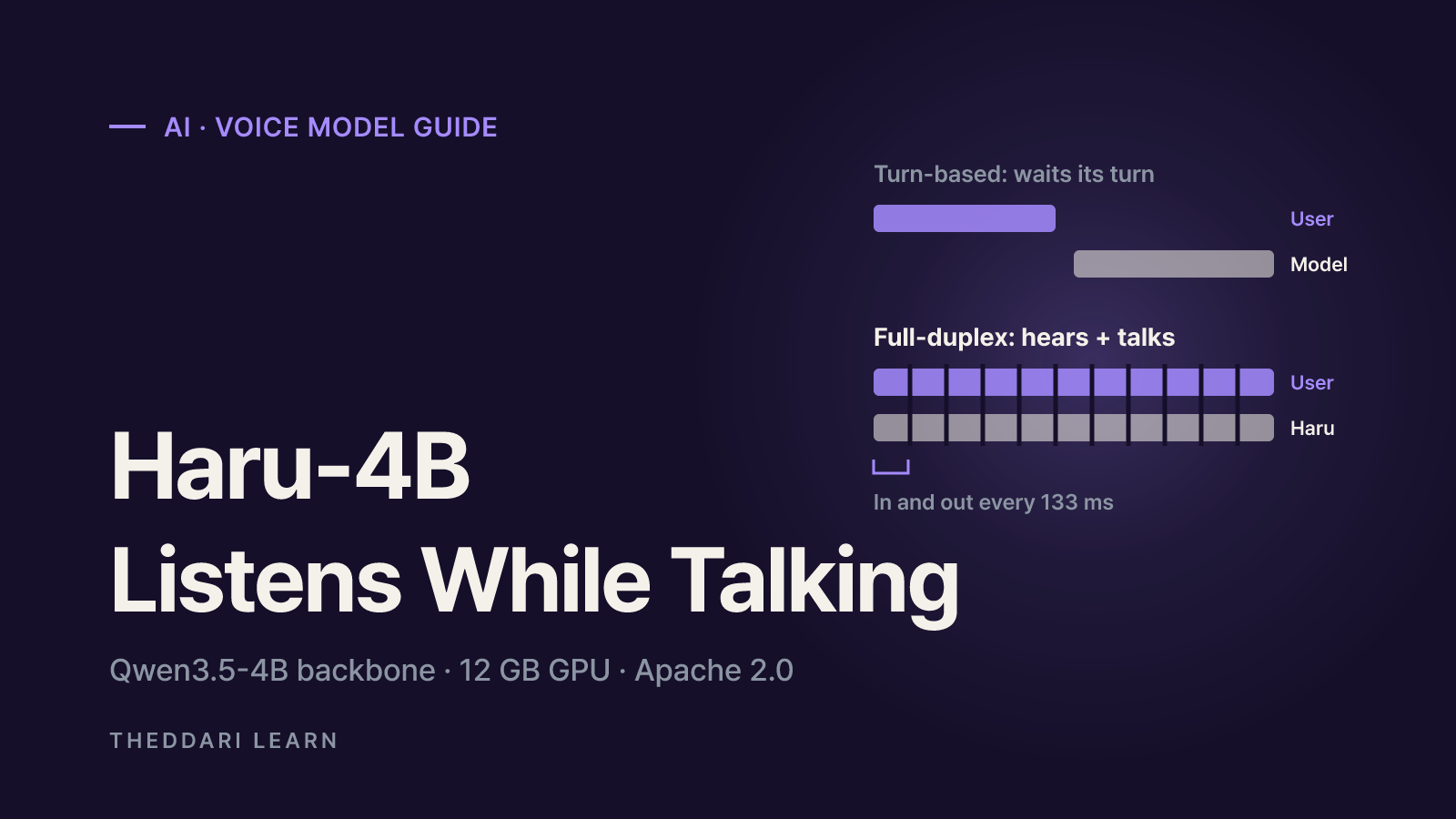
- Every 133 ms it reads one frame of your audio and writes one frame of its own audio and text, so it can backchannel and interrupt like a person on a phone call.
- The official README asks for an NVIDIA GPU with about 12 GB of memory; Apple silicon Macs can use the MLX port, and the checkpoint is about 10 GB.
- Code and weights are Apache 2.0, but the developer says it is not a reliable source of facts and does not follow instructions like an assistant. No standard benchmark table has been published yet.
- It can imitate a reference voice, so only use voices you have the right to use, and avoid the public share link for sensitive audio.
Haru-4B is an open full-duplex spoken dialogue model from the Japanese startup higurashi: it listens and speaks at the same time, the way people do on a phone call. Despite the name, it is not a small text LLM you load into a chat app. As of November 19, 2026, it sits at number one on the Hugging Face trending list, with about 1.74k likes and 5,314 downloads last month shown on its model page.
That popularity makes it easy to grab the weights expecting another laptop-friendly chatbot. The first thing to check is what you actually want: a text assistant, or a real-time voice conversation experiment. This guide uses the official model card, the GitHub README, and the developer's technical blog to explain how Haru-4B works, what hardware it needs, how to treat the quantized uploads, and where the risks are.
What is Haru-4B?
According to the higurashi technical blog, Haru-4B was released on November 13, 2026 as a pretrained base model for research and further fine-tuning. The stated goal is conversation that feels human rather than the stop-and-wait rhythm of agentic assistants, so the model learns backchannels, interruptions, and turn-taking from real recordings.
- Native full-duplex at 7.5 Hz. Every 133 ms the model takes one frame of user audio and produces one frame of its own audio plus text. User audio, model audio, and model text are summed into a single position of the language model, so listening never waits for speaking.
- Continuous audio in one step. Each frame is a 64-dimensional latent. A small MLP head trained with MeanFlow generates it in a single sampling step; there is no separate audio transformer and no discrete audio tokens.
- Character and voice control. A text character card sets the persona and situation; a short reference clip sets the voice.
- Nine primary languages: English, Spanish, Portuguese, German, French, Chinese, Japanese, Russian, and Korean.
How it was trained
The blog says pretraining used more than 40 million hours of real speech across over 160 languages, deliberately excluding LLM-generated dialogues and TTS audio. The team then built a separation model, FastDialogueSidon, to turn single-channel recordings into over 13 million hours of two-speaker full-duplex data, with samples up to 60 minutes long. Training ran on 256 NVIDIA B200 GPUs for about 8 days. The dataset list itself has not been published.
How it differs from a small text LLM
The language model inside Haru-4B is the Qwen3.5-4B text backbone (32 layers, hidden size 2560). On top of that sit audio input projections, the MeanFlow audio head, and the VibeVoice acoustic codec, which is why the model card reports roughly 5B parameters in BF16. The 4B in the name tracks the backbone, not the full checkpoint.
Input and output
- Typical 4B text LLM
- Text in, text out
- Haru-4B
- Audio frames in, audio plus text frames out
Conversation style
- Typical 4B text LLM
- Waits for your turn to end
- Haru-4B
- Can talk while you are talking
Instruction following
- Typical 4B text LLM
- Instruct versions are common
- Haru-4B
- Base model; not tuned to follow instructions
Factual reliability
- Typical 4B text LLM
- Varies by model
- Haru-4B
- Developer says it is not a reliable source of facts
Common runtimes
- Typical 4B text LLM
- llama.cpp, Ollama, LM Studio
- Haru-4B
- Official PyTorch, MLX, and vLLM-Omni plugin
Published benchmarks
- Typical 4B text LLM
- MMLU-style scores are common
- Haru-4B
- No standard benchmark table as of November 2026
If you searched for a small LLM to run locally for summaries, translation, or coding help, Haru-4B is the wrong tool. If you are prototyping a voice agent, studying turn-taking, or want open weights to fine-tune a real-time speech model, it is one of the few public options at this size.
The developer notes that the small backbone limits response quality and says it is already pretraining full-duplex models with more than 100 billion parameters. Treat Haru-4B as a research foundation, not a finished assistant.
How to run Haru-4B locally
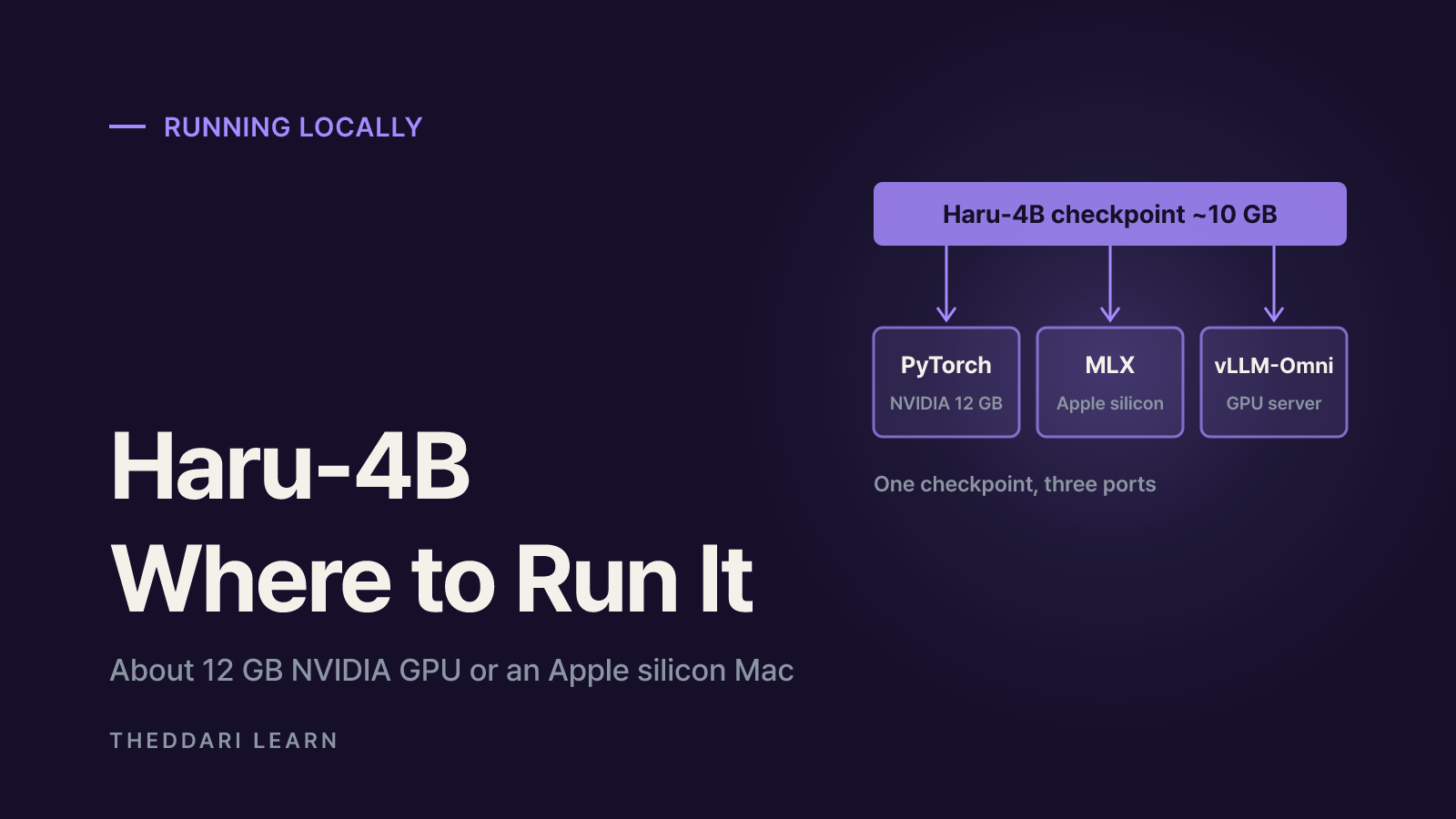
The GitHub repository ships three implementations that all read the same checkpoint. Weights download from Hugging Face on first run, and the MLX README puts the checkpoint at about 10 GB, so plan disk space accordingly.
haru (PyTorch)
- Hardware
- NVIDIA GPU
- What the docs say
- About 12 GB of GPU memory; web demo on localhost:8998
haru_mlx
- Hardware
- Apple silicon Mac, Python 3.10+
- What the docs say
- bfloat16 by default, optional 8-bit backbone, native macOS app
haru_vllm
- Hardware
- GPU server
- What the docs say
- vLLM-Omni plugin for many concurrent conversations
- 1
Confirm the use case
Make sure you want live voice conversation. For text tasks, choose a different model.
- 2
Check hardware
An NVIDIA GPU with about 12 GB of memory, or an Apple silicon Mac, plus at least 10 GB of free disk space.
- 3
Install and launch
Clone the repo, run pip install -e ./haru, then python -m haru.server --hf-repo higurashi-ai/Haru-4B. On a Mac, build the app with swift/build_app.sh inside haru_mlx.
- 4
Add a voice and a character
Haru ships without voice clips. Upload or record one speaker, 3 seconds to 3 minutes of clean speech. Build the character card with render_card (persona, names, relationship, situation).
- 5
Use wired audio
The README recommends a wired microphone and headphones; Bluetooth adds 100 ms or more of delay.
Reading the latency numbers
The blog reports a median end-to-end latency of about 65 ms on an Apple M1 Max MacBook using int8 weights and the native Swift app, with one model step taking about 34 ms. That figure excludes audio framing; the blog itself notes that the 7.5 Hz frame rate can add up to 133 ms. On an NVIDIA B300 server GPU, audio encode, decode, and one model step take about 15 ms. No figures are published for consumer GPUs, so measure on your own machine.
Before you download a quantized version
As of November 19, 2026, the model tree lists six quantized derivatives, including GGUF, MLX 8-bit, and a ROCm conversion. All of them are third-party uploads. With text LLMs a single GGUF file often just works in llama.cpp, but Haru-4B also needs its audio codec and audio head to run, so check more carefully.
- Official route first. The MLX port's --quantize 8 option shrinks only the language model weights and embeddings; the codec, audio head, and norms stay at full precision. The 65 ms measurement used int8.
- Runtime support. For any community GGUF, confirm which runtime plays back audio and whether codec weights are included. At least one derivative is tagged as text generation, which suggests a different purpose.
- Provenance. Look for the uploader's conversion method and update date, and prefer files that explain what changed from the original.
- License carry-over. The original is Apache 2.0; confirm each derivative did not add other terms.
To see how often new open models like this come up in AI channels, the theddari AI Telegram trends page tracks mentions over time.
Limits and risks to weigh
Facts and instructions
The model card's limitations section says Haru-4B holds a natural conversation but is not a reliable source of facts and does not follow instructions the way an assistant does. The blog's demo shows a financial-advice style conversation, but that demonstrates conversational flow, not verified financial accuracy. Do not use it for health, money, or legal answers.
Voice cloning
Because a short reference clip sets the voice, the model can imitate real people. The developer repeatedly asks users to only use voices they have the right to use. The Apache 2.0 license covers the weights, not anyone's voice, so stick to your own voice or recordings with explicit consent.
Share links and network exposure
Adding --share to the web demo prints a public HTTPS link. Anyone with the link can use your demo, and traffic passes through Gradio's share servers, so avoid it for meetings or personal audio. Browsers only grant microphone access on localhost or HTTPS, so remote deployments need TLS.
Thin evaluation data
Official material includes a latency table but no standard benchmark for conversation quality or per-language performance. The developer only says a more detailed technical report and training code are planned. Trending rank and likes measure attention, not quality. To compare voice models fairly, record the same prompts on the same hardware and listen. For wider discussion around new releases, the theddari blog trends page collects posts by topic.
 theddari.comTrendsBlog PostsSummarized Naver blog posts
Who should try Haru-4B
- Good fit: developers and researchers building real-time voice agents or character calls, or looking for an open full-duplex base model to fine-tune.
- Poor fit: anyone who needs accurate text answers, document summaries, or coding help.
- Pre-flight checklist: about 12 GB NVIDIA GPU or an Apple silicon Mac, 10 GB of disk, wired audio, and a reference voice you have rights to.
- Before publishing a demo: keep the Apache 2.0 and third-party notices, document voice consent, and decide whether a public share link is acceptable.
Frequently asked questions
Can I use Haru-4B as a text chatbot in Ollama or LM Studio?
Will Haru-4B run on an 8 GB GPU?
Which languages does Haru-4B support?
Is Haru-4B free for commercial use?
Sources and references
- 1higurashi-ai/Haru-4B model card (Hugging Face)(opens in a new tab)huggingface.co
- 2higurashi-ai/Haru GitHub repository README(opens in a new tab)github.com
- 3Haru-4B technical blog post (higurashi, Nov 13, 2026)(opens in a new tab)blog.higurashi.ai
- 4haru_mlx README (Apple silicon port)(opens in a new tab)github.com
- 5Quantized models derived from Haru-4B (Hugging Face)(opens in a new tab)huggingface.co
- 6Hugging Face trending models(opens in a new tab)huggingface.co
Related articles
 AI
Gemini 4 Neon: Pricing, Access and Hydrogen vs Argon
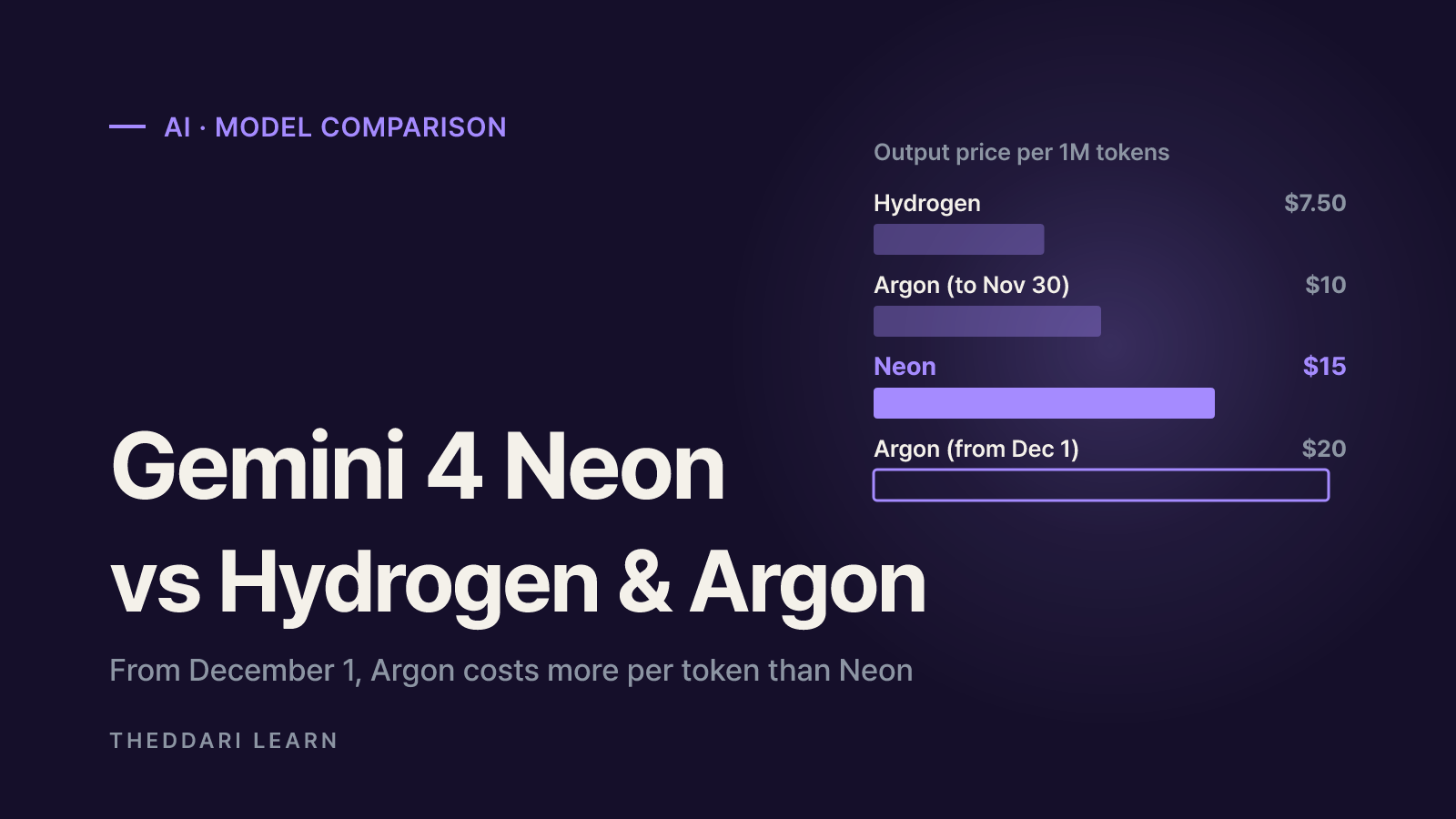
Gemini 4 Neon is Google's new mid-tier Gemini 4 model, priced at $3 input and $15 output per million tokens with no free tier. Here is what Google announced, how it stacks up against Hydrogen and Argon, and what to check before you switch.
 AI
MiniMax-H3-Image: Specs, ComfyUI Setup and License Limits
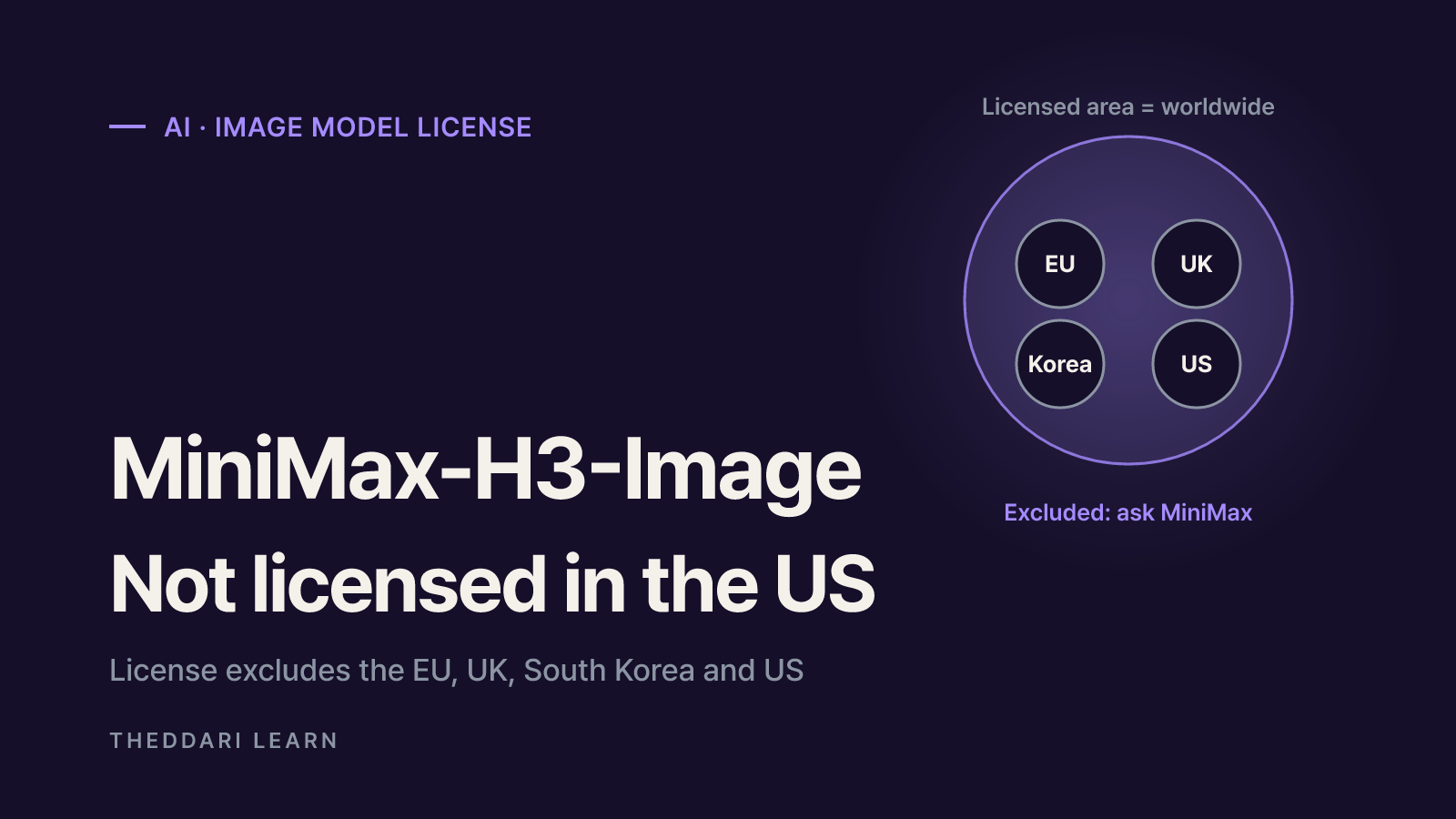
MiniMax-H3-Image topped Hugging Face trending. We checked the model card, the official ComfyUI tutorial and the license text: what the model does, how the Comfy-Org repack differs, how to set it up, and why US, UK, EU and Korean users are outside the default license.
 AI
GPT-6.2 Astra vs Sol: Differences, Pricing and Access
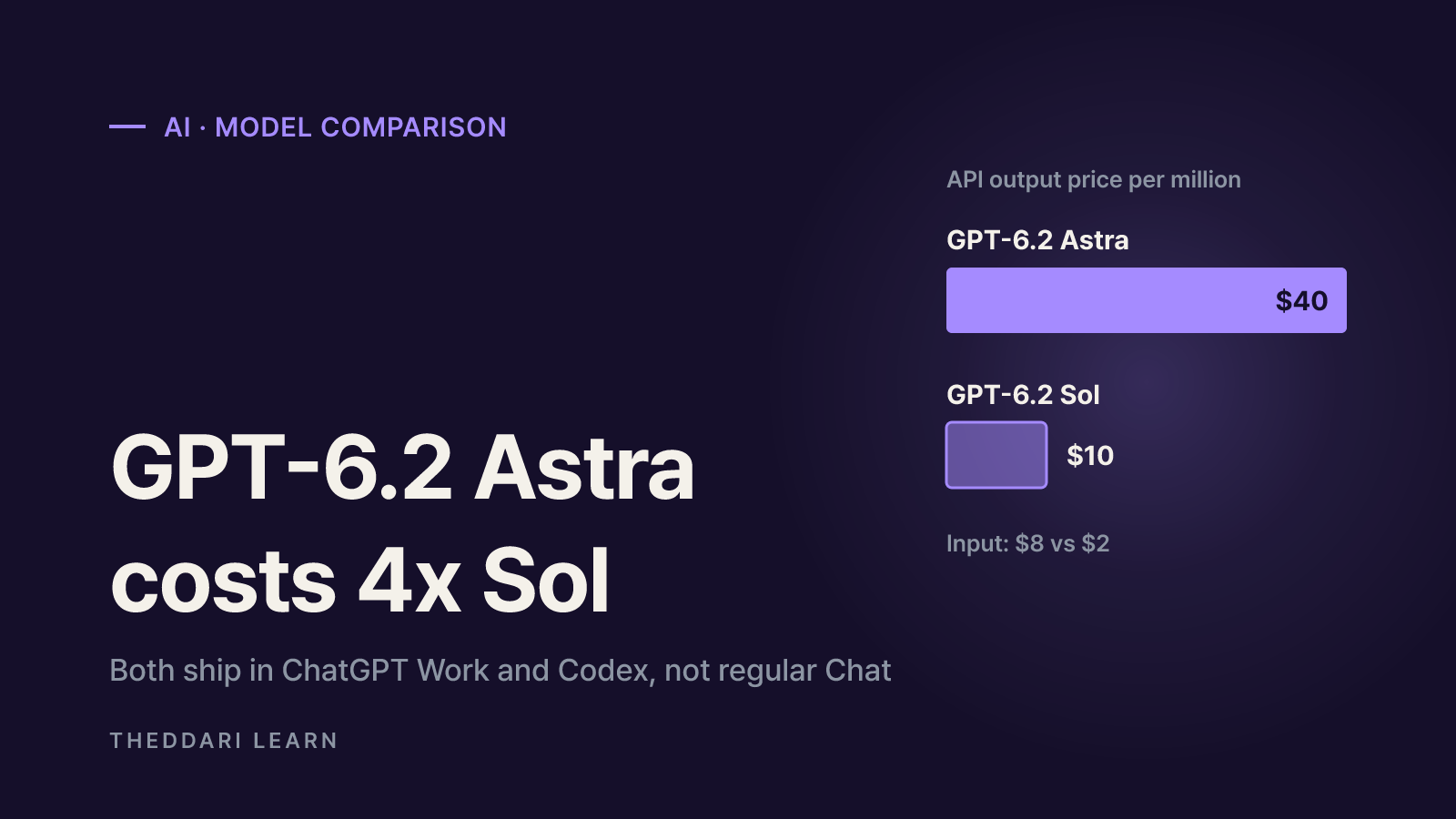
GPT-6.2 Astra is OpenAI's frontier model for hard professional work; GPT-6.2 Sol is the efficient everyday model. Astra costs 4x more per API token, and both ship in ChatGPT Work and Codex, not regular Chat.