Contents8 sections
- What is a systematic withdrawal plan and how does it work?
- SWP vs dividend income: what actually differs
- Why a market downturn hurts an SWP: more shares sold for the same income
- How to design withdrawals that survive a bear market
- How SWP withdrawals are taxed in the US and elsewhere
- Checklist before you start an SWP
- Frequently asked questions
- Sources and references
A systematic withdrawal plan (SWP) is a way to draw retirement income by selling a fixed dollar amount of your fund or ETF holdings on a set schedule, usually monthly or quarterly. It is the mirror image of dollar-cost averaging: instead of buying a fixed amount each month, you sell one. The rest of your money stays invested, but because you sell the same amount whether markets are up or down, a downturn can drain the portfolio faster than the headline loss suggests. This guide, based on sources reviewed in November 2026, explains how an SWP works, how it compares with living off dividends, why bear markets hurt, how to design withdrawals that bend instead of break, and how taxes differ for US taxpayers and Korean residents. It focuses on how to withdraw, not on the separate question of how much you can spend.
What is a systematic withdrawal plan and how does it work?
With an SWP you choose three things: the amount, the frequency and the date. On each date, enough shares are sold at that day's price (the net asset value for a mutual fund, the market price for an ETF) to produce the amount, and the cash goes to your bank account. Some fund companies and brokers automate this; you can also do it manually by placing the same sale each month. The process continues until you stop it or run out of shares.
The key detail is that the dollar amount is fixed while the number of shares sold changes. When prices are high you sell a few shares; when prices are low you sell more. Investor education material from Fidelity Bank's LPL Financial resource center puts it bluntly: systematic withdrawals do the precise opposite of systematic investing, selling fewer shares when prices are high and more when they are low, which reduces the number of shares able to participate in a later recovery (Fidelity Bank / LPL). Volatility that helped you while saving works against you while spending.
Cash flow
- Dollar-cost averaging
- Money goes in
- Systematic withdrawal plan
- Money comes out
What stays fixed
- Dollar-cost averaging
- Amount invested
- Systematic withdrawal plan
- Amount withdrawn
When prices fall
- Dollar-cost averaging
- You buy more shares
- Systematic withdrawal plan
- You sell more shares
Effect of volatility
- Dollar-cost averaging
- Can lower average cost
- Systematic withdrawal plan
- Can shrink your share count faster
Typical life stage
- Dollar-cost averaging
- Saving years
- Systematic withdrawal plan
- Retirement
An SWP is a selling method, not a product. Its risk, cost and tax profile come from whatever you hold. Drawing from a stock-heavy fund means larger swings; drawing from a balanced or bond fund means smaller swings but usually lower long-term growth. If your fund or broker charges redemption or transaction fees, frequent small withdrawals can add up, so check the terms before you automate anything.
SWP vs dividend income: what actually differs
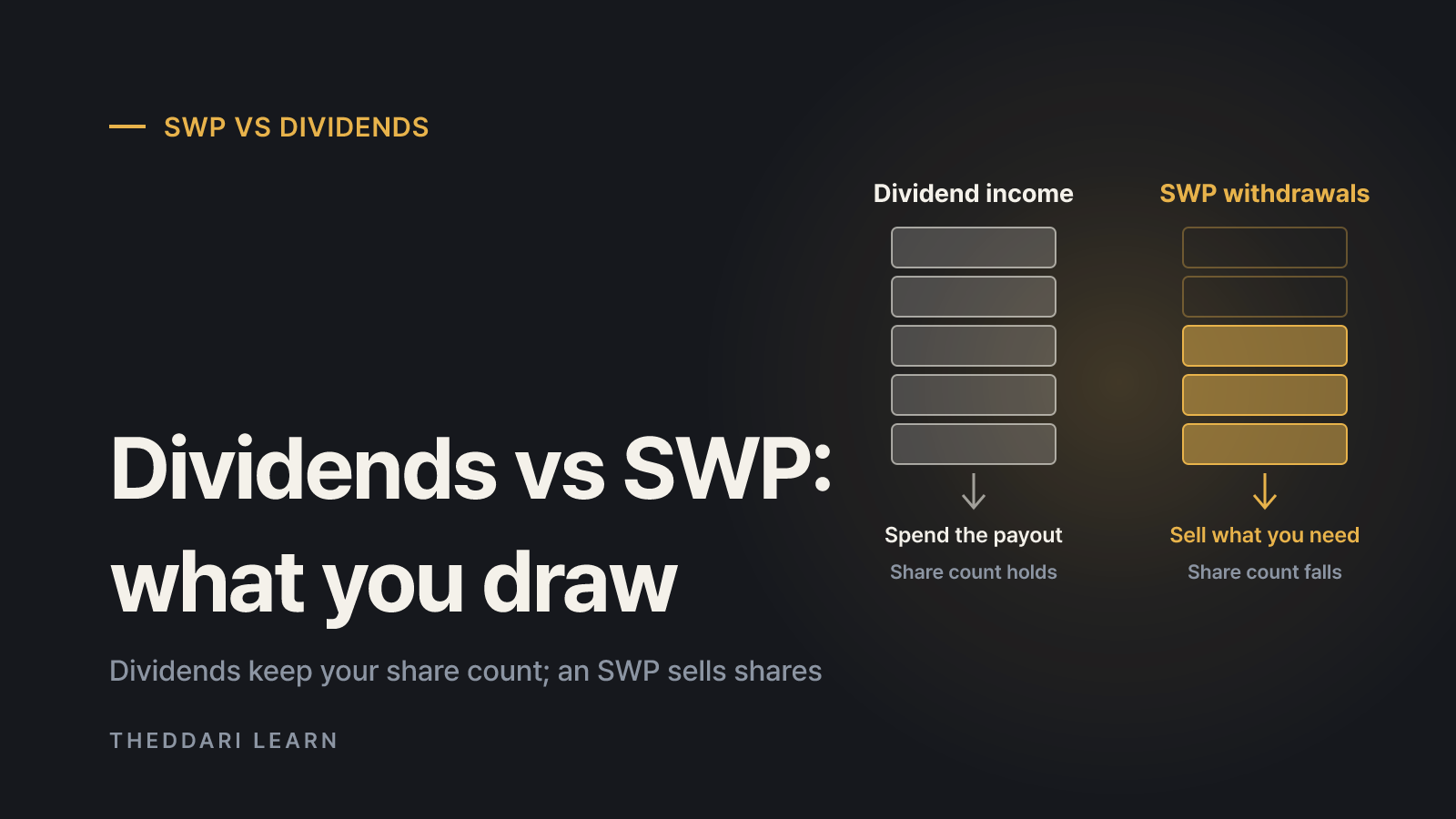
There are two broad ways to turn a portfolio into income. You can spend only what the portfolio pays out, such as dividends and fund distributions, and never sell shares. Or you can sell what you need, which is what an SWP does. The income-only approach feels safer because your share count never drops, but when a fund pays a distribution its price falls by roughly that amount. For the same total return, the money leaving your portfolio is the same either way.
Who sets the amount
- Living off dividends
- The company or fund; it can be cut
- Systematic withdrawal plan
- You
Share count
- Living off dividends
- Stays the same
- Systematic withdrawal plan
- Declines each period
In a downturn
- Living off dividends
- Payouts may fall, but no forced sales
- Systematic withdrawal plan
- You sell more shares for the same income
Investment choices
- Living off dividends
- Tends to tilt toward high-yield holdings
- Systematic withdrawal plan
- Works with low-yield index or growth funds
US taxable account
- Living off dividends
- Dividends taxed when paid
- Systematic withdrawal plan
- Only the gain on each sale is taxed
The practical trade-off is control versus exposure. Dividend payers can trim their payouts, which cuts your income without warning. An SWP lets you set the paycheck, but you give up the ability to avoid selling at low prices. Chasing enough yield to cover all your spending can also concentrate a portfolio in a few high-dividend sectors, while an SWP lets you keep a broad, low-cost index fund. Many retirees blend the two: spend the distributions first and sell shares only to cover the gap. With high-distribution products such as covered call ETFs, part of the payout may be a return of capital, so a high yield on its own does not mean you are living off income alone.
Why a market downturn hurts an SWP: more shares sold for the same income

A simple example shows the mechanics. Suppose an ETF trades at $50 and you withdraw $2,000 a month, so you sell 40 shares. If the price falls 20% to $40, the same $2,000 requires selling 50 shares, 25% more shares for the same paycheck. If the slump lasts several months, your share count falls quickly, and when prices recover you own fewer shares to ride the rebound.
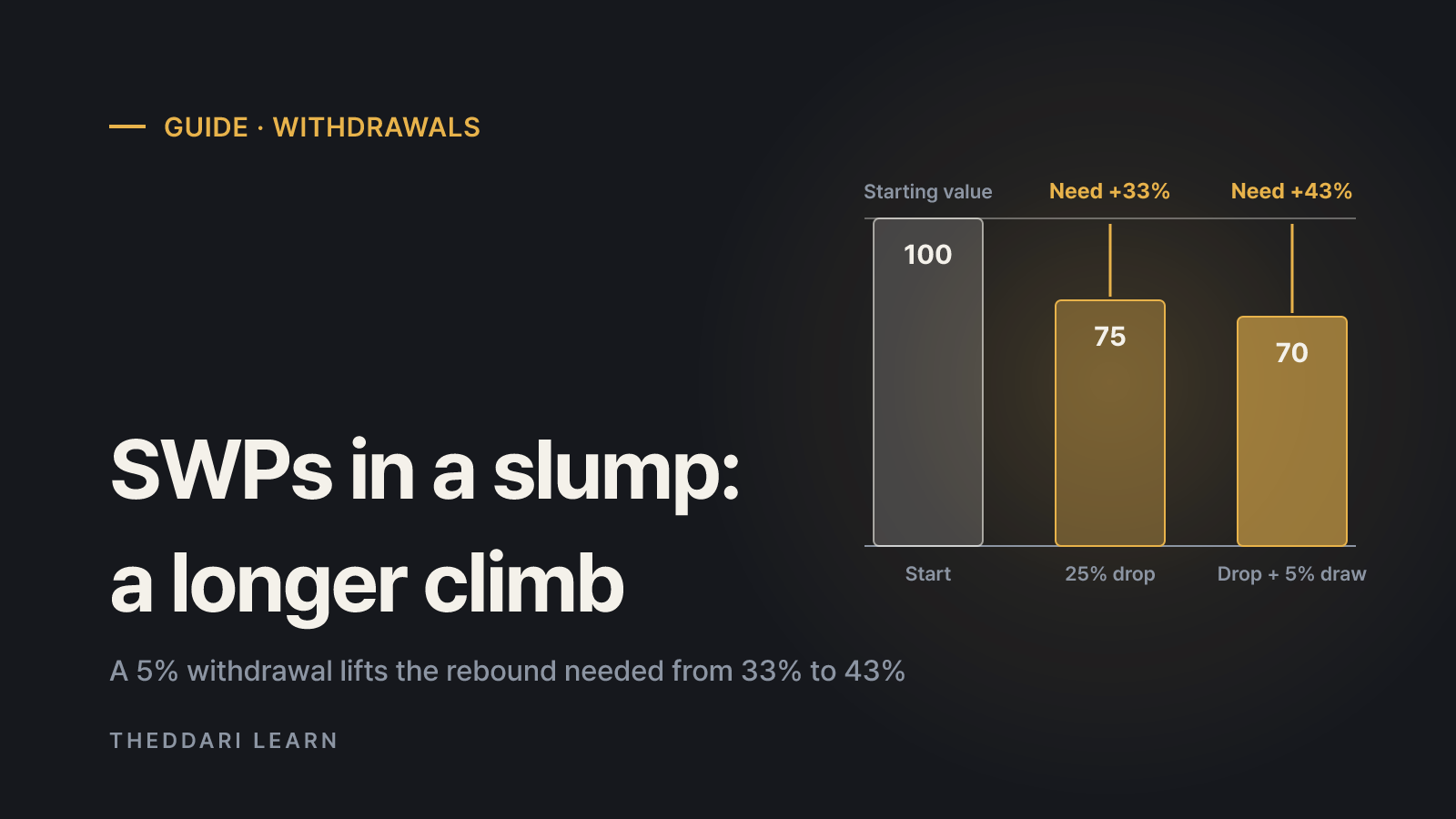
The recovery math changes too. Without withdrawals, a 25% decline needs about a 33% gain to get back to even (100 to 75, then 100 ÷ 75 − 1 ≈ 33%). Withdraw 5% of the original value during the same decline and the portfolio falls to 70, so you need roughly a 43% gain to recover (100 ÷ 70 − 1 ≈ 43%). This hypothetical comes from the same Fidelity Bank / LPL article.
Sequence of returns risk peaks early in retirement
While you are saving, the order of returns does not change the ending balance if the average is the same. Once withdrawals begin, order matters. A bear market in the first years of retirement forces you to sell many shares at low prices, and later strong returns only apply to what is left. This is sequence of returns risk. Vanguard identifies roughly years 3 to 15 of retirement as the stage where it becomes a critical concern (Vanguard).
Most SWP calculators assume the same return every year. Two portfolios with the same average return can last very different lengths of time if one suffers its losses early, so treat a calculator result as one average scenario, not a forecast.
How to design withdrawals that survive a bear market
The weakness of a plain SWP is that it sells the same amount regardless of price. The fixes target exactly that point, and they work best in combination.
- Keep a cash buffer
- Hold one to two years of essential spending in cash, a money market fund or short-term bonds.
- Draw from the buffer when stocks are down sharply, then refill it after markets recover.
- Use dynamic spending
- Set a rule in advance to trim withdrawals in down years and raise them after recoveries.
- Vanguard says a modest 2.5% spending cut in down years can increase portfolio success rates by over 30%, based on its own research.
- Choose which asset to sell
- If you hold both stock and bond funds, sell from whichever has held up better instead of from one fixed fund.
- A single automated redemption from one fund removes that flexibility.
- Split essential and flexible spending
- Cover housing, insurance and healthcare with steady income such as Social Security or a pension, and use the SWP for travel and other flexible costs you could cut.
Inflation adds a second layer. A flat withdrawal loses purchasing power over time, while inflation-adjusted raises speed up depletion. Pick a regular review date tied to inflation and interest-rate releases. The theddari economic calendar lists upcoming CPI prints and central bank decisions so you can schedule those reviews; it tells you when data arrives, not which way markets will move.

During a sell-off the news flow can make it hard to stick to a plan. The theddari stock-market Telegram trends page is a way to gauge the mood, but change your withdrawals based on the rules you wrote down, such as the size of the decline or your remaining buffer, not on headlines.
How SWP withdrawals are taxed in the US and elsewhere
You do not owe tax on the full withdrawal. In most systems only the gain portion of each sale is taxable, while the part that returns your original cost is not. What counts as a gain, and the rate applied, depends on your country, the product and the account type.
US taxpayers with taxable brokerage accounts
Each sale realizes a capital gain or loss equal to the difference between the sale proceeds and your adjusted basis. Shares held more than one year produce long-term gains; one year or less, short-term gains, which are taxed at ordinary income rates. According to IRS Topic 409 (page last updated September 2026, citing thresholds for tax years beginning in 2025), long-term gains are taxed at 0%, 15% or 20% depending on taxable income, and net capital losses can offset up to $3,000 of other income per year ($1,500 if married filing separately), with the rest carried forward. Because the gain depends on which shares you sell, the lot-selection method your broker uses can change the tax bill on the same withdrawal. Withdrawals from IRAs and 401(k)s follow different rules.
Korean residents and other jurisdictions
Rules differ sharply outside the US. For Korean residents using regular accounts, the Korea Council for Investor Education explains that only gains from Korean stocks (and related stock futures) inside a fund are tax-exempt; other fund income is taxed as dividend income. Gains from Korea-listed ETFs tracking foreign stocks are taxed at 15.4% as dividend income, while ETFs listed abroad are treated like shares and taxed at 22% capital gains tax including local tax. If you live elsewhere, check your own tax authority's guidance before setting withdrawal amounts, since the after-tax income is what you actually spend.
Checklist before you start an SWP
- 1
Map your essential spending and other income
Subtract steady income such as Social Security or a pension from essential costs. The SWP only needs to fill the gap, and a smaller gap means fewer shares sold in a downturn.
- 2
Decide which accounts and funds to draw from
Taxable, tax-deferred and tax-free accounts are taxed differently. Set an order for which account and which fund you sell from first.
- 3
Size your cash buffer
Choose how many months of essential spending to keep outside the market, and write down when you will refill it.
- 4
Write down your downturn rule
For example: if stock holdings fall by a set percentage from their peak, reduce withdrawals and spend from the buffer first. Rules made in calm markets are easier to follow than decisions made in a panic.
- 5
Review once a year
Recheck your balance, inflation, tax rules and asset mix, and confirm that any automated withdrawal still matches your current plan.
A systematic withdrawal plan gives you control over your retirement paycheck, but it has a built-in weakness: it keeps selling the same dollar amount when prices are low. A cash buffer, a willingness to trim spending in bad years, a deliberate selling order and a clear view of your tax position turn that weakness into a manageable risk. Run the numbers for your own time horizon and income sources, and confirm the tax treatment with current guidance where you live.