Korean Covered Call ETF Tax: Are Payouts Really Tax-Free?
How Korean covered call ETF tax works: why KOSPI 200 option premiums escape the 15.4% dividend tax and how twice-monthly payout pairs really work.
Contents8 sections
- Korean covered call ETF tax: which payout sources are taxed
- How twice-monthly payout portfolios are built
- Why a high payout can still shrink your investment
- Overlap and concentration when you combine the two funds
- Where tax-free does not apply: selling and account type
- A pre-purchase checklist
- Frequently asked questions
- Sources and references
Key takeaways
- For Korean residents, the tax-free part of a domestic covered call ETF payout comes from KOSPI 200 option premiums and Korea-listed share gains; dividends and interest are taxed at 15.4%.
- Tax is withheld on a per-share taxable amount disclosed for each payout, so the taxable share can jump in months when portfolio companies pay dividends.
- A twice-monthly setup is two ETFs with different record dates, not one fund paying twice. TIGER KOSPI200 Covered Call Active starts mid-month payouts in December 2026.
- Every distribution lowers the fund's net asset value, and covered calls cap upside while keeping most downside, so judge these funds on total return.
- Active ETFs can still trigger tax on sale, and pension accounts tax withdrawals regardless of the original income type.
Korean covered call ETF tax is often summed up as tax-free, but that is only partly true. As of November 2026, for Korean tax residents holding Korea-listed covered call ETFs in a regular brokerage account, the part of each distribution that comes from selling KOSPI 200 call options or from gains on Korea-listed shares is excluded from taxable fund income. The part that comes from dividends paid by the stocks in the portfolio, plus any interest, is still taxed as dividend income at 15.4%. This guide explains that split, how the popular twice-monthly payout portfolio is built, and what to check before buying.
Some context for readers outside Korea: Korean ETFs are legally investment funds, so income received from them is classified as dividend income under Korean tax law. The 15.4% rate is 14% national income tax plus a 1.4% local income tax. None of this describes US, UK or other foreign tax rules, and foreign investors in Korean ETFs face different withholding treatment.
Korean covered call ETF tax: which payout sources are taxed
Article 26-2 of the Enforcement Decree of the Income Tax Act sets out which collective investment vehicles produce dividend income, and its fourth paragraph removes trading and valuation gains on securities listed on the Korean stock market, and on exchange-traded derivatives based on them, from the fund's taxable income. KOSPI 200 options are exchange-traded derivatives on Korea-listed shares, so the premium a fund earns by writing them falls inside that exclusion. Bonds, funds tracking foreign market indexes and options on foreign indexes are carved out of the exclusion, so their gains remain taxable.
Dividends from Korean portfolio stocks
- Regular account tax
- 15.4% dividend tax
- Notes
- Tend to cluster around quarter-end and spring
Interest on cash holdings
- Regular account tax
- 15.4% dividend tax
- Notes
- Usually small
KOSPI 200 call option premiums
- Regular account tax
- Excluded from taxable income
- Notes
- Domestic exchange-traded derivative
Gains on Korea-listed shares
- Regular account tax
- Excluded from taxable income
- Notes
- May effectively return capital
Foreign index options and foreign stocks
- Regular account tax
- Taxable
- Notes
- Applies to Korea-listed foreign covered call funds
How the per-share taxable amount works
Withholding is calculated on a per-share taxable amount that the fund manager discloses for each payout, not on the whole distribution. A summary of a Samsung Asset Management notice by Gaejang Briefing explains that tax applies to the smaller of the distribution and the increase in the fund's tax base price, and that taxable income such as dividends is paid out first. That is why the taxable share moves around. In the same summary, KODEX 200 Target Weekly Covered Call paid 300 won per share in September 2026 with a taxable amount of 2 won, but its October payout of 281 won carried a taxable amount of 105 won, or 37%. The manager warned that in dividend-heavy months the taxable share can reach 100%.
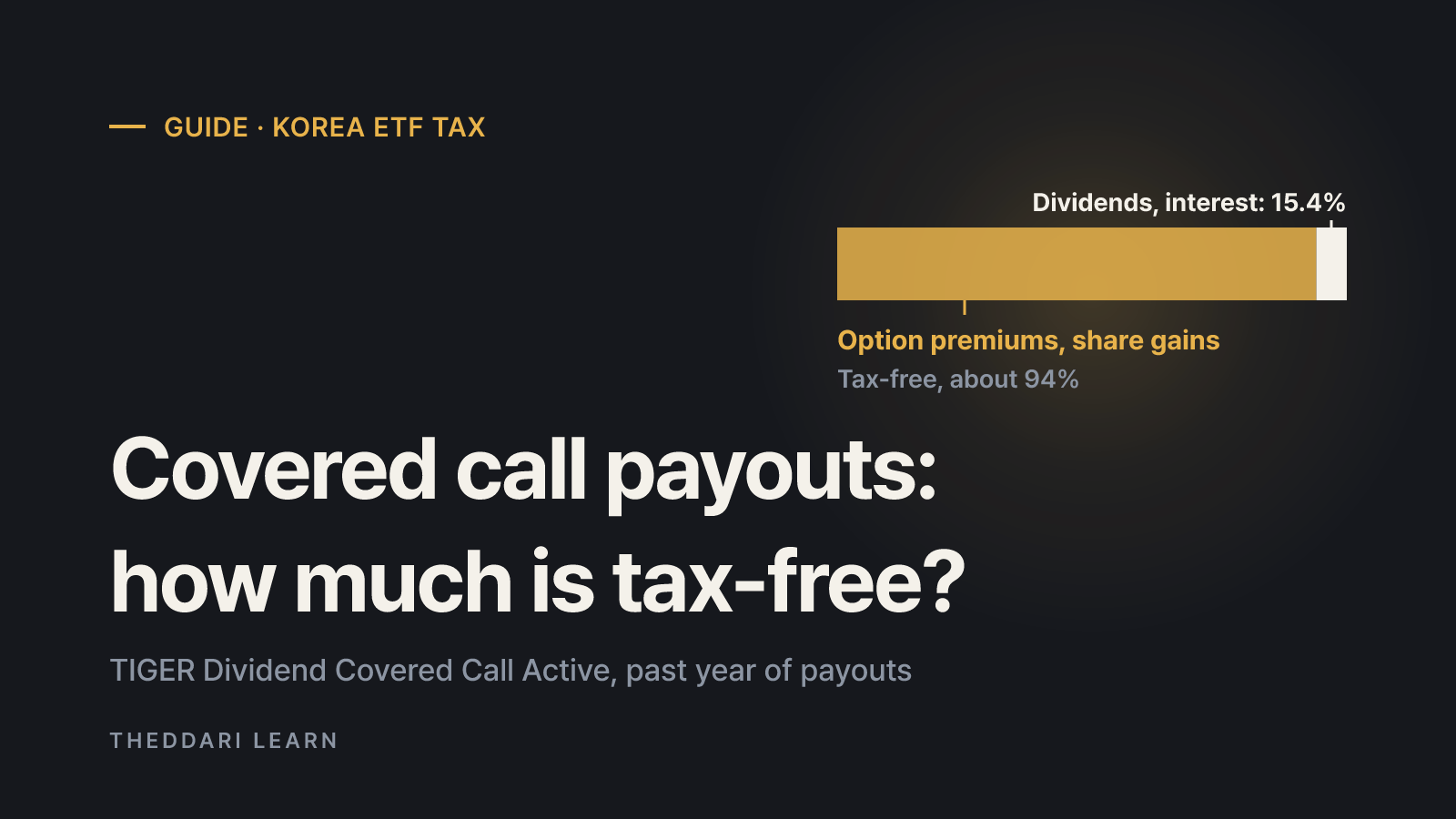
Mirae Asset Global Investments says roughly 94% of the past year's distributions from TIGER Dividend Covered Call Active came from tax-free sources, according to Newspim, and Daehan Economy reported an average monthly taxable share of about 4 to 6%. These are historical figures published by the manager. A large one-off dividend, such as a special dividend from a major holding, can push the taxable share up in a given month, and nothing guarantees the ratio will hold.
A high tax-free share also tells you that much of the payout came from option premiums or realized stock gains rather than dividends. A distribution funded by trading gains is tax-efficient, but it may simply be handing back part of the fund's own assets.
How twice-monthly payout portfolios are built
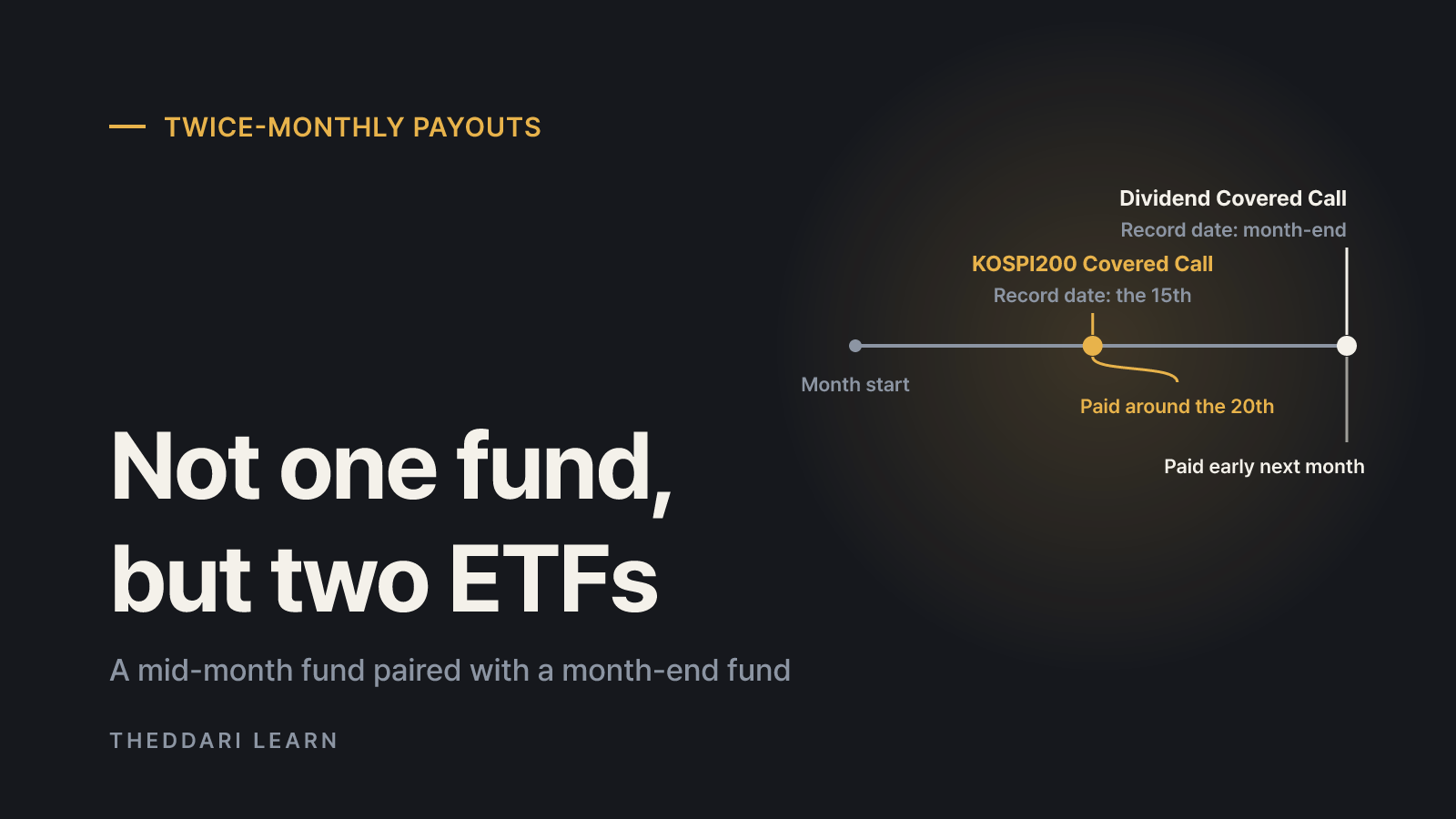
The twice-monthly payout idea promoted in Korean investing videos does not involve a fund that pays twice a month. It pairs two ETFs with different record dates so cash arrives mid-month and at month-end. TIGER KOSPI200 Covered Call Active (ticker 0262B0), listed on November 10, 2026, uses the 15th of each month as its record date starting in December 2026. Its sibling, TIGER Dividend Covered Call Active (472150), uses the last business day of each month. The new fund skipped November because it had no distributable income yet.
Record date
- TIGER KOSPI200 Covered Call Active
- 15th of each month (from Dec 2026)
- TIGER Dividend Covered Call Active
- Last business day of each month
Cash arrives (per manager)
- TIGER KOSPI200 Covered Call Active
- Around the 20th
- TIGER Dividend Covered Call Active
- Early the following month
Stock portfolio
- TIGER KOSPI200 Covered Call Active
- About 100 growth names from the KOSPI 200
- TIGER Dividend Covered Call Active
- Tilted to dividend growers, financials, preferred shares
Option strategy
- TIGER KOSPI200 Covered Call Active
- Writing ratio adjusted by market regime
- TIGER Dividend Covered Call Active
- Same option strategy
Benchmark
- TIGER KOSPI200 Covered Call Active
- KOSPI 200 Covered Call 5% OTM
- TIGER Dividend Covered Call Active
- KOSPI 200 Covered Call 5% OTM
To receive a payout you must be the holder of record. Korean trades settle two business days after execution, so buy at least two business days before the record date; the business day just before the record date is the ex-distribution date, when the price drops by roughly the payout. Buying right before the record date and selling right after rarely helps once tax and trading costs are counted. Weekends and public holidays can move the schedule, so check the manager's notice every month.
Staggering record dates smooths the timing of cash flow, but it does not increase total income. Splitting the same capital across two funds mostly divides one payout into two smaller ones. The income still comes from the same two engines: Korean stocks and KOSPI 200 options.
Why a high payout can still shrink your investment
When an ETF pays a distribution, its net asset value falls by the amount paid. The cash is not new money from outside the fund; it is part of the fund's assets handed to you. Comparing funds by distribution yield alone is therefore misleading. If the price fell by more than the payouts over the same period, total return was negative.
Covered calls are also asymmetric by design. Writing calls hands part of any strong rally to the option buyer, while the premium cushions only a limited part of a decline. At the launch briefing, the head of the manager's strategy ETF division stressed that covered call ETFs carry asymmetric returns and possible capital loss, and that distribution amounts are not fixed. Active covered call funds try to soften the cap by writing fewer options in rising markets, but that also reduces premium income and can change the size of future payouts.
- Compare total return including distributions over identical periods, not headline yield.
- Read the taxable amount alongside each payout to see whether it came from dividends, premiums or realized stock gains.
- Plan for lower payouts if the fund cuts its option-writing ratio.
- Expect option premiums to swing when Korean market volatility rises around major economic releases.

Overlap and concentration when you combine the two funds
The manager calls these two products siblings, and the overlap is substantial: same manager, same option strategy, same benchmark, and both select about 100 stocks from the KOSPI 200. One leans toward growth companies and the other toward dividend growers, but large KOSPI 200 names can easily sit in both. Daehan Economy reported that the growth fund holds 12.8% in industrials such as shipbuilding, construction and power equipment, about 3.7 percentage points above the KOSPI 200. Combining the pair still leaves you exposed to a single market.
The option sleeve overlaps too. With the same option model, both funds can see option gains or losses move in the same direction during a sharp rally or sell-off. Spreading out payment dates does not spread out risk. If you already own a KOSPI 200 tracker or a Korean high-dividend ETF, line up the top holdings and check how much repeats. Watching which Korean stocks are being discussed in market chat channels can show you what is popular, but popularity is not a measure of portfolio overlap.
Where tax-free does not apply: selling and account type
Tax on sale matters as well. Gains on a domestic equity ETF that tracks an index as-is are tax-free, but as ETFstyle notes, active ETFs are not index-tracking funds and are taxed on the holding-period gain: 15.4% on the smaller of the actual trading gain and the rise in the tax base price. Because domestic share gains and option results are excluded from the tax base price, the bill is usually small, but do not assume zero withholding when selling either active fund.
Regular brokerage
- When payouts arrive
- Taxable amount x 15.4% withheld
- Later tax
- Comprehensive taxation if interest and dividends exceed 20 million won a year
Brokerage-type ISA
- When payouts arrive
- No withholding
- Later tax
- At closing, net gain up to 2 million won (4 million for eligible holders) exempt, excess at 9.9%
Pension savings / IRP
- When payouts arrive
- No withholding
- Later tax
- Pension income tax on withdrawal, including formerly tax-free parts
Korean pension accounts treat withdrawals as pension income regardless of the original income type. Option premium payouts that would be tax-free in a regular account become subject to pension income tax when withdrawn. Because domestic covered call payouts already carry a low taxable share, moving them into a tax-advantaged account may save less than doing the same with foreign-index covered call funds.
A pre-purchase checklist
- 1
Check payout sources and taxable amounts
Pull a year of per-payout distributions and per-share taxable amounts from the manager's site or a disclosure service, and note both the average and the highest taxable share. Do not extrapolate a year of tax from one payout.
- 2
Check NAV and total return
Compare total return including distributions with the change in net asset value over the same period, and look for stretches where payouts continued while the price kept falling.
- 3
Write down record and cut-off dates
For both the mid-month and month-end funds, record the record date, ex-distribution date and expected payment date, and recheck months affected by holidays.
- 4
Review holdings overlap
Compare the top holdings of both funds and any Korean ETFs you already own to see whether one sector or a few large caps dominate.
- 5
Decide the account and note sale tax
Choose between a regular account, an ISA or a pension account, and record that selling an active ETF may trigger holding-period tax.
In short, the tax-free label attaches to specific income sources, option premiums and domestic share gains, not to the fund name. A twice-monthly payout setup changes when cash arrives but not where returns come from, and the two funds share one market and one option strategy. Looking at taxable amounts, total return including price changes and holdings overlap together gives a clearer picture than the tax-free headline alone.
Frequently asked questions
Do tax-free covered call distributions count toward Korea's 20 million won financial income threshold?
Is a Korea-listed Nasdaq 100 covered call ETF also tax-free?
When do I need to buy to receive the mid-month and month-end payouts?
Should I hold Korean covered call ETFs in an ISA or a pension account?
Sources and references
- 1Newspim: Mirae Asset lists KOSPI 200 covered call ETF with mid-month payouts (2026-11-10)(opens in a new tab)newspim.com
- 2Daehan Economy: TIGER 200 Covered Call Active ETF listing and payout schedule (2026-11-09)(opens in a new tab)www.cnews.co.kr
- 3Korea Law Information Center: Enforcement Decree of the Income Tax Act, Article 26-2(opens in a new tab)www.law.go.kr
- 4Gaejang Briefing: ETF distribution tax for domestic, foreign-index and pension accounts (2026-11-03)(opens in a new tab)gaejang.com
- 5ETFstyle: ETF tax by type, including domestic equity, foreign-index and active ETFs(opens in a new tab)www.etfstyle.com
Related articles
 Investing
Korean ISA Maturity Pension Transfer: Tax Credit and DCA
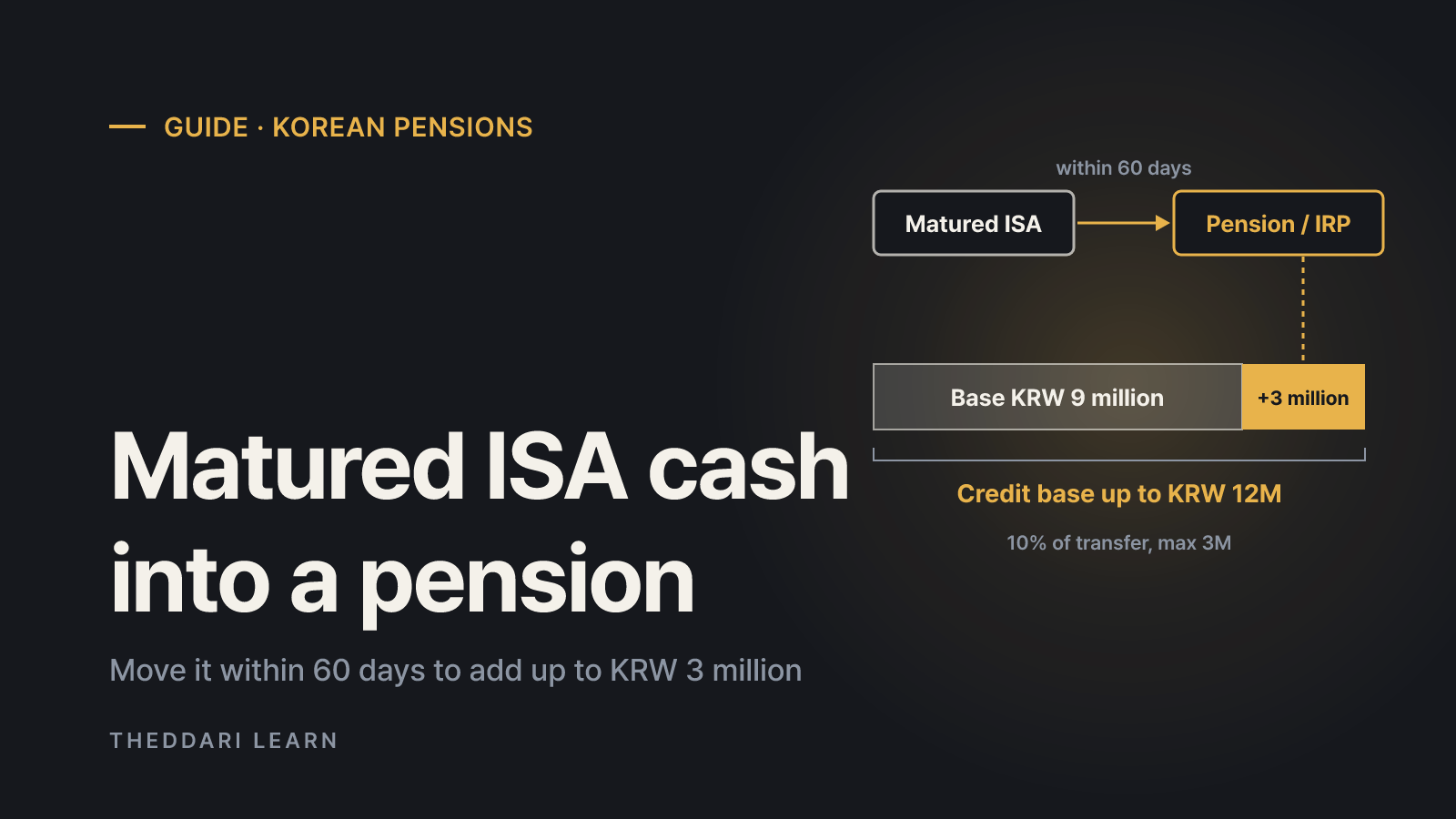
A practical guide for Korean tax residents: how the extra pension tax credit for matured ISA money is calculated, how to finish the transfer inside the 60-day window, and how to decide between investing the cash at once or in stages.
 Investing
Stock Market Circuit Breakers and Sidecars: US vs Korea
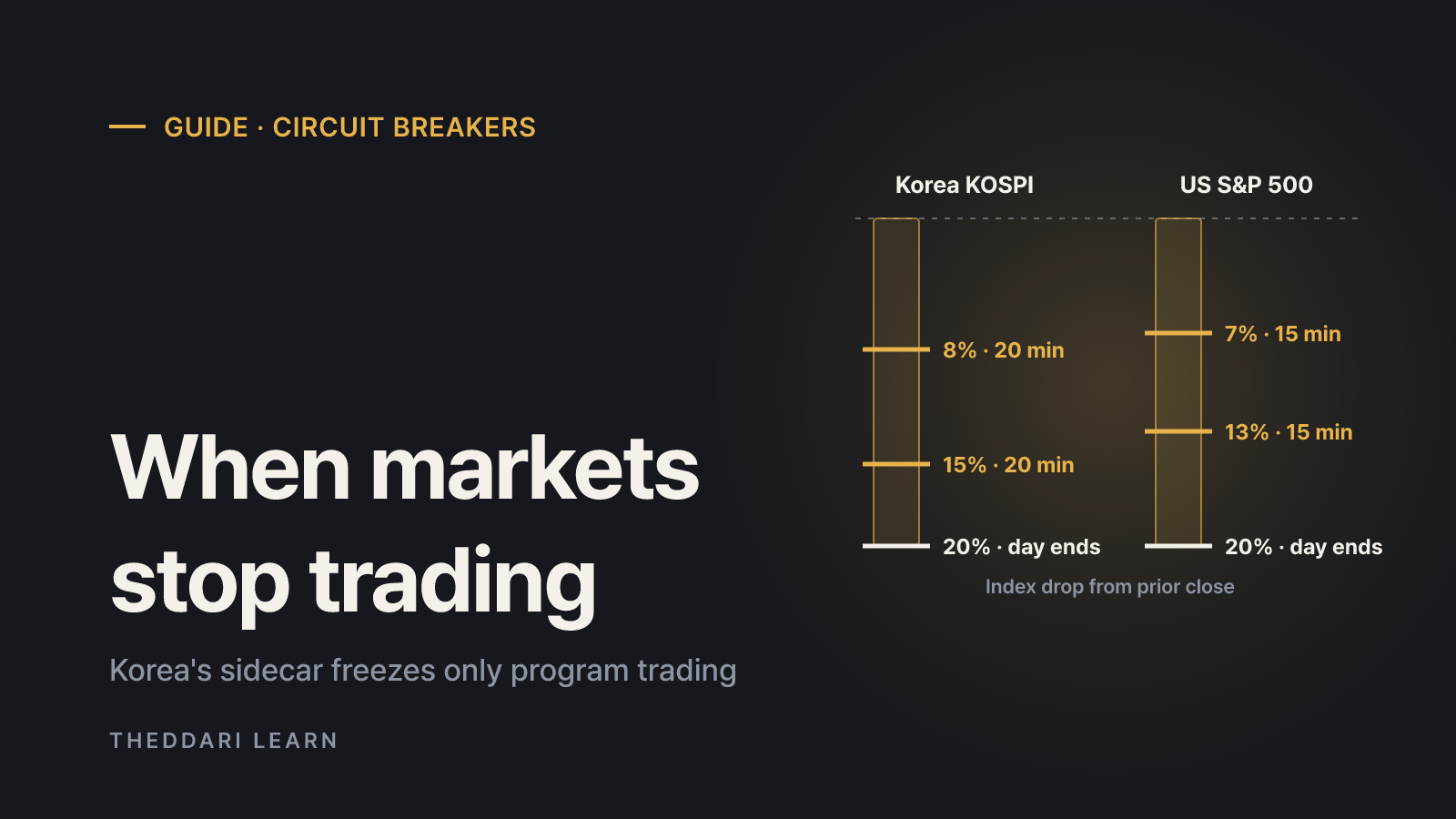
US market-wide circuit breakers halt all trading when the S&P 500 drops 7%, 13% or 20%. Korea uses 8%, 15% and 20% thresholds plus a sidecar that freezes only program trading. Here is how each rule works and what happens to your orders.
 Investing
Pension Withdrawal Order in Korea: How IRP Money Is Taxed
When you take part of the money out of a Korean pension savings account or IRP, the law decides which money left first, and each part is taxed differently. A November 2026 guide to the withdrawal order, rates and exceptions for Korean tax residents.