Contents7 sections
Short answer: stablecoin financial stability risks are real but not yet system-breaking. Dollar stablecoins are still small next to the US banking system and the Treasury market, but their links to both are growing fast. The concern is not the price of any single token; it is what happens to bank funding and to short-term government debt when hundreds of billions of dollars sit in instruments that promise instant redemption at par. This guide summarizes research from the Federal Reserve, the Bank for International Settlements (BIS), Brookings and the Bank of Korea, as of November 2026.
What are stablecoin financial stability risks?
A fiat-backed stablecoin promises to swap each token for one dollar. To keep that promise, the issuer holds reserves such as cash, bank deposits, Treasury bills and repo. According to Brookings, dollar stablecoins outstanding grew from about $25 billion in 2020 to nearly $280 billion at the end of 2025. The San Francisco Fed estimates that Tether (USDT) and USD Coin (USDC) made up more than 80% of the market as of mid-August 2026.
That structure looks a lot like a bank or a money market fund: money that users treat as cash is invested in other assets. If confidence slips, everyone may try to redeem at once. Regulators focus on three ways that kind of run could spill outside crypto:
- Bank funding: deposits move into stablecoins, changing how much funding banks have and how stable it is.
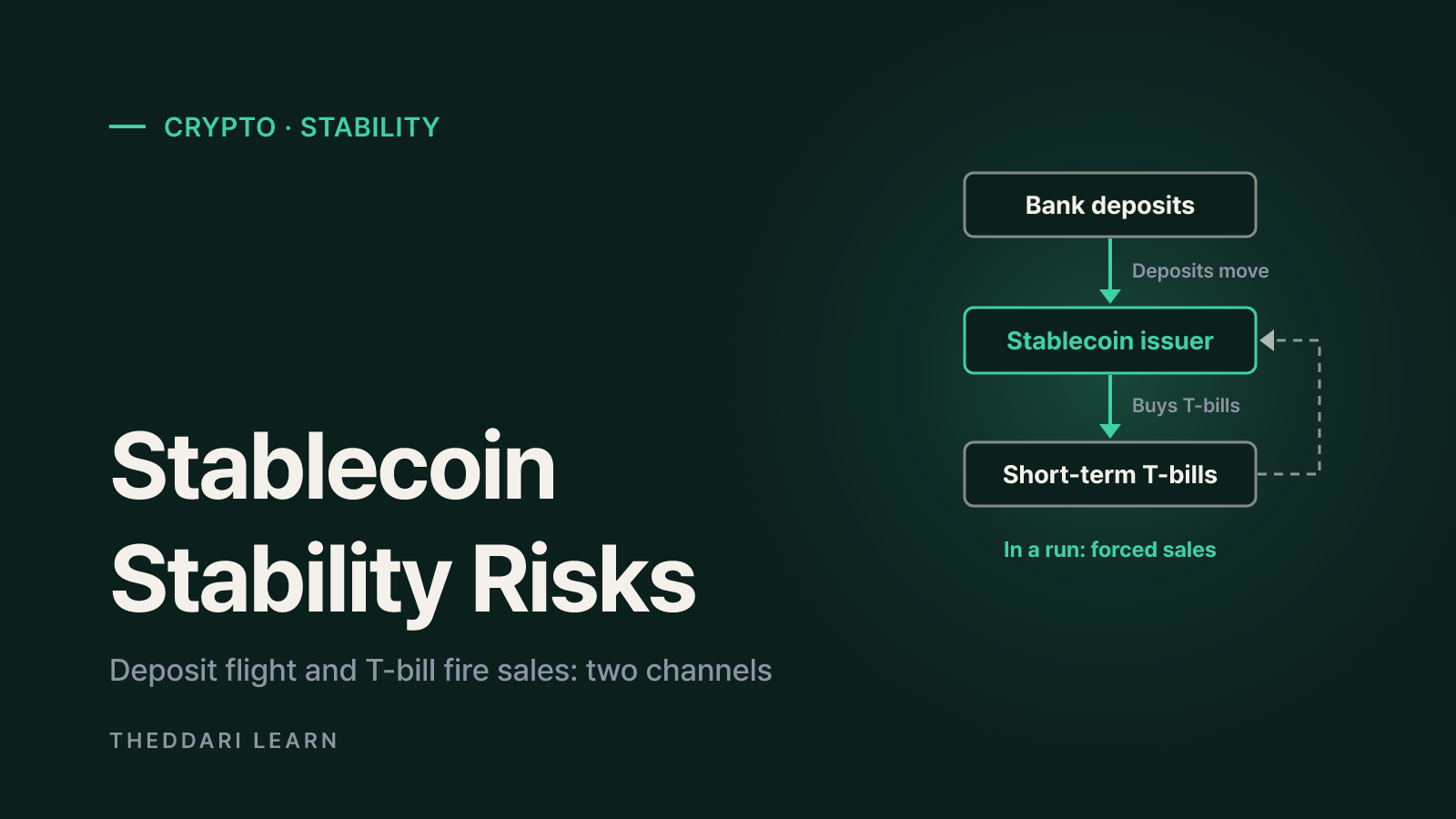
- Treasury market: issuers become large buyers of short-term bills, and potential forced sellers when redemptions spike.
- Payments and operations: deeper ties with wallets, card networks and banks let outages or depegs travel into everyday payments.
Bank deposits: drained, recycled or reshaped?
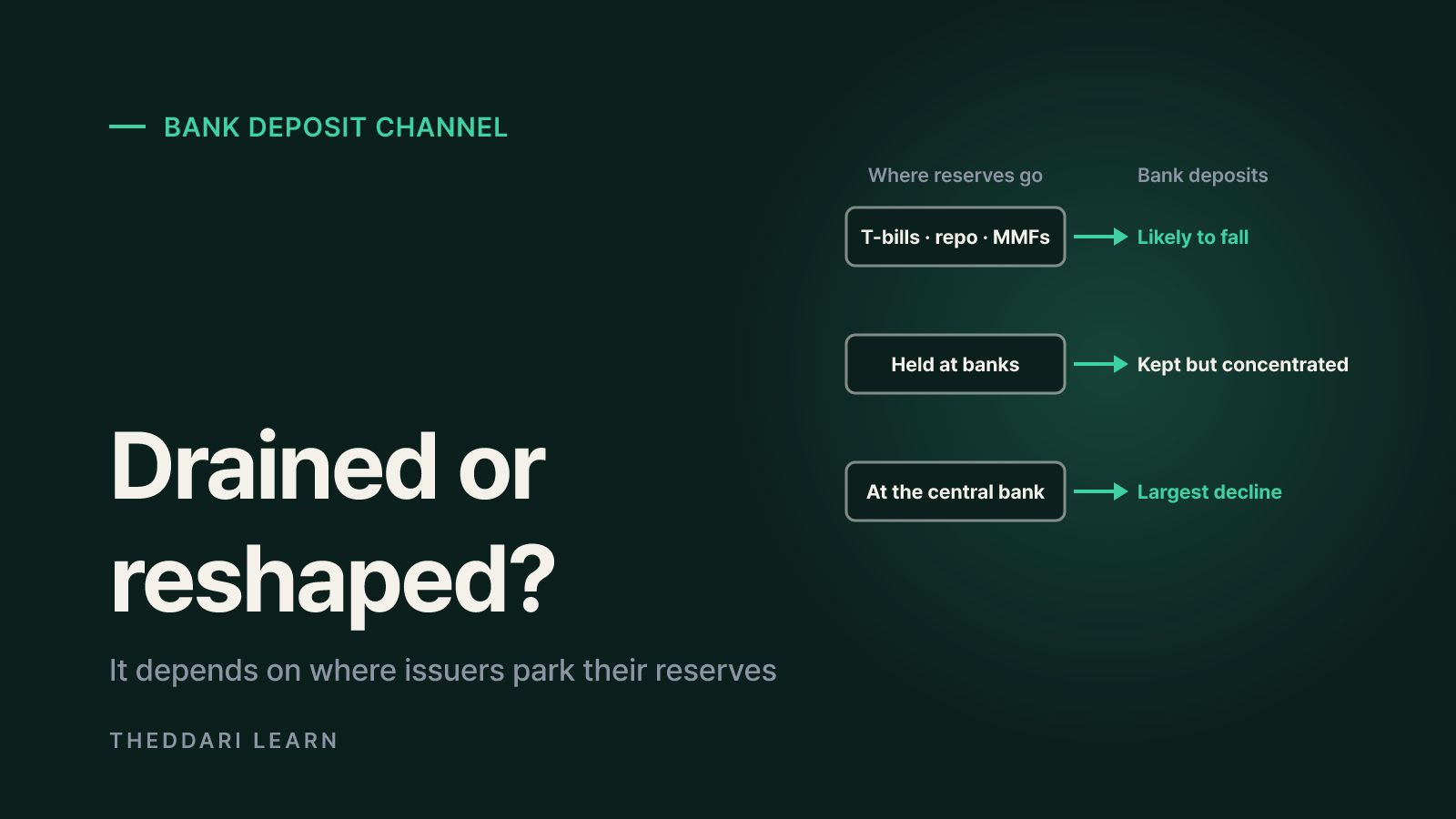
A December 2025 Fed note argues that stablecoins can reduce, recycle or restructure bank deposits rather than simply draining them. The key variable is where issuers keep their reserves.
Mostly T-bills, repo, money funds
- Total bank deposits
- Likely to fall
- What changes for banks
- Less loanable funding, higher funding costs
Mostly bank deposits
- Total bank deposits
- Roughly unchanged
- What changes for banks
- Small insured balances become large uninsured issuer deposits at a few banks
Directly at the central bank
- Total bank deposits
- Largest decline
- What changes for banks
- Money bypasses banks; outflows can accelerate in stress
Issuers differ a lot. The same note estimates Circle keeps around 13% of USDC reserves in bank deposits, while Tether holds close to none. That is why any single number for "deposits lost to stablecoins" should be read with caution.
Why lending can fall more than deposits
Banks fund long-term loans with short-term deposits, so an outflow can force a larger cut in lending to keep liquidity and capital ratios in line. The Fed note cites research by Kundu, Park and Vats (2025) estimating that a $1 drop in deposits leads to a $1.26 drop in lending. Large firms can often tap bond markets instead; smaller borrowers usually feel the squeeze first.
Size estimates vary with who is making them. US commercial bank deposits exceed $18 trillion. The Independent Community Bankers of America argues that interest-paying stablecoins could cost community banks $1.3 trillion in deposits and $850 billion in loans, while Brookings expects aggregate credit to be supported through other channels. Treat industry estimates and neutral research differently.
Stress can flip the direction of flows. The Fed note warns that if issuers could hold reserves directly at the Fed, money might leave banks for the central bank exactly when banks are under pressure. The 2023 Silicon Valley Bank failure showed how fast large uninsured deposits move once confidence cracks.
Treasury demand and fire-sale risk
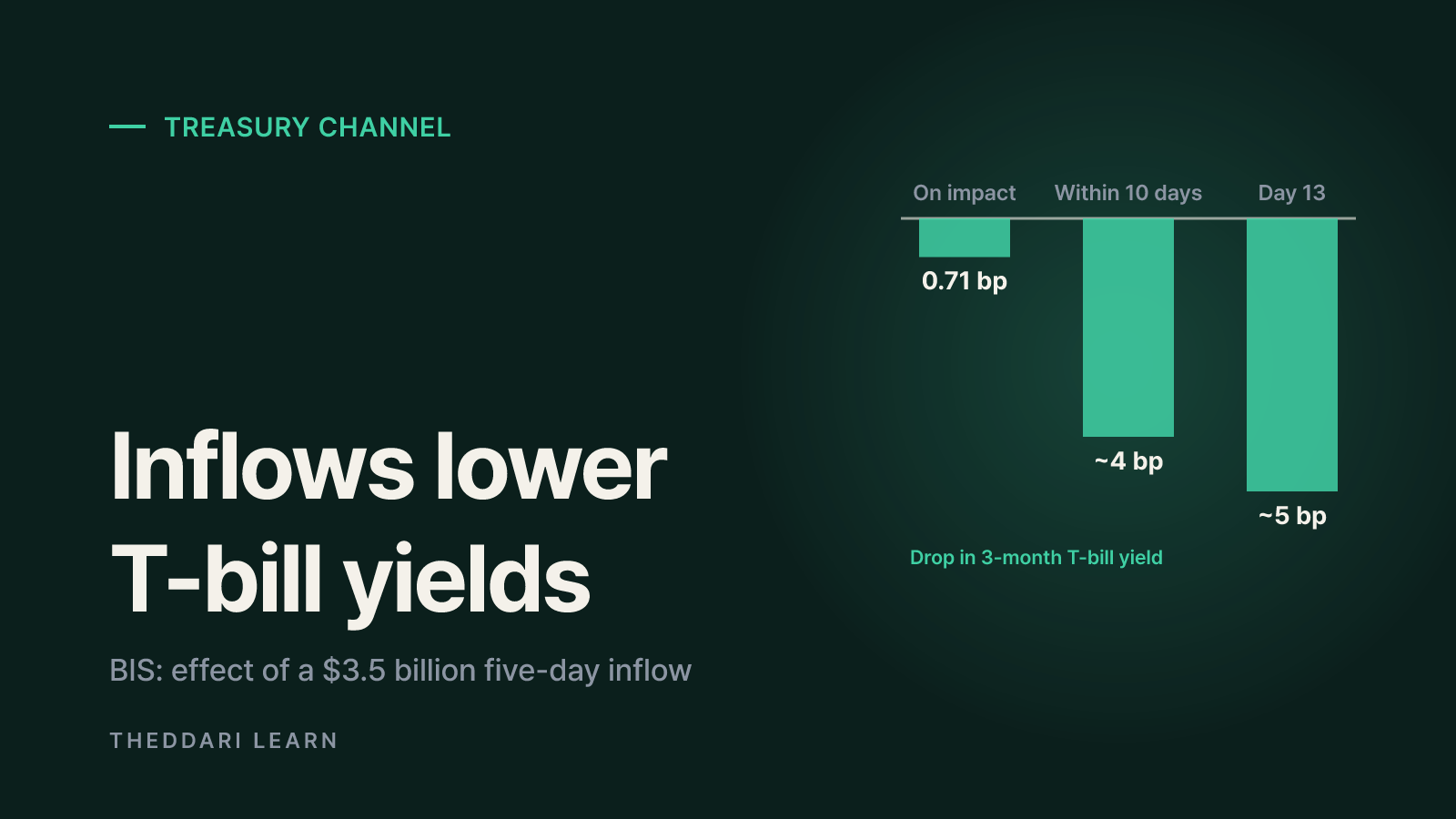
Stablecoin treasury demand is already visible in market data. BIS Working Paper 1270 reports that dollar stablecoins held more than $270 billion in assets as of December 2025 and bought nearly $35 billion of T-bills during 2025, similar to the largest government money market funds.
- A $3.5 billion five-day inflow lowers 3-month T-bill yields by 0.71 basis points on impact and about 4 basis points within 10 days, with a trough of roughly 5 basis points at 13 days.
- The effect is concentrated in short maturities, with little spillover to longer bonds.
- The impact is larger when Treasury market intermediaries are under stress and as the stablecoin sector grows.
The San Francisco Fed finds that Tether and USDC added about $200 billion of Treasury holdings over five years, offsetting more than 40% of China's decline over the same period. If the trend continues, issuer demand for short-term Treasuries could nearly double to about $400 billion by the end of 2030, though that would remain small relative to federal financing needs.
How a run turns into a fire sale
The mechanism that pushes yields down on the way in can push them up on the way out. The BIS authors note their estimates come from a period of steady growth, when issuers could choose when to buy; in a redemption wave they cannot choose when to sell, so outflow effects are probably larger. Worse, the price impact is biggest when Treasury markets are already stressed. The Bank of Korea makes the same point, noting that roughly 80% of dollar stablecoin reserves are in government bonds.
How the GENIUS Act and other regulators respond
The GENIUS Act, enacted in July 2025, requires payment stablecoins to hold at least 1:1 reserves and bans interest paid by issuers. Brookings flags two gaps: eligible reserves include uninsured bank deposits and repo, which can turn illiquid in stress, and the law does not clearly stop exchanges or affiliates from paying rewards, which banks fear will speed deposit flight.
In an October 2025 report, the Bank of Korea listed seven risks of a won stablecoin, including coin runs, weaker monetary policy transmission and reduced bank lending capacity. It proposed bank-led issuance, an inter-agency policy council and parallel use of bank deposit tokens. Korean legislation was not finalized as of November 2026.
The Bank of Korea stresses that safe reserves alone do not prevent runs. When roughly 8% of USDC reserves were trapped at Silicon Valley Bank in March 2023, the coin fell to about $0.88 and redemption requests hit 18% of the market, about $7.8 billion. Fully digital redemptions can move faster than a traditional bank run.
Signals to watch
- 1
Reserve reports
Check issuer attestations for the mix of T-bills, repo, bank deposits and other assets. A rising share of uninsured deposits or riskier assets weakens redemption capacity.
- 2
Sudden supply drops
A sharp fall in circulating supply signals redemptions. Compare it with moves in 3-month T-bill yields over the same days.
- 3
Interest and rewards rules
Rules on exchange or affiliate rewards shape how fast deposits migrate. Follow both GENIUS Act rulemaking and market-structure bills.
- 4
Policy calendar
FOMC meetings and Treasury refunding announcements move short-term rates. Marking them helps separate policy-driven moves from stablecoin flows.

Local market premiums are another clue. When USDT trades well above or below its overseas price on Korean exchanges, it often reflects dollar demand and capital-flow frictions. You can compare those prices on the premium tracker.
The bottom line: stablecoin risks reach beyond token prices into bank funding and the T-bill market. Today the sector is small relative to $18 trillion in bank deposits and the Treasury market, but its growth rate and its one-way behavior in stress are why central banks keep watching. Tracking reserve mix, supply swings, rewards rules and the rate calendar together makes it easier to tell real warning signs from noise.