Contents7 sections
The Social Security 2027 COLA will be set by a formula written into law, not by a policy decision. SSA takes the average Consumer Price Index for Urban Wage Earners and Clerical Workers (CPI-W) for July, August and September 2026, compares it with the third-quarter average from the last year a COLA took effect, and rounds the percentage increase to the nearest tenth of a percent. As of October 13, 2026, the official 2027 figure has not been released. The final input, September 2026 CPI, is listed on the BLS October 2026 release calendar for Wednesday, October 14, at 8:30 a.m. Eastern. This guide covers the U.S. federal program only: the formula, the timeline, how Medicare premiums interact with your raise and what to check once the number is out.
How the Social Security 2027 COLA formula works
According to the SSA Office of the Chief Actuary, a COLA effective for December equals the percentage increase, if any, in average CPI-W from the third quarter of the last year a COLA became effective to the third quarter of the current year. An increase is rounded to the nearest 0.1 percent. If there is no increase, or the rounded result is zero, there is no COLA for that year. The formula can hold benefits flat, but it cannot cut them.
The index matters. SSA's COLA page notes that CPI-W, published monthly by the Bureau of Labor Statistics, is by law the official measure used for the calculation. It is not the same series as the headline CPI-U most news reports quote. Because the two indexes track different household groups, plugging a headline inflation rate into your budget can give you a slightly wrong answer.
A worked example: the 2.8% COLA for 2026
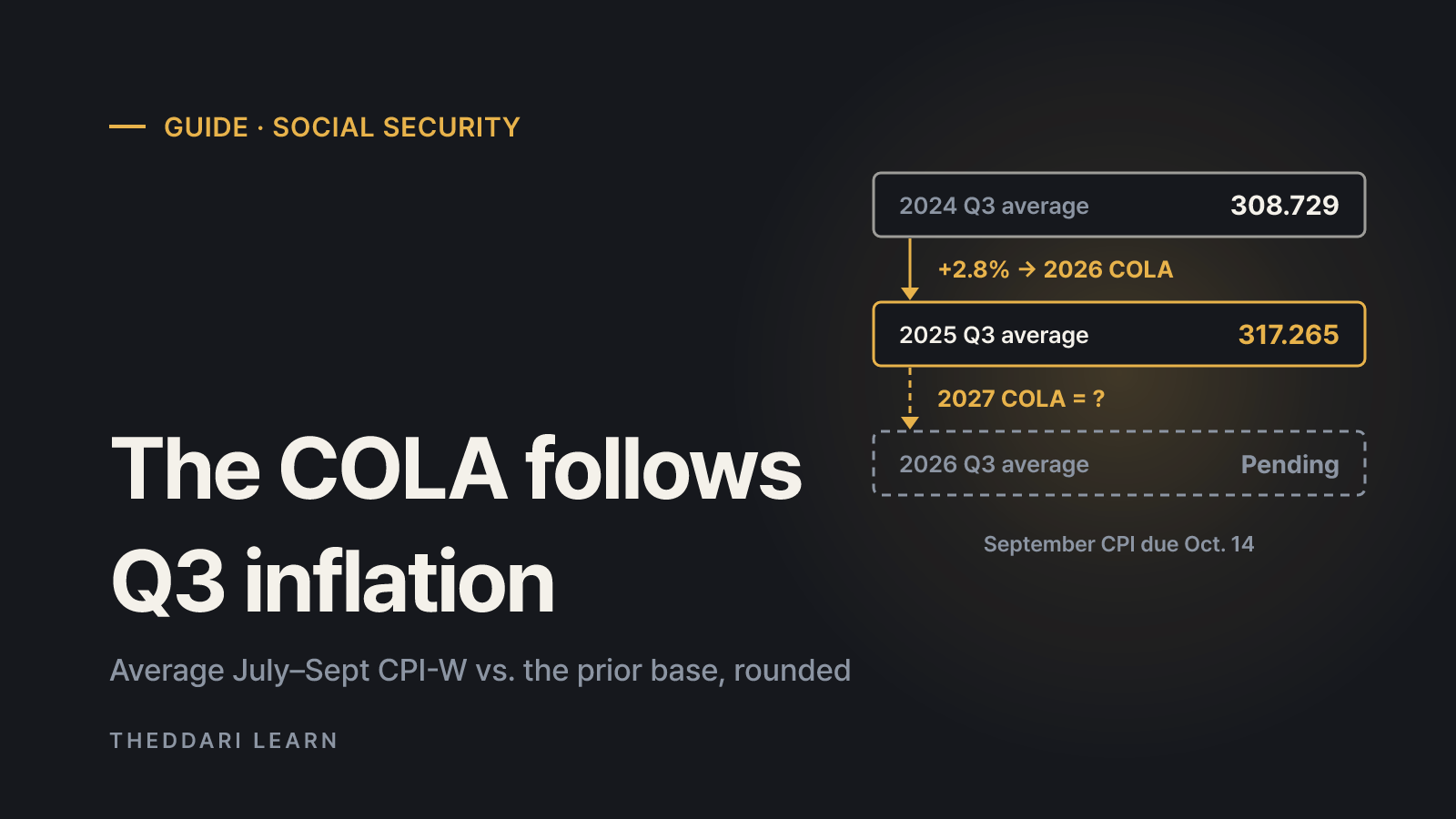
SSA publishes its arithmetic. The third-quarter 2024 CPI-W average was 308.729; the third-quarter 2025 average was 317.265. Dividing the difference by the base gives (317.265 − 308.729) / 308.729 × 100, which rounds to 2.8 percent. That increase applied to December 2025 benefits, which were paid in January 2026.
July
- 2024
- 308.501
- 2025
- 316.349
August
- 2024
- 308.640
- 2025
- 317.306
September
- 2024
- 309.046
- 2025
- 318.139
Q3 average
- 2024
- 308.729
- 2025
- 317.265
Result
- 2024
- Base
- 2025
- 2.8% COLA for 2026
For 2027, the base becomes 317.265, the 2025 average, because 2025 is now the last year a COLA took effect. July and August 2026 index values are already public, so analysts publish estimates. Until the September value is released and SSA confirms the result, any 2027 percentage you see is a projection, not a benefit amount.
Announcement date and when the raise shows up
The COLA announcement follows the September CPI release. If you track U.S. data releases across time zones, the theddari economic calendar lists scheduled indicators in one place. It is a scheduling aid only; it does not forecast the data or market reactions.

July and August CPI-W
- Timing
- Published August and September 2026
- Where to confirm
- BLS CPI releases
September CPI-W
- Timing
- Oct. 14, 2026, 8:30 a.m. ET (scheduled)
- Where to confirm
- BLS release calendar
2027 COLA announced
- Timing
- After the September CPI release
- Where to confirm
- SSA COLA page and press release
SSI January payment
- Timing
- Late December 2026
- Where to confirm
- SSA payment schedule
Social Security increase paid
- Timing
- January 2027 (December 2026 benefits)
- Where to confirm
- Your personal COLA notice
Since 1983, COLAs have taken effect with benefits payable for December, which arrive in January. For SSI, the January payment is normally due on the first, but because New Year's Day is a federal holiday it is paid at the end of December. For the 2026 COLA, increased SSI payments began on December 31, 2025. Statistical release schedules can shift if federal operations are disrupted, so verify the date on the BLS calendar rather than assuming it.
Why your net raise can be smaller than the COLA
The COLA applies to your gross benefit. As a purely arithmetic illustration, a $1,500 monthly gross benefit increased by the 2026 COLA of 2.8 percent rises by $42. What lands in your bank account can differ because of deductions such as Medicare premiums and voluntary federal tax withholding. Your COLA notice, not a back-of-the-envelope estimate, is the authoritative amount.
Medicare Part B premiums
Many beneficiaries have their Medicare Part B premium deducted from Social Security. According to Medicare.gov, the 2026 standard Part B premium is $202.90 a month, or higher depending on income, and the annual deductible is $283; both can change every year. As of October 13, 2026, the 2027 premium has not been officially announced. If it rises, part of your COLA is absorbed by the higher deduction, so wait for both announcements before finalizing a 2027 budget. SSA says Medicare enrollees can see their new benefit amount in December through the mailed COLA notice and the my Social Security Message Center.
Other figures announced alongside the COLA
SSA releases related limits at the same time. For 2026, the taxable maximum is $184,500. The earnings test limit is $24,480 for beneficiaries under full retirement age all year, with $1 withheld for every $2 above it, and $65,160 for those reaching full retirement age in 2026, with $1 withheld for every $3 above it until the month they reach that age. These amounts follow separate formulas, so do not assume they move by the COLA percentage. If you work while collecting benefits, check the 2027 values when they are published.
COLA history: how much the adjustment varies
Congress added automatic COLAs in the 1972 Social Security Amendments, and they began in 1975. Before that, benefit increases required separate legislation. Recent years show how widely the adjustment can swing with inflation.
January 2022
- COLA
- 5.9%
- Note
- Post-pandemic price surge
January 2023
- COLA
- 8.7%
- Note
- Highest in decades
January 2024
- COLA
- 3.2%
January 2025
- COLA
- 2.5%
January 2026
- COLA
- 2.8%
- Note
- 2025 sets the base for 2027
January 2010, 2011, 2016
- COLA
- 0.0%
- Note
- No COLA, not a cut
Past adjustments are not a forecast. Because the COLA relies only on a three-month average of CPI-W, it can diverge from what retirees experience in a full year, especially when health care and housing costs move differently from the CPI-W basket. If you want to see how markets and investors are discussing inflation data, the theddari stock Telegram trends page collects those conversations; community commentary is not a substitute for official figures.
A checklist for beneficiaries
- 1
Get the number from SSA
After the September CPI release, read the 2027 percentage on SSA's COLA page or press release. If early reports disagree, rely on SSA.
- 2
Estimate your gross change
Multiply your current gross monthly benefit by the official percentage for a rough figure. Treat it as an estimate until your notice arrives.
- 3
Factor in Medicare and withholding
When the 2027 Part B premium is announced, adjust for the change in your deduction. Higher-income beneficiaries may pay more than the standard premium.
- 4
Watch for your notice and for scams
Check your my Social Security Message Center for the COLA notice. SSA says it never asks for fees by wire transfer or gift card, so ignore calls or texts that use the COLA as a pretext.
Beneficiaries living outside the United States receive the same COLA percentage, but payment methods, reporting duties for work abroad and taxation depend on the country and any tax treaty. Check SSA guidance for your situation and consult a qualified tax professional where needed.
This AI-written guide reflects public information as of October 13, 2026, and is general information, not investment advice. Confirm the official 2027 COLA, Medicare premiums and your personal benefit amount with SSA, Medicare.gov and your own notice, and consult a professional for tax questions.