Contents7 sections
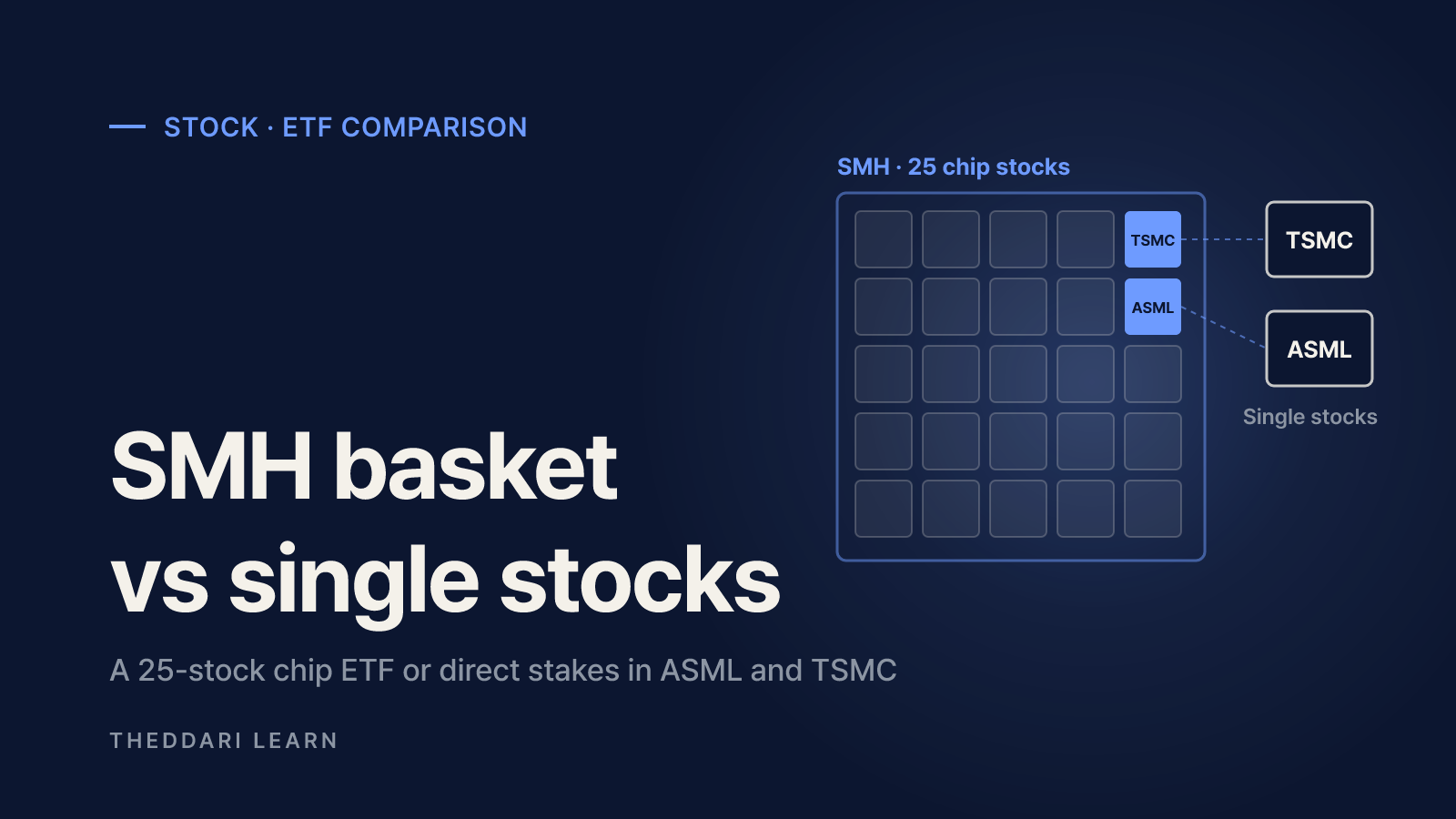
The SMH ETF is VanEck's U.S.-listed semiconductor fund, built to track the MVIS US Listed Semiconductor 25 Index. One share gives you exposure to 25 chip companies listed on U.S. exchanges, from Nvidia to TSMC to ASML. Buying ASML or TSMC directly is a different decision: you take on one company's business, valuation and country risk in full. SMH spreads that across the industry, but it is far more concentrated than its 25-stock count suggests. This guide uses public index data checked in October 2026 to explain the trade-offs. It does not recommend either approach.
How the SMH ETF builds its portfolio
According to MarketVector, the index provider, the index holds the 25 largest and most liquid U.S. exchange-listed companies in the semiconductor industry. A company qualifies only if at least 50% of its revenue comes from semiconductors or semiconductor equipment. The index is modified market-cap weighted: company size drives the weights, but the rules adjust the largest positions instead of letting them grow without limit. Because the filter is a U.S. listing rather than a U.S. headquarters, foreign companies are included through the securities that trade in New York. TSMC enters as a sponsored American depositary receipt (ADR), and ASML enters through its New York registry shares. The exact capping and review rules are spelled out in the index guide linked from the same page.
The top 10 holdings make up about two-thirds of the index
The table below lists the top constituents shown on MarketVector's public page when checked in October 2026. These are index weights. The fund's daily holdings can differ slightly, so use VanEck's holdings file when you need exact figures.
1
- Company
- Nvidia
- Country
- United States
- Index weight
- 19.58%
2
- Company
- TSMC (sponsored ADR)
- Country
- Taiwan
- Index weight
- 9.30%
3
- Company
- Advanced Micro Devices
- Country
- United States
- Index weight
- 5.66%
4
- Company
- Broadcom
- Country
- United States
- Index weight
- 5.35%
5
- Company
- Micron Technology
- Country
- United States
- Index weight
- 4.79%
6
- Company
- Texas Instruments
- Country
- United States
- Index weight
- 4.71%
7
- Company
- Marvell Technology
- Country
- United States
- Index weight
- 4.66%
8
- Company
- Applied Materials
- Country
- United States
- Index weight
- 4.65%
9
- Company
- KLA
- Country
- United States
- Index weight
- 4.60%
10
- Company
- ASML (NY registry shares)
- Country
- Netherlands
- Index weight
- 4.38%
Add those up and the top 10 account for roughly 67.7% of the index. Nvidia alone is about 19.6%, and Nvidia plus TSMC is about 28.9%. ASML sits around 4.4%. Put another way, if you hold $10,000 of SMH, only around $440 is tied to ASML, while close to $2,000 rides on Nvidia. If your interest in SMH started with ASML stock, the fund will not give you the exposure you might expect. Its day-to-day moves are driven far more by Nvidia and TSMC.
Country and sector concentration
MarketVector's country breakdown shows the United States at 79.28% across 19 constituents, Taiwan at 9.30% (one company), the Netherlands at 6.27% (three companies), South Korea at 4.08% (one company) and the United Kingdom at 1.08% (one company). Every constituent is classified as Information Technology. So SMH diversifies across chip companies, but not across sectors, and most of its weight sits in U.S.-domiciled names. In a broad semiconductor downturn, holdings that look different on paper can fall together, because they share the same demand cycle and capital spending trends.
SMH vs individual stocks: ASML and TSMC compared
Owning a single stock means your result depends on one company's execution. Owning SMH means your result depends on the semiconductor cycle and, heavily, on its largest holdings. ASML and TSMC sit at different points in the supply chain, so even between the two of them the drivers differ. The table compares structure, not which choice is better.
What you own
- SMH
- 25 U.S.-listed chip companies
- ASML (direct)
- One chip equipment maker
- TSMC via TSM (direct)
- One contract chip manufacturer (foundry)
U.S. listing form
- SMH
- U.S.-listed ETF
- ASML (direct)
- New York registry shares
- TSMC via TSM (direct)
- Sponsored ADR
Main concentration
- SMH
- Sector and top holdings
- ASML (direct)
- Customer capital spending, export rules
- TSMC via TSM (direct)
- Taiwan location, heavy capital spending
Ongoing costs
- SMH
- Expense ratio plus trading costs
- ASML (direct)
- Trading costs
- TSMC via TSM (direct)
- Trading costs; check any ADR fees
Key documents
- SMH
- Prospectus and daily holdings
- ASML (direct)
- Earnings releases and annual report
- TSMC via TSM (direct)
- Earnings releases and ADR terms
ASML stock: an equipment cycle story
ASML does not make chips. It sells the lithography systems that chipmakers install in their fabs. That means its orders and revenue timing can swing with customers' capital spending plans, including those of TSMC. Export control policy also matters, because restrictions can narrow the set of customers that can receive certain tools. If you buy ASML directly, these company-specific factors hit your position at full weight. Inside SMH, they are diluted to roughly 4% of the fund. Anyone tracking ASML stock closely should read its quarterly results for order intake and regional sales commentary, not just the headline numbers.
TSMC stock: what owning TSM actually means
TSM, the ticker most U.S. investors use for TSMC, is an ADR backed by ordinary shares listed in Taiwan. Before buying, check the ADR ratio, how dividends are converted and paid, and whether your broker passes through depositary fees. The ADR trades during U.S. hours while the underlying shares trade during Taipei hours, so news that lands overnight shows up in one market before the other. You also carry exposure to the Taiwan dollar and to Taiwan-specific geopolitical risk. Since TSMC is already SMH's second-largest constituent, owning both adds up quickly.
Measure the overlap before combining them
Many investors hold SMH alongside a few individual chip names, and look-through math helps. Say you own $10,000 of SMH and $3,000 of TSM. At about a 9.3% index weight, roughly $930 of your SMH is TSMC, so your total TSMC exposure is closer to $3,930 than $3,000. Broad index funds you already own may hold the same large chipmakers as well. Weights change every day, so treat this as an estimate and rerun it with current holdings files.
Costs and risks to compare across semiconductor ETFs
Look up SMH's expense ratio in VanEck's prospectus or fact sheet rather than relying on a third-party summary. That fee is deducted from fund assets every year. Individual stocks have no expense ratio, but each purchase carries trading costs, and managing several positions takes time. The SEC's investor education site, Investor.gov, points out that fees that seem small can add up and take away from what you would otherwise earn. If you invest from outside the United States, add currency conversion costs and local tax treatment, which depend on your country of residence and account type. When comparing SMH with another semiconductor ETF, first confirm whether the two track the same index and hold similar companies.
Volatility is the other big variable. MarketVector lists a one-year volatility of 40.13 for this index, a sign that the sector as a whole can swing widely. A single stock adds company-specific events on top of that. Strong past returns in chip stocks do not tell you what the next period will bring.
- Concentration: the top two names are about 29% of the index, so a few companies can drive overall results.
- Industry cycle: chip demand and capital spending can shift sharply with inventory corrections and the economy.
- Currency: investors who fund purchases in another currency carry exchange-rate risk on top of the U.S. dollar price.
- Policy and geopolitics: export controls and Taiwan-related risk can affect both SMH and the individual stocks.
Track earnings dates and market chatter
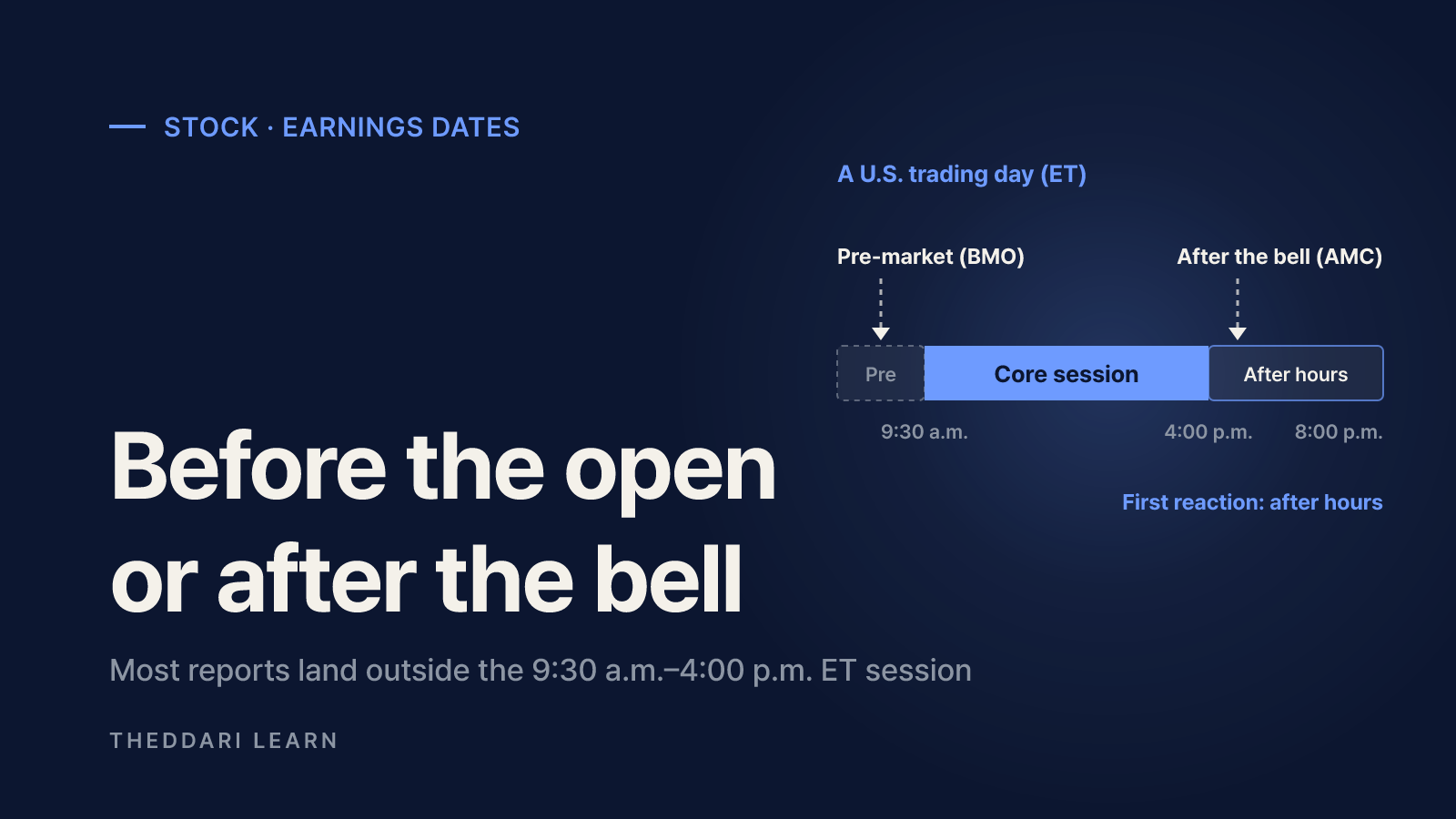
If you own ASML or TSM directly, each quarterly earnings release is a key checkpoint, and SMH can move sharply during the weeks when its largest holdings report. The theddari earnings calendar lists reporting dates for major companies, and the economic calendar shows when interest rate and inflation data are scheduled. These are scheduling tools, not price forecasts, so confirm dates with each company's investor relations page.

To see which chip stories traders are discussing, the theddari Telegram stock trends page summarizes channel activity. More mentions are not a reason to buy. Go back to filings and earnings materials before acting on anything you read there.
A simple framework for choosing between them
- 1
Define the exposure you want
Write one sentence: the whole chip sector, one equipment supplier, or one foundry. A general view on the industry may fit a sector fund better, while a view built on one company's business fits a single stock better.
- 2
Check what you already own
List your funds and stocks, pull their holdings and add up how much is tied to each large chipmaker. The same names often appear in several products.
- 3
Compare total costs
Include the expense ratio, commissions, any ADR fees, currency conversion and taxes in your jurisdiction. Write them down as separate items.
- 4
Set limits in advance
Decide the maximum share of your portfolio for semiconductors, the loss you can tolerate and when you will review the position. Both sector ETFs and single stocks can see deep drawdowns.
In short, the SMH ETF gives you one-ticket exposure to the semiconductor industry but leans heavily on Nvidia and TSMC. Owning ASML or TSMC directly puts one company's risks fully on your books in exchange for expressing a specific view. Neither is right for everyone; the answer depends on what you want exposure to, what you already own and how much volatility you can live with.
This AI-written guide is general information based on public data checked in October 2026 and is not investment advice. It does not recommend buying or selling SMH, ASML, TSMC or any other security. Index weights, fund fees and tax rules change, so confirm current details in official issuer and company documents and consider your own circumstances.