Samsung Special Dividend: Record Date, Ex-Date and Tax
How to qualify for a Samsung special dividend: what is confirmed as of November 2026, year-end record and ex-dividend dates, and Korean dividend tax.
Contents7 sections
Key takeaways
- As of November 2026, the only confirmed Samsung special dividend is the Q3 payout of KRW 4,601 per share (record date September 30, 2026; payment scheduled November 27).
- The 'January special dividend' is a late-January 2027 board decision on KRW 55–75 trillion of remaining funds, split between dividends and buybacks.
- Last year's year-end dividend was approved in January 2026 but used a December 31, 2025 record date, so buying after the announcement was too late.
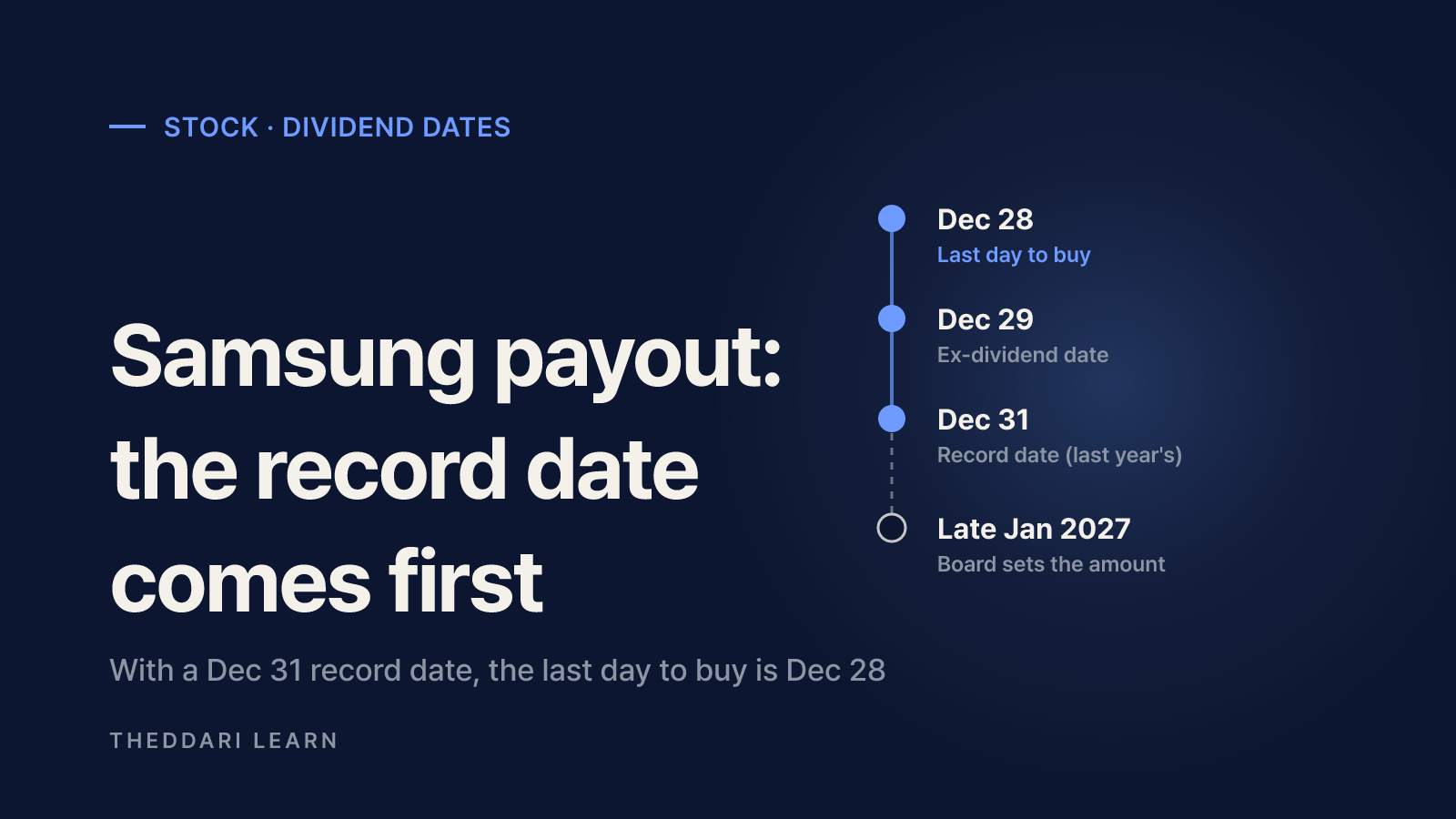
- If the 2026 year-end record date is again December 31, Korea's T+2 settlement and the year-end market holiday make December 28 the last day to buy and December 29 the ex-dividend date.
- Korean residents usually have 15.4% withheld. Above KRW 20 million of yearly financial income, comprehensive tax or a 14–30% high-dividend separate tax option applies.
To receive a samsung special dividend, you must be on Samsung Electronics' shareholder register on the record date, and because Korean stock trades settle two business days after the trade (T+2), you have to buy before that date. As of November 2026, the only confirmed special payout is the Q3 2026 dividend of KRW 4,601 per share. The 'January special dividend' discussed in Korean YouTube videos and on forums is a plan: Samsung's board will decide the remaining 2026 shareholder return in late January 2027, and no amount or record date has been filed yet. This guide covers Samsung shares (005930 common, 005935 preferred) listed on the Korea Exchange and held through a regular brokerage account.
Samsung special dividend: what is confirmed and what is not
Samsung's October 29, 2026 cash dividend filing set the Q3 dividend at KRW 4,601 for both common and preferred shares, roughly KRW 30 trillion in total. The disclosed dividend yield was 1.7% on common and 2.2% on preferred. Under Samsung's 2024–2026 policy the regular quarterly dividend pool is about KRW 2.45 trillion, so most of this payout is an extra return on top of the regular dividend. That is why Korean media call it a special dividend.
FY2025 year-end
- Record date
- Dec 31, 2025
- Per common share
- KRW 566 (preferred 567)
- Decision / payment
- Board Jan 28, 2026; paid within a month of the AGM
- Status
- Paid
Q3 2026
- Record date
- Sep 30, 2026
- Per common share
- KRW 4,601 (preferred same)
- Decision / payment
- Board Oct 29, 2026; payment scheduled Nov 27
- Status
- Confirmed
Remaining 2026 return
- Record date
- Not filed
- Per common share
- Not decided
- Decision / payment
- Board meeting planned for late Jan 2027
- Status
- Planned
According to Samsung's Q3 2026 earnings release, the company expects a total 2026 shareholder return of KRW 90–110 trillion. After KRW 35 trillion already paid or committed, KRW 55–75 trillion remains, and Samsung said that remainder will include cash dividends and a substantial share buyback and cancellation. Claims that the full amount will be paid as cash, or that a specific per-share figure is locked in, are not supported by any filing so far.
Per-share forecasts circulating online are analyst estimates or personal calculations. Treat them as guesses until the board's decision appears on DART and on Samsung's investor relations disclosure page.
Record date vs ex-dividend date in Korea
The record date is the day the company fixes the list of shareholders who will be paid. The Korea Exchange rule on ex-dividend measures explains that regular trades settle on the third day counting the trade date, so the exchange marks shares ex-dividend from the trading day before the record date. Put simply, the last day to buy is the trading day before the ex-dividend date. This is the same idea as the US ex-dividend rule, but Korean holidays shift the calendar.
Why a January decision can still use a December record date
This is the part most investors miss. In the FY2025 year-end filing, the board decided the dividend on January 28, 2026, yet the record date was December 31, 2025. The filing also notes the board added KRW 1.3 trillion to the regular quarterly amount, bringing the payout to about KRW 3.75 trillion. If Samsung follows the same structure for 2026, anyone who buys after the late-January announcement will miss that payout. Since 2023, Korean companies may set the record date after the dividend decision if their articles of incorporation allow it, so watch for a record-date notice in December rather than assuming.
Thu, Dec 24
- Settlement (T+2)
- Tue, Dec 29
- If record date is Dec 31
- Eligible
Mon, Dec 28
- Settlement (T+2)
- Wed, Dec 30
- If record date is Dec 31
- Eligible (last day to buy)
Tue, Dec 29
- Settlement (T+2)
- Settles in January 2027
- If record date is Dec 31
- Not eligible (ex-dividend date)
Wed, Dec 30
- Settlement (T+2)
- Settles in January 2027
- If record date is Dec 31
- Not eligible
The table skips weekends, the December 25 Christmas holiday and the December 31 year-end market closure. A December 31 record date is an assumption based on last year, not a filed fact, so recheck the dates once Samsung publishes its notice. The exchange also announces year-end ex-dividend schedules in December.
What happens to the share price on the ex-date
The exchange applies the ex-dividend measure so the price reflects that new buyers no longer get the payout. Shares therefore start trading without the dividend right on the ex-date, and a large special dividend can mean a visible price adjustment. Buying only to collect the dividend and selling right after can lose money once price moves, trading costs and tax are counted.
How to estimate your payout
- 1
Find the per-share amount
Open the 'Decision on Cash Dividend' filing on DART or Samsung's IR site and note the common and preferred amounts separately.
- 2
Multiply by shares held on the record date
Only shares settled by the record date count. Shares bought on or after the ex-date do not.
- 3
Subtract withholding
For Korean residents in a regular account, 14% national income tax plus 1.4% local income tax is withheld. Rounding can shift the result by a few won.
- 4
Add up your annual financial income
Combine all dividends and interest received in the calendar year and check the KRW 20 million threshold.
Example: 100 common shares held on September 30, 2026 earn 100 × KRW 4,601 = KRW 460,100 before tax. About KRW 70,855 (15.4%) is withheld, leaving roughly KRW 389,245. To pass KRW 20 million from the Q3 dividend alone you would need about 4,347 shares; interest income lowers that number.
Dividend tax in Korea: 15.4% and the KRW 20 million line
The National Tax Service withholding table lists 14% as the standard withholding rate on dividends paid to resident individuals; local income tax of 10% of that brings the total to 15.4%. If your combined interest and dividends stay at or below KRW 20 million a year, withholding usually settles the tax. Above that, the excess can be added to wages or business income in the May comprehensive income tax return, where progressive rates apply.
High-dividend company separate taxation (dividends paid from 2026)
Korea's amended Restriction of Special Taxation Act, summarized by the Ministry of Government Legislation, lets residents tax dividends from companies that meet payout-ratio and dividend-growth tests separately at 14% to 30% instead of adding them to comprehensive income. It applies to dividends paid on or after January 1, 2026. For investors well above the KRW 20 million line, the gap versus top comprehensive rates can be meaningful.
- Whether Samsung qualifies as a high-dividend company for a given year depends on filed criteria; it is not automatic for large caps.
- The option is chosen when filing the comprehensive income tax return, not at payment. Check Hometax guidance before filing.
- Non-residents are taxed under Korea's non-resident withholding rules and any applicable tax treaty; the separate taxation option is for residents.
- Dividends received inside Korean tax-advantaged accounts such as ISA or pension savings accounts follow those accounts' own rules.
How to verify a dividend claim
- Search DART or Samsung's IR 'Management Information Disclosure' page for a 'Decision on Cash Dividend' filing and read the per-share amount, record date and payment date.
- If a record-date notice is filed, recalculate the last buy date from that notice.
- Put Samsung's results date on your calendar; the late-January 2027 board meeting is likely to sit close to full-year earnings.
- When Telegram channels or blogs repeat a number, compare it with the filing and mark anything not in the filing as an estimate.
- After payment, confirm the actual tax on your broker's dividend statement and withholding receipt.

To see how fast a Samsung dividend story is spreading among Korean retail investors, the stock Telegram trends page tracks mentions. Use it to find claims worth checking, not as confirmation.
In short: the confirmed Samsung special dividend is the Q3 2026 KRW 4,601 payout, and the next decision comes from the board in late January 2027. If the year-end record date is again December 31, you must buy by December 28, 2026, accept the ex-date price adjustment, and plan for 15.4% withholding and the KRW 20 million financial income threshold.
Frequently asked questions
When will Samsung announce its next special dividend?
Can I buy Samsung shares after the January announcement and still get the dividend?
Do foreign investors pay the same Korean dividend tax?
Is the preferred share dividend the same as the common share dividend?
Sources and references
- 1Samsung Electronics IR disclosure: Decision on cash dividend (Oct 29, 2026, Q3)(opens in a new tab)www.samsung.com
- 2Samsung Electronics IR disclosure: Decision on cash dividend (Jan 29, 2026, FY2025 year-end)(opens in a new tab)www.samsung.com
- 3Samsung Newsroom Korea: Q3 2026 earnings release (shareholder return)(opens in a new tab)news.samsung.com
- 4Korea Exchange: Ex-dividend and ex-rights measures (KOSPI market rules)(opens in a new tab)regulation.krx.co.kr
- 5Ministry of Government Legislation: Promulgation of 35 tax and other bills incl. dividend separate taxation(opens in a new tab)www.moleg.go.kr
- 6National Tax Service: Withholding tax rates for residents and non-residents(opens in a new tab)www.nts.go.kr
Related articles
 Stocks
Baidu AI Hype Warning: Metrics for China AI Stock Investors
At the APEC CEO Summit in Shenzhen on Nov. 17, 2026, Baidu's Robin Li and Xiaomi's Lei Jun said few companies are making money from AI yet. Here is how to test that claim against Baidu's own Q3 numbers.
 Stocks
Pre-Market Trading and After-Hours Moves, Explained
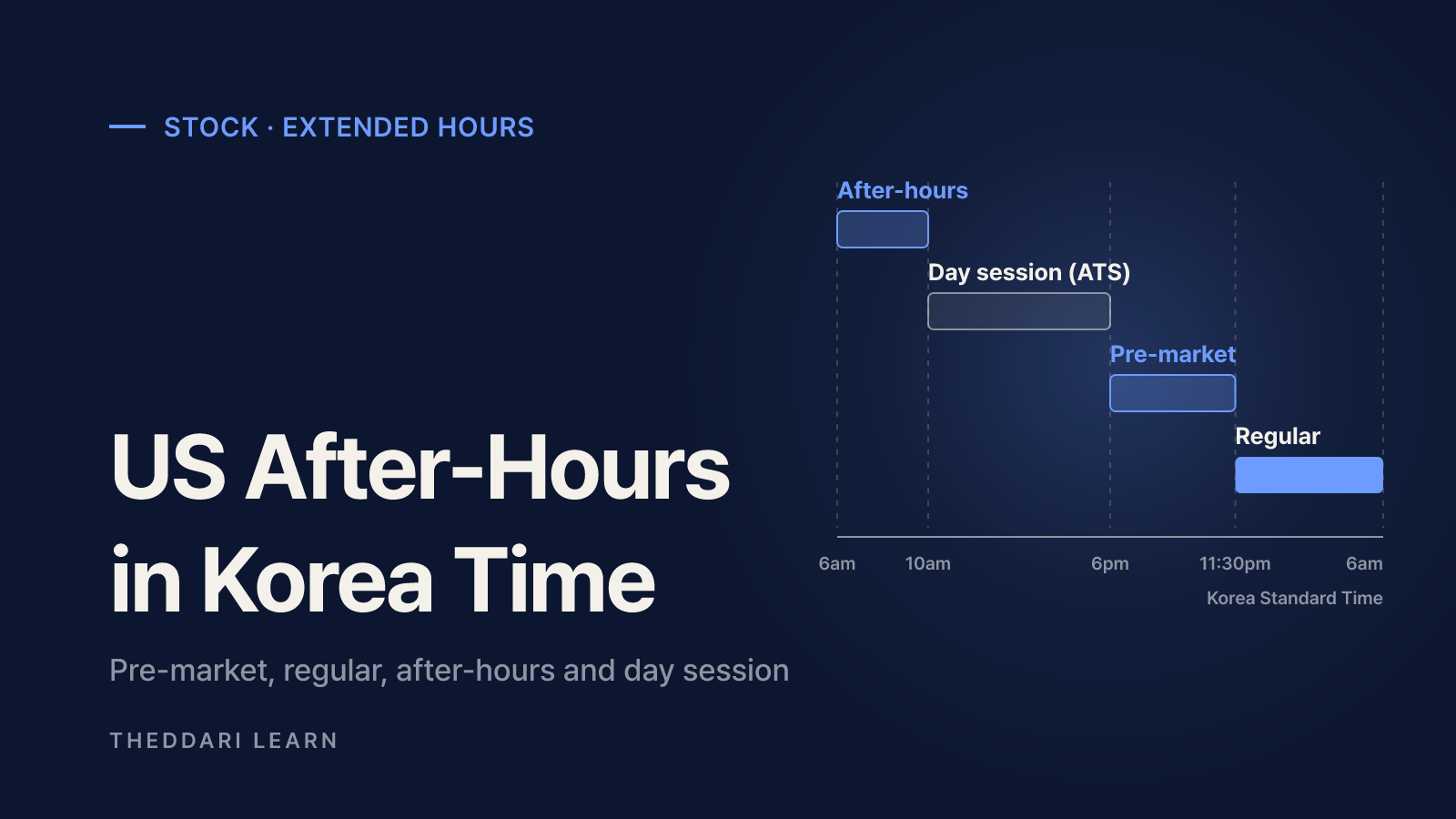
An after-hours drop is usually measured against the last official close, set by a small number of trades. Learn the session times, how to read the move, and what changes for investors trading US stocks from Korea.
 Stocks
Jensen Huang Return Petition: Can Staff Reinstate a CEO?
After Jensen Huang resigned as Nvidia CEO, employees pushed for his return. This guide explains what an employee petition can and cannot do, how board and shareholder power works under Delaware law, and why the 2023 OpenAI reversal is a weak template.