Pre-Market Trading and After-Hours Moves, Explained
How pre-market trading and after-hours sessions work, what 'down 2% after hours' measures, why thin liquidity distorts it, and how Korean brokers route orders.
Contents8 sections
- Pre-market trading and after-hours sessions: the schedule
- How to read an after-hours price move
- Why extended-hours prices can be misleading
- Trading US stocks from Korea outside regular hours
- Nasdaq 23/5 trading from December 6, 2026
- Checklist before an extended-hours order
- Frequently asked questions
- Sources and references
Key takeaways
- US regular trading runs 9:30 a.m. to 4:00 p.m. Eastern Time; Nasdaq's extended sessions currently run 4:00 to 9:30 a.m. and 4:00 to 8:00 p.m. ET.
- A move such as 'down 2% after hours' is normally measured against the official 4:00 p.m. close, and it does not set the next day's opening price.
- Extended-hours prices can be exaggerated by thin liquidity, wide bid-ask spreads and unlinked venues where the NBBO best-price requirement does not apply.
- Korean brokers resumed a daytime US stock session on November 4, 2025, routed through alternative trading systems with limit-order and cancellation conditions.
- Nasdaq says it plans to start 23-hour, five-day trading on Sunday, December 6, 2026 at 9 p.m. ET, with a daily one-hour pause from 8 to 9 p.m. ET.
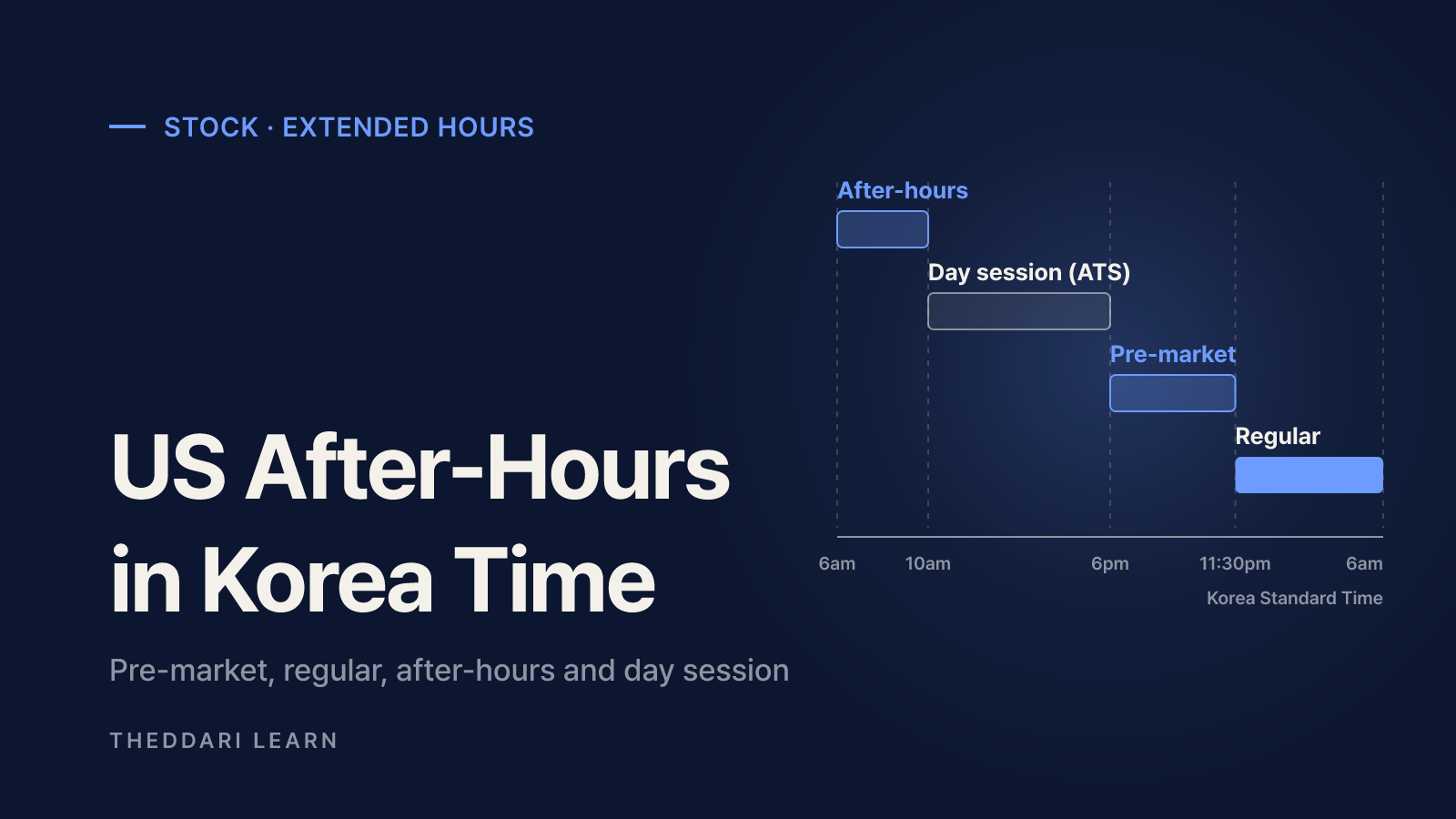
Pre-market trading is the session before the US stock market's regular open, and after-hours trading is the session after the close. As of November 2026, the regular session runs from 9:30 a.m. to 4:00 p.m. Eastern Time (ET), while Nasdaq's extended sessions run from 4:00 to 9:30 a.m. and from 4:00 to 8:00 p.m. ET. When a headline says a stock is "down 2% after hours," that figure is almost always measured against the official 4:00 p.m. close, and it comes from a market with far fewer participants. This guide explains how the sessions fit together, how to read an extended-hours move, and what changes for investors who trade US stocks through brokers in South Korea.
Pre-market trading and after-hours sessions: the schedule
The SEC's investor bulletin defines regular trading hours as 9:30 a.m. to 4:00 p.m. ET and calls anything outside that window extended-hours trading. The length of those sessions varies by exchange and venue. FINRA describes pre-market trading as typically running from 7:00 to 9:30 a.m. ET, while Nasdaq currently operates extended trading from 4:00 a.m. FINRA also notes that overnight trading between 8:00 p.m. and 4:00 a.m. ET has more recently become available to retail investors for certain stocks.
Pre-market
- Eastern Time
- 4:00-9:30 a.m.
- Korea Standard Time (Nov 2026)
- 6:00-11:30 p.m.
- Notes
- Nasdaq hours; brokers may support less
Regular session
- Eastern Time
- 9:30 a.m.-4:00 p.m.
- Korea Standard Time (Nov 2026)
- 11:30 p.m.-6:00 a.m.
- Notes
- Official open and close are set here
After-hours
- Eastern Time
- 4:00-8:00 p.m.
- Korea Standard Time (Nov 2026)
- 6:00-10:00 a.m.
- Notes
- Many Korean brokers stop earlier
Korean daytime session
- Eastern Time
- Overnight US hours
- Korea Standard Time (Nov 2026)
- 10:00 a.m.-5:30 or 6:00 p.m.
- Notes
- Broker service routed to an ATS
Korea does not observe daylight saving time, so every Korean-time figure shifts one hour earlier between the second Sunday of March and the first Sunday of November. Your broker's window is what actually matters: the exchange may be open while your broker is not accepting orders for that session.
How to read an after-hours price move
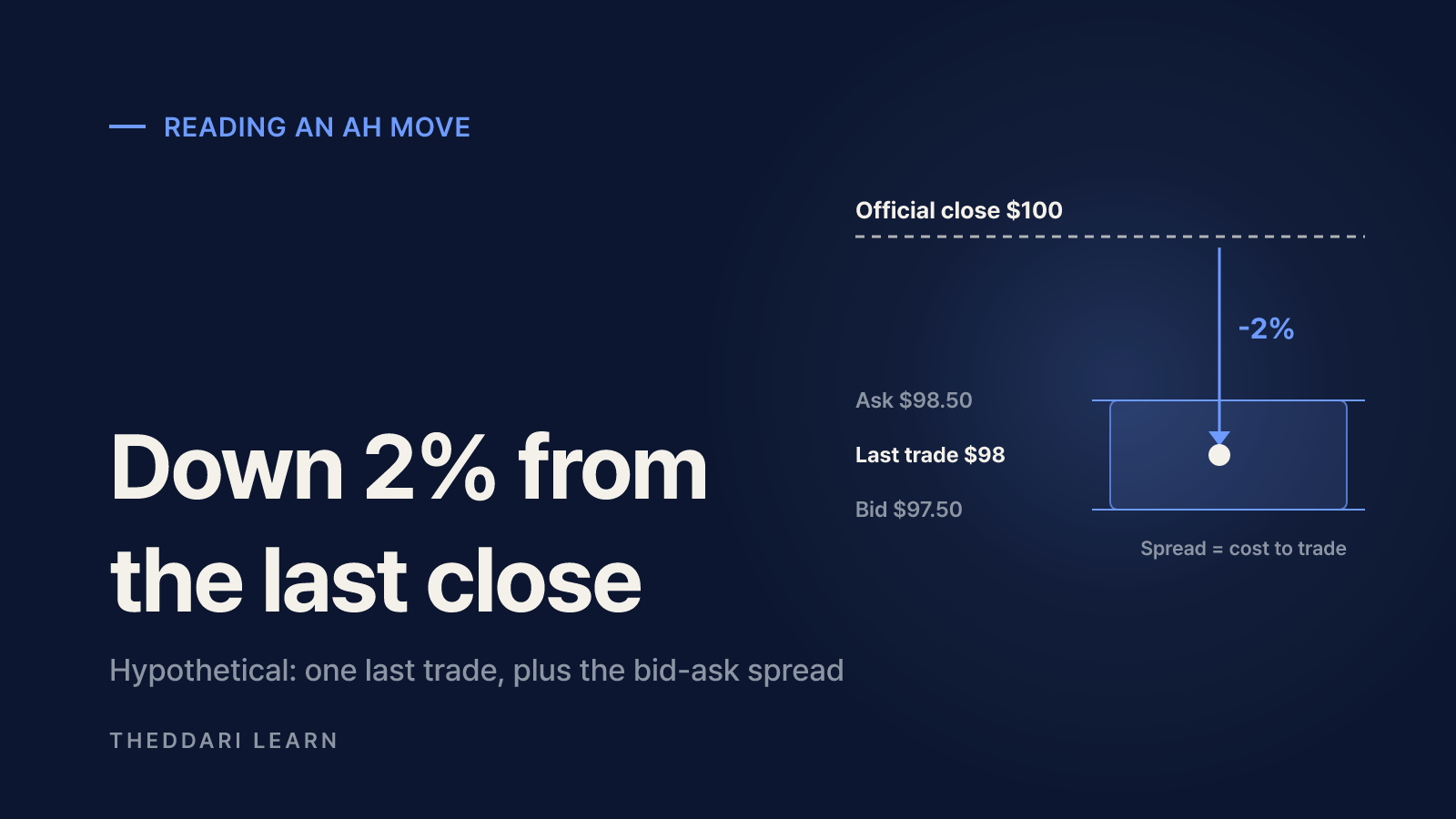
Start with the reference price. Most apps calculate extended-hours change from the prior official close; Shinhan Securities, for example, states that its daytime-session price change is measured against the previous regular-session close. In a hypothetical case where a stock closes at $100 and the latest after-hours trade prints at $98, the screen shows a 2% decline. That tells you the most recent trade happened at $98. It does not tell you how many shares changed hands or whether you could sell at that price right now.
FINRA is explicit that extended-hours trading does not change the exchange's official closing price, which funds use to value their holdings, and does not determine the next day's opening price. The open is set by supply and demand when the market opens. Nasdaq says its Opening and Closing Crosses remain in place, and the Closing Cross establishes the official close for Nasdaq-listed securities. An after-hours drop is an early reaction by a subset of traders, not a settled verdict.
- Confirm the baseline: is the percentage against the prior close or the start of the session?
- Check volume: compare extended-hours volume and the size of the last trade with a normal regular session.
- Measure the spread: in a hypothetical quote of $97.50 bid and $98.50 ask, an immediate round trip costs close to a dollar per share.
- Match the move to a cause: look for an earnings release, company filing or scheduled economic data rather than relying on social media summaries.
Earnings are the most common driver of big extended-hours moves because many US companies report right after the close or before the open. The theddari earnings calendar helps you see which reports are scheduled, and the economic calendar lists data releases such as inflation and jobs figures. Both tools tell you when an event is due; neither predicts how a price will react.

Why extended-hours prices can be misleading
The SEC lists the main risks: lack of liquidity, higher volatility, prices that may not match the regular session, unlinked markets, news announcements, wider quote spreads, different order handling and competition with professional traders who often have more information. Some stocks may have no active market makers, and some may not trade at all.
Participants
- Regular session
- Many, with strong price competition
- Extended hours
- Fewer; a handful of trades can move the price
Bid-ask spread
- Regular session
- Usually narrow
- Extended hours
- Often wide, or no quote
Best-price rule (NBBO)
- Regular session
- Brokers generally must fill at the NBBO
- Extended hours
- NBBO is not published, so the rule does not apply
Venue linkage
- Regular session
- Markets are linked
- Extended hours
- Systems are not linked; prices can differ
Volatility controls
- Regular session
- Standard mechanisms apply
- Extended hours
- Some may be limited or unavailable
FINRA adds that orders may be filled partially or not at all, and gives the example of a company whose shares fall sharply after disappointing earnings, only for trading to become smoother once investors absorb the results and the regular session resumes. That is why a single extended-hours percentage is a weak basis for concluding what "the market" thinks.
Trading US stocks from Korea outside regular hours
Investors in South Korea reach US pre-market and after-hours sessions through the overseas-stock accounts at local brokers. Korean brokers also offer a daytime session, often called day market, which covers the US overnight hours. After a suspension in August 2024, brokers including KB Securities and Shinhan Securities announced that the service would resume on November 4, 2025. Unlike pre-market and after-hours orders, daytime-session orders execute on an alternative trading system (ATS) rather than a national exchange.
Daytime session (standard time, KST)
- KB Securities
- 10:00 a.m.-6:00 p.m.
- Shinhan Securities
- 10:00 a.m.-5:30 p.m.
After-hours ends (KST)
- KB Securities
- 9:50 a.m.
- Shinhan Securities
- 9:30 a.m.
Order types
- KB Securities
- Check broker rules
- Shinhan Securities
- Limit orders only
Unfilled daytime orders
- KB Securities
- Converted to pre-market orders
- Shinhan Securities
- Cancelled at session end
Venue
- KB Securities
- ATS
- Shinhan Securities
- FINRA-approved ATS
Both brokers warn that daytime trading has limited participants and thin volume, so prices can be temporarily distorted and a matching limit price may still go unfilled. They also state that executed trades can be cancelled because of ATS issues or corporate actions such as stock splits. Shinhan notes that some stocks may have limited or no quotes. If you track how Korean-language investor channels react to overnight moves, the theddari Telegram stock trends page shows what is circulating, but confirm any claim against an official filing.
Nasdaq 23/5 trading from December 6, 2026
In an October 23, 2026 explainer, Nasdaq said it will expand US equity trading to 23 hours a day, five days a week, beginning Sunday, December 6, 2026 at 9:00 p.m. ET. Trading will run from Sunday evening through 8:00 p.m. ET on Friday, with a one-hour maintenance pause from 8:00 to 9:00 p.m. ET each weekday. US market holidays still apply, and the opening and closing crosses stay unchanged. Nasdaq also says most liquidity is still expected to concentrate in traditional US hours. Longer exchange hours do not automatically change how your broker routes orders, so check your broker's own announcement before assuming the new session is available to you.
Checklist before an extended-hours order
- Know which price the percentage change is measured against.
- Compare extended-hours volume and trade size with the regular session.
- Read the current bid and ask, and set a limit price you can accept.
- Confirm your broker's session times, allowed order types and whether unfilled orders carry over or cancel.
- Understand that daytime-session trades on an ATS can be cancelled after execution.
- Verify the news behind the move against an official release or filing.
Extended-hours trading lets you respond to news sooner, but you accept prices set by fewer participants. When you see a headline about an after-hours drop, check the baseline, volume, spread and cause before reading it as a signal. Schedules change with daylight saving time and with launches like Nasdaq's 23/5 session, so use your broker's current notice as the final reference.
Frequently asked questions
Does an after-hours drop mean the stock will open lower the next day?
Can I use market orders in pre-market or after-hours trading?
What time is pre-market trading in Korea?
Why do different apps show different after-hours prices for the same stock?
Sources and references
- 1SEC Investor.gov: Extended-Hours Trading Investor Bulletin(opens in a new tab)www.investor.gov
- 2FINRA: Extended-Hours Trading: Know the Risks(opens in a new tab)www.finra.org
- 3Nasdaq: What is 23/5 Trading?(opens in a new tab)www.nasdaq.com
- 4Shinhan Securities: US daytime trading details (Korean)(opens in a new tab)open.shinhansec.com
- 5KB Securities: US stock daytime trading resumption notice (Korean)(opens in a new tab)www.kbsec.com
Related articles
 Stocks
Jensen Huang Return Petition: Can Staff Reinstate a CEO?
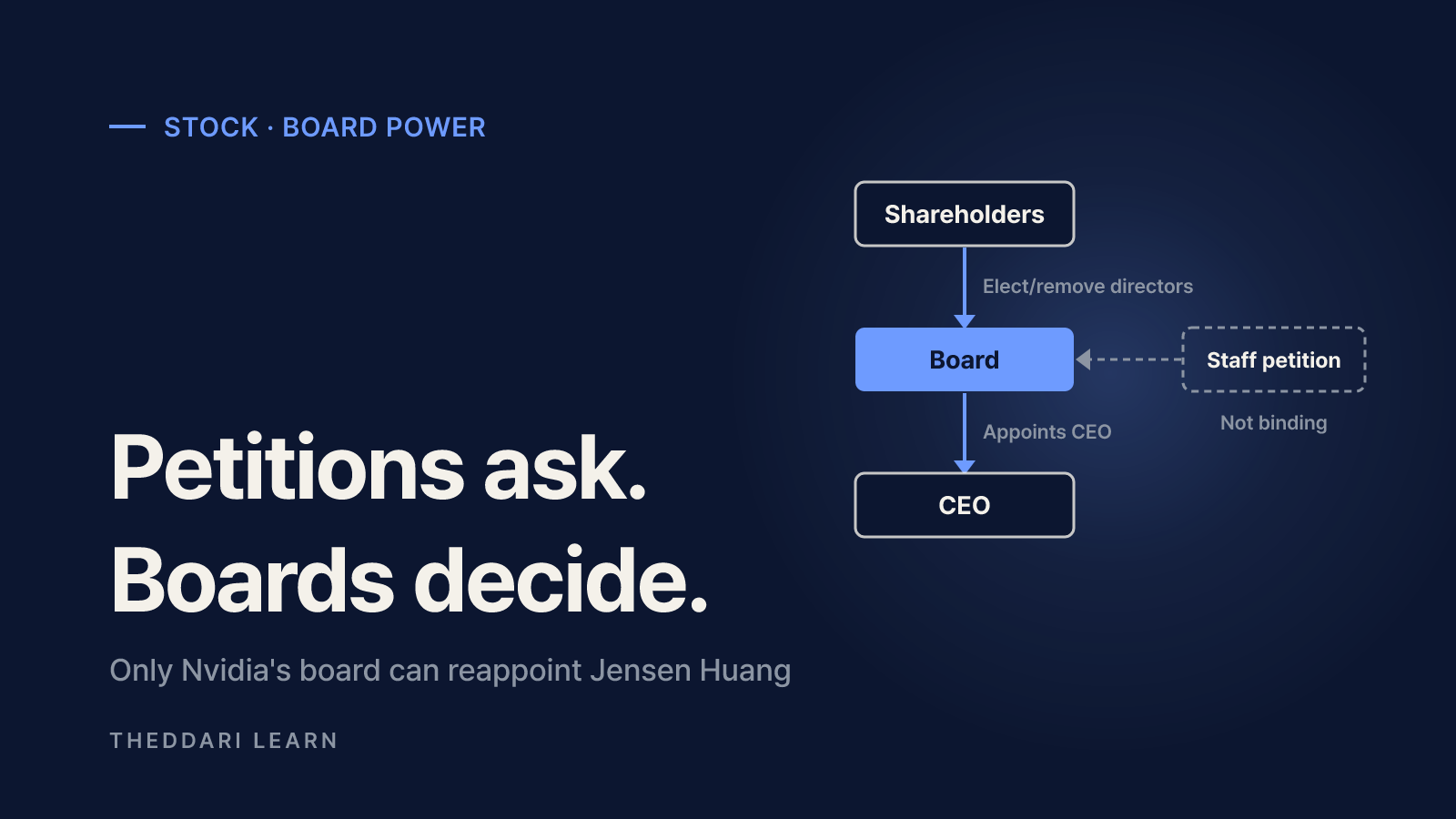
After Jensen Huang resigned as Nvidia CEO, employees pushed for his return. This guide explains what an employee petition can and cannot do, how board and shareholder power works under Delaware law, and why the 2023 OpenAI reversal is a weak template.
 Stocks
Nvidia Circular Financing Claims: What Holders Should Check
A Wall Street Journal report, relayed by tech outlets, says Nvidia leaned on investments and guarantees to keep customers buying GPUs. Here is how to separate the allegation from the filings and what to watch on the Q3 call.
 Stocks
Anthropic IPO: What to Check in the S-1, Timing and Access
Anthropic launched its IPO roadshow on Nov. 10, 2026. Here is how to verify the process in SEC filings, which S-1 numbers matter, the expected timeline and who can actually buy shares at the offer price.