Baidu AI Hype Warning: Metrics for China AI Stock Investors
Baidu and Xiaomi CEOs say AI spending is outrunning returns. Use Baidu's Q3 2026 cloud, ad, capex and cash-flow figures to judge China AI stocks for yourself.
Contents7 sections
Key takeaways
- On Nov. 17, 2026, Baidu CEO Robin Li said most companies adopting AI are not yet seeing higher revenue or profit; Xiaomi CEO Lei Jun said relatively few firms are actually making money from AI.
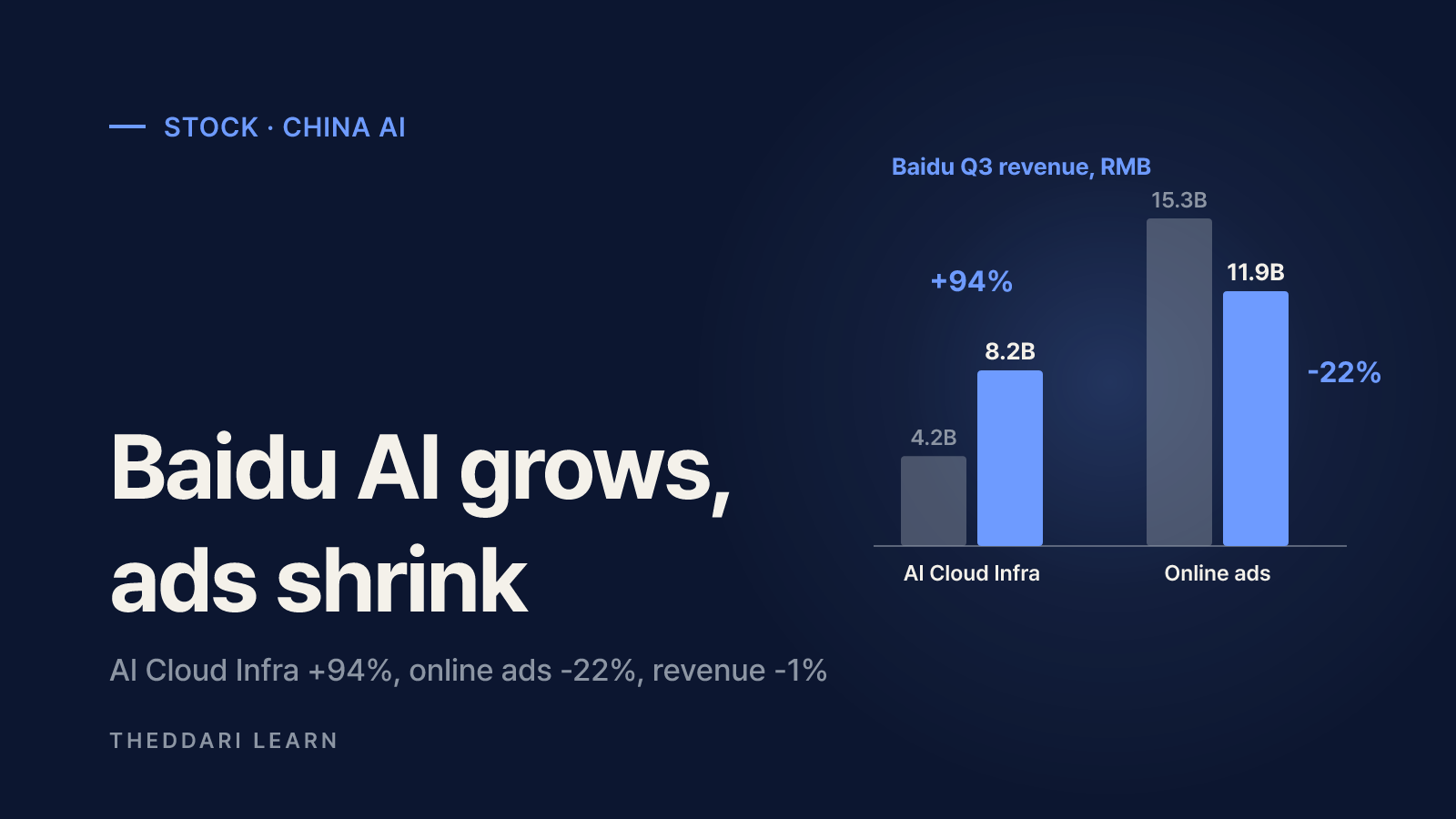
- Baidu's Q3 2026 AI Cloud Infra revenue rose 94% to RMB 8.2 billion, but online marketing fell 22% to RMB 11.9 billion and total revenue slipped 1% to RMB 30.8 billion.
- Baidu spent about RMB 7.3 billion on capex in Q3 against roughly RMB 2.8 billion of operating cash flow, leaving free cash flow near negative RMB 4.6 billion.
- For China AI stocks, judge AI growth together with legacy-business decline, margins, capex versus cash flow, and rising borrowings.
The Baidu AI hype warning is backed by Baidu's own numbers. As of November 2026, the company's AI businesses are growing fast, but the money going into AI is still rising faster than the money coming out of it. On Nov. 17, 2026, at the Asia-Pacific Economic Cooperation (APEC) CEO Summit in Shenzhen, Baidu CEO Robin Li and Xiaomi CEO Lei Jun both said returns on AI are lagging the investment. A day earlier, Baidu's third-quarter report showed exactly that gap.
This guide summarizes what the two executives said, then walks through the disclosures that let you check whether a Chinese AI company is actually earning back its spending. Figures come from company releases and are unaudited. Amounts are in Chinese yuan (RMB); Baidu converted at RMB 6.7045 per US dollar as of Sept. 30, 2026.
The Baidu AI hype warning: what the two CEOs actually said
According to AFP's report, Li described the situation as "urgent" and said AI's expansion into practical use cases "has arguably fallen short of expectations." He asked whether companies are seeing higher revenue or profit after adopting AI, and answered: "For most, the answer is no. If we fail to address this, the concern that AI might be a bubble could well become a reality."
Cailian Press reported that Li split the industry into four layers: GPU chips, cloud infrastructure, foundation models and applications, and argued that the ultimate value comes from applications. He compared AI to electric motors in factories, which added little to GDP until production lines were redesigned around them. His point was that organizations, not models, are now the bottleneck.
In the same report, Lei Jun said practitioners are "troubled and anxious" despite four years of rapid progress in large models. AI spending is enormous, workable use cases are limited, and relatively few companies have closed the commercial loop and made money in this cycle. He still expects breakthrough AI phones and AI cars within a few years and sees embodied robots as a bigger opportunity than the auto industry.
Neither CEO said to stop investing in AI. The useful signal for investors is that two of China's largest tech companies openly acknowledged a time lag between AI spending and AI profits.
Baidu AI results: cloud up 94%, ads down 22%
Baidu's Q3 2026 release, covering the quarter ended Sept. 30 and published Nov. 16, shows AI and advertising moving in opposite directions. AFP noted it was Baidu's sixth straight quarterly revenue decline.
Total revenue
- Q3 2025
- 31.2B
- Q3 2026
- 30.8B
- YoY
- -1%
AI Cloud Infra
- Q3 2025
- 4.2B
- Q3 2026
- 8.2B
- YoY
- +94%
AI Applications
- Q3 2025
- 2.6B
- Q3 2026
- 2.6B
- YoY
- Flat
AI-native marketing
- Q3 2025
- 2.8B
- Q3 2026
- 2.4B
- YoY
- -15%
Online marketing (all ads)
- Q3 2025
- 15.3B
- Q3 2026
- 11.9B
- YoY
- -22%
Non-GAAP net income to Baidu
- Q3 2025
- 3.8B
- Q3 2026
- 2.4B
- YoY
- About -36%
Baidu's AI-powered businesses brought in RMB 13.2 billion, up 37%, or 53% of Baidu General Business revenue. GPU Cloud revenue rose 191% year over year, and revenue from external customers' token usage on its Qianfan platform rose 1,159%. Meanwhile, advertising's share of General Business revenue fell from 62% to 48%.
Why faster revenue growth is not yet more profit
- Costs rose too. Cost of revenue climbed 9% to RMB 19.9 billion, driven by cloud costs and traffic acquisition costs.
- Margins are thin. GAAP operating margin was 2% and non-GAAP operating margin 6%, down from 12% in the prior quarter.
- Applications are flat. The layer Li says holds the real value, AI Applications, was roughly unchanged at RMB 2.6 billion. Growth came mostly from renting out computing power.
In short, Baidu is replacing high-margin search ads with lower-margin cloud infrastructure. The revenue gap is closing; the profit gap is not, at least not yet.
Capex vs operating cash flow: the cleanest test of AI payback
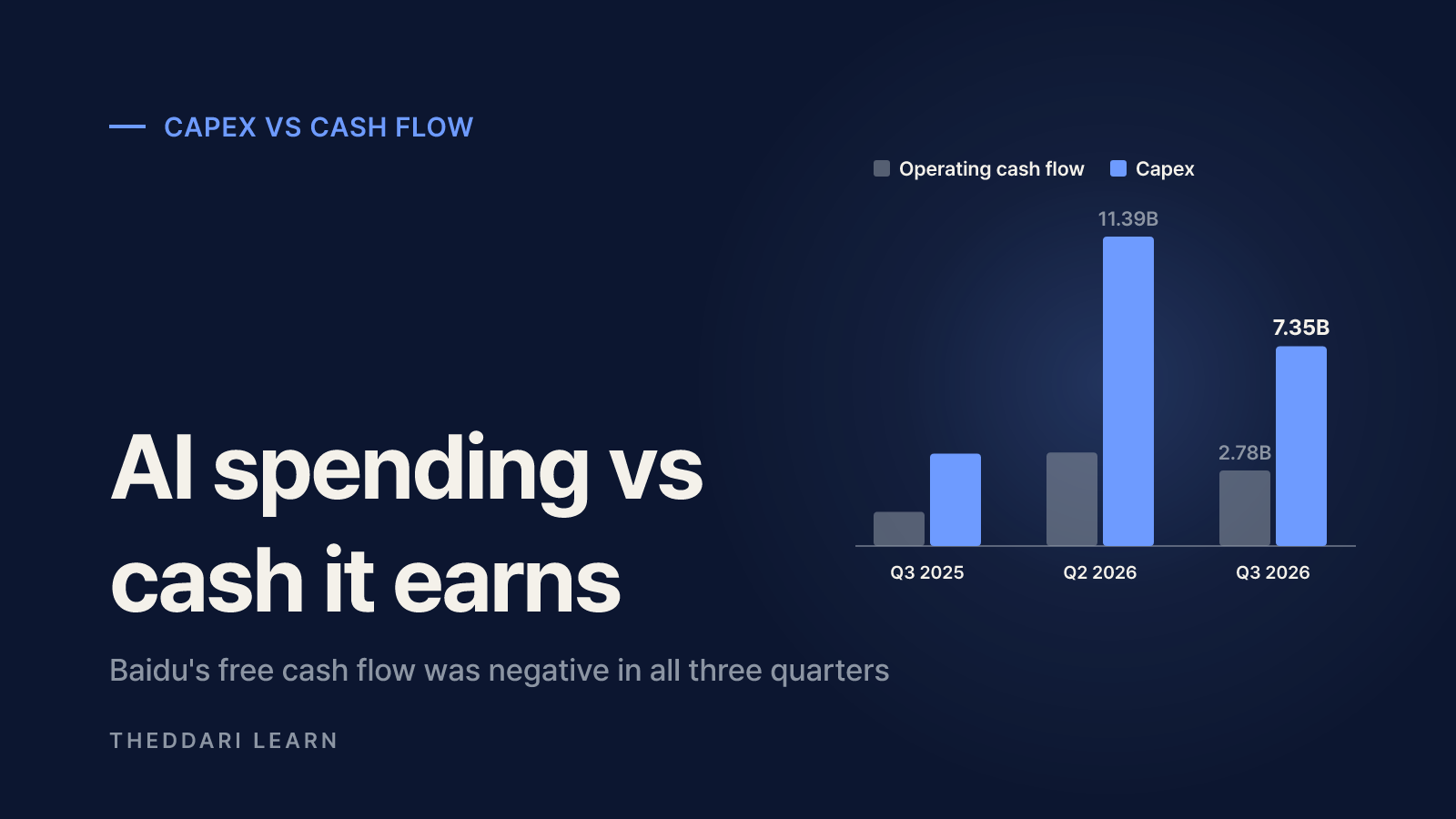
If you track one thing in the AI bubble debate, track capital expenditure against operating cash flow. When spending on data centers and GPUs exceeds the cash a business generates, the difference has to come from cash reserves or borrowing.
Operating cash flow
- Q3 2025
- 1.26B
- Q2 2026
- 3.44B
- Q3 2026
- 2.78B
Capital expenditures
- Q3 2025
- 3.40B
- Q2 2026
- 11.39B
- Q3 2026
- 7.35B
Free cash flow
- Q3 2025
- -2.15B
- Q2 2026
- -7.95B
- Q3 2026
- -4.57B
Q3 capex was about 2.2 times the year-earlier level, and free cash flow was negative in all three quarters shown. On the balance sheet, short-term loans rose from RMB 7.6 billion at the end of 2025 to RMB 23.2 billion at Sept. 30, 2026, and long-term loans from RMB 3.4 billion to RMB 25.6 billion. With RMB 276.6 billion in total cash and investments, Baidu is not facing a liquidity squeeze, but the trend is worth watching.
Depreciation hits future earnings
Capex is not expensed all at once; it flows through the income statement as depreciation over several years. Baidu's depreciation and amortization in Q3 was RMB 2.78 billion, up from RMB 2.22 billion a year earlier. If spending keeps climbing faster than revenue, margins will stay under pressure. Assumptions about GPU useful life also change how fast that cost shows up.
A checklist for China AI stocks at earnings time
The same framework works for Xiaomi, Alibaba, Tencent and other Chinese AI names. Check report dates on the theddari earnings calendar, and follow post-earnings chatter on the stock Telegram trends page.
- 1
Read the definition of AI revenue
Check the footnotes. Baidu groups cloud infrastructure, applications and AI-native marketing, and says these figures come from internal management accounts that are not audited. Definitions differ across companies, so direct comparisons are risky.
- 2
Compare AI growth with legacy decline
Is the yuan increase in AI revenue bigger than the yuan decline in ads, devices or other legacy lines? In Baidu's Q3, AI Cloud Infra added about RMB 4.0 billion while ads lost about RMB 3.4 billion.
- 3
Track margins
Compare cost-of-revenue growth and operating margin with the prior quarter and prior year. Cloud-heavy growth can lift revenue while lowering margins.
- 4
Net capex against operating cash flow
Pull both figures from the cash flow statement and watch whether negative free cash flow is shrinking or widening.
- 5
Check the quality of demand
Look for customer prepayments, longer contracts and external customer mix. Baidu cited more prepayments and a shift toward longer-term contracts in Q3.
- 6
Hold management to the numbers
Write down what executives promise on earnings calls and at events, then check it against the next quarter's filings.
How to read Xiaomi AI
Lei Jun sees AI paying off through physical products: phones, cars and robots. That means Xiaomi's AI returns are more likely to show up in EV and smartphone sales, segment operating results, R&D and capex growth than in a standalone AI revenue line. Use HKEX filings to confirm the results date and segment disclosures, and watch whether losses in its new-initiatives business widen as AI spending rises.
Risks specific to Chinese AI stocks
- Export controls and policy. US restrictions on advanced chips and the outcome of US-China talks can change GPU costs and timelines. That is one reason Baidu highlights its in-house Kunlunxin M100 chip.
- Domestic demand. AFP noted that China's consumer slump is weighing on Baidu's ad cash flow. If legacy decline outpaces AI growth, total results still deteriorate.
- Adjusted figures. Non-GAAP profit excludes items such as share-based compensation. Read it alongside GAAP net income, which was RMB 1.4 billion for Baidu in Q3.
- Listing structure and currency. ADSs in New York and shares in Hong Kong trade in different currencies and hours, and yuan moves affect dollar returns.
- Context of remarks. Summit comments may be aimed at policymakers or the whole industry. Keep them separate from company guidance.
The takeaway: Chinese tech leaders are now saying in public that AI spending has not yet paid for itself, and Baidu's filing confirms it. Rather than chasing a single headline growth rate, put legacy decline, margins, capex versus cash flow and borrowings side by side each quarter. That gives you your own read on whether China AI stocks are overheating or moving into the payback phase. For broader AI news flow, see the AI Telegram trends page.
Frequently asked questions
Did Baidu's CEO call AI a bubble?
Why is Baidu's quarter seen as weak if AI cloud revenue grew 94%?
Is Baidu stock (BIDU) the same as Baidu's Hong Kong shares?
Where can I check Xiaomi's AI spending and returns?
Is negative free cash flow a sign that AI investment has failed?
Sources and references
- 1Baidu Announces Third Quarter 2026 Results (Baidu IR)(opens in a new tab)ir.baidu.com
- 2Head of China's Baidu warns of AI 'bubble' ahead of APEC talks (AFP via Yahoo Finance)(opens in a new tab)finance.yahoo.com
- 3Lei Jun, Robin Li and others discuss AI and robotics at APEC (Cailian Press via Sina Finance, Chinese)(opens in a new tab)finance.sina.com.cn
Related articles
 Stocks
Samsung Special Dividend: Record Date, Ex-Date and Tax
Samsung confirmed a KRW 4,601 per-share Q3 2026 dividend, but the next payout will only be set by its board in late January 2027. Here is how record dates, ex-dates and Korean withholding tax work.
 Stocks
Pre-Market Trading and After-Hours Moves, Explained
An after-hours drop is usually measured against the last official close, set by a small number of trades. Learn the session times, how to read the move, and what changes for investors trading US stocks from Korea.
 Stocks
Jensen Huang Return Petition: Can Staff Reinstate a CEO?
After Jensen Huang resigned as Nvidia CEO, employees pushed for his return. This guide explains what an employee petition can and cannot do, how board and shareholder power works under Delaware law, and why the 2023 OpenAI reversal is a weak template.