Contents6 sections
The Qualcomm Cloud AI 100 Ultra is a PCIe accelerator card built only for AI inference: it puts 128GB of memory behind a 150W power budget so that large language models can be served without a rack full of power-hungry GPUs. It is not a general-purpose GPU and it does not do graphics or training. As of November 2026, the published specs are a 150W TDP, 128GB of LPDDR4x, 548GB/s of memory bandwidth, up to 870 INT8 TOPS, 64 AI cores and a PCIe Gen4 x16 host interface. Below we explain what those numbers mean for LLM serving, how the card stacks up against an NVIDIA data center GPU, and what to verify before you budget for it.
Qualcomm Cloud AI 100 Ultra specs at a glance
Qualcomm's product page renders only with JavaScript, so we used the spec list Qualcomm partner Advantech published in its March 10, 2026 announcement. The three headline figures that circulated on Hacker News, 150W, 128GB and 548GB/s, match that list.
Form factor
- Published value
- PCIe FH3/4L (full height, three-quarter length)
- Why it matters
- Fits standard server PCIe slots
TDP
- Published value
- 150W
- Why it matters
- Card-level thermal design power
Memory
- Published value
- 128GB LPDDR4x
- Why it matters
- Holds model weights and KV cache
Memory bandwidth
- Published value
- 548GB/s
- Why it matters
- How fast weights can be read
INT8 compute
- Published value
- Up to 870 TOPS
- Why it matters
- Theoretical 8-bit peak
AI cores
- Published value
- 64
- Why it matters
- Per card
Host interface
- Published value
- PCIe Gen4 x16
- Why it matters
- Link to the host CPU
Compute figures are vendor peaks. Real throughput depends on model architecture, quantization, batch size and compiler optimization. We could not find public list pricing or independent third-party benchmarks for this card.
Why an inference-only design matters
Training builds a model in a large, time-boxed burst of compute. Inference runs every time a user sends a prompt, around the clock, so latency and electricity turn directly into operating cost. Inference accelerators drop training-oriented features and optimize for performance per watt and memory capacity instead. The Cloud AI 100 Ultra follows that philosophy.
How it compares with a GPU
A useful reference point is the NVIDIA L40S, a PCIe data center GPU commonly used for inference. NVIDIA lists 48GB of GDDR6, 864GB/s of bandwidth, 350W maximum power, a dual-slot design and PCIe Gen4 x16. Its INT8 rating is 733 TOPS dense, or 1,466 TOPS with sparsity.
Memory
- Qualcomm Cloud AI 100 Ultra
- 128GB LPDDR4x
- NVIDIA L40S
- 48GB GDDR6
Bandwidth
- Qualcomm Cloud AI 100 Ultra
- 548GB/s
- NVIDIA L40S
- 864GB/s
Power
- Qualcomm Cloud AI 100 Ultra
- 150W (TDP)
- NVIDIA L40S
- 350W (max power)
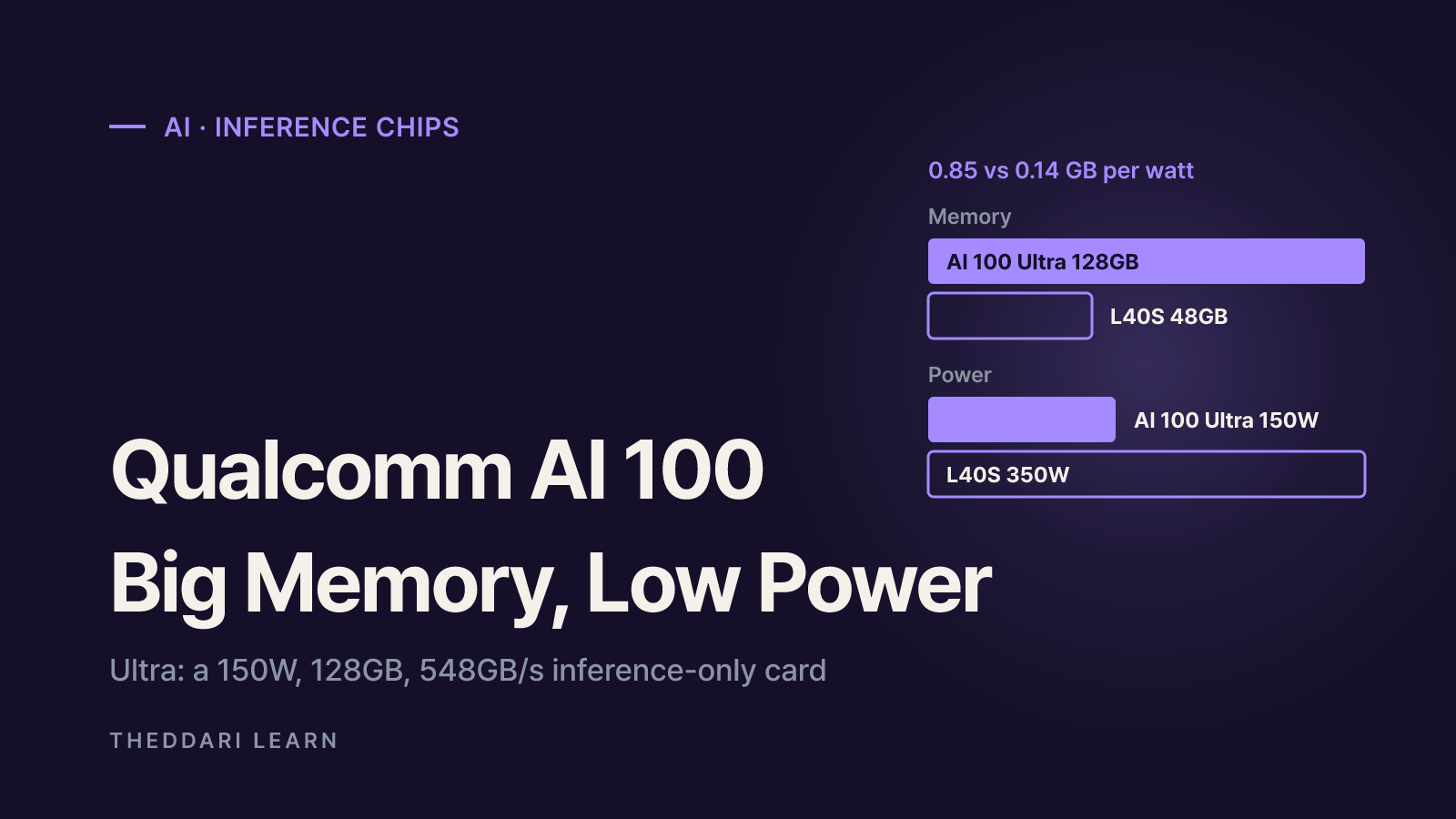
Memory per watt (calculated)
- Qualcomm Cloud AI 100 Ultra
- ~0.85GB/W
- NVIDIA L40S
- ~0.14GB/W
INT8 peak
- Qualcomm Cloud AI 100 Ultra
- 870 TOPS
- NVIDIA L40S
- 733 TOPS dense (1,466 sparse)
Slot width
- Qualcomm Cloud AI 100 Ultra
- Single slot
- NVIDIA L40S
- Dual slot
Software
- Qualcomm Cloud AI 100 Ultra
- Qualcomm Cloud AI SDK, AI Inference Suite
- NVIDIA L40S
- CUDA ecosystem
Memory per watt is our own arithmetic from the published specs (128 / 150 and 48 / 350). The vendors define power differently, TDP versus maximum power, and the INT8 figures are not measured under identical conditions, so read the table as a picture of design priorities rather than a benchmark.
Strength: capacity per watt
An LLM's weights must sit in accelerator memory. When they do not fit, the model is split across cards, and the cross-card traffic adds cost and latency. Putting 128GB on one 150W card targets operators who want large models, or many smaller ones, resident on fewer cards at lower power. Advantech says the card is optimized to run models of up to 109B parameters, such as Llama 4, on a single card and supports up to 20 peak concurrent users per card. Its SKY-641E3 server holds up to 12 single-slot accelerators in a 4U chassis; simple math gives 12 x 128GB = 1,536GB of accelerator memory and 12 x 150W = 1,800W of card power.
Weakness: bandwidth and token speed
During token-by-token generation, the weights are read from memory for every new token, so bandwidth often sets the ceiling. As a rough upper bound, a 70GB model (for example 70 billion parameters stored in 8-bit) read at 548GB/s tops out near 7.8 tokens per second for a single stream (548 / 70). Batching, caching and sharding change the real number, but the bandwidth-to-capacity ratio is clearly low. The card fits batch serving and multi-model hosting better than maximum speed for one user.
What to check before evaluating it
- 1
Confirm model support
CUDA code will not run as-is. Models are compiled ahead of time with Qualcomm's toolchain, so confirm that your architecture and quantization format are on the supported list.
- 2
Benchmark your own workload
Ignore peak TOPS. Measure time to first token and tokens per second with the same model, context length and concurrency you plan to run. If you only have vendor data, record its test conditions.
- 3
Price the whole system
Card pricing is not public. When you request quotes, compare total cost of ownership: cards per server, rack power limits, cooling, and software support.
- 4
Check the roadmap
Qualcomm continues to announce new data center inference products. For a multi-year deployment, confirm supply and support timelines and software compatibility through official channels.
AI chip news moves fast and is often over-interpreted. The theddari AI Telegram trends page collects industry chatter in one place, but always cross-check numbers against the vendor's own documents.

What it means for Qualcomm's data center business
A viral product page does not translate directly into revenue. Qualcomm is a late entrant in a market dominated by NVIDIA and AMD GPUs and crowded with inference start-ups, and it has to close a software ecosystem gap. On the other hand, as inference demand grows, buyers who prioritize power efficiency and memory capacity could become a real customer base. For anyone following QCOM stock, these are the signals worth tracking:
- Whether earnings reports break out data center revenue or bookings.
- Whether customer deals disclose size, duration and delivery dates.
- Whether server partners ship volume products or only announce prototypes.
- How the core handset and automotive chip businesses move, since they drive far more of the results.
Use the theddari earnings calendar to find Qualcomm's next report date, then listen for data center questions on the call. Management commentary is better evidence than a spec sheet.
In short, the Qualcomm Cloud AI 100 Ultra is less a fast GPU than a high-memory, low-power inference card. It is attractive for keeping large models resident on a tight power budget, while bandwidth and software compatibility need to be proven on real workloads. Until pricing and independent benchmarks appear, treat the spec sheet as a starting point, not proof of an advantage.