Contents7 sections
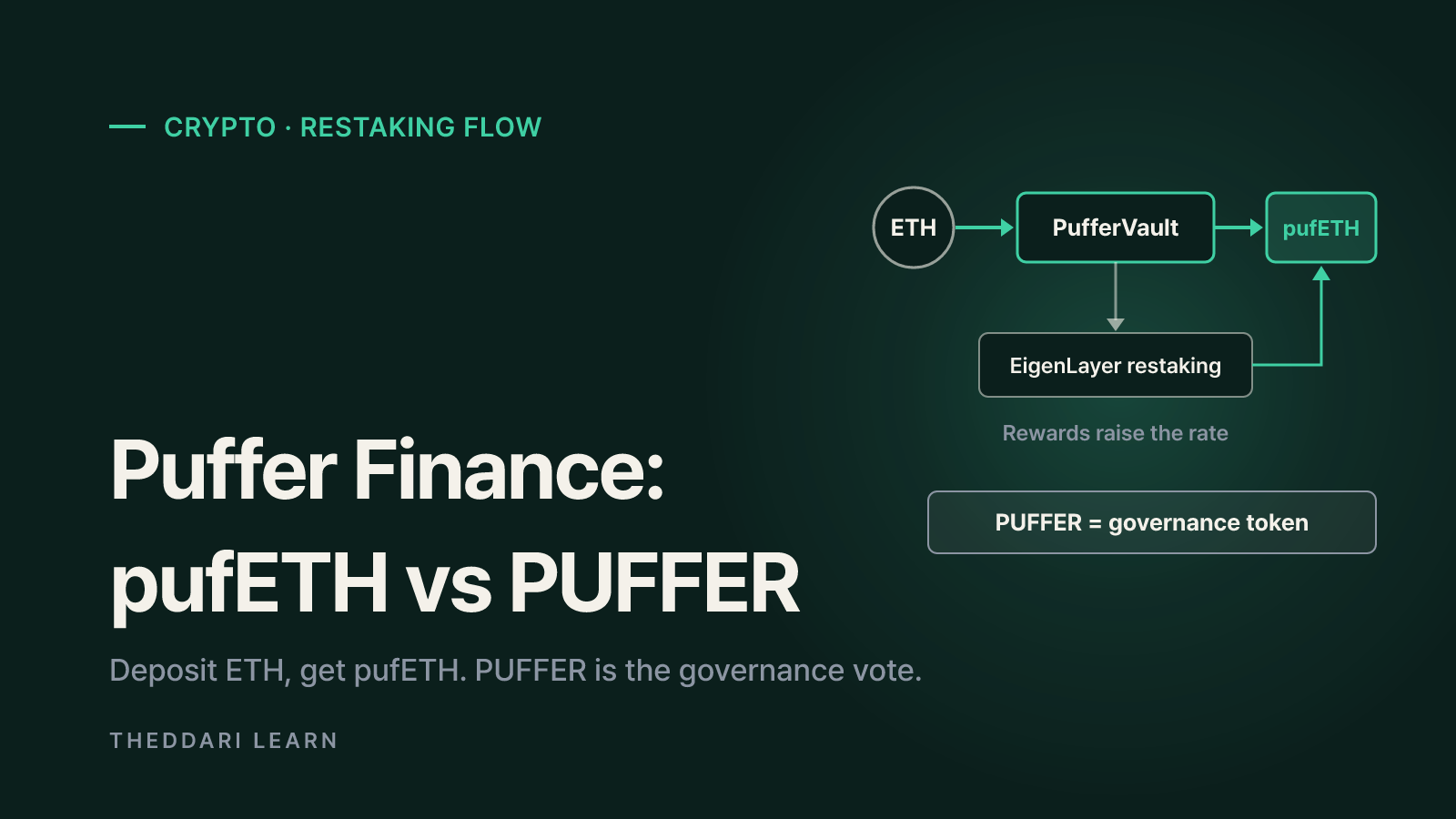
Puffer Finance is a native liquid restaking protocol built on EigenLayer. You deposit ETH, receive pufETH, and the underlying ETH is used both to run Ethereum validators and to secure additional services through restaking. PUFFER, the token that started trending on CoinGecko in mid-October 2026, is a separate governance token. This guide, current as of October 2026 and based on Puffer's official documentation, explains how the pieces fit together, how the token supply is scheduled, and which risks are easy to miss.
The trigger for the attention was an exchange listing: South Korea's Upbit opened a PUFFER/KRW market on October 15, 2026, with trading starting at 05:00 UTC and deposits and withdrawals on the Ethereum network, CoinScreamer reported.
How Puffer Finance restaking works
Ordinary staking locks ETH in a validator to earn proof-of-stake (PoS) rewards. Restaking reuses that same staked ETH as collateral for other networks, called actively validated services (AVSs), in exchange for extra fees. The trade-off is simple: more sources of reward, and more ways to get slashed.
Most liquid restaking tokens (LRTs) are built by depositing an existing liquid staking token, such as Lido's stETH, into a restaking protocol. Puffer's docs call pufETH a native LRT (nLRT) instead: validator ETH is restaked directly through an EigenPod on EigenLayer, so a single token is meant to capture both PoS rewards and restaking rewards. The token follows a reward-bearing ERC-20 design similar to Compound's cTokens, which keeps it usable across DeFi.
Who does what inside the protocol
Staker
- Role
- Deposits ETH into the PufferVault
- Paid with
- A rising pufETH conversion rate
Node operator (NoOp)
- Role
- Posts 2 ETH plus Validator Tickets and runs a 32 ETH validator
- Paid with
- 100% of its PoS rewards and a share of restaking rewards
Restaking operator
- Role
- Runs AVSs on behalf of a module
- Paid with
- AVS commission
Guardians
- Role
- Provision 32 ETH chunks and can eject weak validators
- Paid with
- Protocol fees
Per the protocol overview, node operators prepay for Validator Tickets, which is how stakers receive PoS-linked value up front rather than waiting on validator performance. When the vault collects 32 ETH, Guardians assign it to a queued operator. Operators must also hand encrypted key shares to the Guardians' secure enclaves so a validator can be ejected if its balance drops too low. That safety net is also a trust assumption; the docs say it will move to a trustless design once Ethereum's EIP-7002 allows it.
Minting and redeeming pufETH
Your pufETH balance does not grow. Instead, each pufETH becomes redeemable for more ETH as rewards accrue. Puffer defines the conversion rate = (deposits + rewards − penalties) ÷ pufETH supply. In the docs' example, 10 ETH minted 10 pufETH at launch; after 2 ETH of rewards, the rate is (10 + 2 − 0) ÷ 10 = 1.2. A new depositor adding 1 ETH then receives about 0.83 pufETH, so earlier holders are not diluted. If penalties exceed what operators have bonded, the rate goes down.
Instant versus standard withdrawals
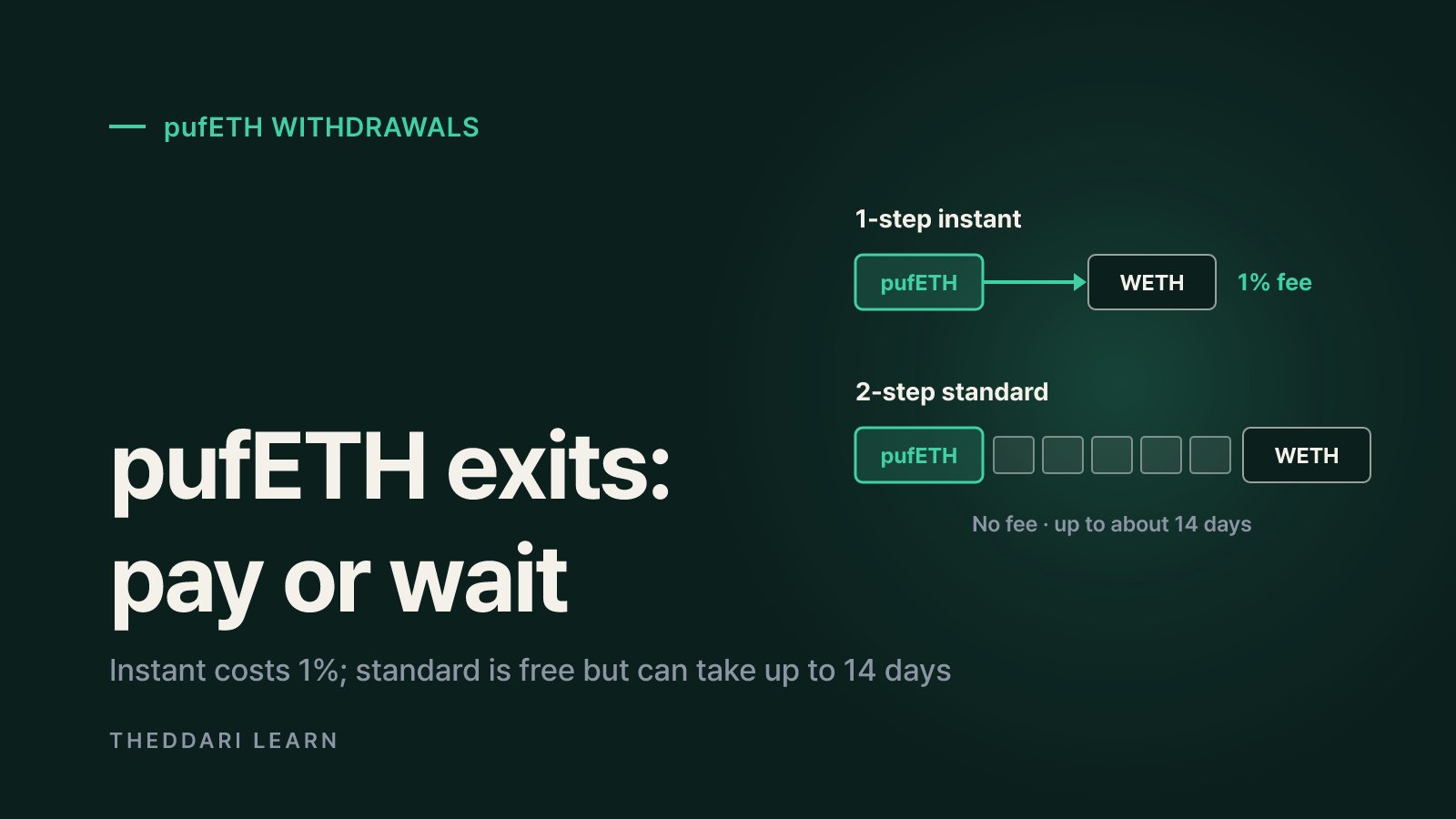
1-step (instant)
- You receive
- WETH
- Fee
- 1% of amount
- Typical time
- One transaction
- Conditions
- Limited by the liquidity vault
2-step (standard)
- You receive
- WETH
- Fee
- None
- Typical time
- Up to about 14 days
- Conditions
- 0.01 pufETH minimum; processed in batches
The withdrawal guide says the 1% instant fee goes to the protocol treasury, to fund improvements and PUFFER buybacks. Standard withdrawals are slower when the vault has to exit validators from the Beacon Chain and wait through EigenLayer's withdrawal queue. In a fast-moving market, plan in advance whether you would rather pay the fee or wait.
PUFFER token utility, supply and unlocks
According to the token page, PUFFER governs the Puffer LRT and the UniFi ecosystem: fees, limits and bond requirements; Guardian and restaking-operator selection; which AVSs are supported; and UniFi rollup fees and treasury use. There is no built-in claim on staking rewards simply from holding it.
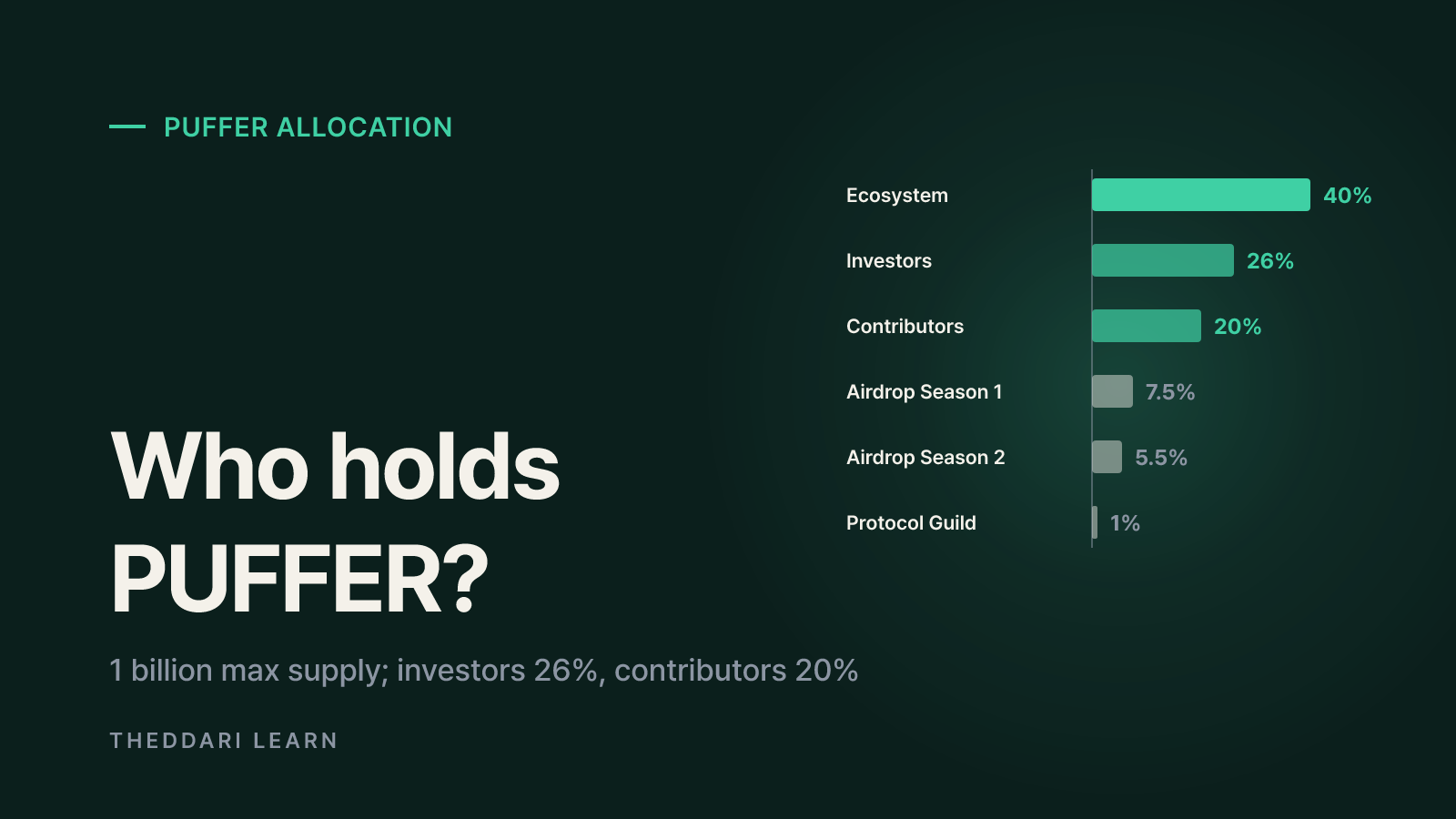
Ecosystem and community
- Share
- 40%
- Release terms (official docs)
- Future airdrops, incentives, exchange liquidity
Investors
- Share
- 26%
- Release terms (official docs)
- 3 years: 1-year cliff, then 2 years of vesting
Early contributors and advisors
- Share
- 20%
- Release terms (official docs)
- 3 years with a 1-year cliff
Airdrop Season 1
- Share
- 7.5%
- Release terms (official docs)
- 65% on day one; remainder for large depositors over 6 months
Airdrop Season 2
- Share
- 5.5%
- Release terms (official docs)
- Season 2 participants
Protocol Guild
- Share
- 1%
- Release terms (official docs)
- Vested over 4 years
Max supply is 1,000,000,000 PUFFER, with an initial circulating supply of 102.3 million (10.23%) at the time the docs were written. A Bitrue blog post citing CoinGecko on October 15, 2026 put circulating supply at roughly 574.9 million, market cap near $36.2 million and fully diluted valuation near $62.9 million. It describes monthly unlocks of about 19.17 million tokens (around 1.9% of supply) running through October 2028, with the next one on November 8, 2026. Treat these as secondary figures and check a live source before trading.
vlPUFFER: voting power for locked tokens
Locking PUFFER for 30 days to 2 years mints non-transferable vlPUFFER, with multipliers from 1x (30 days) to 24x (24 months) and a 10 PUFFER minimum. Tokens cannot be withdrawn before expiry. If you do not withdraw within 7 days after expiry, anyone can "kick" the lock and keep 1% of it as a fee. Weigh that illiquidity before locking for governance rewards.
Risks to check before buying PUFFER or holding pufETH
- Slashing: validator misbehavior on Ethereum or a restaking operator fault on an AVS can cut collateral. Losses beyond the operator bond flow into pufETH's conversion rate. Puffer says it restricts restaking-operator participation in its early stage.
- Smart contract stack: PufferVault, modules, EigenPods and EigenLayer contracts are layered, so a bug in one can affect the rest.
- Exit liquidity: instant exits are capped by vault liquidity; standard exits can take up to about 14 days; DEX prices can sit below redemption value.
- Trusted roles: Guardians hold key shares and handle provisioning until a trustless upgrade actually ships.
- Token supply: monthly unlocks and a small market cap make PUFFER sensitive to shifts in supply and demand.
The same Bitrue data listed Puffer's total value locked at about $28.1 million on October 15, 2026. TVL and token market cap measure different things, so one does not validate the other. Google Cloud joining Puffer Preconf as a gateway operator, announced September 22, 2026, was described there as still in a test environment, so separate partnership headlines from live mainnet usage.
Reading the October 2026 listing spike
CoinScreamer reported that the new KRW market opened at 93 won, hit 118 won and traded at 75.8 won by 07:09 UTC, about 18.5% below the open. Upbit's older BTC market peaked 243.75% above its prior close before easing to +115.6%. Those percentages use different baselines and should not be compared directly. Korean won prices can also drift away from global USD prices; theddari's Kimchi premium tracker shows that gap, and the funding arbitrage page shows whether perpetual funding is unusually skewed. Neither tool predicts the next move.

- 1
Know which asset you hold
Decide whether you want PUFFER (governance exposure) or pufETH (restaked ETH exposure). They respond to different drivers.
- 2
Verify the contract and network
Match the contract address in Puffer's docs with what your wallet or exchange shows, and use the supported network for transfers.
- 3
Log supply data
Write down circulating supply, FDV and the next unlock date and size, then watch volume around unlock dates.
- 4
Check protocol health separately
Track the pufETH conversion rate, TVL, withdrawal queue and audit reports. A token rally does not change these numbers.
- 5
Set a loss limit first
Newly listed small-cap tokens can move tens of percent in a day. Decide your order type and maximum acceptable loss before you trade.
In short, Puffer Finance packages ETH staking and restaking into pufETH, while PUFFER is the vote over how that system runs. A new listing widens access but does not change the protocol's risk profile. Read the conversion formula, withdrawal terms, unlock schedule and slashing design yourself, and keep a record of what you verified.