Why Pension Savings Insurance Payouts Fall Short in Korea
Korean pension savings insurance can pay less than its illustration. See how crediting rates, minimum floors, dividends, fees and taxes cut the payout.
Contents7 sections
- Why the pension savings insurance payout falls short of the illustration
- Three variables that change the payout: crediting rate, fees and dividends
- How to check your own reserve and projected pension
- Payouts can change during the payout phase and on early exit
- What to weigh before moving to a pension savings fund
- Frequently asked questions
- Sources and references
Key takeaways
- A pension illustration in Korea is a projection that assumes the crediting rate at sign-up stays the same; it is not a promised amount.
- With rate-linked products, falling crediting rates slow account growth, and the contractual minimum rate is only a floor.
- Projected policyholder dividends depend on the insurer's results, and the minimum rate does not cover them.
- Fees come out of premiums before interest is credited, so compare fee ratios and accumulation ratios, not just the headline pension.
- Early withdrawal is generally taxed at 16.5%, and transfers can be blocked if payouts have started or the policy has a loan or seizure.
A Korean pension savings insurance payout usually falls short of the sales illustration for one core reason: the illustrated pension was calculated as if the crediting rate at sign-up would last for the entire contract. In rate-linked policies, the insurer resets that rate over time, so when market rates fall, the account grows more slowly. Participating policies add projected dividends that depend on the insurer's results, and fees and taxes widen the gap further. This guide reflects information as of October 2026 and applies to Korean residents holding pension savings insurance inside a Korean tax-advantaged pension savings account. It draws on a consumer notice that Korea's Financial Supervisory Service (FSS) published on October 21, 2026, and on official disclosure pages.
Why the pension savings insurance payout falls short of the illustration
The FSS notice was prompted by continuing complaints from people whose actual pension notices came in far below what their sign-up documents showed (Yonhap). The FSS also reported that pension savings balances reached 224.8 trillion won at the end of the second quarter of 2026, up 13.4% from the end of 2025 (eToday). More savers means more people reaching the payout stage and comparing the numbers.
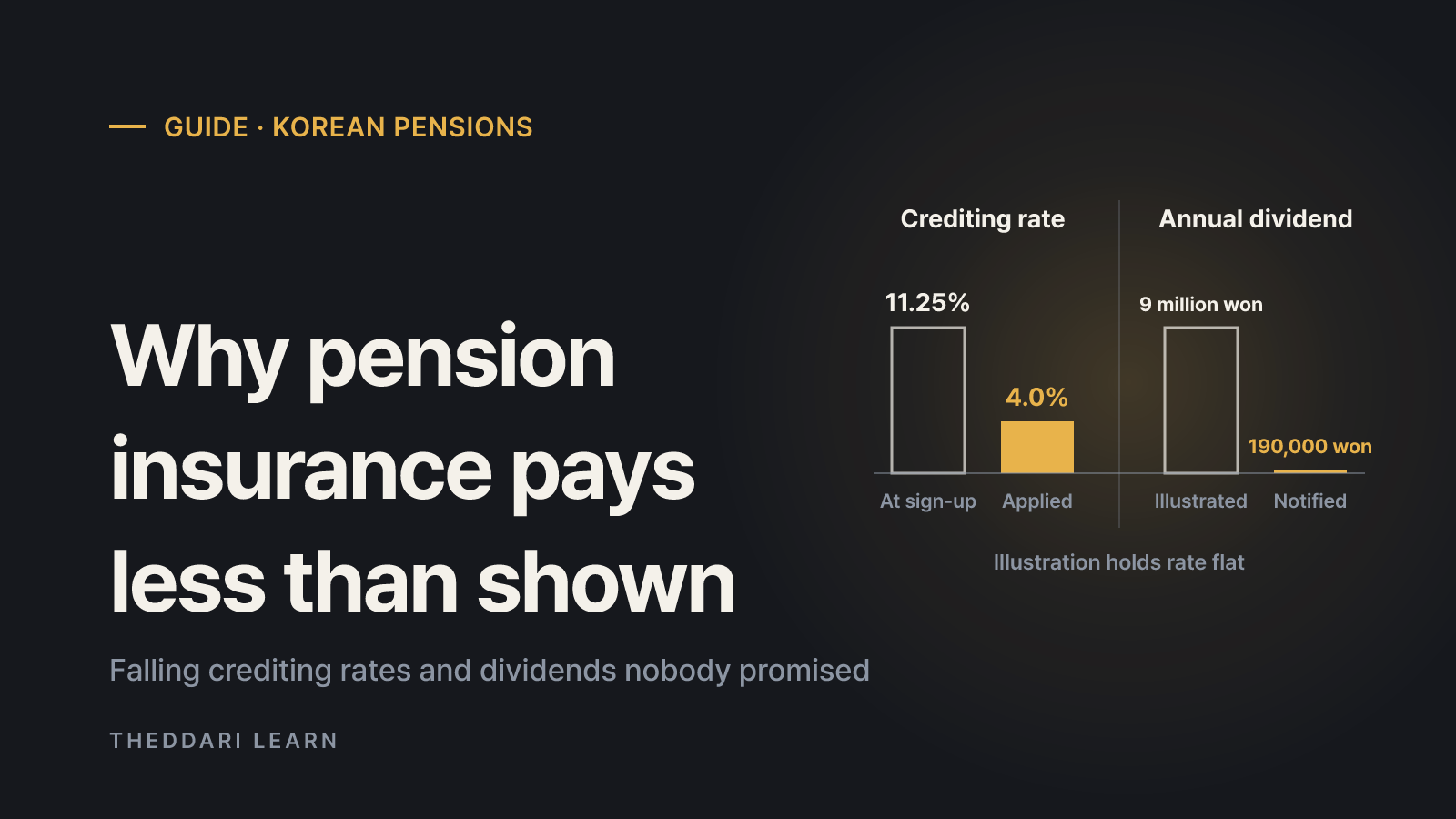
Case 1: an 11.25% rate that fell to a 4.0% floor
One policyholder who joined in the late 1990s was told, just before payouts began, that the scheduled pension would be less than half of the illustrated amount. The policy's applied rate had been 11.25% at sign-up, but after years of lower interest rates the contract's minimum crediting rate of 4.0% was being applied (Financial News). The illustration had assumed an 11%-plus rate for decades; reality broke that assumption.
A quick compounding example shows why the effect is so large. One won compounded at 11.25% a year for 20 years grows to about 8.4 won; at 4.0% it grows to about 2.2 won. This is a simplified illustration of the principle that ignores fees, contribution timing and the actual path of rate changes, so it does not reproduce the policyholder's real numbers. It does show that cutting the rate to roughly one-third reduces the outcome by much more than one-third over long horizons.
Case 2: a projected 9 million won dividend that became about 190,000 won
Another late-1990s policyholder bought a participating (dividend-paying) pension savings policy. The illustration showed policyholder dividends of about 9 million won a year after maturity, but the insurer's notice showed roughly 190,000 won a year, about 2% of the projection. The FSS explained that dividends vary each year with the insurer's results, and that the minimum crediting rate on the base pension does not extend to dividends (Financial News). In other words, there is no contractual basis for expecting a minimum dividend.
Any figure in an illustration labeled as an example, estimate or assumption is not a promise. What the contract commits to is the minimum crediting rate and the method written in the policy terms.
Three variables that change the payout: crediting rate, fees and dividends
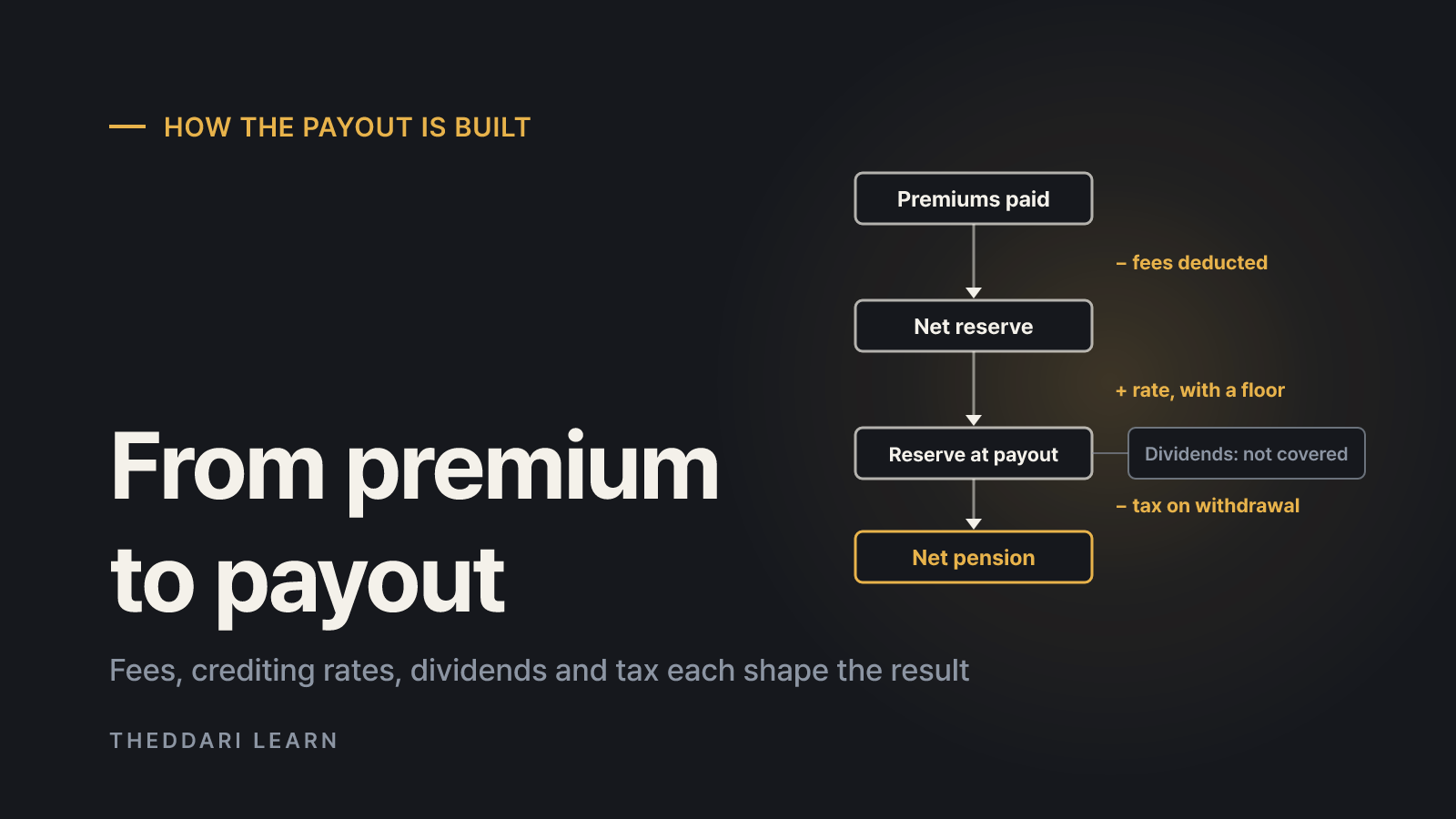
Roughly, the pension is built in this order: premiums minus fees, then interest at the crediting rate (never below the contractual minimum), then the reserve at the payout start date, then installments under the payout option you choose, then tax. The table shows which inputs can move after the illustration is printed.
Crediting rate (applied rate)
- Illustration assumption
- Sign-up rate held constant
- How it actually changes
- Insurer resets it periodically based on market rates and investment returns; floor is the contractual minimum
- Where to check
- Insurer's disclosure page, annual pension savings return report
Minimum crediting rate
- Illustration assumption
- Shown only as a floor
- How it actually changes
- Protects only down to the contractual level; may differ by policy year
- Where to check
- Policy terms, product summary
Fees and charges
- Illustration assumption
- Product charges deducted
- How it actually changes
- Taken from premiums first, so early account value can be below premiums paid
- Where to check
- Fee ratios versus premiums and versus reserves
Dividends (participating policies)
- Illustration assumption
- Dividend level at sign-up continues
- How it actually changes
- Set each year based on results; not covered by the minimum rate
- Where to check
- Insurer's dividend disclosures and notices
Crediting rate versus the contractual floor
Rate-linked pension savings insurance does not pay a fixed rate. The insurer applies a published crediting rate that can change. The FSS advises consumers to confirm whether a product is rate-linked, what the current applied rate is, and what minimum rate applies however far rates fall (eToday). Korean insurers' standardized disclosures can show projected accumulation ratios under three assumptions: the minimum crediting rate, the current crediting rate and the average crediting rate (KB Life disclosure room). The spread between those figures is a practical range for how much your pension could vary.
How fees affect the reserve
Interest is not credited on the full premium. Acquisition and maintenance charges come out first, and only the remainder accumulates. Industry disclosures therefore calculate returns and accumulation ratios after deducting all charges borne by the customer, and they publish fees two ways: total fees divided by total premiums, and annual fees divided by year-end reserves (KB Life disclosure room). Still, the public record does not show that fees alone turned 9 million won into 190,000 won. Fees widen the gap; the large swings come mainly from rate and dividend assumptions.
How to check your own reserve and projected pension
- 1
Pull your contract status from the insurer
In the insurer's app or website, find total premiums paid, current reserve, surrender value, current applied rate, payout start date and payout option. Many insurers also show a projected pension at the current rate. If something is missing, ask the call center for a written calculation.
- 2
Find your pension savings return report
The FSS Integrated Pension Portal says individual returns and fee ratios are shown in the pension savings return report that each financial company sends to its customers (FSS comparison page). Check your mail, email or app inbox.
- 3
Consolidate your pensions in one place
The FSS Integrated Pension Portal offers a pension lookup that gathers contracts across providers, which helps if you hold several accounts or have forgotten one.
- 4
Compare product-level disclosures
Look up your product in the FSS pension savings comparison and in the Korea Life Insurance Association or insurer disclosure rooms. Compare projected accumulation under the minimum and current rates, plus fee ratios. These figures use standard assumptions, such as joining on the first sale date and paying a fixed monthly amount, so your own result can differ.
- 5
Line up the documents
Write the illustration's assumed rate, the contract's minimum rate and the dividend clauses next to your current figures. If a rate below the contractual minimum was applied or the explanation does not match, request a written response, then escalate to the FSS if needed.
Crediting rates tend to follow broader interest-rate conditions. The theddari economic calendar lists scheduled releases such as central bank decisions and inflation data, which can help you understand the backdrop when an insurer revises its rate. It is a scheduling tool and does not show your policy's rate.

Payouts can change during the payout phase and on early exit
A fixed-period payout spreads the reserve over the remaining years, but the FSS notes that payments still change if the insurer's crediting rate or a fund's return moves (Financial News). Money inside the account is also withdrawn in a set order by type, such as contributions that did not receive a tax credit, contributions that did, and investment earnings. When the taxable portion starts being paid out, withholding begins and the net deposit can drop.
- Annual contributions to Korean pension accounts are capped at 18 million won, and up to 6 million won of pension savings contributions qualify for a 12% to 15% tax credit depending on income.
- Withdrawals taken as a pension after five years of membership and age 55, within the annual pension limit, are taxed separately at 3.3% to 5.5%.
- If total private pension income exceeds 15 million won a year, you choose between comprehensive taxation and a 16.5% separate tax.
- Early termination or withdrawal of credited contributions and earnings is generally subject to 16.5% other-income tax. Specified unavoidable reasons, such as death, emigration or medical care of three months or more, qualify for 3.3% to 5.5% if documents are filed within six months.
These figures come from the FSS guidance as reported by Financial News and eToday, as of October 2026. Ask your provider for an after-tax amount before you terminate or withdraw, because your history and other income affect the result.
What to weigh before moving to a pension savings fund
Korea's pension savings transfer system lets you move to another provider or product without losing the tax treatment, but restrictions apply. Accounts already paying a pension, accounts on a lifetime payout, and accounts with an outstanding policy loan, seizure, provisional seizure or pledge cannot be transferred, and partial transfers are not allowed (eToday, Financial News).
Return driver
- Rate-linked pension savings insurance
- Crediting rate with a contractual floor
- Pension savings fund
- Performance of the chosen funds
Loss potential
- Rate-linked pension savings insurance
- Floor exists, but early fees can leave value below premiums
- Pension savings fund
- Value can fall below contributions in market declines
Costs
- Rate-linked pension savings insurance
- Charges deducted from premiums
- Pension savings fund
- Fund management and sales fees
Check before moving
- Rate-linked pension savings insurance
- Transfer amount may be based on surrender value; you give up the existing minimum rate
- Pension savings fund
- Fund choice and your tolerance for losses
Moving means giving up the existing minimum crediting rate. In the FSS case above that floor was 4.0%, so check what your own contract offers before switching. Funds open the door to higher returns and to losses, so compare the projected outcomes and risks on the same basis. The theddari stock Telegram trends page can show which market topics investors are discussing, but that chatter should not set the timing of a pension transfer.
To sum up, review a pension savings insurance payout in this order: what rate the illustration assumed, the current crediting rate and contractual floor, whether dividends were ever promised, the actual reserve and surrender value after fees, and the taxes and restrictions on payout, termination and transfer. Keeping these figures on one page makes it clear what was an estimate and what was a promise when you talk to the insurer or the FSS.
Frequently asked questions
Can I claim the difference if my insurer pays less than the illustration showed?
Does a minimum crediting rate mean I cannot lose money?
If I choose a fixed-period payout, is the annual amount fixed?
Is pension savings insurance the same as a US annuity or IRA?
Sources and references
- 1Financial News (fnnews): Expected 9 million won, received 190,000 won – pension insurance disputes (Oct 22, 2026)(opens in a new tab)www.fnnews.com
- 2Yonhap: Pension figures in pension savings insurance illustrations may differ from actual payouts (Oct 21, 2026)(opens in a new tab)www.yna.co.kr
- 3eToday: FSS consumer notice on pension savings (Oct 21, 2026)(opens in a new tab)www.etoday.co.kr
- 4FSS Integrated Pension Portal: Pension savings comparison by product (returns and fee ratios)(opens in a new tab)www.fss.or.kr
- 5FSS Integrated Pension Portal(opens in a new tab)www.fss.or.kr
- 6KB Life Insurance pension savings disclosure room (projected accumulation and fee methodology)(opens in a new tab)www.kblife.co.kr
Related articles
 Investing
How to Buy ETFs in Singapore: CDP vs Custodian and Fees
A practical guide for Singapore residents: how SGX-listed and US-listed ETFs are held, what the CDP rule changes of July 2026 mean for custodian accounts, and what a trade really costs at different order sizes.
 Investing
KOSPI 200 Covered Call ETF Tax: Tax-Free Option Premiums
Korean managers pitch KOSPI 200 covered call ETFs as offering tax-free option premiums. What the rule covers for Korean residents, how payouts split between taxable dividends and exempt premiums, and why Korea-listed US-index covered call ETFs differ.
 Investing
Dollar-Cost Averaging Losses: Keep Buying ETFs or Bitcoin?
A red DCA account is not automatically a reason to stop or to double down. Check your average cost, why you own the asset, your cash cushion and your position size before changing the plan.