Contents7 sections
If you are facing dollar-cost averaging losses on a monthly plan, the decision to keep buying should rest on three checks rather than on a price forecast: whether your reason for owning the asset still holds, whether your cash flow can support the contributions, and whether the position is still within the size you planned. Working through those three questions tells you whether to continue, reduce, pause or sell. This guide is written as of November 2026 for people making regular purchases of index ETFs or bitcoin. It does not predict prices or recommend buying any asset, and tax rules depend on your country and account type.
Why dollar-cost averaging losses happen and how your average cost moves
Dollar-cost averaging (DCA) means investing the same amount at regular intervals regardless of what the market is doing. As the SEC's Investor.gov glossary explains, a fixed amount buys more of an investment when its price is low and less when it is high. That pulls your average cost down during a decline. But your average cost falls more slowly than the price itself, so while a decline continues your account will look red.
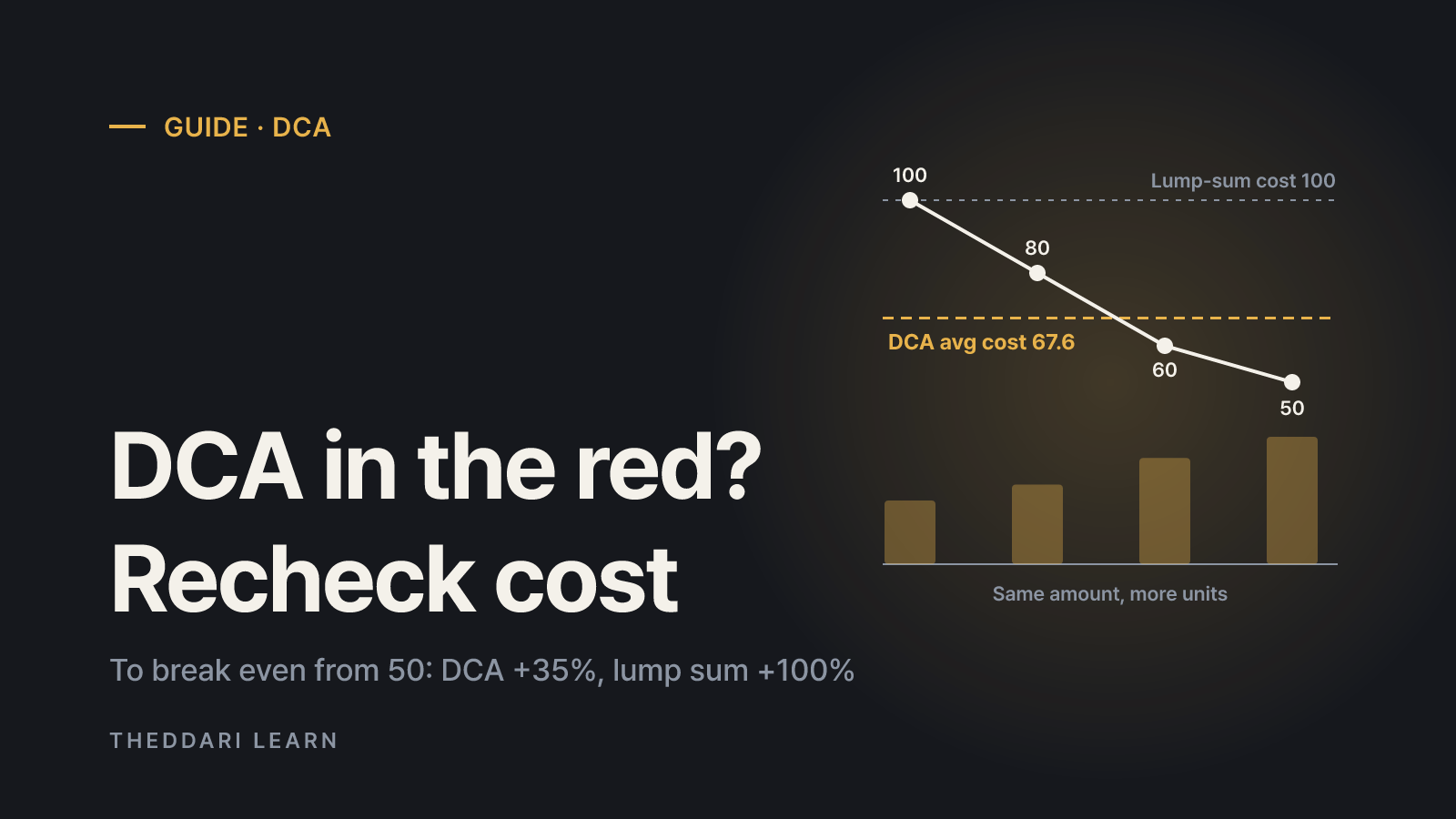
Here is a hypothetical example, not real market data. You invest $500 a month and the price goes 100, then 80, then 60, then 50.
1
- Price
- 100
- Units bought with $500
- 5.00
- Total invested
- $500
2
- Price
- 80
- Units bought with $500
- 6.25
- Total invested
- $1,000
3
- Price
- 60
- Units bought with $500
- 8.33
- Total invested
- $1,500
4
- Price
- 50
- Units bought with $500
- 10.00
- Total invested
- $2,000
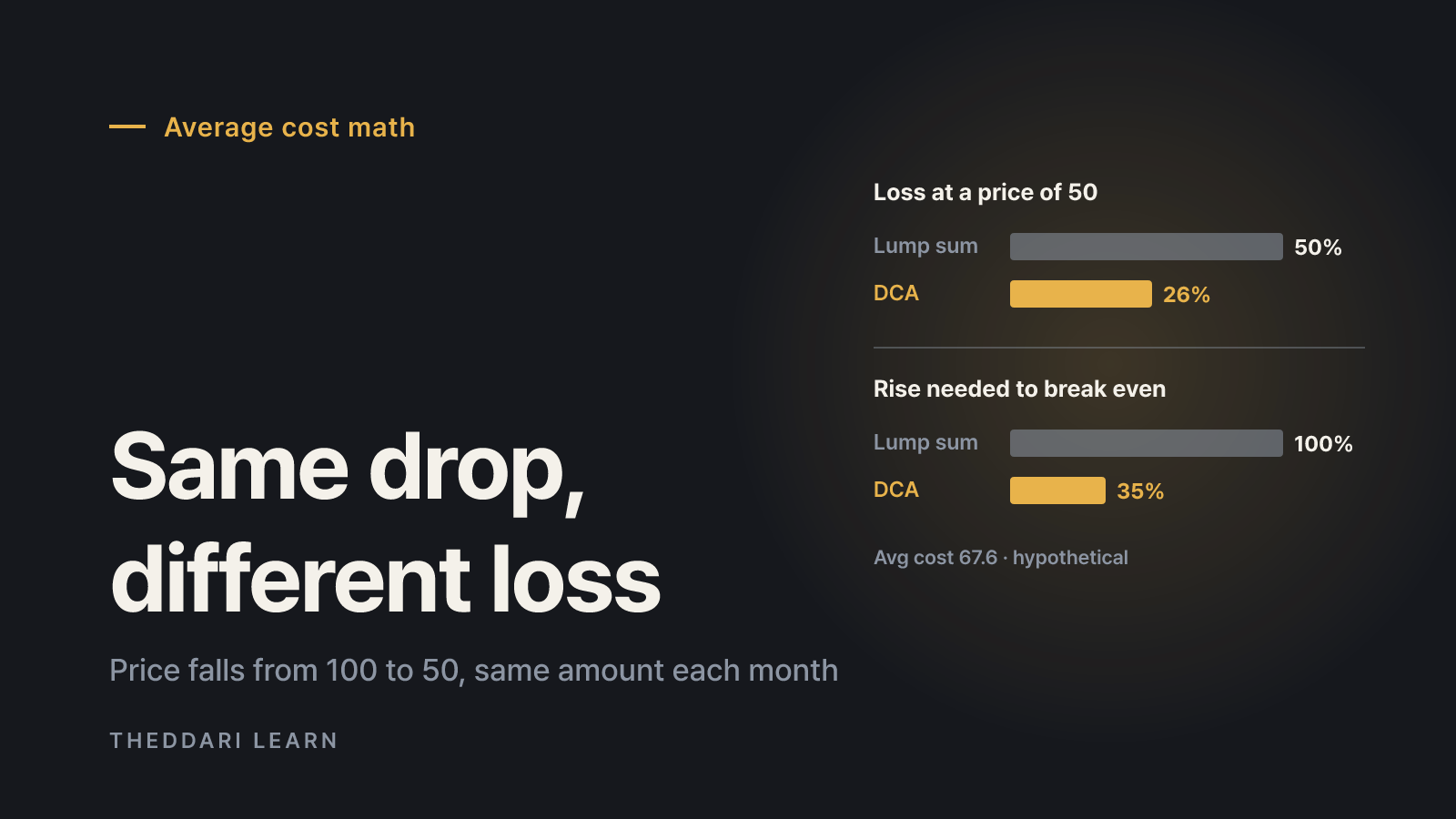
You now hold about 29.58 units, so your average cost is $2,000 ÷ 29.58 ≈ 67.6. That is lower than the simple average of the four prices (72.5) because you bought more units in the cheaper months. At today's price of 50, the position is worth about $1,479, a loss of roughly 26%. Had you invested the full $2,000 at 100 in month one, you would be down 50%. The recovery needed is also different: the lump sum needs a 100% rise to break even, while this DCA account needs about a 35% rise to get back to 67.6.
Two caveats matter. A lower average cost does not erase the loss; if the price stays below 67.6 or keeps falling, you are still behind. And the math only works in your favor if the price eventually recovers. If the asset trades sideways in a narrow range, DCA has little chance to lower your cost. If it never recovers, steady buying simply adds to the loss.
What DCA protects against, and what it does not
FINRA's May 2026 investor insight says DCA can take some emotion out of investing and limit losses on money not yet invested during a sharp decline. It also says that holding cash longer often produces lower returns than a lump sum over long periods, and that per-transaction fees can erode returns. FINRA points out that payroll contributions to a 401(k) are already a form of DCA, and the opportunity-cost argument does not apply there because you invest money as you earn it. In short, DCA reduces timing risk, the risk of putting everything in at one bad moment. It does not reduce asset risk, the risk that what you are buying loses value.
DCA into an ETF vs DCA into bitcoin: different risks
A fund that tracks the S&P 500 or the total market spreads your money across many companies that produce earnings and dividends. When one company fails, the index replaces it, and drawdowns usually reflect shifts in the economy, interest rates or profit expectations. A sector or theme ETF is narrower. If its industry falls out of favor, recovery can take much longer, or may not happen at all.
Bitcoin sits in a separate category. The SEC's guide to crypto asset-related investments warns that these investments can see rapid and significant price swings and lose money, and that if your holdings' security is compromised you could permanently lose access to them. Bitcoin has no earnings or dividends, so whether its price recovers depends on demand, adoption, regulation and liquidity. That is why a sensible bitcoin DCA plan starts with a hard cap on the amount you could lose without affecting your daily life.
What supports value
- Broad index ETF
- Earnings of many companies
- Sector or theme ETF
- Growth of one industry
- Bitcoin
- Demand, adoption, liquidity
Diversification
- Broad index ETF
- Broad
- Sector or theme ETF
- Narrow
- Bitcoin
- Single asset
Extra risks
- Broad index ETF
- Fees, currency for foreign funds
- Sector or theme ETF
- Sector concentration, top-holding weight
- Bitcoin
- Custody, platform, regulation, volatility
Question to ask
- Broad index ETF
- Is my long-term plan unchanged?
- Sector or theme ETF
- Has the industry outlook changed?
- Bitcoin
- Am I within my loss cap?
Leveraged and inverse ETFs aim for a multiple of one day's return. When prices swing up and down, losses can build even if the underlying index ends where it started. These products are designed for short holding periods and do not belong in a long-term DCA plan. If one is part of your automatic buys, review it separately from your plain index funds.
Continue, reduce, pause or sell: how to decide
You have four realistic choices. The key point is that stopping contributions and selling your holdings are separate decisions. Pausing is about your future cash flow. Selling is about the risk of what you already own.
Keep going
- When it fits
- Reason to own is intact, emergency fund is solid, position is within target
- Watch out for
- Confirm you could keep the same amount even if prices fall further
Reduce
- When it fits
- Income dropped or savings thinned, but the long-term plan stands
- Watch out for
- Write down the new amount and when you would raise it again
Pause
- When it fits
- You need cash soon or should pay off high-interest debt first
- Watch out for
- Set a restart date or condition, or the pause can become permanent
Sell some or all
- When it fits
- Your reason for owning is gone, or the position is larger than you can tolerate
- Watch out for
- Losses become realized; plan for taxes, fees and where the cash goes
Check 1: Is your reason for owning the asset still valid?
Write down in one sentence why you started. If the reason was broad, such as owning a slice of large US companies for decades, a falling price alone does not change it. If the reason was a short-term bet that a theme would take off, the drawdown may be evidence that the bet was wrong. Separate the fact that the price fell from the question of whether your reason disappeared.
Check 2: Can your cash flow handle the contributions?
Investor.gov's savings guidance notes that many investors keep enough savings to cover an emergency such as sudden unemployment, and some hold up to six months of income. The same SEC education series lists paying off credit cards and other high-interest debt as a step before investing. If you have no emergency fund or are carrying expensive debt, sticking with contributions during a downturn raises the odds that you will be forced to sell at a low price when you need cash.
Check 3: Is the position still the size you planned?
Long-running plans drift. A volatile holding like bitcoin can grow quickly in a rally and then drag down your whole portfolio in a decline. Work out what percentage of your investable assets the position represents. If it has grown past the limit you set, you can reduce the monthly amount or direct new money elsewhere to bring it back in line.
A checklist before you change your plan
- 1
Break the loss into numbers
Record total invested, units held, average cost and current value. For funds bought in a foreign currency, separate the price move from the currency move. Concrete numbers make the next steps easier than a vague sense of loss.
- 2
Check your emergency fund and debt
Count how many months of expenses you hold in cash and list any high-interest balances. If either is a problem, consider reducing or pausing contributions first.
- 3
Restate your reason and your cap
For each holding, write one line on why you own it and the maximum share of your portfolio you will allow. Holdings whose reason is gone or that exceed the cap are the ones to adjust.
- 4
Record the decision and when to revisit it
Pick continue, reduce, pause or sell, and write a trigger for reviewing it, such as resuming the original amount once you rebuild six months of savings. A written rule makes it harder for a bad week to rewrite your plan.
- 5
Know the calendar and the costs
Interest-rate decisions and inflation releases tend to bring volatile days. Knowing when they land helps you avoid snap decisions, but a calendar does not tell you which way prices will go. Review trading fees, currency conversion costs and the tax treatment of any sale.

Common mistakes when DCA turns red
- Taking comfort from a falling average cost. It means you own more units, not that you lost less.
- Suddenly increasing the amount. Averaging down to recover faster can push the position past your cap. Treat any increase as a new decision.
- Pausing and selling in one move. If the problem is cash flow, you can stop contributions and keep your existing holdings.
- Mixing leveraged or single-stock products into the plan. Judging them by the same standard as a broad index fund can lead to much bigger losses than expected.
- Changing rules because of a forecast. Price predictions on video channels and forums do not account for your income or allocation. If you follow crypto sentiment, scan several sources, such as the Telegram crypto trends page, so that one loud view does not drive your decision.
Losses during a downturn are a normal part of dollar-cost averaging, but they are not by themselves a reason to keep going or to quit. Run the three checks on your reason for owning, your cash flow and your position size, pick one of the four options, and write down when you will look at it again. Before selling, confirm current fees and tax rules with your broker, exchange or tax authority for your jurisdiction.