Contents7 sections
- Two ways to buy ETFs in Singapore: SGX vs US-listed
- CDP account vs custodian account: who is on the register
- Singapore broker fees: what a trade really costs
- How to choose a broker in Singapore, step by step
- US-listed ETFs: withholding tax and estate tax exposure
- Frequently asked questions
- Sources and references
If you want to buy ETFs in Singapore, the real decision is not which app looks nicest but how your units will be held. You can use a CDP-linked broker, where SGX-listed ETFs land in your own Central Depository (CDP) account, or a custodian broker, where the broker holds them in its name on your behalf. This guide, written as of November 2026 for Singapore residents, explains both structures, the fixed SGX fees every trade pays, what a buy actually costs at S$1,000, S$5,000 and S$20,000, and the tax issues that come with US-listed ETFs.
Short answer: small, regular buyers usually pay far less with a low-minimum custodian broker, while investors who place larger, infrequent orders and value direct registration and portability may prefer a CDP-linked account. Many people end up using both.
Two ways to buy ETFs in Singapore: SGX vs US-listed
SGX-listed ETFs trade on the Singapore Exchange, mostly in Singapore dollars, and settle through CDP. US-, Hong Kong- or London-listed ETFs are bought through your Singapore broker's overseas execution and custody chain. They never enter CDP, so for overseas ETFs you are always in a custodian arrangement, whatever account you hold. The CDP-versus-custodian question only applies to SGX-listed products.
How it is held
- SGX-listed ETF
- Own CDP account or broker sub-account
- US-listed ETF
- Broker or its custodian, in nominee name
Fixed exchange costs
- SGX-listed ETF
- 0.0075% trading, 0.0325% clearing, S$0.35 SI fee
- US-listed ETF
- SEC and FINRA fees on sells
Currency
- SGX-listed ETF
- Mostly SGD, some USD counters
- US-listed ETF
- USD, so FX conversion usually applies
Dividend tax
- SGX-listed ETF
- Depends on fund domicile and holdings
- US-listed ETF
- US-domiciled funds: US withholding
CDP account vs custodian account: who is on the register
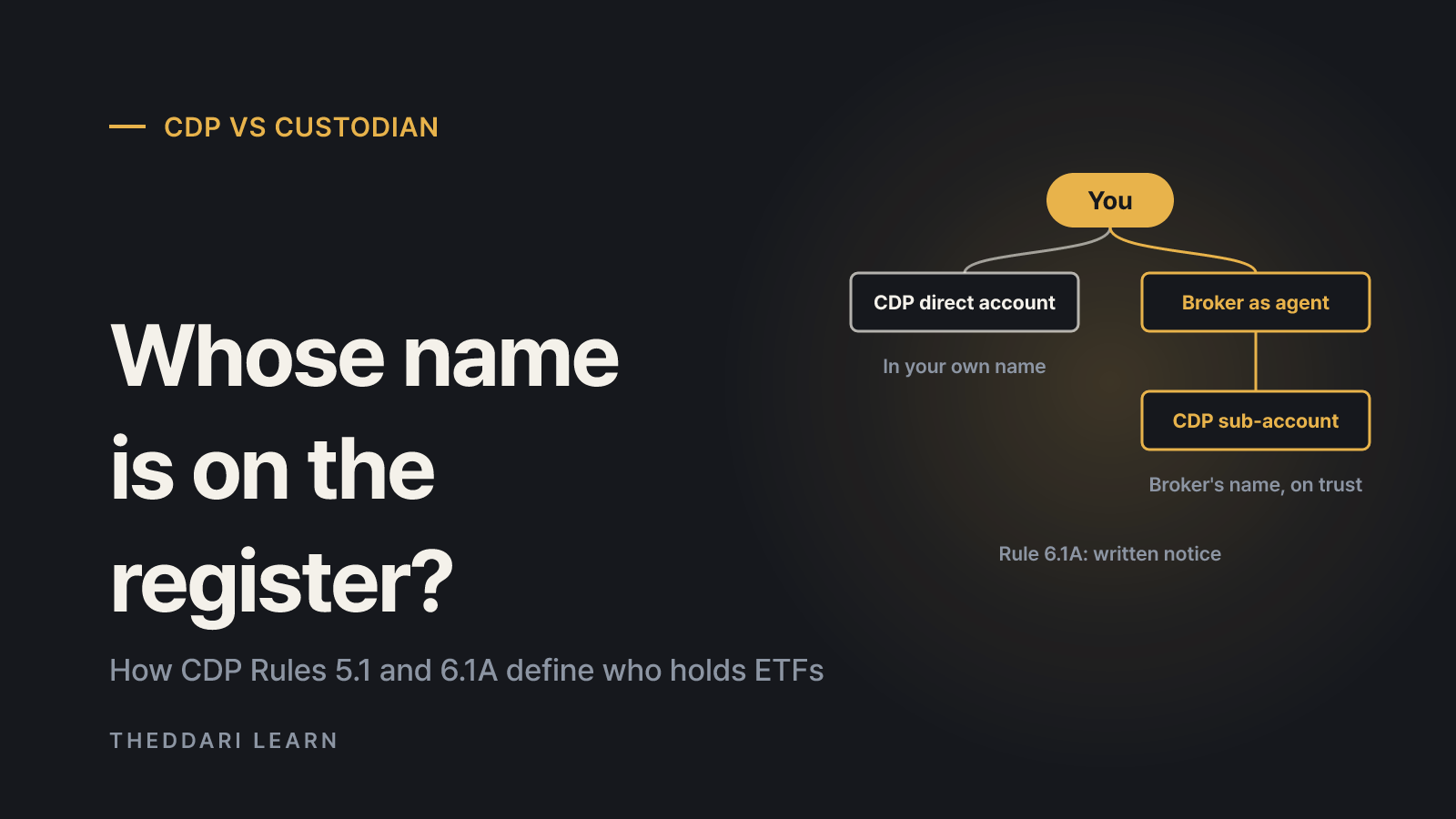
Under CDP Depository Rule 5.1, CDP opens a Direct Securities Account for an individual holding securities for their own account and treats that account holder as the absolute owner of the deposited securities (SGX Rule 5.1). In practice, ETFs bought through a CDP-linked broker sit in your name, and if you change to another CDP-linked broker your holdings stay put.
With a custodian broker, the broker acts as a depository agent and keeps your units in a CDP sub-account under its own name. A rule added on 15 July 2026 requires the agent, before depositing a retail client's securities, to disclose in writing that the securities are in the agent's name, that the agent holds them on trust for you, whether they are commingled with other clients' securities, the risks of that commingling and what happens to your assets if the agent becomes insolvent (SGX Rule 6.1A).
Name on CDP records
- CDP-linked (direct)
- You
- Custodian (sub-account / nominee)
- The broker as depository agent
Legal position
- CDP-linked (direct)
- Treated as absolute owner
- Custodian (sub-account / nominee)
- Broker holds on trust; you are beneficial owner
Switching brokers
- CDP-linked (direct)
- Keep holdings, link another broker
- Custodian (sub-account / nominee)
- Transfer process; fees may apply
Corporate notices and votes
- CDP-linked (direct)
- Directly as registered holder
- Custodian (sub-account / nominee)
- Relayed through the broker
Overseas markets
- CDP-linked (direct)
- Not covered by CDP
- Custodian (sub-account / nominee)
- Usually available
When you open a custodian account, look for the account-structure disclosure. It tells you whether your units share a sub-account with other clients and how assets would be returned in an insolvency.
Singapore broker fees: what a trade really costs
Total cost is broker commission plus fixed exchange charges plus GST. Broker fee pages checked in November 2026 list the SGX trading fee at 0.0075%, the clearing fee at 0.0325% and the settlement instruction fee at S$0.35, with 9% GST on all of them (UP pricing, Lim & Tan charges). Those exchange charges are the same whichever broker you use.
- CDP-linked example (Lim & Tan online cash account): 0.28% up to S$50,000, 0.22% from S$50,000 to S$100,000, 0.18% above that, minimum S$25.
- Custodian example (UP by CGS International, CDP sub-account): 0.06% with a S$1 minimum, but buy commissions are currently waived until further notice; sells pay the standard rate; S$1 platform fee per trade.
- UP lists a CDP sub-account maintenance fee (0.25bps a year, minimum S$2 a quarter) as waived until further notice.
Applying those schedules to an SGX ETF buy gives the following all-in costs. Formula: (commission + 0.0075% + 0.0325% + S$0.35) x 1.09.
S$1,000
- CDP-linked example (S$25 min)
- about S$28.07 (2.81%)
- Custodian example (buy waived + S$1 platform)
- about S$1.91 (0.19%)
S$5,000
- CDP-linked example (S$25 min)
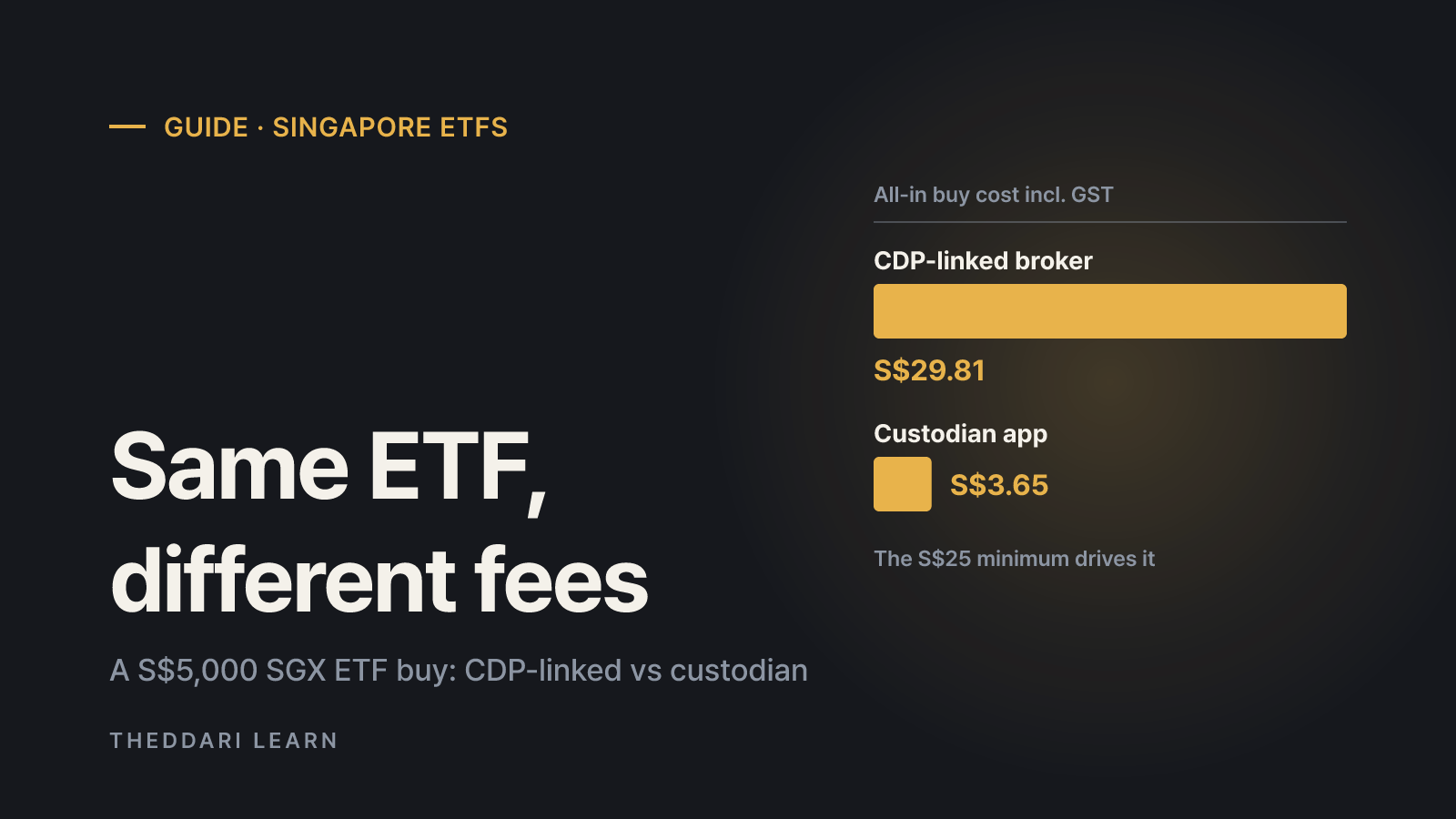
- about S$29.81 (0.60%)
- Custodian example (buy waived + S$1 platform)
- about S$3.65 (0.07%)
S$20,000
- CDP-linked example (S$25 min)
- about S$70.14 (0.35%)
- Custodian example (buy waived + S$1 platform)
- about S$10.19 (0.05%)
Most of the gap comes from the minimum commission. Below roughly S$8,900 the 0.28% rate never exceeds the S$25 floor, so small orders are expensive in percentage terms. The custodian route is not free either: selling S$5,000 at UP's standard 0.06% rate costs about S$6.92 all-in. If you dollar-cost average every month, multiply these numbers by twelve before deciding.
Fee waivers described as 'until further notice' can end at any time. Compare a full year of buys, sells, platform, custody, inactivity and transfer charges rather than a single headline commission.
How to choose a broker in Singapore, step by step
- 1
Decide which markets you need
If you only want SGX ETFs, both models work. For US or Hong Kong ETFs you need a broker that supports those markets; compare US commissions separately (for example Lim & Tan 0.3% with a US$20 minimum versus UP 0.05% with a US$1 minimum).
- 2
Choose the holding structure
Pick CDP-linked if direct registration and portability matter most; pick custodian if low minimums and app convenience matter more. Running one of each is common.
- 3
Estimate a year of costs
Number of trades x (commission + exchange fees) x 1.09, then add sells and any platform, custody or inactivity charges. For small monthly buys, the minimum commission is the biggest variable.
- 4
Read the custody and transfer terms
For custodian accounts, read the Rule 6.1A disclosure and check per-counter transfer-out fees in case you move to another broker or to CDP later.
- 5
Check how currency conversion works
For USD-traded ETFs, the broker's FX spread can exceed the commission. Look for multi-currency wallets and a published conversion rate.
If you plan when to convert SGD into USD, the economic calendar shows upcoming US data releases and central bank decisions that often move the dollar.

US-listed ETFs: withholding tax and estate tax exposure
Dividends from US-domiciled ETFs are taxed in the US before they reach you. The IRS says US-source dividends paid to nonresident aliens are withheld at 30% or a lower treaty rate (IRS guidance). Singapore does not appear on the IRS list of US income tax treaty partners (IRS treaty list), so Singapore residents generally face the full 30%. Ireland is on that list, which is why some investors compare Ireland-domiciled UCITS ETFs; check each fund's documents for the withholding it actually suffers.
Estate tax is the less obvious risk. The IRS states that the executor of a non-US-citizen nonresident must file Form 706-NA if US-situated assets exceed US$60,000 at death, and that stock of US corporations counts even when registered in a nominee's name (IRS estate tax notice). Holding through a custodian account does not take you outside that rule. If US-domiciled ETFs are a large share of your portfolio, get professional tax advice.
To see which US market themes Singapore-based investors are discussing, the Telegram stock trends page summarises chatter across channels. Popularity is context, not a reason to buy.
Pre-trade checklist
- Is the ETF listed on SGX or overseas?
- Will it sit in your own CDP account or a broker sub-account, and have you read the custody disclosure?
- Have you added buy and sell commissions, minimums and platform, custody and transfer fees?
- For USD products, have you included the FX spread and 30% dividend withholding?
- Are your US-situated assets close to the US$60,000 estate filing threshold?