Contents9 sections
- Where KOSPI 200 covered call ETF distributions come from
- The legal basis for tax-free option premiums
- How the tax is calculated: tax base price and taxable income first
- Domestic vs overseas-index covered call ETFs listed in Korea
- Account type matters: taxable, pension savings and retirement accounts
- Risks that matter more than the tax break
- What to check before buying
- Frequently asked questions
- Sources and references
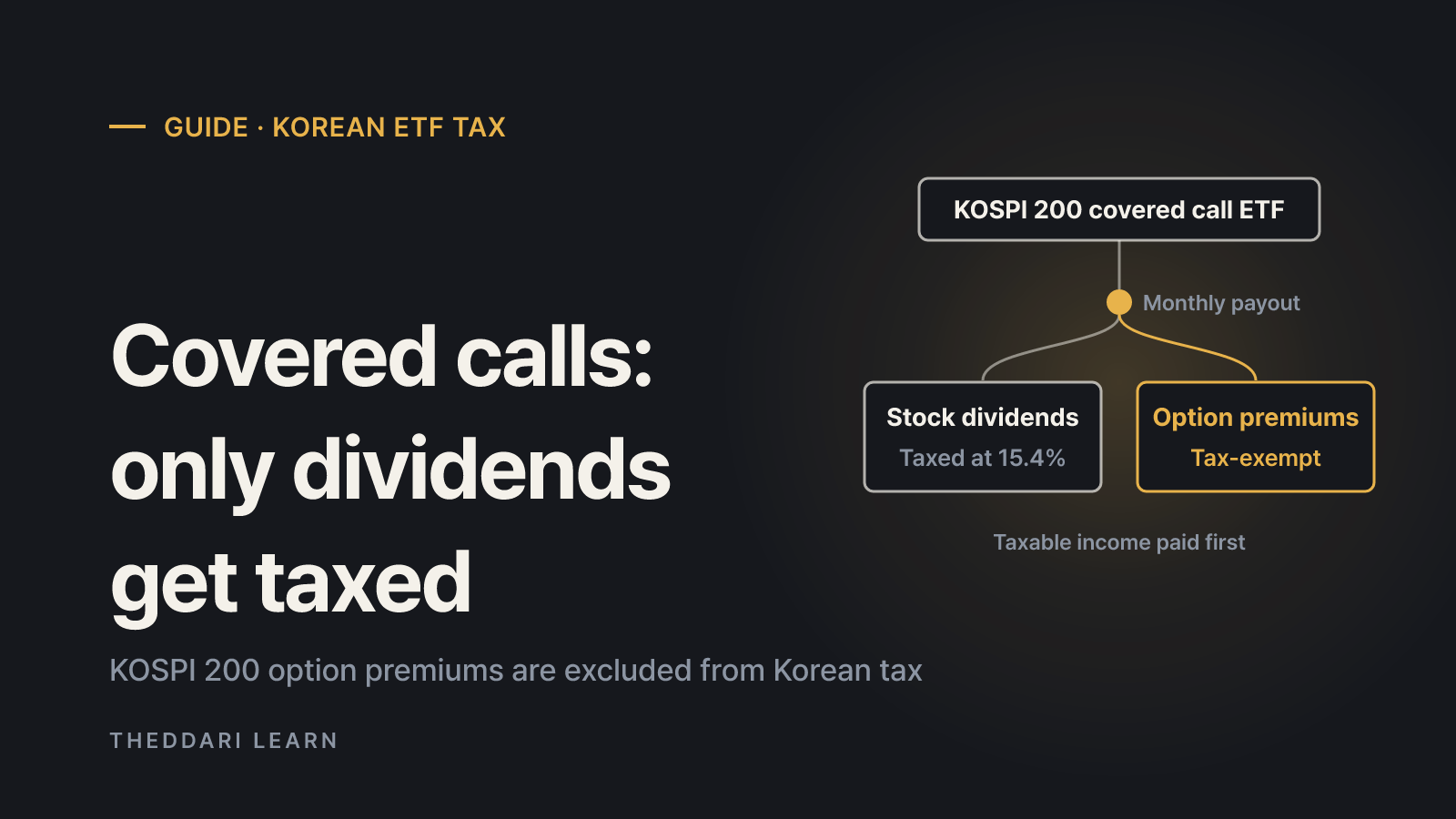
A KOSPI 200 covered call ETF listed in Korea is not fully tax-free, even when the marketing says 'tax-free option premiums'. As of November 2026, for a Korean resident holding one in a regular taxable account, the slice of each distribution that comes from selling KOSPI 200 index call options (and from gains on Korean listed shares) is excluded from tax, while the slice funded by stock dividends and interest is taxed at 15.4%, which is 14% national income tax plus 1.4% local income tax. That can leave more cash after tax than a Korea-listed covered call ETF on a US index, but the taxed share changes from month to month and the strategy still gives up upside.
The question resurfaced when Shinhan Asset Management listed SOL 200 Covered Call Active (ticker 0262Y0) on the KOSPI market on November 10, 2026 and promoted the premium tax break. This guide explains what the rule covers, how the tax is calculated, and which disclosures to read. It applies to Korean tax residents; non-residents and investors taxed in other countries face different rules.
Where KOSPI 200 covered call ETF distributions come from
A covered call fund owns a basket of stocks and sells call options against it, collecting a premium in exchange for giving up gains above the strike price. In the Korean version, the fund holds KOSPI 200 constituents and sells KOSPI 200 index options traded on the Korea Exchange (KRX). Monthly payouts therefore come from a mix of sources.
Stock dividends
- Where it comes from
- Dividends paid by the Korean shares in the fund
- Tax in a regular Korean account
- Taxable as dividend income, 15.4%
Option premiums
- Where it comes from
- Premiums and gains from selling KOSPI 200 calls
- Tax in a regular Korean account
- Excluded from taxable fund income
Gains on Korean listed shares
- Where it comes from
- Profits from rebalancing the stock basket
- Tax in a regular Korean account
- Excluded
Interest
- Where it comes from
- Cash and deposit interest
- Tax in a regular Korean account
- Taxable
Samsung Asset Management, which runs the KODEX range, spells this out in a notice on its Korean equity covered call ETFs: dividends are taxable in any ETF holding Korean stocks, while option premium income can qualify for the exemption on Korean exchange-traded derivatives. Its illustration splits a 15% annual payout into 5% taxable dividends and 10% tax-exempt premiums. That is an example, not a forecast for any fund.
The new SOL 200 Covered Call Active
According to the SOL ETF product page, 0262Y0 is benchmarked to the KOSPI 200 Target 15% Weekly Covered Call Index, charges a total fee of 0.5% a year, and uses the 15th of each month as its record date. The page notes that payouts can be held back or changed under the manager's policy. Newspim reported that the fund actively tilts toward market-leading KOSPI 200 stocks, adjusts how much of the portfolio is covered by calls, and plans its first payment on December 16. Because its stock mix differs from the index, its dividend share, and so its taxed share, may not match other KOSPI 200 covered call funds.
The legal basis for tax-free option premiums
The exemption comes from Article 26-2(4) of the Enforcement Decree of Korea's Income Tax Act. In plain terms, when a fund's taxable income is calculated, gains and losses from trading or valuing securities listed on the Korean stock market, and from exchange-traded derivatives on those securities, are left out. It mirrors the fact that individual investors in Korea generally do not pay tax on gains from Korean listed shares held directly. Samsung's notice cites this clause by name.
- Covered: gains on KRX-listed derivatives such as KOSPI 200 index options, and gains on Korean listed shares.
- Not covered: dividends, deposit or bond interest, premiums on options traded on foreign exchanges, and gains on foreign underlying assets.
- Check separately: funds that sell single-stock or over-the-counter options, or that mix in bonds, gold or other assets.
'Tax-free premium' means part of the payout is kept out of the tax base. It does not mean every distribution is untaxed, and it says nothing about returns. Product disclosures also warn that tax rules may change.
How the tax is calculated: tax base price and taxable income first
Korean ETFs are taxed against a tax base price (gwapyo gijunga), not the cash you receive. The KODEX tax guide describes it as a reference price that strips out the tax-exempt part of the fund's return. It is published daily on manager websites and in brokerage apps.
Receiving a distribution
- Taxable amount
- Lower of the distribution or the rise in tax base price
- Rate
- 15.4%
Selling the ETF
- Taxable amount
- Lower of the trading gain or the rise in tax base price
- Rate
- 15.4%
Since tax-exempt premiums never raise the tax base price, they stay out of the taxable amount whether you take them as a distribution or as a capital gain when you sell. This is the holding-period method Samsung describes for its Korean equity covered call ETFs; confirm the method for any other fund in its prospectus.
Why the taxed share changes every month
Samsung says taxable income such as dividends is paid out before option premiums. When dividends exceed the target payout, a month's distribution can be made up entirely of taxable income. Premiums earned in that period stay in the fund and keep their tax-exempt status for later payouts or for a sale after the ex-date. In months with no dividends, the payout can be 100% tax-exempt.
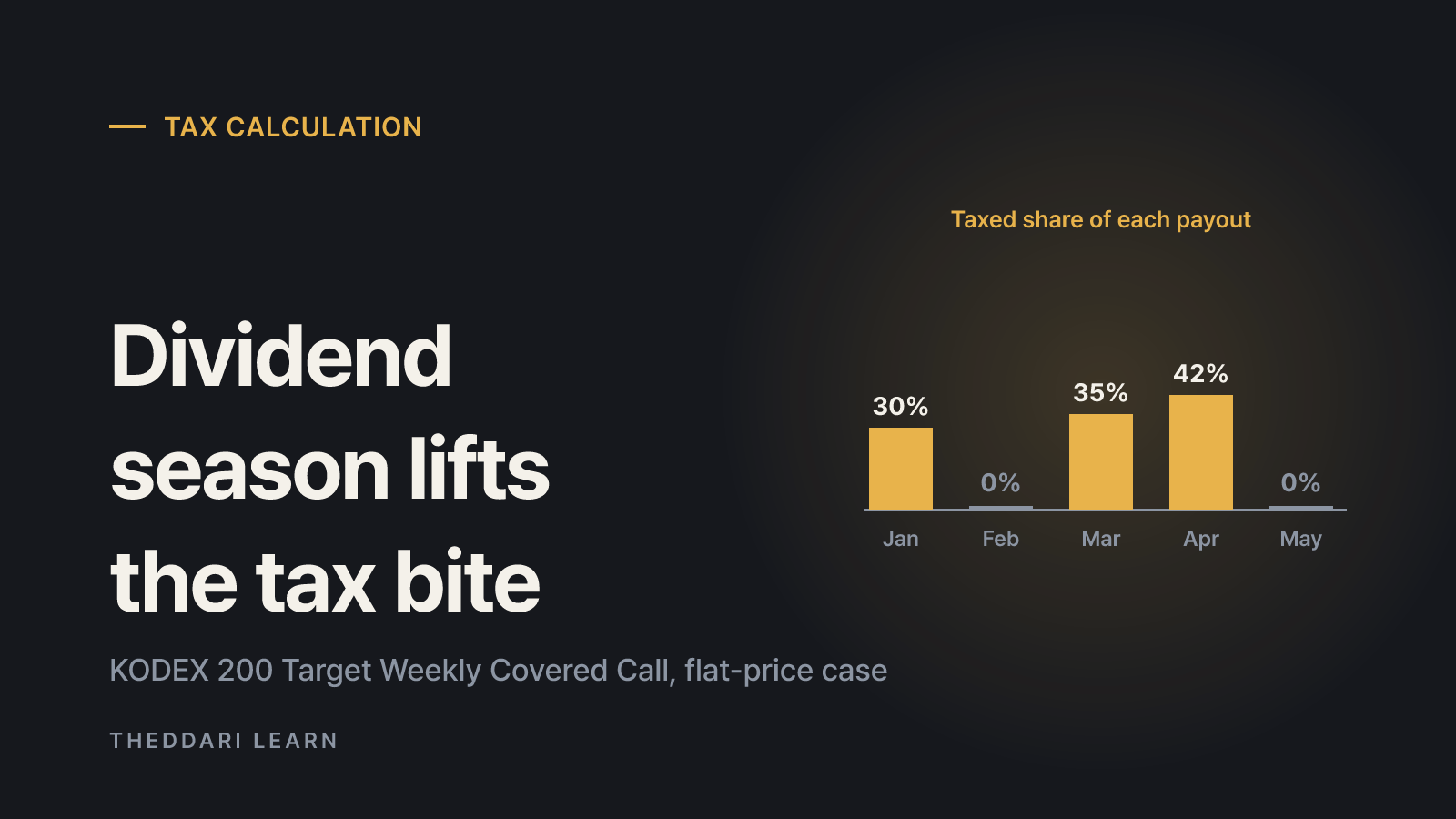
Samsung's simulation for KODEX 200 Target Weekly Covered Call assumes a flat price and a 142 won monthly payout, about 17% a year made up of roughly 15% premiums and 2% dividends. The taxed share comes out at 30% in January, 0% in February, 35% in March and 42% in April, then 0% in May. For its financials-heavy sister fund, the end-of-March and end-of-April payouts were shown as 100% taxable. Korean companies pay most annual and quarterly dividends early in the year, which is why the tax bite clusters there.
Domestic vs overseas-index covered call ETFs listed in Korea
Many Korea-listed covered call ETFs track US indexes. Options on the Nasdaq-100 or S&P 500 are not Korean exchange-traded derivatives, so their premiums are taxable, and trading gains on non-Korean-equity ETFs are also taxed as dividend income.
Option premiums
- KOSPI 200 covered call
- Excluded
- Nasdaq-100 / S&P 500 covered call listed in Korea
- Taxable as dividend income
Stock dividends
- KOSPI 200 covered call
- Taxable, 15.4%
- Nasdaq-100 / S&P 500 covered call listed in Korea
- Taxable, 15.4%; foreign withholding is paid inside the fund first
Gains when you sell
- KOSPI 200 covered call
- Gains on Korean shares excluded
- Nasdaq-100 / S&P 500 covered call listed in Korea
- Taxed up to the rise in tax base price
Taxed share of payouts
- KOSPI 200 covered call
- Spikes in dividend season, low otherwise
- Nasdaq-100 / S&P 500 covered call listed in Korea
- Usually high, but can be low when the tax base price did not rise
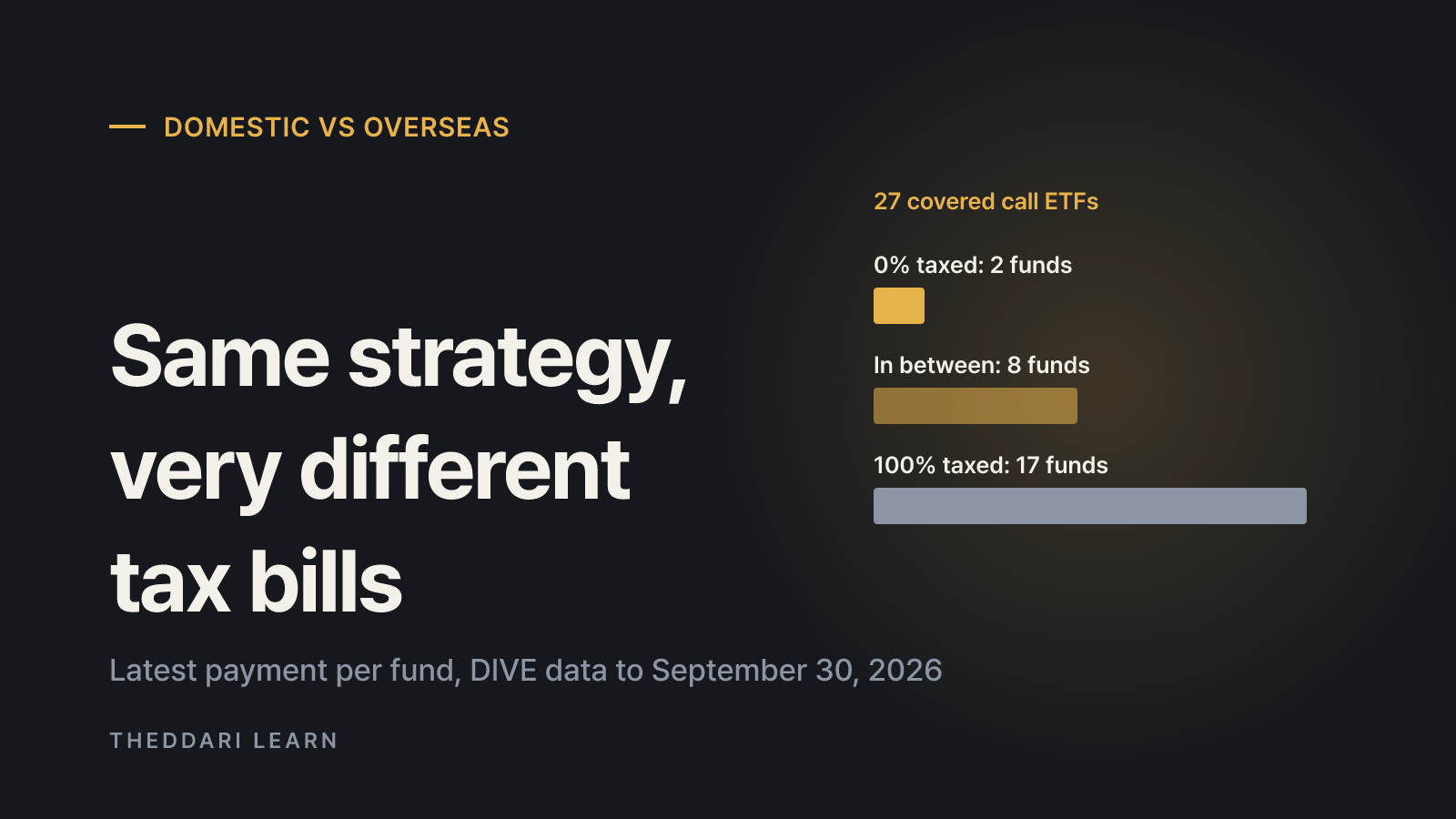
A DIVE compilation of manager disclosures looked at the latest payment for 27 Korea-listed covered call ETFs with published taxable amounts, using record dates up to September 30, 2026: 2 had a 0% taxed share, 17 were 100% taxed and 8 fell in between. KODEX 200 Target Weekly Covered Call had 2 won taxable out of a 300 won payout on September 15, 2026, while TIGER US Nasdaq100 Covered Call (Synthetic) had all 108 won taxed. One US-index fund, KODEX US S&P500 Daily Covered Call OTM, showed just 1.7% taxed in one payment, so 'overseas means fully taxed' is not a safe rule either. These are snapshots of one payment, not predictions.
Account type matters: taxable, pension savings and retirement accounts
- Regular taxable account: 15.4% is withheld on the taxable portion. Taxed dividend income counts toward Korea's comprehensive financial income taxation threshold together with other interest and dividends; the excluded premium income does not appear as taxable income on broker statements.
- Pension savings and retirement accounts (DC, IRP): the KODEX guide says distributions are not taxed when credited and are taxed at a lower rate when withdrawn as a pension. Note that income which would have been exempt in a regular account can become subject to pension income tax on withdrawal.
- Retirement account limit: Newspim reported that 0262Y0 can be held in pension savings and retirement accounts, where it counts as a risky asset limited to 70% of the balance.
- Korean ISA: a separate account-level regime, so compare each fund's taxable share before deciding which ETF deserves the limited tax-advantaged room.
The practical takeaway many Korean investors draw is that a KOSPI 200 covered call fund already carries a small tax bill in a regular account, while a US-index covered call fund benefits more from a tax-advantaged wrapper.
Risks that matter more than the tax break
- Capped upside: selling calls gives away gains above the strike. In a strong rally the fund can trail a plain KOSPI 200 ETF.
- Most of the downside stays: premiums cushion only a little. Newspim's report carried the manager's warning that losses can occur when stocks fall.
- Payouts are not interest: distributions can be reduced or suspended, and paying out more than the fund earns shrinks net asset value.
- Premiums depend on volatility: calmer markets mean smaller premiums; covering more of the portfolio to hit a target payout further limits upside.
- Rule changes: the exemption sits in an enforcement decree that can be amended.
Option premiums tend to rise when volatility rises around big events. Checking rate decisions and inflation releases on the economic calendar can help explain why payout rates move, though it will not tell you where the index is heading.

What to check before buying
- 1
Confirm the underlying and the options
Read the prospectus: Korean listed shares and KRX index options qualify; foreign-index, single-stock or OTC options change the picture.
- 2
Read several payments of taxable amount per share
The manager's distribution page lists the payout and taxable amount for each record date. One month can mislead because of dividend season.
- 3
Compare tax base price with NAV
A small rise in the tax base price means a small taxable amount.
- 4
Judge on total return
Compare total return including payouts, price change and fees over the same period. A newly listed fund has no payout history yet, only its benchmark.
- 5
Check your account and other income
In a taxable account, watch your total financial income for the year; in a pension account, consider withdrawal tax and risky-asset limits.
You can also see how often new covered call listings and payout notices come up in Korean stock Telegram channels on the stock Telegram trends page. Popularity is not the same as a suitable tax structure.
In short: the tax-free premium on a KOSPI 200 covered call ETF comes from a Korean rule that keeps exchange-traded derivative gains out of fund income; dividends are still taxed at 15.4%; and because taxable income is paid out first, the taxed share of each payout varies. Before choosing a fund, look past the label to the underlying assets, the per-payment tax disclosures, and the capped-upside trade-off.