Korean Pension Savings ETF Limits: Leveraged and US ETFs
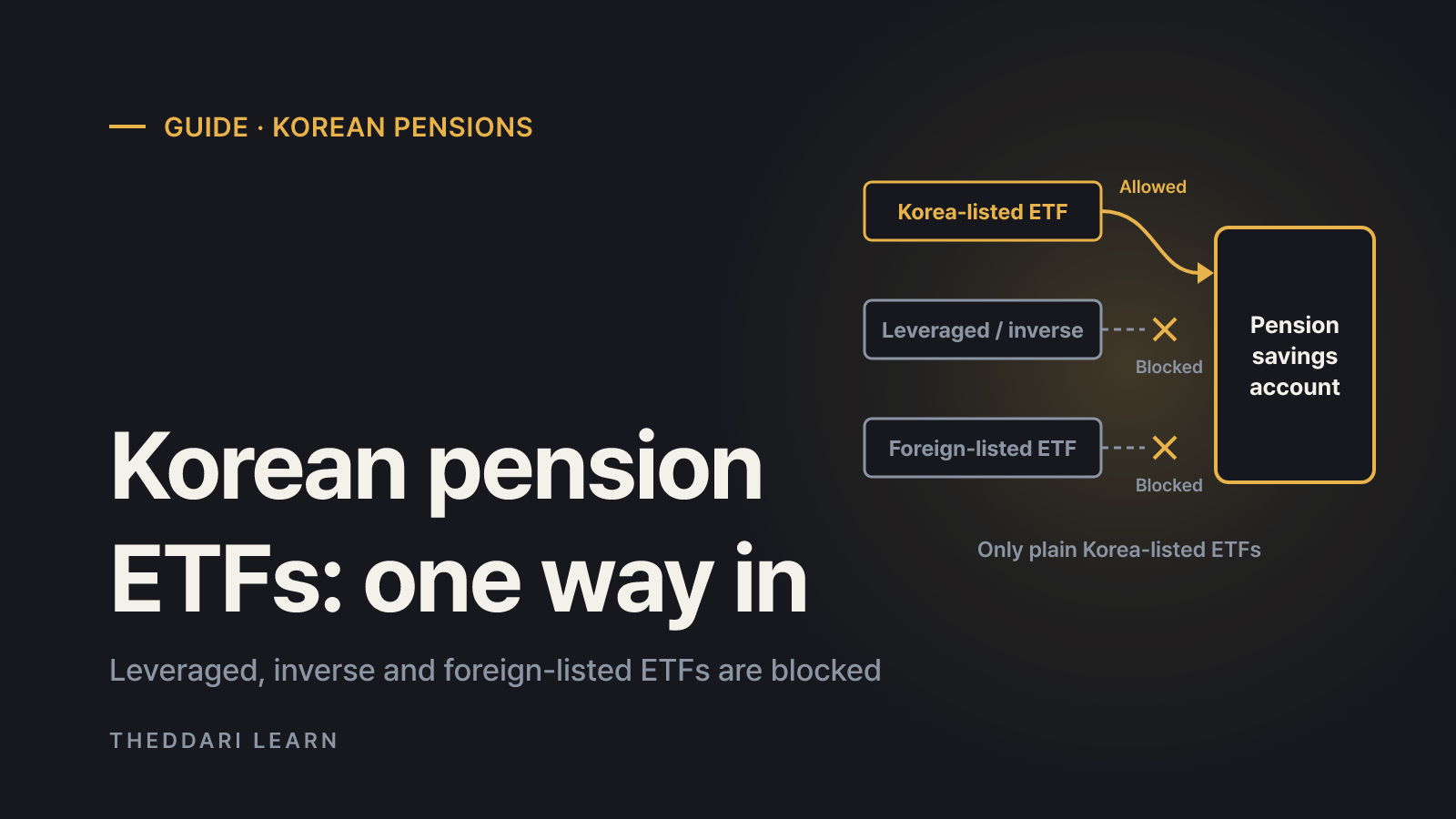
Which ETFs can a Korean pension savings account hold? Only Korea-listed ones: leveraged, inverse and US-listed ETFs are blocked. Rules and workarounds.
Contents8 sections
Key takeaways
- A Korean pension savings account at a brokerage can buy ETFs listed on the Korea Exchange, but not ETFs listed abroad such as US-listed funds.
- Leveraged and inverse ETFs have been excluded since the Financial Services Commission opened these accounts to ETFs in November 2017.
- For US or global exposure, investors use Korea-listed ETFs that track overseas indexes, as long as they are not leveraged or inverse.
- Margin, credit, short selling and securities lending are blocked, so every purchase must be fully funded with cash in the account.
- Retirement pension accounts (IRP and DC) have stricter rules, including a 70% cap on risky assets and a derivatives-exposure test.
The short answer on Korean pension savings ETF rules: you can buy ETFs listed on the Korea Exchange that are not leveraged or inverse, and nothing listed abroad. That means no US-listed funds bought directly, no 2x products and no inverse funds. If you want US or global exposure inside the account, you use a Korea-listed ETF that tracks an overseas index. This guide applies to Korean tax residents holding a pension savings account (연금저축계좌, often called a pension savings fund account) at a Korean brokerage, and it reflects official sources checked as of October 2026. Brokerages implement the rules slightly differently, so the final section explains how to confirm a specific fund.
Korean pension savings ETF basics: allowed vs blocked
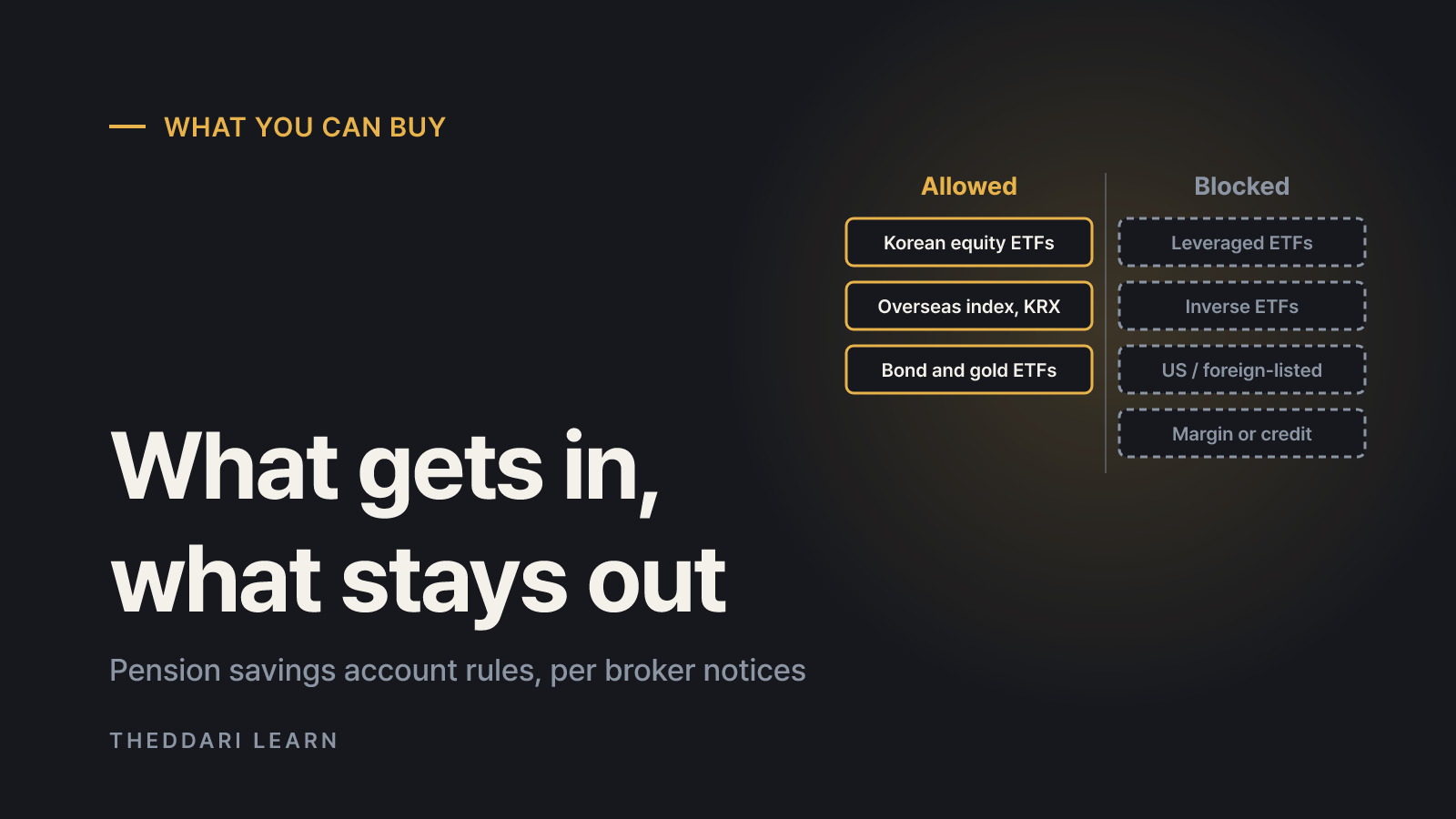
A pension savings account is Korea's main personal retirement wrapper. Contributions can earn an income tax credit, and gains inside the account are taxed only when money comes out. Banks and insurers offer older trust and insurance versions, but only the brokerage version lets you trade ETFs yourself. ETF trading in these accounts opened after the Financial Services Commission's November 2017 announcement, which clarified that brokerage commissions count as costs rather than withdrawals. The same announcement excluded inverse and leveraged ETFs and restricted margin trading and credit.
Brokerage notices today repeat those limits. Hana Securities says only domestically listed ETFs can be traded and that leveraged and inverse ETFs are excluded. A Mirae Asset Securities FAQ adds that individual stocks, overseas stocks, deposits, listed and unlisted bonds and IPO subscriptions are not available, while domestic ETFs other than inverse and leveraged types, plus listed REITs and infrastructure funds, can be traded.
Korean equity index ETF (e.g. KOSPI 200)
- In a pension savings account
- Allowed
- Notes
- The most common holding
Korea-listed ETF tracking S&P 500 or Nasdaq-100
- In a pension savings account
- Allowed
- Notes
- Only if not leveraged or inverse; currency risk applies
Korea-listed bond, gold or covered-call ETF
- In a pension savings account
- Allowed
- Notes
- Check each fund's structure and risks
Leveraged ETF (2x)
- In a pension savings account
- Blocked
- Notes
- Excluded since 2017
Inverse ETF (-1x, -2x)
- In a pension savings account
- Blocked
- Notes
- Excluded for the same reason
ETF listed on a US or other foreign exchange
- In a pension savings account
- Blocked
- Notes
- Overseas trading is not offered
Individual stocks and IPO subscriptions
- In a pension savings account
- Blocked
- Notes
- Some brokers allow listed REITs
Margin, credit, short sales, lending
- In a pension savings account
- Blocked
- Notes
- Purchases need 100% cash
Exchange-traded notes (ETNs) look similar on a trading screen but are debt securities issued by a brokerage, not funds. Do not assume they follow the ETF list; check whether your broker shows them as buyable in the pension account.
Why leveraged and inverse ETFs are excluded
The regulator's reasoning is about volatility decay. In its 2017 release, the Financial Services Commission used a simple example: 100 won invested in an ordinary ETF that rises 5% and then falls 5% ends at 99.75 won. A leveraged ETF moving twice as much, up 10% and then down 10%, ends at 99 won. Because daily multiples compound, a choppy market can leave a leveraged fund lower even when the index returns to where it started. The commission said that pattern does not suit retirement savings meant to be held for decades.
Margin and credit were blocked for a tax reason as well as a protective one. If an investor bought on credit, failed to pay and triggered a forced sale or late interest, it would be unclear whether that cash counted as an early withdrawal from a tax-favored account. Daishin Securities, for example, lists a 100% margin requirement and no credit, lending or short selling. In practice you can only buy with the cash already in the account.
Names that cause confusion
- Anything labeled leverage or 2X is blocked, whether it tracks a Korean or an overseas index.
- Inverse and inverse 2X products are blocked too.
- Covered call, synthetic or futures in a fund name is not the same as leveraged or inverse; such funds may be available but need a careful prospectus read.
- A trailing (H) marks a currency-hedged version and does not affect eligibility.
Getting overseas exposure without US-listed ETFs
Not being able to buy US-listed funds is the restriction English-language investors notice first. The workaround is a domestic ETF: Korean asset managers list funds on the Korea Exchange that track the S&P 500, Nasdaq-100, US dividend indexes and many others, and these trade in won inside the pension account. Even when two funds track the same index, compare the manager, total expense ratio, whether currency is hedged and how distributions are handled. A Korea-listed S&P 500 ETF is a different product from a US-listed one.
The tax benefit comes from the account, not the fund. Gains and distributions inside the account are not taxed at the time they occur; the tax treatment depends on how money is eventually withdrawn. According to the Financial Supervisory Service's FinLife portal, retirees whose pension income exceeds 12 million won a year may choose either comprehensive taxation or a 15% separate tax. Cancelling early or taking a lump sum is different: Hana Securities notes that credited contributions and investment gains are then taxed at 16.5% as other income.
Overseas-index funds also react to foreign central bank decisions and data releases, often overnight in Korea, and those events can move both the index and the exchange rate. The theddari economic calendar lists major releases in Korean time so you can see when volatility is scheduled. It is a scheduling aid, not a forecast of price direction.

Pension savings vs IRP and DC accounts
Korea's retirement pension accounts, the individual retirement pension (IRP) and defined-contribution (DC) plans, also allow ETFs but under the Retirement Pension Supervisory Regulation. Mirae Asset Securities summarizes the exclusions: ETFs whose derivatives risk exposure exceeds 40% of fund assets (synthetic ETFs are allowed up to 100%), ETFs without an investment-grade rating, and leveraged or inverse ETFs. Eligible ETFs are further split into those that can fill 70% or 100% of the account.
Leveraged and inverse ETFs
- Pension savings account
- Blocked
- IRP / DC
- Blocked
Foreign-listed ETFs
- Pension savings account
- Blocked
- IRP / DC
- Blocked
ETFs with derivatives exposure above 40%
- Pension savings account
- Generally allowed if not leveraged or inverse
- IRP / DC
- Blocked (separate synthetic ETF rule)
Cap on risky assets
- Pension savings account
- None
- IRP / DC
- 70% for many funds
Contributions eligible for tax credit
- Pension savings account
- 6 million won a year
- IRP / DC
- 9 million won combined with pension savings
FinLife lists the credit rates as 16.5% for earners with total salary of 55 million won or less (or comprehensive income of 45 million won or less) and 13.2% above that, with a combined contribution limit of 18 million won a year across both account types. A common pattern is to keep higher-risk ETF holdings in the pension savings account and use the IRP for the rest of the credit-eligible amount.
How to check before you buy
- 1
Confirm the account type
Make sure you hold a brokerage pension savings account, not an insurance or trust version or a legacy pension fund product. Daishin, for instance, says ETF trading is not available in its older pension fund product.
- 2
Activate ETF trading if required
Some brokers, such as Hana Securities, require a separate ETF trading agreement that takes effect the next business day and pauses automatic fund purchases. Check where new contributions are parked.
- 3
Search the ticker in the pension order screen
If the ETF is leveraged, inverse or foreign-listed it will not appear or the order will be rejected. Read the fund name carefully for 2X or inverse labels.
- 4
Place a fully funded order
You need the full purchase amount in cash. Trading is available in regular and after-hours sessions; check the bid-ask spread and consider a limit order.
- 5
Plan the exit before payouts start
Hana notes that ETFs are not sold automatically when pension payments begin. Decide in advance which holdings to sell and when, so you are not forced to sell at an unplanned moment.
If you want to see which Korean ETFs local investors are discussing, the theddari Telegram stock trends page collects that chatter. Popularity says nothing about whether a fund is eligible for your account or suitable for retirement savings, so run any name through the checks above.
Summary checklist
- Is the ETF listed on the Korea Exchange? Foreign-listed funds cannot be bought directly.
- Does the name include leverage, 2X or inverse? Then it is not eligible.
- For overseas-index ETFs, have you compared expense ratios and hedging against other Korea-listed funds tracking the same index?
- Do you have the full purchase amount in cash? Margin and credit are not available.
- Have you factored in the 16.5% tax on credited contributions and gains if you cancel early?
- If you also use an IRP, have you checked the 70% risky-asset rule there?
Frequently asked questions
Can I buy a US-listed ETF like an S&P 500 fund in my Korean pension savings account?
Why are leveraged and inverse ETFs banned in Korean pension accounts?
Is a pension savings account or an IRP better for ETF choice?
Can foreigners living in Korea open a pension savings account?
Sources and references
- 1Financial Services Commission (Korea): ETF investment via pension savings accounts, press release 2017-11-21(opens in a new tab)www.fsc.go.kr
- 2Hana Securities: Pension ETF trading guide(opens in a new tab)www.hanaw.com
- 3Daishin Securities: Pension savings account ETF trading notice(opens in a new tab)money2.daishin.com
- 4Mirae Asset Securities FAQ: Stocks and IPO subscriptions in pension savings accounts(opens in a new tab)securities.miraeasset.com
- 5Mirae Asset Securities: ETFs tradable in pension savings and retirement pension accounts(opens in a new tab)securities.miraeasset.com
- 6Financial Supervisory Service FinLife: Tax-advantaged financial products(opens in a new tab)finlife.fss.or.kr
Related articles
 Investing
Stock Market Circuit Breakers and Sidecars: US vs Korea
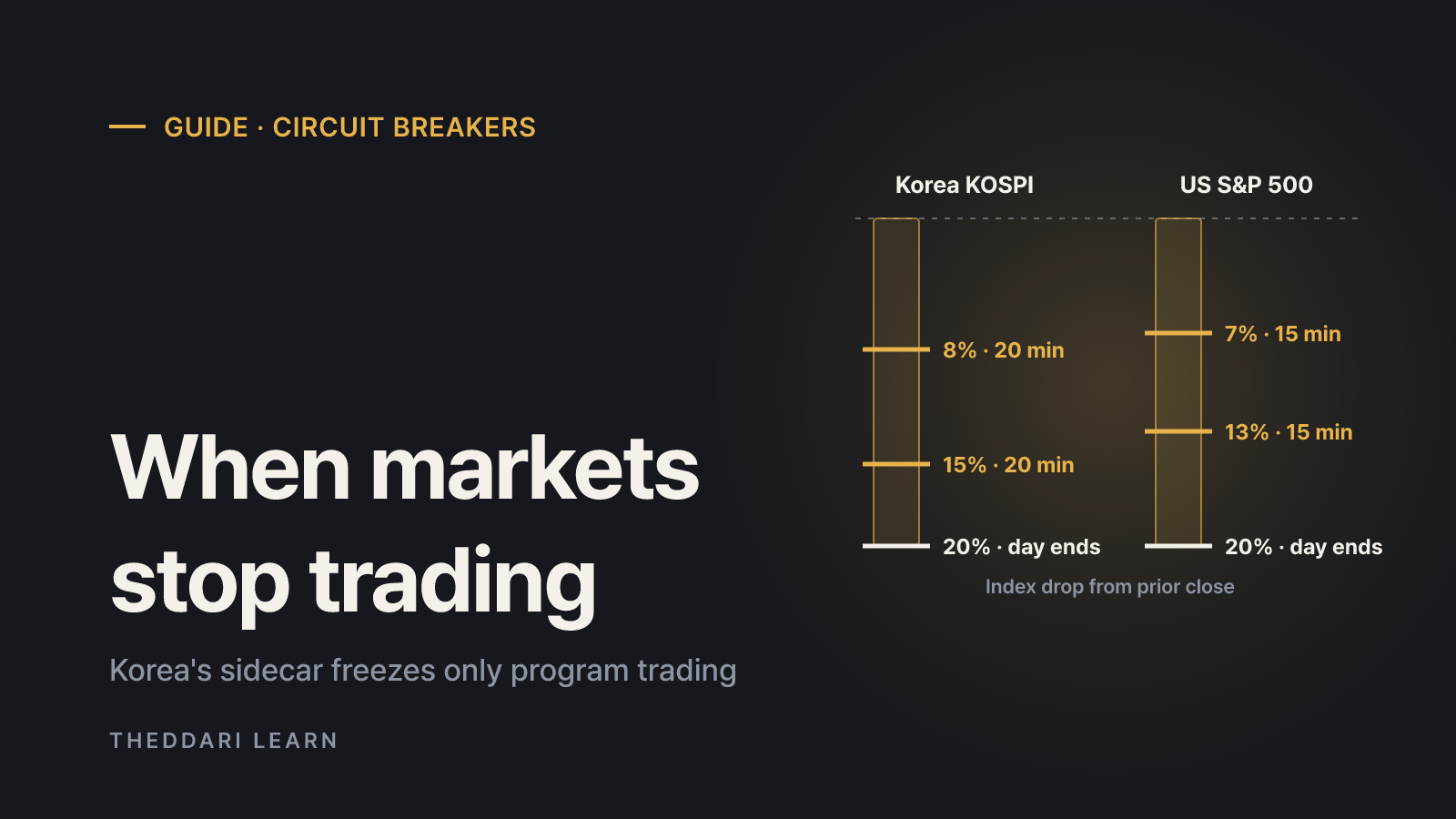
US market-wide circuit breakers halt all trading when the S&P 500 drops 7%, 13% or 20%. Korea uses 8%, 15% and 20% thresholds plus a sidecar that freezes only program trading. Here is how each rule works and what happens to your orders.
 Investing
Pension Withdrawal Order in Korea: How IRP Money Is Taxed
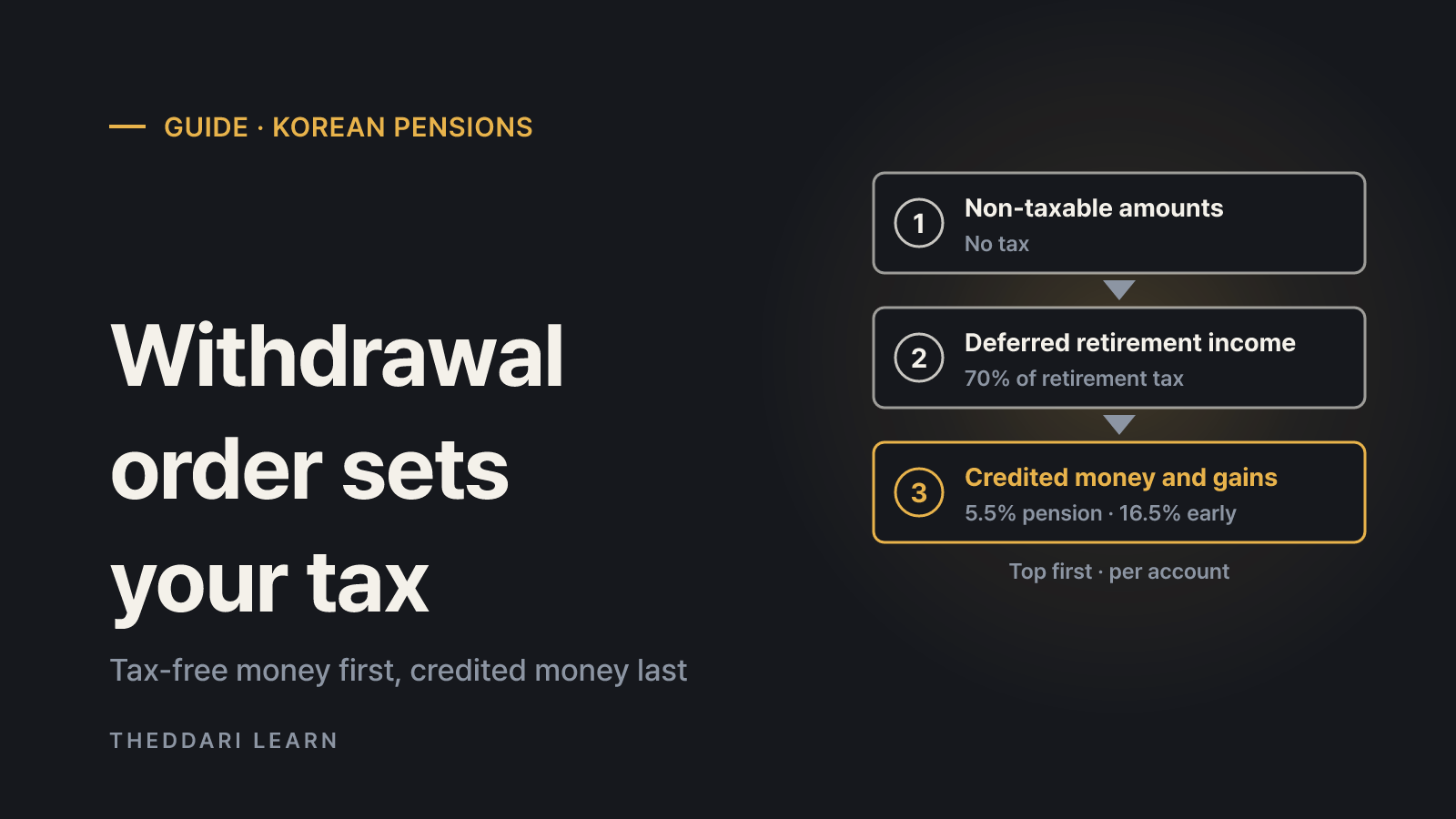
When you take part of the money out of a Korean pension savings account or IRP, the law decides which money left first, and each part is taxed differently. A November 2026 guide to the withdrawal order, rates and exceptions for Korean tax residents.
 Investing
How to Buy ETFs in Singapore: CDP vs Custodian and Fees
A practical guide for Singapore residents: how SGX-listed and US-listed ETFs are held, what the CDP rule changes of July 2026 mean for custodian accounts, and what a trade really costs at different order sizes.