Contents7 sections
- What the OpenAI valuation news actually says
- How a private company valuation is set in a funding round
- Secondary sales and tender offers: other price signals
- What the reported cut means for listed stocks and retail investors
- A checklist for reading private AI valuation headlines
- Frequently asked questions
- Sources and references
The headline OpenAI valuation cut is real, but it is narrower than it sounds. As of October 2026, reports say OpenAI lowered the price it is asking new investors to pay, from a $1.4 trillion pre-money valuation to $1.25 trillion, while it negotiates a raise of up to $30 billion. Nothing that was already agreed has been marked down. This guide explains what changed, how private AI companies are valued through funding rounds, secondary sales and tender offers, and what the news does and does not tell investors in listed companies.
What the OpenAI valuation news actually says
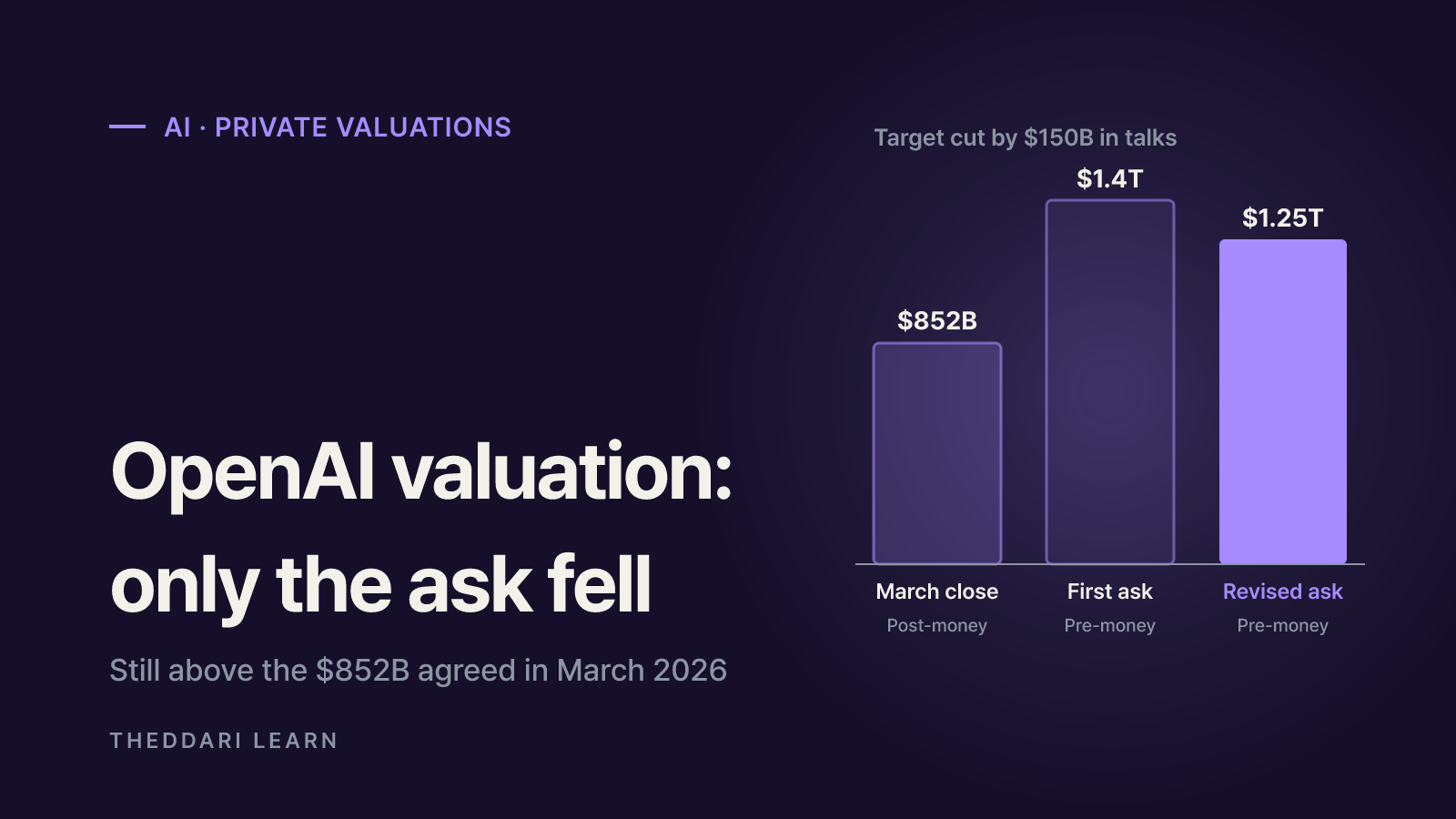
TechCrunch, citing CNBC, reported on October 22, 2026 that OpenAI is close to raising up to $30 billion at a $1.25 trillion pre-money valuation in a round led by Coatue and investors from the United Arab Emirates. Bloomberg had reported a month earlier that the company was targeting $1.4 trillion, which makes the reduction $150 billion. The Next Web summarized Financial Times reporting that some investors pushed back on the higher figure. Every outlet stressed that terms were still being negotiated, and OpenAI declined to comment.
The useful reference point is the last completed round. In its March 31, 2026 announcement, OpenAI said it closed $122 billion in committed capital at an $852 billion post-money valuation. Measured against that, $1.25 trillion is roughly 47% higher. So the story is better described as a smaller step-up than the company hoped for, not a decline in value.
Last closed round
- When
- March 2026
- Basis
- Post-money
- Amount
- $852 billion
Initial ask
- When
- September–October 2026 talks
- Basis
- Pre-money
- Amount
- $1.4 trillion
Revised ask
- When
- Reported October 22, 2026
- Basis
- Pre-money
- Amount
- $1.25 trillion
Notice that the bases differ. The March figure includes the new money; the October figures exclude it. If the full $30 billion arrives at the revised price, the post-money valuation would be about $1.28 trillion. Comparing a post-money number with a pre-money number without adjusting is a common way headlines overstate or understate change.
How a private company valuation is set in a funding round
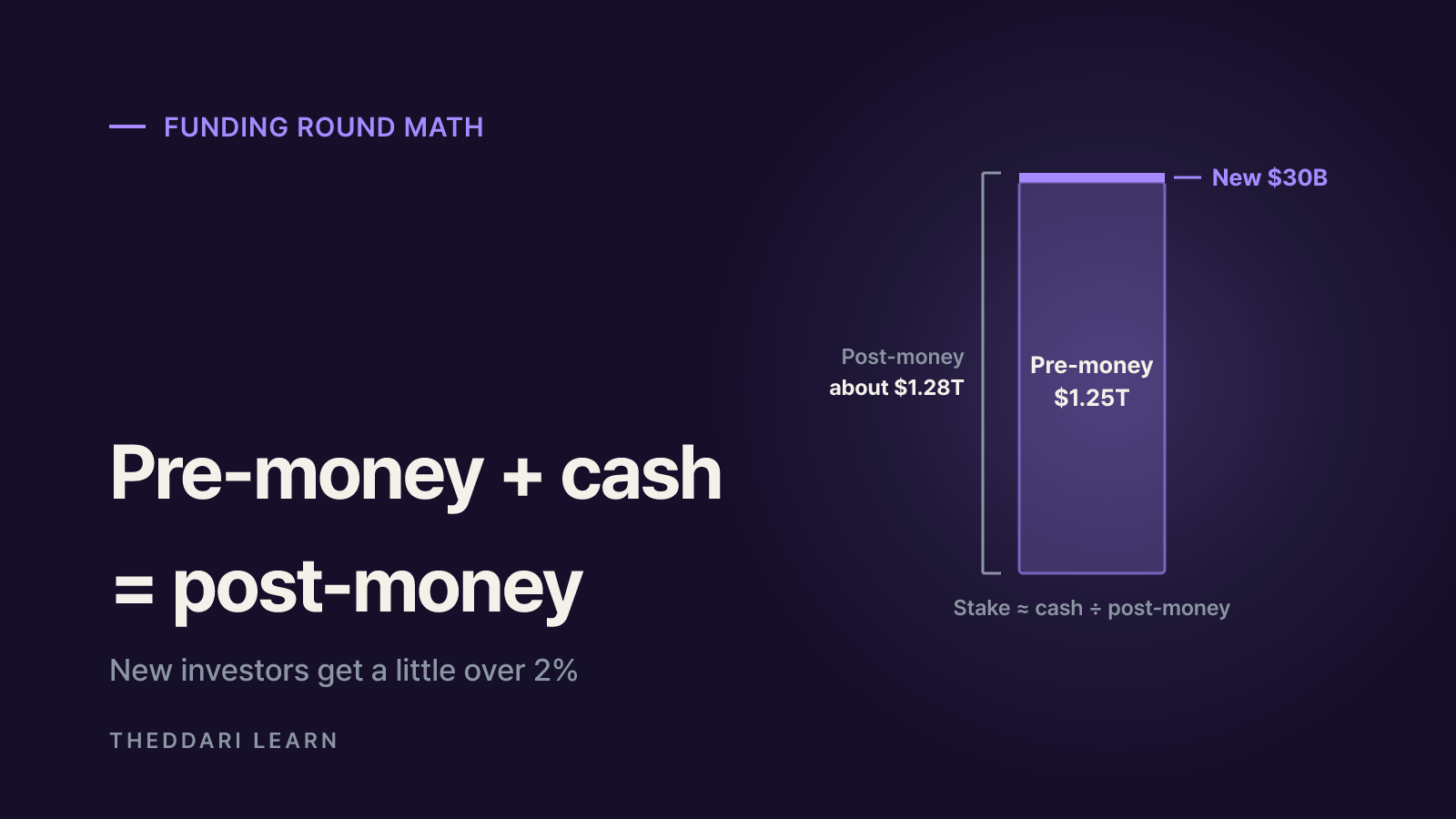
A listed company has a market capitalization that updates every trading second. A private company has no such price. Its valuation is inferred from a priced round: the company sells newly issued shares, usually preferred stock, and the amount investors pay for a given ownership percentage implies a value for the whole business. Carta puts it plainly: pre-money and post-money valuations are not exact appraisals of assets and liabilities but an expression of how much investors are willing to pay for a stake, based on how they see the company's growth prospects.
The pre-money and post-money math
- Post-money valuation = pre-money valuation + new investment
- New investors' approximate stake = new investment ÷ post-money valuation
- Price per share = pre-money valuation ÷ pre-money fully diluted shares
Applied to the reported terms, $30 billion on a $1.25 trillion pre-money base implies a post-money value of about $1.28 trillion and a new-investor stake of a little over 2%. Lowering the pre-money target means the same dollars buy more shares, so the price per share falls for incoming investors and existing holders are diluted slightly more. Real ownership also depends on option pools, convertible instruments and deal structure, so treat this as an illustration of the mechanics rather than a cap table.
Why the headline number can overstate value
Preferred shares sold in late-stage rounds often carry protections such as liquidation preferences. Multiplying the preferred price by every share outstanding produces a headline figure that can exceed what common stock is worth. Mega-rounds in AI also tend to bundle non-cash elements. CNBC reported that the UAE money could be paired with a deal for more computing capacity for OpenAI. Those terms change what a valuation means, which is why the final, official announcement matters more than leaked numbers.
Secondary sales and tender offers: other price signals
A funding round is a primary transaction: new shares are created and the cash goes to the company. In a secondary sale, an employee or early investor sells existing shares to someone else; the cash goes to the seller and no one is diluted. Carta's overview of the secondary market lists the frictions that make private secondaries less informative than a stock exchange: transfer restrictions, no public price history, inefficient price discovery and settlement that can take two to four weeks or longer.
Primary funding round
- Who gets the cash
- The company
- How the price is set
- Negotiated with lead investors
- What it signals
- The basis for headline valuations
Tender offer
- Who gets the cash
- Selling shareholders
- How the price is set
- One price set for all eligible sellers
- What it signals
- Relatively consistent and transparent
Direct secondary sale
- Who gets the cash
- The individual seller
- How the price is set
- Negotiated trade by trade
- What it signals
- Prices vary and are rarely disclosed
A tender offer is a formal program in which the company or a third-party buyer offers to purchase shares from eligible holders at a set price, with the same terms for everyone. Direct secondaries are bilateral and often need company approval; companies can block them through transfer restrictions or a right of first refusal. Carta notes that secondary prices are usually expressed as a discount or premium to the latest preferred price, and that in private block trades sellers have accepted discounts of 20% to 30% while buyers sought 50% or more. A single secondary print is weak evidence about the whole company.
What the reported cut means for listed stocks and retail investors
OpenAI is private, but listed companies are tied to it. Its March round was anchored by Amazon, NVIDIA and SoftBank, with Microsoft also participating. OpenAI said it raised more than $3 billion from individual investors through bank channels and that it would be included in several ETFs managed by ARK Invest. Holders like these often reference round prices when they value private stakes, so a change in the asking price can feed into how analysts read their exposure. The exact accounting depends on each company's filings and reporting standards, so check their disclosures rather than assuming a mechanical impact. The earnings calendar below helps you track when those companies next report.

The timing also matters. Coverage linked the revision to investor doubts about the payoff from AI infrastructure spending and a weak week for technology shares. TechCrunch noted that OpenAI filed confidentially for an IPO in June 2026, and private round prices tend to anchor expectations for an eventual offering price. A lower ask therefore resets assumptions about listing value, not just about this round.
For individuals, the bigger risk is products marketed as early access. FINRA's August 18, 2026 alert explains that many pre-IPO offers in well-known private companies are interests in a fund that tries to acquire shares, not the stock itself. It warns that the company may never go public, the securities are hard to value, exits are limited by resale restrictions and lock-ups, layered fees can be significant, and transfers can be void without company approval. Unsolicited offers of "OpenAI pre-IPO shares" deserve a registration check before anything else. The theddari pre-IPO page is a starting point for following private-company information.
A checklist for reading private AI valuation headlines
- 1
Pin down the basis
Is the figure pre-money or post-money, and is it a closed round or a target under negotiation? Mixing the two is the most common source of misleading comparisons.
- 2
Identify the transaction type
Determine whether it is a primary round, a tender offer or an individual secondary trade. Whether the money goes to the company or to sellers changes what the price tells you.
- 3
Weigh the source
Separate anonymous-source reporting from official company statements. Negotiated terms can move, so note the date and look for the final announcement.
- 4
Look for side terms
Compute agreements, conditional commitments and preferred-stock rights can make two equal headline numbers economically different.
- 5
Map your own exposure
If you are exposed through a listed company or an ETF, read how that issuer values its private holdings. If someone offers you direct access, verify registration and product structure first.
To follow how the wider AI conversation reacts to stories like this, the theddari AI Telegram trends page collects frequently discussed topics. It shows what people are talking about, not whether a valuation is justified, so pair it with the checklist above.
The accurate summary of the October 2026 story is this: OpenAI lowered the pre-money price it is asking new investors to accept from $1.4 trillion to $1.25 trillion, and even the lower figure sits well above the $852 billion post-money value agreed in March. Private company valuations are prices agreed at a specific time, by specific investors, under specific terms. Reading them that way makes the next funding round or IPO filing much easier to interpret.