Contents8 sections
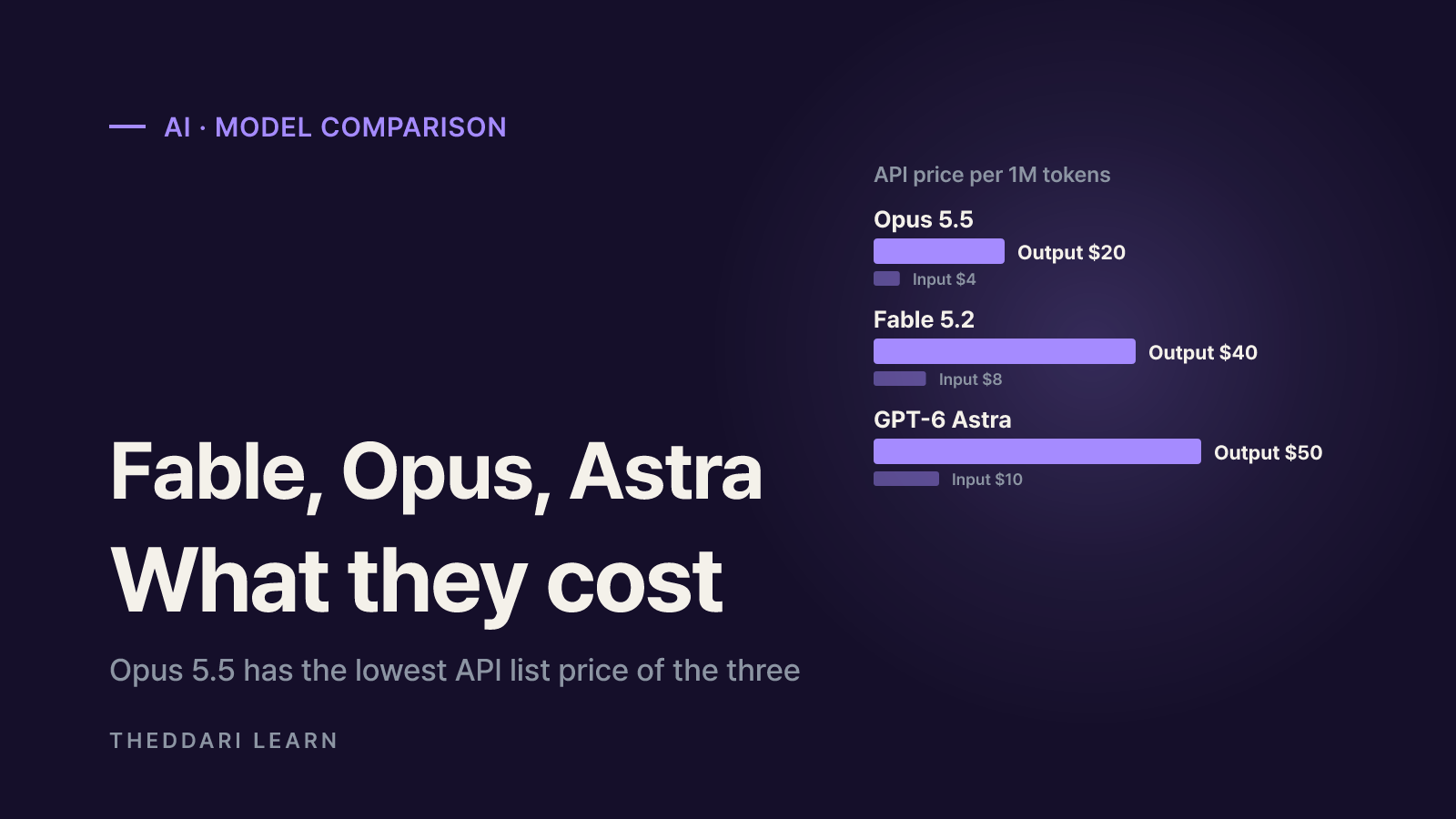
If you are weighing Claude Fable 5.2, Claude Opus 5.5 and ChatGPT's GPT-6 Astra (often searched as 'ChatGPT Astra'), the useful question is not which model is smartest but which plan gives you enough of the right model for the least money. As of November 15, 2026, based on each company's official pages, Opus 5.5 is the cheapest of the three on the API at $4 per million input tokens and $20 per million output tokens. Fable 5.2 costs $8 and $40, and GPT-6 Astra costs $10 and $50. On subscriptions, Claude Pro charges extra credits for Fable, while ChatGPT Plus only offers limited Astra usage inside Work and Codex. All prices below are US list prices in US dollars before tax; what you pay elsewhere depends on local tax, currency and whether you subscribe on the web or through an app store.
Claude Fable 5.2, Opus 5.5 and GPT-6 Astra serve different roles
The three models are often framed as head-to-head rivals, but their makers position them differently. When Anthropic announced Fable 5.2 on November 9, 2026, it described Fable as the model for the most ambitious, open-ended technical work and called Opus 5.5 its strongest daily driver. Its advice is to start most coding and knowledge tasks on Opus 5.5, move up to Fable when the scope demands it, and move down to Sonnet 5.5 or Haiku 5.5 for lighter work. The Claude models overview says the same: if you are unsure, start with Opus 5.5.
GPT-6 Astra is OpenAI's flagship, launched in September 2026. The OpenAI announcement leads with computer use, browsing, software engineering and polished professional documents. Inside ChatGPT it appears in two places: as the engine behind the GPT-6 Pro reasoning mode in regular Chat, and as a selectable model in ChatGPT Work and Codex.
Maker
- Claude Fable 5.2
- Anthropic
- Claude Opus 5.5
- Anthropic
- GPT-6 Astra
- OpenAI
Released
- Claude Fable 5.2
- November 9, 2026
- Claude Opus 5.5
- September 22, 2026
- GPT-6 Astra
- September 2026
Vendor-recommended role
- Claude Fable 5.2
- Long, hard technical work; leading agent teams
- Claude Opus 5.5
- Default for most coding and knowledge work
- GPT-6 Astra
- Computer use, coding, professional documents
API model ID
- Claude Fable 5.2
- claude-fable-5-2
- Claude Opus 5.5
- claude-opus-5-5
- GPT-6 Astra
- gpt-6-astra
Context window (API)
- Claude Fable 5.2
- 1M tokens
- Claude Opus 5.5
- 1M tokens
- GPT-6 Astra
- See OpenAI model docs
Notable safeguards
- Claude Fable 5.2
- Cyber and biology queries rerouted to other models
- Claude Opus 5.5
- Standard safeguards
- GPT-6 Astra
- Refuses advanced cyber tasks; work may be paused for review
Fable 5.2 and Claude Mythos 5.2 share the same underlying model. Fable ships with strict cybersecurity and biology classifiers so it can be offered to everyone; when a query is blocked, Opus 4.8 answers cyber questions and Opus 5 answers biology questions instead. If security research or life sciences is your main use, a Fable subscription may not give you the answers you expect. Mythos 5.2 is limited to organizations approved through Anthropic's verification programs.
Treat leak videos as rumors
Popular videos this week claim a leaked Claude model family or a stealth model that beats Opus 5.5. As of November 15, 2026, Anthropic's official docs list only Fable 5.2, Opus 5.5, Sonnet 5.5 and Haiku 5.5 as current models. Until a vendor publishes a model with its test conditions, anonymous scores are not a sound reason to switch plans.
API pricing: list rates vs real cost per task
If you call the models directly through an API, these are the standard list rates. Claude rates come from Claude's pricing page and model docs; Astra's come from OpenAI's launch post.
Claude Fable 5.2
- Input (per 1M tokens)
- $8
- Output (per 1M tokens)
- $40
- Cache reads
- $0.20
- Fast mode
- $16 input / $80 output
Claude Opus 5.5
- Input (per 1M tokens)
- $4
- Output (per 1M tokens)
- $20
- Cache reads
- $0.20
- Fast mode
- 2x standard, up to 2.5x faster
GPT-6 Astra
- Input (per 1M tokens)
- $10
- Output (per 1M tokens)
- $50
- Cache reads
- Separate rate
- Fast mode
- 2x standard, up to 2x faster
To make that concrete, take one request with 100,000 input tokens and 10,000 output tokens. At list rates, Opus 5.5 costs $0.40 + $0.20 = $0.60, Fable 5.2 costs $0.80 + $0.40 = $1.20, and GPT-6 Astra costs $1.00 + $0.50 = $1.50. That math assumes every model uses the same number of tokens, which is rarely true. Anthropic says that on its FrontierCode 2.0 coding test, Fable 5.2 at High effort roughly matched Opus 5.5's best score for about half the cost per task. OpenAI says Astra was trained to finish tasks in fewer tokens with fewer retries. The only reliable way to compare is to run a handful of your real tasks and read the token counts in each usage dashboard.
- Claude's Batch API cuts input and output prices by 50%, and US-only inference costs 1.1x.
- Claude 4.6 and later models bill the full 1M-token context at standard rates, so long documents do not raise the per-token price.
- GPT-6 Astra has separate cache read and write rates; if you resend long prompts, check OpenAI's pricing docs as well.
Subscription plans: what each tier unlocks
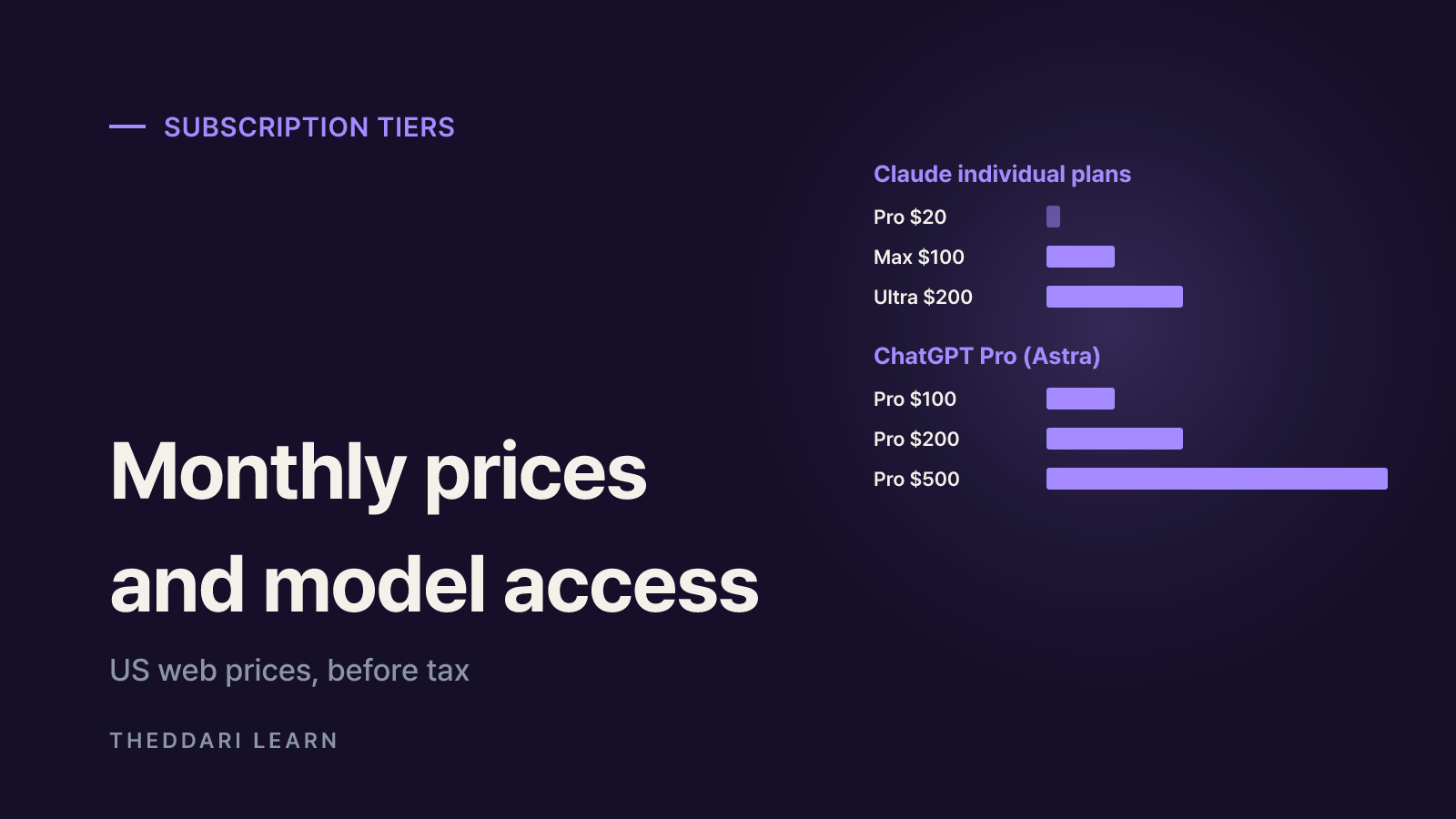
Most individuals use these models through an app subscription, not the API. Then the cost question becomes which tier unlocks the top model and how quickly the allowance runs out.
Claude Free
- Monthly price (US, before tax)
- $0
- Top-model access
- Sonnet and Haiku only; no Opus or Fable
Claude Pro
- Monthly price (US, before tax)
- $20 ($17/month billed annually)
- Top-model access
- Opus included; Fable paid with usage credits
Claude Max
- Monthly price (US, before tax)
- $100
- Top-model access
- 5x Pro usage; Fable up to 50% of weekly limit; $100 monthly API credits
Claude Ultra
- Monthly price (US, before tax)
- $200
- Top-model access
- 10x Pro weekly usage; no 5-hour limit for verified accounts; Fable up to 50%; $200 monthly API credits
ChatGPT Plus
- Monthly price (US, before tax)
- Shown by region on the pricing page
- Top-model access
- Limited Astra in Work and Codex; buy credits after
ChatGPT Pro 100
- Monthly price (US, before tax)
- $100
- Top-model access
- Astra-powered GPT-6 Pro; full Work and Codex allowance usable on Astra
ChatGPT Pro 200
- Monthly price (US, before tax)
- $200
- Top-model access
- More usage than Pro 100
ChatGPT Pro 500
- Monthly price (US, before tax)
- $500
- Top-model access
- Highest usage; includes Ultrafast
On the Claude side, note where Fable sits. Per the pricing page, Pro pays for Fable with credits, and even Max and Ultra cap Fable at half of the weekly limit, so no individual plan is designed for all-day Fable use. Annual billing exists only for Pro; Max and Ultra are monthly.
On the ChatGPT side, OpenAI's help article says Pro $100, Pro $200 and Business Premium seats can spend their full Work and Codex allowance on Astra, while Plus and Business Standard seats get limited Astra usage. Astra can consume allowance faster than GPT-5.6 Sol. OpenAI's usage docs estimate roughly 5 to 45 local Astra messages per five hours on Plus, and stress that this is a range, not a fixed cap.
Speed modes burn through limits. In ChatGPT, Fast mode draws included usage at 2.5x the standard rate and Ultrafast at 8x, and Ultrafast is only on Pro 500 (Pro tiers). Leaving the fastest mode on by default keeps the price the same but cuts how much work you get.
Which model fits which job
Use these as starting points drawn from vendor guidance and published evaluations. Results shift with prompts, file sizes and effort settings, so confirm with your own tests.
- Writing, summaries, everyday tasks: Differences between top models are hard to notice here. Start on Claude Pro with Opus 5.5 or ChatGPT Plus; buying a higher tier just for Fable or Astra rarely pays off.
- Everyday coding: Anthropic recommends Opus 5.5 for feature work, debugging, refactoring and code review. In ChatGPT, Codex lets you choose Astra or other models such as GPT-6.1 Sol.
- Large or long-running agent work: Multi-repo migrations and jobs that run for hours are Fable 5.2's target. In Anthropic's launch table, FrontierCode 2.0 scores were Fable 5.2 49.1%, Opus 5.5 45.5% and GPT-6 Astra 42.8%.
- Computer use and document automation: OpenAI calls Astra its best computer-use model and reports 72.6% on OSWorld 2.0. Anthropic's run of OSWorld 2.1 shows Fable 5.2 at 89.3%, Opus 5.5 at 87.2% and Astra at 79.5%. Different test versions mean these numbers cannot be compared directly.
- Math and research analysis: Anthropic reports Humanity's Last Exam with tools at 74.2% for Fable 5.2, 67.7% for Opus 5.5 and 57.2% for Astra; OpenAI reports Astra at 97.6% on FrontierMath Tier 4. Each vendor highlights the tests where it looks best.
- Security and life sciences: Fable 5.2 reroutes these queries and Astra refuses advanced cyber work such as writing exploits. If this is your core use, neither consumer plan may deliver.
Reading benchmarks and comparison videos
Hands-on comparison videos show real-world feel, but they usually rest on a few prompts, which may not match your work. Vendor benchmarks have their own caveats: Anthropic's table uses each model's highest effort with Claude safeguards on, and OpenAI notes its scores come from a research environment or the API and may differ from production ChatGPT.
- Who ran it: Most numbers are self-reported; rival models were run on the other vendor's harness.
- Which version: OSWorld 2.0 vs 2.1 and FrontierCode 1.1 vs 2.0 are different tests despite similar names.
- Effort and speed: Max or Xhigh effort scores may not reflect app defaults (Claude apps default to Medium).
- Plan terms move: In late September OpenAI announced a cut to the Pro 200 Work and Codex allowance, then canceled it and restored the allowance. Value verdicts from a month or two ago may no longer hold.
To keep up with new releases without chasing every rumor, scan TheDdari's AI Telegram trends and blog trend dashboard for recurring topics, then verify numbers on the official pages.

Checklist before you subscribe
- 1
List a month of tasks by type
Split them into writing, everyday coding, long agent runs and data analysis, and note how often each comes up. If long runs are rare, you probably do not need a Fable- or Astra-heavy plan.
- 2
Test on an entry plan
Run three to five real tasks under the same conditions on a $20-class plan such as Claude Pro or ChatGPT Plus, and record output quality and how many fixes you needed.
- 3
Watch when limits run out
Check Claude's five-hour and weekly limits or ChatGPT's Work and Codex usage dashboard. Only consider Max, Ultra or Pro 100/200 if you hit limits often.
- 4
Compare against the API
Multiply expected monthly input and output tokens by list rates and compare with the subscription price, including any bundled monthly API credits.
- 5
Check billing terms
List prices exclude tax and vary by region and payment channel. Only Claude Pro offers annual billing; ChatGPT Pro and Claude Max and Ultra are monthly only.
For most people, starting on Claude Pro with Opus 5.5 or on ChatGPT Plus and watching how often you hit limits is enough. Fable 5.2 can justify a higher tier when long, difficult technical work is a regular part of your week, and GPT-6 Astra when you hand off lots of computer-use and document automation in Codex or Work. Prices and allowances have changed every few weeks, so check the official pricing pages again right before you pay.