Contents6 sections
Gemini 4 Hydrogen is the fast, lower-cost member of Google's Gemini 4 family, announced on November 12, 2026. Google calls it a daily driver for coding and agentic workflows, while Gemini 4 Carbon, made generally available two days earlier, is positioned as the frontier model for the hardest long-horizon reasoning. This guide is based on Google's announcement and the Gemini API documentation as of November 14, 2026. Prices are in US dollars for the Gemini Developer API; availability in consumer apps can vary by plan and country, so confirm the current pricing page before you commit spend.
What is Gemini 4 Hydrogen? The launch at a glance
Hydrogen is built for rapid execution: writing code, running tests, verifying changes and calling tools across many short steps. It can run on its own or act as the execution engine next to Carbon or Argon in a multi-model setup. Google also framed it as the release that brings Gemini 4 to everyone, in contrast with Carbon, which went to paying developers, enterprises and Google AI Ultra subscribers.
- Where it is available: all tiers of Google AI Studio, the Gemini API, Gemini for business, the Gemini app, Google Search, and Google Antigravity for paid Google AI Pro and Ultra subscribers.
- Gemini app free users: access comes through auto model selection when the app decides Hydrogen fits the prompt, not through a manual pick.
- Four thinking levels: low, medium, high (the default) and a new xhigh. Higher levels add latency and tokens.
- Context: a unified 1,048,576-token window shared by input, thinking and output, with long decode up to 1M tokens.
Most performance numbers come from Google itself. The announcement says Hydrogen scores 51 on the Artificial Analysis Intelligence Index at its default high setting, edging Argon's 50, and reaches 54 at xhigh. Against Gemini 3.8 Flash, Google reports tasks finishing 2.5 times faster at high, Terminal-Bench 4.1 rising from 18.2% to 57%, and fabricated claims cut by more than 5x. Early partner tests cited runs 2x to 2.8x faster with 12% to 23% fewer tokens.
Gemini Hydrogen vs Carbon: role, pricing and thinking levels
Hydrogen, Argon and Carbon share the same context window, long-decode design and built-in tools. The differences are reasoning depth, price and who can access them. The Hydrogen developer guide describes Carbon as the strongest model, spending more thinking tokens per turn to test hypotheses and check edge cases. Argon handles most advanced long-horizon work with fewer tokens than Carbon. Hydrogen is the recommended upgrade from Gemini 3.8 Flash and older Gemini 3 and 2.5 models.
Launch
- Gemini 4 Hydrogen
- November 12, 2026
- Gemini 4 Carbon
- General availability November 10, 2026
Best fit
- Gemini 4 Hydrogen
- Fast execution, everyday coding and agents
- Gemini 4 Carbon
- Hardest reasoning and extended verification
Input per 1M tokens (standard)
- Gemini 4 Hydrogen
- $1.50
- Gemini 4 Carbon
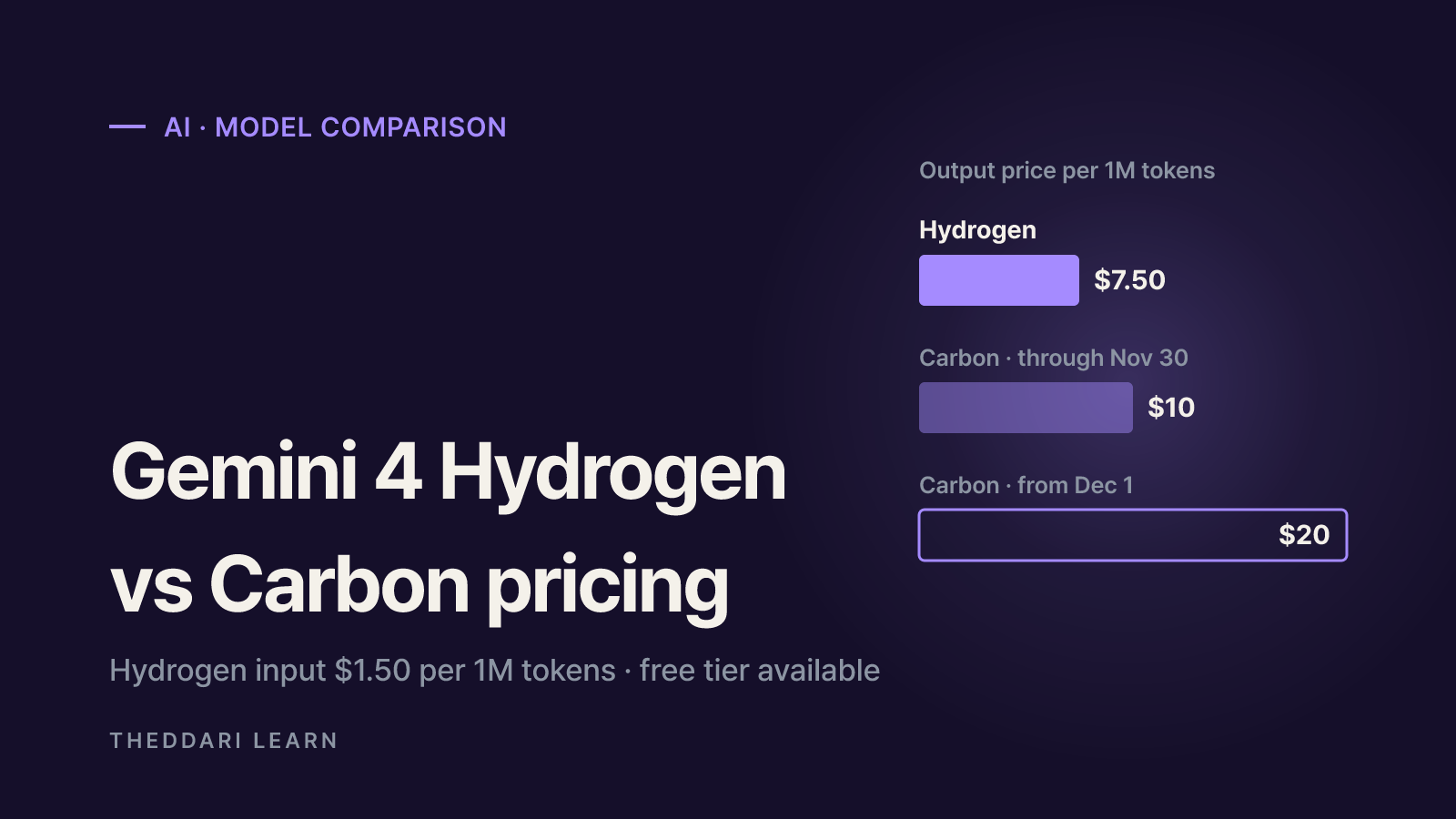
- $2 through Nov 30; $4 from Dec 1
Output per 1M tokens (incl. thinking)
- Gemini 4 Hydrogen
- $7.50
- Gemini 4 Carbon
- $10 through Nov 30; $20 from Dec 1
Free tier
- Gemini 4 Hydrogen
- Yes, rate-limited
- Gemini 4 Carbon
- No
Default thinking level
- Gemini 4 Hydrogen
- high, up to xhigh
- Gemini 4 Carbon
- medium, up to high
Max non-streaming hop
- Gemini 4 Hydrogen
- 65,536 tokens
- Gemini 4 Carbon
- 32,768 tokens (REST)
Prices come from the Gemini API pricing page and the Carbon announcement. Carbon launched at Argon's introductory price, which doubles once the intro period ends on November 30. As a simple illustration, a job using 2 million input tokens and 500,000 output tokens would cost $6.75 on Hydrogen, $9 on Carbon at the intro price, and $18 on Carbon from December 1. Because output pricing includes thinking tokens and Carbon is designed to think more per turn, the real gap on the same task can be larger.
Pairing the two with Orchestrator
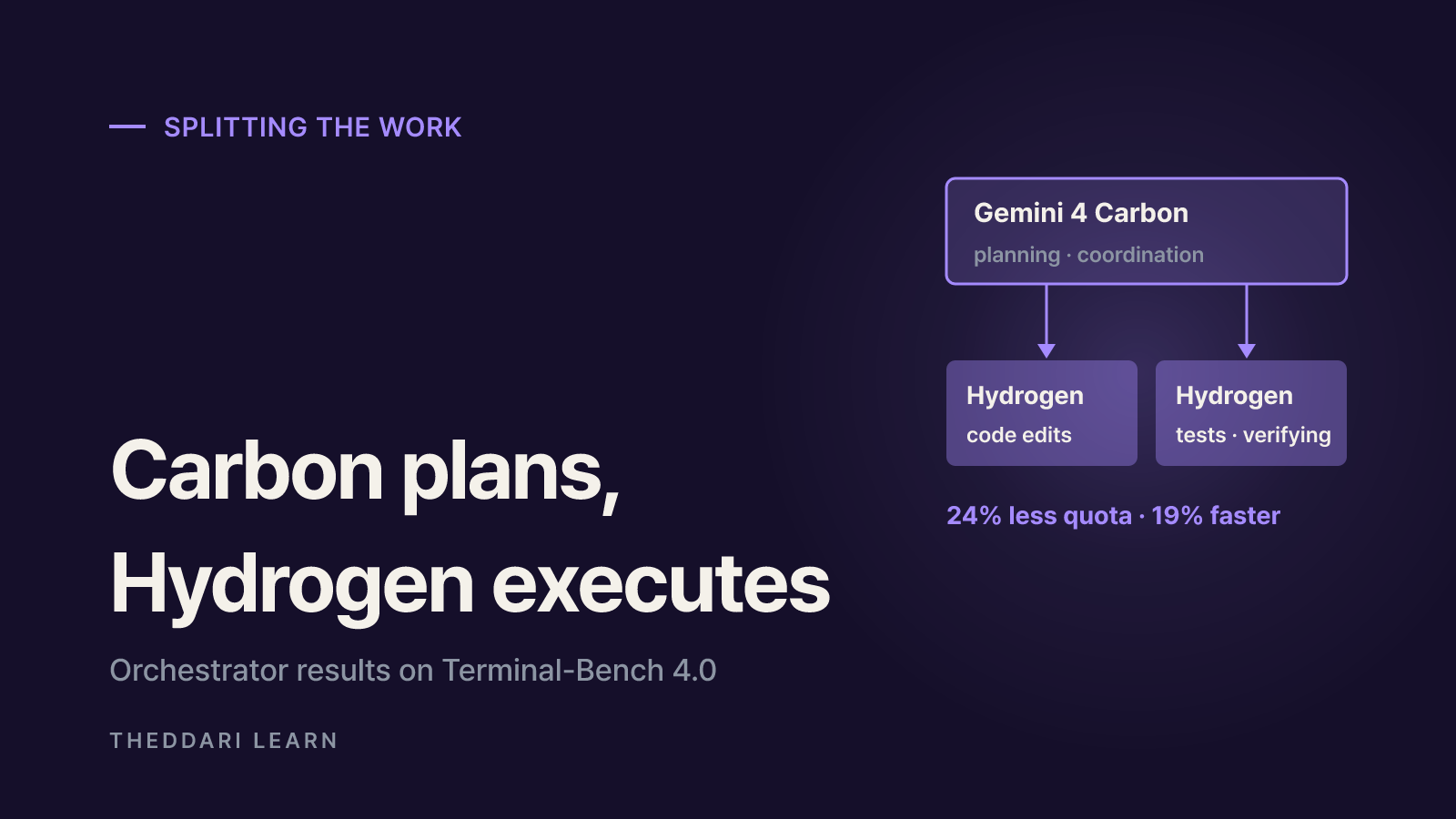
Google added Orchestrator to Google Antigravity to switch between Carbon and Hydrogen inside one session. On Terminal-Bench 4.0, Google says Orchestrator came close to Carbon's success rate while using 24% less quota on average and finishing 19% faster. For parallel agents, Carbon coordinates while Hydrogen powers worker and verifier agents. Through the API, the docs show routing planning turns to Carbon and execution turns to Hydrogen within one multi-turn interaction.
What to check before you use Gemini 4 Hydrogen
Swapping the model string is not the whole job. Google's migration checklist lists several behavior changes, and the price comparison with Gemini 3.8 Flash is less obvious than it looks. Flash costs $0.75 input and $3.75 output per million tokens through December 31, 2026, then $1.50 and $7.50 from January 1, 2027. Moving this year means paying twice the per-token rate, so the business case depends on whether faster runs and fewer tokens offset it.
- 1
Set the model ID and thinking level
Change the model to gemini-4-hydrogen and set thinking_level explicitly. The default is high, and minimal is rejected with an error. Google suggests evaluating all four levels and choosing the lowest one that meets your quality bar.
- 2
Fix output caps and context math
Gemini 3.8 Flash had separate 1M input and 64K output budgets; Hydrogen shares one window. Hardcoded low caps such as 8,192 for max_output_tokens can truncate answers once thinking tokens are counted, so raise or remove them.
- 3
Clean up caching and sampling
Explicit caching (cachedContents) is not supported. Implicit caching applies to prompts of at least 4,096 tokens and discounts cache hits by 95%, to $0.075 per million input tokens. Custom temperature, top_p and top_k values are ignored.
- 4
Review data use and extra charges
Free-tier content may be used to improve Google's products, so consider the paid tier for business data. Grounding with Google Search includes 5,000 free requests per month, then $14 per 1,000, and thinking tokens and tool instructions are billed too.
For bulk jobs, Batch and Flex halve Hydrogen's price to $0.75 input and $3.75 output per million tokens. Latency-sensitive Priority inference costs $2.70 input and $13.50 output. Model the traffic for each mode separately. Model launches and price changes move quickly, so the theddari AI Telegram trends and blog trend pages are handy for tracking developer reaction, but always confirm figures against the official docs.
 theddari.comTrendsBlog PostsSummarized Naver blog posts
Risks and limits when reading the launch numbers
Many headline figures come from benchmarks Google selected or from internal evaluations, such as a 96.7% honesty rate on an internal agent test and 2.3x stronger resilience on the Gray Swan indirect prompt injection benchmark. Those conditions are hard to reproduce outside Google. Scores also depend on settings: the same model posts 51 or 54 on the Intelligence Index depending on thinking level, so always note which configuration a number refers to.
- Cost illusions: a lower per-token price can still produce a bigger bill if xhigh reasoning inflates output tokens.
- Moving prices: Carbon's intro rate ends November 30 and Flash pricing changes January 1, 2027. Date-stamp any comparison you build.
- Permissions and safety: better alignment scores do not replace sandboxing and human approval when an agent can touch files or production tools.
- Uneven rollout: app, Search and Antigravity access differ by plan and region, so check the model picker in your own account.
In short, Gemini 4 Hydrogen is not Google's smartest model; it is the one designed to do a lot of work quickly and cheaply. Start with Carbon when hard design and verification matter most, and with Hydrogen when repetitive coding, tool calls and document processing dominate. Either way, measure quality, latency and billed tokens on your own samples, and record the date you checked the pricing table so the next price change is easy to compare.