OpenAI's 948 Linux Root Exploits: What It Means for Admins
OpenAI says an AI pipeline built 948 Linux kernel root exploits. Here is what the number counts, how to verify AI bug claims, and what admins should check.
Contents7 sections
Key takeaways
- On November 4, 2026, OpenAI said an automated pipeline built on an unreleased cyber model produced 948 unique local privilege escalation (LPE) exploits for the Linux kernel.
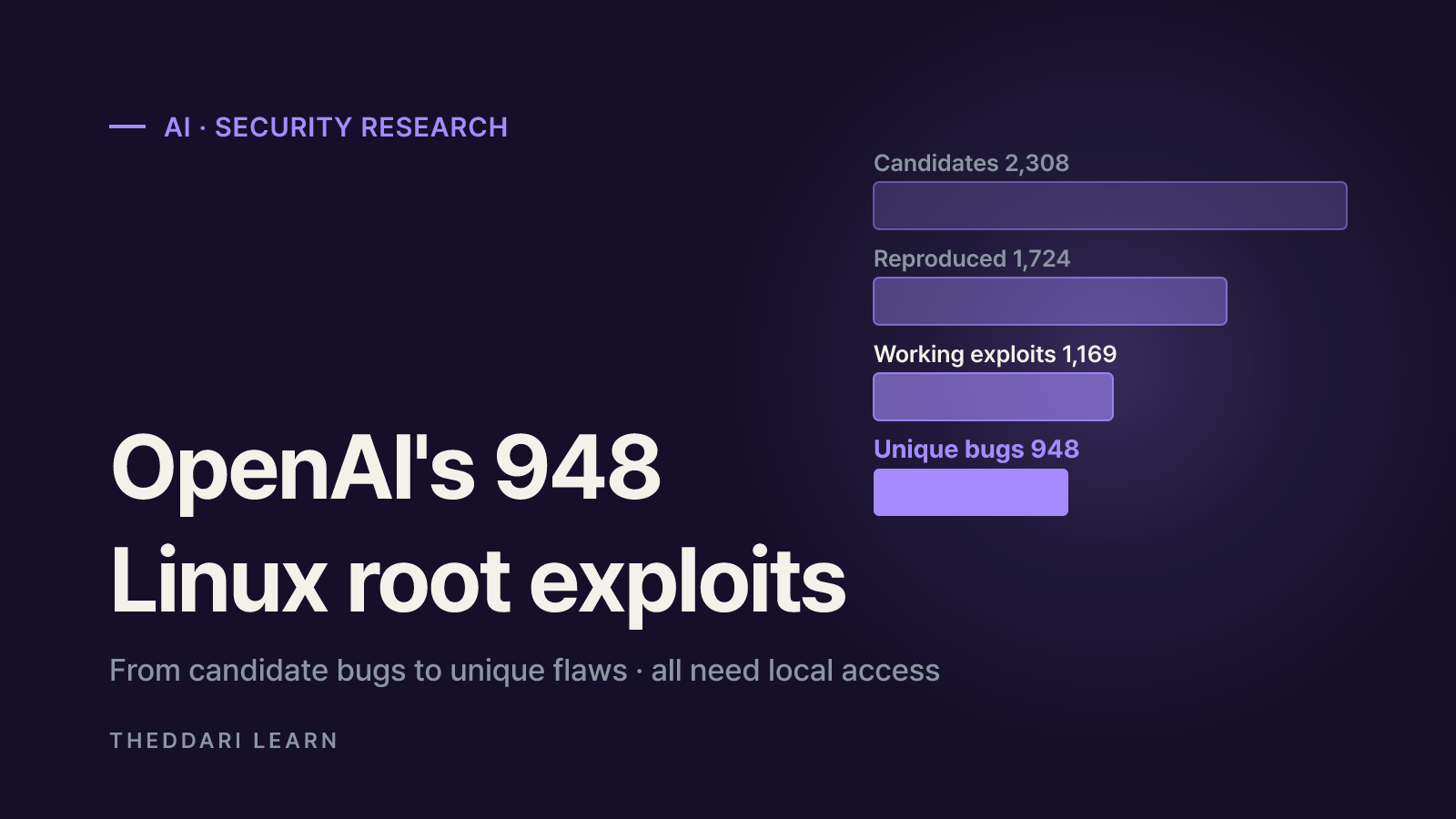
- The 948 figure sits at the end of a funnel: 2,308 candidate findings, 1,724 reproduced bugs and 1,169 working exploits, grouped into 948 distinct patches.
- Every exploit is local. An attacker first needs an account or code running on the machine, so this is not 948 ways for a stranger to break into any server remotely.
- Linux kernel CVEs are normally assigned after a fix lands in a stable tree, so a missing CVE number right after the announcement does not mean the claim is false.
- Admins should compare the running kernel with their distribution's fixed build, finish reboots or live patching, and cut down local access paths for untrusted code.
Short answer: the viral claim about 948 Linux root exploits is based on a real announcement, but it is narrower than the headline suggests. In a November 4, 2026 research post, A thousand fewer paths to root, OpenAI said an automated pipeline powered by an unreleased cyber model built working local privilege escalation (LPE) exploits for 948 unique Linux kernel vulnerabilities and wrote a candidate patch for each. That does not mean 948 ways for anyone on the internet to take over your server. Each exploit assumes the attacker already has low-privileged access, and the results come from the latest kernel code tested in OpenAI's lab. This guide, current as of November 2026, explains what the number counts, how to check AI vulnerability claims, and what Linux admins should do now.
What OpenAI actually reported about Linux root exploits
The mid-October 2026 run scanned the Linux kernel master branch as it stood at the time. OpenAI reports a total cost of $1,213,430 in API credits, or about $1,279 per LPE exploit. An earlier run in late July 2026 using GPT-5.6 Sol produced 166 unique LPEs for $513,690. Exploits were tested on virtual machines running a stock desktop distribution with standard protections enabled, including SMEP, SMAP, KASLR and HARDENED_USERCOPY, so OpenAI argues the target was not artificially weakened.
Independent outlets repeated the same figures. SecurityWeek noted on November 5, 2026 that 948 is the count of separate patches written for the bugs behind the exploits, and that OpenAI researchers reviewed exploits, fixes and proposed severity before anything went to kernel maintainers. That coverage confirms what OpenAI said; it is not an independent re-test of all 948 findings.
Published
- What OpenAI reported
- November 4, 2026 research post
- Why it matters
- Read the primary source, not the video title
Target
- What OpenAI reported
- Kernel master branch, mid-October 2026
- Why it matters
- Distribution kernels may differ or carry backports
Test setup
- What OpenAI reported
- Stock desktop distro, default protections on
- Why it matters
- Not a deliberately weakened target
Output
- What OpenAI reported
- 948 unique LPEs, 291 info-leak PoCs
- Why it matters
- All require local access first
Cost
- What OpenAI reported
- About $1.2M in API credits
- Why it matters
- OpenAI calls its figures closer to an upper bound
Hardened kernel test
- What OpenAI reported
- 21 LPEs on an adapted kernelCTF setup
- Why it matters
- Configuration changes results sharply
Reading the funnel: candidates vs. exploits vs. unique bugs
Most confusion around AI vulnerability discovery comes from mixing up the stages. OpenAI's scout agents first picked 5,034 audit targets reachable by low-privileged users, about 2.8 million lines or roughly 7% of the kernel. Analyst agents then reported candidates, and triage agents tried to reproduce each one in an isolated VM running KASAN.
- 2,308 candidate findings from static analysis after deduplication.
- 1,724 reproduced vulnerabilities (about 74.7%); only 3.1% reflected impossible conditions assumed by the model.
- 1,238 LPE candidates and 313 information-leak candidates after an initial screen.
- 1,169 working LPE exploits that gave an unprivileged user a root shell.
- 948 unique vulnerabilities, counted by the number of distinct patches after variant analysis.
OpenAI also documents a failure worth remembering. In an early run, 20 of 200 exploits marked as successful actually reached root through a different zero-day than the one assigned. The team added an independent check afterward. Even a reported root shell needs its path verified.
How much is already fixed?
According to the post, when the scan and manual analysis finished after 10 days, 61 LPEs had been patched upstream, 43 had staging patches and 299 were being reported and discussed publicly. OpenAI says it started with critical bugs, following kernel community guidance, and is sending the rest in stages through its Patch the Planet partners. In other words, there is no single update today that covers all 948.
How to verify an AI vulnerability discovery claim
- 1
Find the primary source
Look for the company's research post, the project's security advisory or the maintainers' mailing list. Videos and social posts tend to round up and drop conditions.
- 2
Separate the counts
Ask whether a number refers to candidates, reproduced bugs, working exploits or unique vulnerabilities. Treating candidates as confirmed bugs is the most common exaggeration.
- 3
Check the attack conditions
Is it remote or local? What privileges are required? Were default mitigations enabled? The same bug can be critical or minor depending on these answers.
- 4
Follow the disclosure trail
For Linux, that means reports to maintainers and [email protected], fixes in stable trees, CVE announcements and your distribution's advisories.
- 5
Look for outside confirmation
Note whether maintainers, external researchers or the bounty programs involved have confirmed results, or whether the only evidence is the vendor's own post.
Two official kernel documents help here. The kernel CVE policy says CVEs are assigned automatically once a fix reaches a supported stable tree, not for unfixed issues, and warns that many kernel CVEs will not apply to a given system. The kernel security bugs guide says AI-assisted findings should be treated as public, because the same bugs tend to surface from several researchers at once, and that a report whose reproducer does not work should have its validity seriously questioned.

What Linux privilege escalation means for your servers
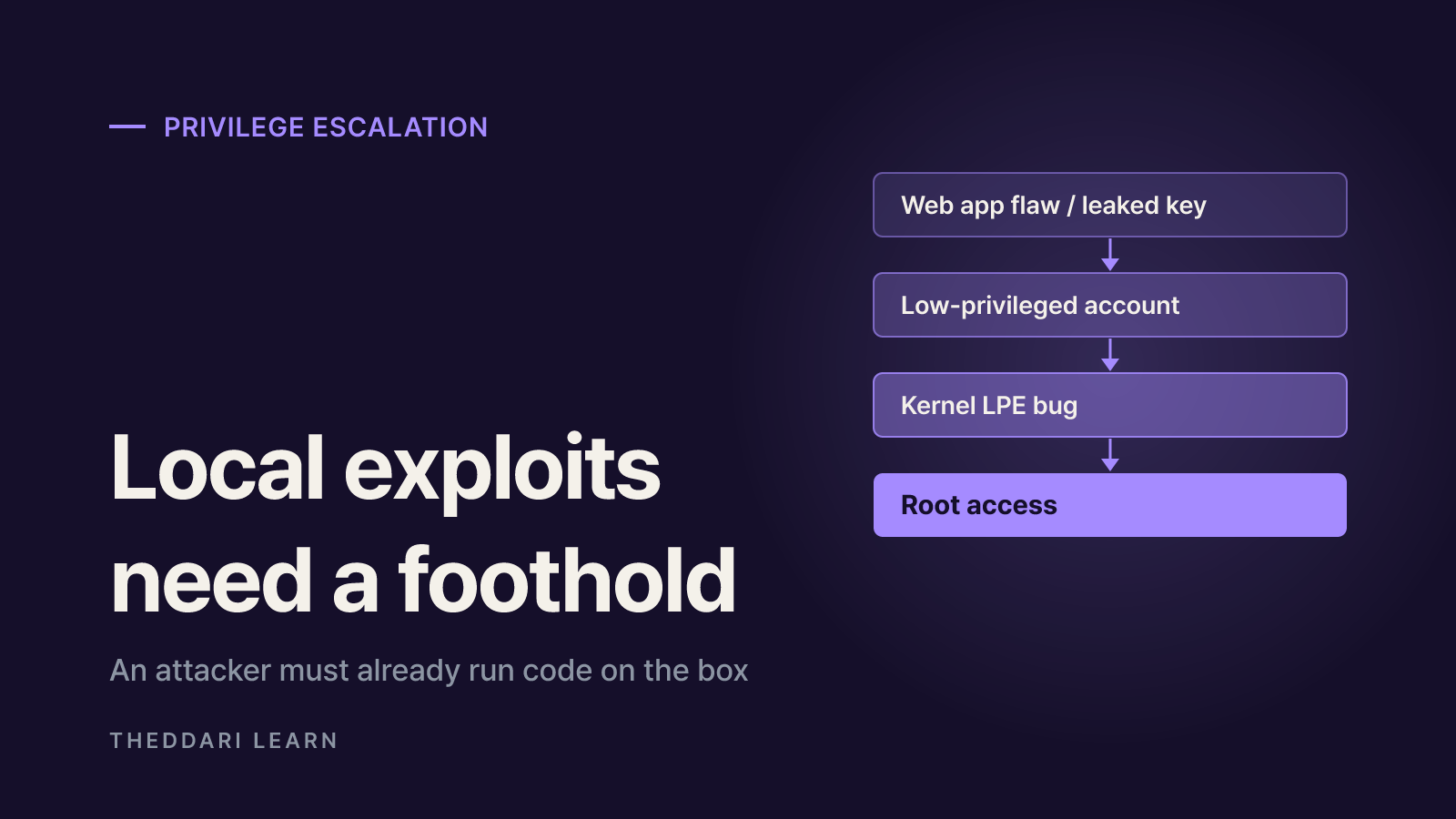
An LPE lets a normal user or restricted service account become root. The attacker needs a foothold first: a compromised web app running as www-data, a leaked SSH key, a legitimate shell account on a shared host, or a malicious build job on a CI runner. OpenAI's own advice is blunt: for the near and medium term, a low-privileged account on an operating system that is not fully patched should be treated as functionally equivalent to root for a well-resourced attacker.
Shared multi-user servers
- Priority
- High
- Reason
- A legitimate account is already a foothold
CI runners and build hosts
- Priority
- High
- Reason
- They execute code from outside repositories
Multi-tenant container hosts
- Priority
- High
- Reason
- Containers usually share the host kernel
Single-purpose internet-facing servers
- Priority
- Medium
- Reason
- LPE can follow a web app compromise
Personal desktop
- Priority
- Lower
- Reason
- Still exposed if you run untrusted software
As LinuxSecurity.com points out, the results describe tested kernel builds and settings. Your server may run different code, carry a vendor backport or have the relevant feature disabled, so 948 is not your personal bug count.
Patch checklist for Linux admins
- 1
Inventory running kernels
Run
uname -ron each host and record the result. The kernel installed by your package manager may not be the one currently booted. - 2
Track distribution advisories
Subscribe to security notices for Ubuntu, Debian, RHEL, SUSE or whatever you run. Vendors backport fixes into older supported kernels, so a lower version number can still be patched.
- 3
Reboot or live patch
A new kernel package does nothing until you reboot into it. If you use a vendor live patching service, confirm the patches are actually applied.
- 4
Shrink local access
Remove stale accounts and SSH keys, avoid shared logins, run services with least privilege, and keep CI runners that execute outside code away from production.
- 5
Revisit isolation
For untrusted workloads, consider stronger isolation such as gVisor or Firecracker micro-VMs, which OpenAI cites as ways to limit blast radius.
- 6
Watch for warning signs
Alert on unexpected root processes, privilege changes and repeated kernel oops or crash logs.
Do not run proof-of-concept code from the internet on production machines to 'test' exposure. OpenAI withheld details of its new techniques for safety reasons, and random PoCs can be malware. Use your vendor's advisories and an isolated test environment instead.
Home users can follow the same logic: keep automatic updates on, reboot after kernel updates, stay on a supported release, and be careful about piping unknown scripts into a shell or giving AI agents broad permissions. To see how stories like this spread, the theddari blog trends dashboard tracks which posts are gaining attention.
The bottom line: OpenAI's report is strong evidence that AI can find, validate and draft patches for kernel bugs at scale, and that patch windows matter more than ever. Your real exposure depends on your kernel build, vendor backports, who can run code on the box and how well workloads are isolated. Check the running kernel, finish updates and reboots, and reduce local footholds.
Frequently asked questions
Is there a CVE list for OpenAI's 948 Linux vulnerabilities?
Can someone hack my Linux server remotely with these exploits?
Do containers protect me from Linux kernel privilege escalation?
How do I tell if an 'AI found hundreds of bugs' claim is credible?
Sources and references
- 1OpenAI: A thousand fewer paths to root (2026-11-04)(opens in a new tab)openai.com
- 2The Linux Kernel documentation: CVEs(opens in a new tab)docs.kernel.org
- 3The Linux Kernel documentation: Security bugs(opens in a new tab)docs.kernel.org
- 4SecurityWeek: AI Agents Got Root on Linux via 948 Kernel Flaws in OpenAI Research(opens in a new tab)www.securityweek.com
- 5LinuxSecurity.com: AI Finds Hundreds of Linux Kernel Vulnerabilities(opens in a new tab)linuxsecurity.com
Related articles
 AI
Can You Publish an AI-Built iOS App Without Coding?
AI tools can write the code, but the developer account, signing, App Review, payment rules and long-term maintenance are still yours. Here is what Apple's own documents require, as of November 2026.
 AI
What Is Qwen4-Max? Pricing, Regions and API Checks
Qwen4-Max is the first model in Alibaba's Qwen4 family. It is served through the QwenCloud API and Token Plan rather than as downloadable weights, and its price and inference location depend on the region you call. Here is what the official docs say and what to test before you build on it.
 AI
Claude Fable 5.2 vs Opus 5.5 vs GPT-6 Astra: Costs Compared
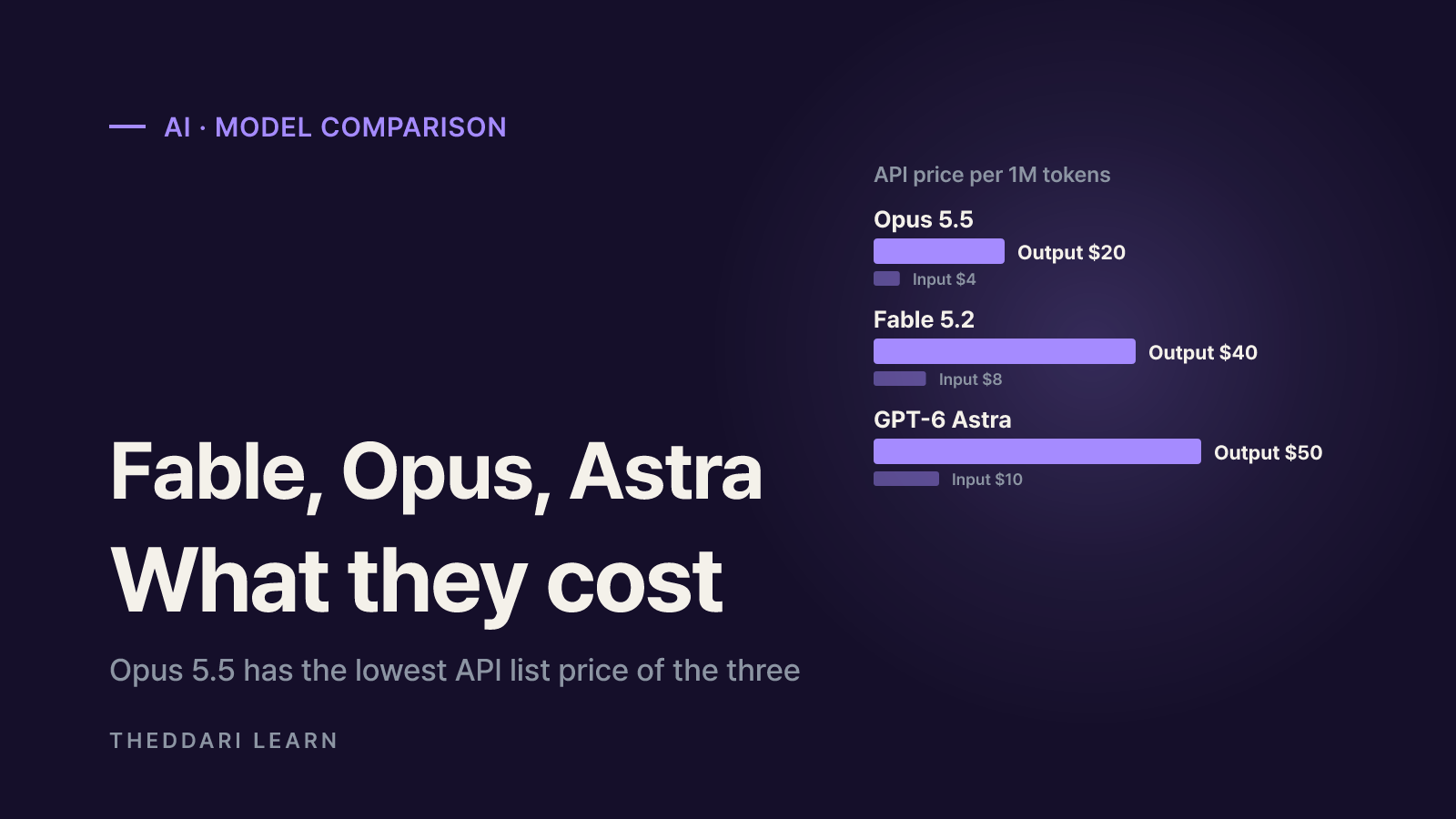
Picking between Claude Fable 5.2, Opus 5.5 and GPT-6 Astra is less about who tops a leaderboard and more about which plan gives you enough of the right model for the least money. Here is how prices, plan access and limits compare as of November 2026.