Contents8 sections
- Dividend stocks meaning: the basics
- How a monthly dividend ETF funds its payouts
- Monthly dividend stocks vs dividend ETFs vs covered call ETFs
- A checklist before choosing a monthly income investment
- Taxes depend on where you live and the account
- Common misconceptions
- Frequently asked questions
- Sources and references
A monthly dividend ETF is an exchange-traded fund that passes income from its holdings, such as dividends, interest or option premiums, to shareholders every month. A dividend stock is a share in a company that returns part of its profits to owners, and a monthly dividend stock is one that pays on a monthly schedule. Getting paid more often does not mean earning more or taking less risk. As of October 2026, this guide uses the sources reviewed for it to explain dividend yield, payout ratio and payment frequency, how covered call funds like JEPI generate their payouts, why distributions change, and how taxes differ by country. It does not recommend any stock or fund.
Dividend stocks meaning: the basics
The IRS describes dividends as distributions of a corporation's earnings and profits to its stockholders, usually in cash but sometimes in stock or other property (IRS Topic 404). The same page notes that regulated investment companies, including mutual funds and ETFs, pass the dividend income from the stocks they hold through to their shareholders. So you can collect dividends either by owning dividend-paying companies directly or by owning a fund that holds them.
A dividend is not a contractual obligation like bond interest. A company can raise, reduce or suspend it when profits fall or when management decides to use the cash elsewhere. A long record of increases tells you about the past, not about next quarter. That is why the first question about any dividend stock is whether the business can keep funding the payment, not just how large the payment is today.
Dividend yield versus payout ratio
Dividend yield is the annual dividend per share divided by the current share price. Suppose a stock trades at $50 and pays $2 a year: the yield is 4%. If the price falls to $40 and the dividend stays the same, the yield rises to 5%. Nothing improved; the price simply dropped. A sudden jump in yield is a prompt to investigate why the share price fell.
Payout ratio is the share of net earnings paid out as dividends. A ratio above 100% means a company paid out more than it earned that year, which is hard to sustain. A lower ratio leaves a cushion if earnings slip. Appropriate levels vary by industry, and structures designed to distribute most of their income, such as real estate investment trusts, should not be judged against an ordinary corporation's benchmark.
Payment frequency and the ex-dividend date
Companies and funds pay annually, semiannually, quarterly or monthly. If the annual total is the same, monthly payments just slice it more finely. That can help with budgeting, but the schedule itself does not add return. To receive a payment you generally need to own the shares before the ex-dividend date, and the price usually adjusts by about the payout on that date. The SEC explains that when a fund distributes dividends, interest or capital gains, its net asset value falls and an ETF's market price typically falls too; that reflects a transfer of value to you rather than a loss (Investor.gov).
How a monthly dividend ETF funds its payouts
The SEC's Fund Distributions bulletin, published August 19, 2026, says a fund pays distributions from money it makes, such as dividends, interest and capital gains, and/or with return of capital. Return of capital means the fund hands back part of the money shareholders invested. That shrinks the asset base, which can limit future growth or raise operating costs. SEC-regulated funds must send a 19(a) notice when they pay return of capital, and the bulletin warns that frequent or regular returns of capital could signal a fund is paying out more than it can afford.
The bulletin is blunt on one more point: distributions are not the same as performance, and a fund can perform poorly and still pay them. It recommends looking at total return and the standardized SEC yield instead. If you shop for a monthly dividend ETF by sorting a screener on yield, you skip exactly the information the regulator says matters most.
Covered calls: trading some upside for cash now
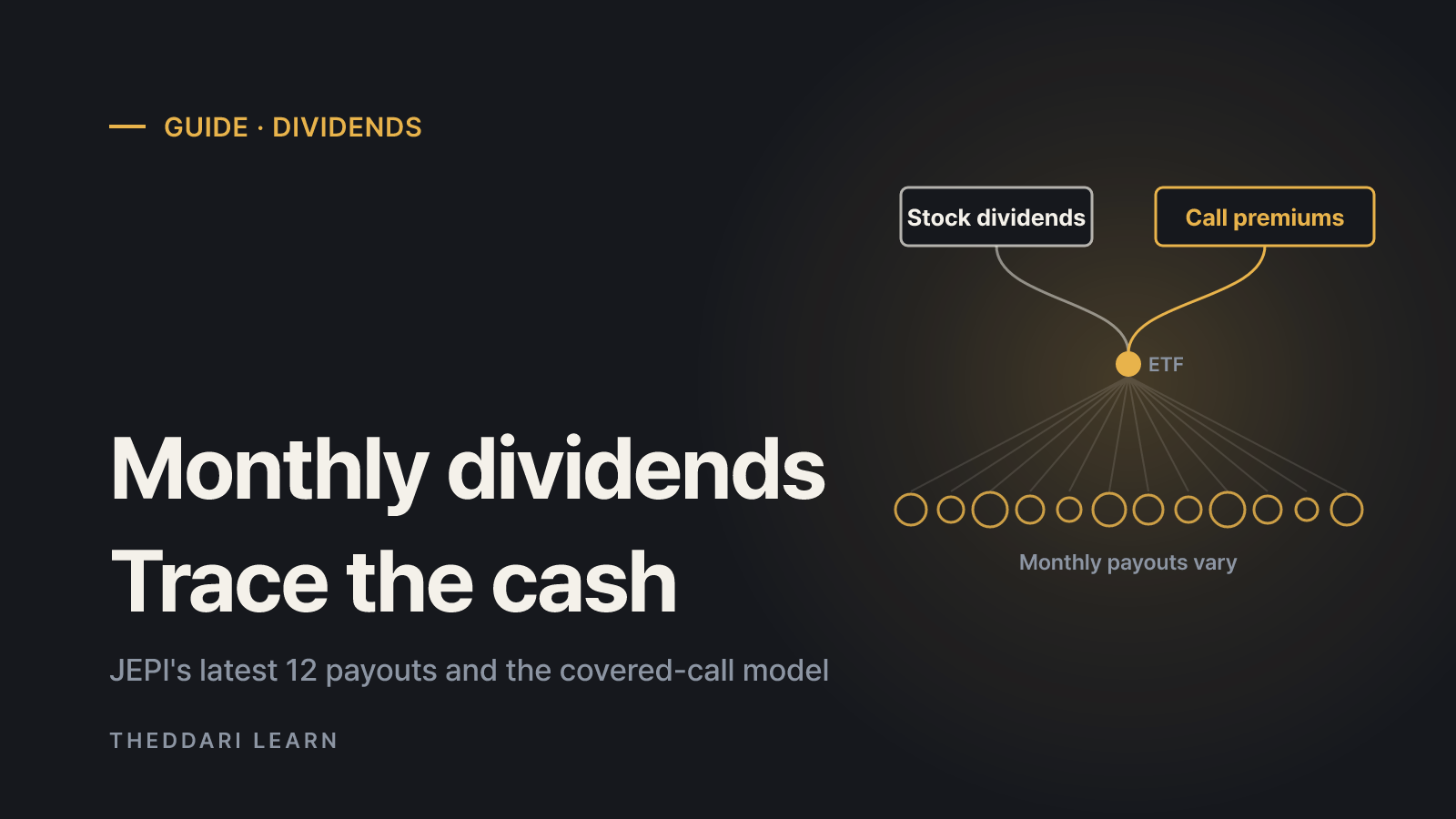
A covered call strategy holds stocks or an index exposure and sells call options, which give the buyer the right to purchase at a set strike price. The seller collects a premium up front. If the market stays below the strike, the premium is extra income. If the market rallies past the strike, the gains above it go to the option buyer. In a decline, the premium cushions losses only by its own amount. Because option prices move with expected volatility, the premium collected, and therefore the payout, can change from month to month.
How JEPI works
According to its fund summary, the JPMorgan Equity Premium Income ETF (JEPI) pursues its objective by building an actively managed portfolio of equity securities and, through equity-linked notes (ELNs), selling call options with exposure to the S&P 500 Total Return Index. The stated design is to provide total return through capital appreciation and income with lower volatility than the broad U.S. large-cap market (Yahoo Finance JEPI profile). As checked in October 2026, the same page lists a net expense ratio of 0.35% from the annual report, holdings turnover of 180%, and the Derivative Income category. ELNs are notes issued by a counterparty, so read the prospectus sections on counterparty and liquidity risk. Fees and strategy terms can change; confirm them in J.P. Morgan's current prospectus.
The table below shows JEPI's per-share distributions by ex-dividend date over the year to October 2026, as listed by Yahoo Finance, in U.S. dollars.
Nov 3, 2025
- Per share (USD)
- 0.346
- Ex-date
- May 1, 2026
- Per share (USD)
- 0.448
Dec 1, 2025
- Per share (USD)
- 0.371
- Ex-date
- Jun 1, 2026
- Per share (USD)
- 0.389
Dec 31, 2025
- Per share (USD)
- 0.427
- Ex-date
- Jul 1, 2026
- Per share (USD)
- 0.387
Feb 2, 2026
- Per share (USD)
- 0.344
- Ex-date
- Aug 3, 2026
- Per share (USD)
- 0.367
Mar 2, 2026
- Per share (USD)
- 0.351
- Ex-date
- Sep 1, 2026
- Per share (USD)
- 0.371
Apr 1, 2026
- Per share (USD)
- 0.421
- Ex-date
- Oct 1, 2026
- Per share (USD)
- 0.341
The twelve payments add up to about $4.56. Divided by the October 9, 2026 close of $56.77, that is roughly 8.0%, while the profile page displays a yield of 8.16%. Different sites use different periods and prices, so trailing yields rarely match exactly. More importantly, a trailing yield describes past cash payments, not future payments or total return. Note also the calendar quirk: two ex-dates fell in December 2025 and none in January 2026.
Monthly dividend stocks vs dividend ETFs vs covered call ETFs
Cash source
- Monthly dividend stock
- One company's earnings
- Traditional dividend ETF
- Dividends from many holdings
- Covered call income ETF
- Dividends plus option premium, sometimes return of capital
Diversification
- Monthly dividend stock
- Single company
- Traditional dividend ETF
- Many companies
- Covered call income ETF
- Many companies plus an options overlay
Strong rally
- Monthly dividend stock
- Full participation
- Traditional dividend ETF
- Tracks its index
- Covered call income ETF
- May lag above the strike
Market decline
- Monthly dividend stock
- Full exposure
- Traditional dividend ETF
- Tracks its index
- Covered call income ETF
- Cushioned only by premium
Key metrics
- Monthly dividend stock
- Payout ratio, debt, dividend history
- Traditional dividend ETF
- Expense ratio, index rules
- Covered call income ETF
- Total return, distribution sources, overlay rules
Searches for a dividend stocks list often surface companies that pay monthly, and many of them sit in a handful of sectors such as real estate, which concentrates interest rate sensitivity. A traditional dividend ETF spreads company risk but charges an expense ratio and can tilt toward certain sectors depending on its screening rules. A covered call fund can show a higher headline payout at the structural cost of lagging in strong rallies. None of these is universally better; the fit depends on your time horizon, when you need cash and how much decline you can tolerate.
A checklist before choosing a monthly income investment
- Write down why you want monthly income. If you plan to reinvest everything, total return and taxes likely matter more than payment frequency.
- Find the distribution sources in the fund's reports, including any 19(a) notices that flag return of capital.
- Compare total return and SEC yield over the same period, not just the distribution rate.
- For individual stocks, review payout ratio, debt, sector sensitivity and any recent dividend cuts or freezes.
- Estimate after-tax income for your account type and country of residence.
- Decide where you will track ex-dates, payment dates and policy changes, and record what you find each time.
Earnings reports are often when companies announce dividend changes. The theddari earnings calendar helps you see when your holdings report so you can reread their dividend announcements afterward. Interest rate and inflation releases can affect dividend stocks, real estate investment trusts and option premium levels. The economic calendar lists release dates, but a calendar does not predict price direction.

Taxes depend on where you live and the account
For U.S. taxpayers, the SEC notes that distributions in a taxable brokerage account can be taxable even when reinvested. The IRS classifies dividends as ordinary or qualified; qualified dividends may be taxed at lower capital gain rates, and the payer identifies them on Form 1099-DIV, which you should receive for distributions of at least $10. Return of capital is not a dividend: it reduces your adjusted cost basis, and once basis reaches zero, further return of capital is a taxable capital gain. If your taxable ordinary dividends exceed $1,500, the IRS requires Schedule B, and large dividend income can also bring the net investment income tax into play.
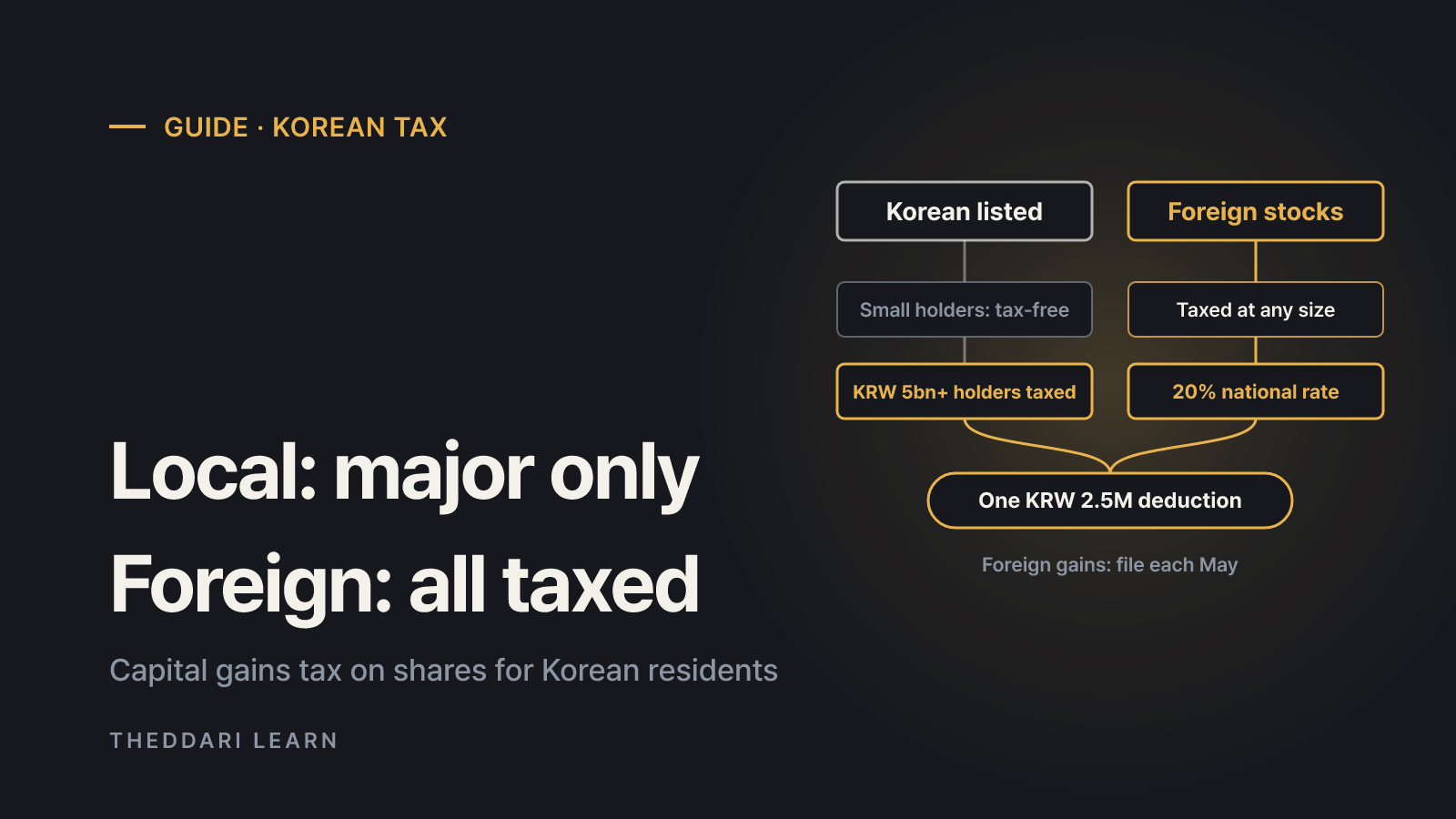
Investors outside the United States usually face U.S. withholding plus their own country's rules. Korean residents, for example, include foreign dividends in financial income; Korea's National Tax Service says that once annual interest and dividend income exceeds 20 million won it is taxed together with other income, and foreign dividends not withheld in Korea are subject to comprehensive taxation even below that threshold. Check your broker's tax statements and a qualified adviser for your own situation.
Common misconceptions
- Monthly cash is not the same as profit; return of capital is your own money coming back.
- Steady payouts can coexist with a falling share price and weak total return.
- A covered call ETF can trail its index in strong markets and still lose value in declines.
- A rising dividend yield can reflect a falling price rather than a growing dividend.
- A list of monthly payers tells you the schedule, not the sustainability.
Monthly dividend stocks and ETFs are tools for timing cash flow, not shortcuts to higher returns. Compare where the money comes from, how the price has held up, what you pay in fees and what you owe in tax, using the latest fund documents and official tax guidance. If you want to see which stocks retail communities are discussing, the stock Telegram trends page shows topic activity, but popularity is not a measure of suitability.
This AI-written guide is general information and not investment advice. It does not recommend buying or selling any stock or ETF. Distributions, fees and tax rules change, so confirm current details in the fund prospectus and official tax guidance and consider your own circumstances.