Contents7 sections
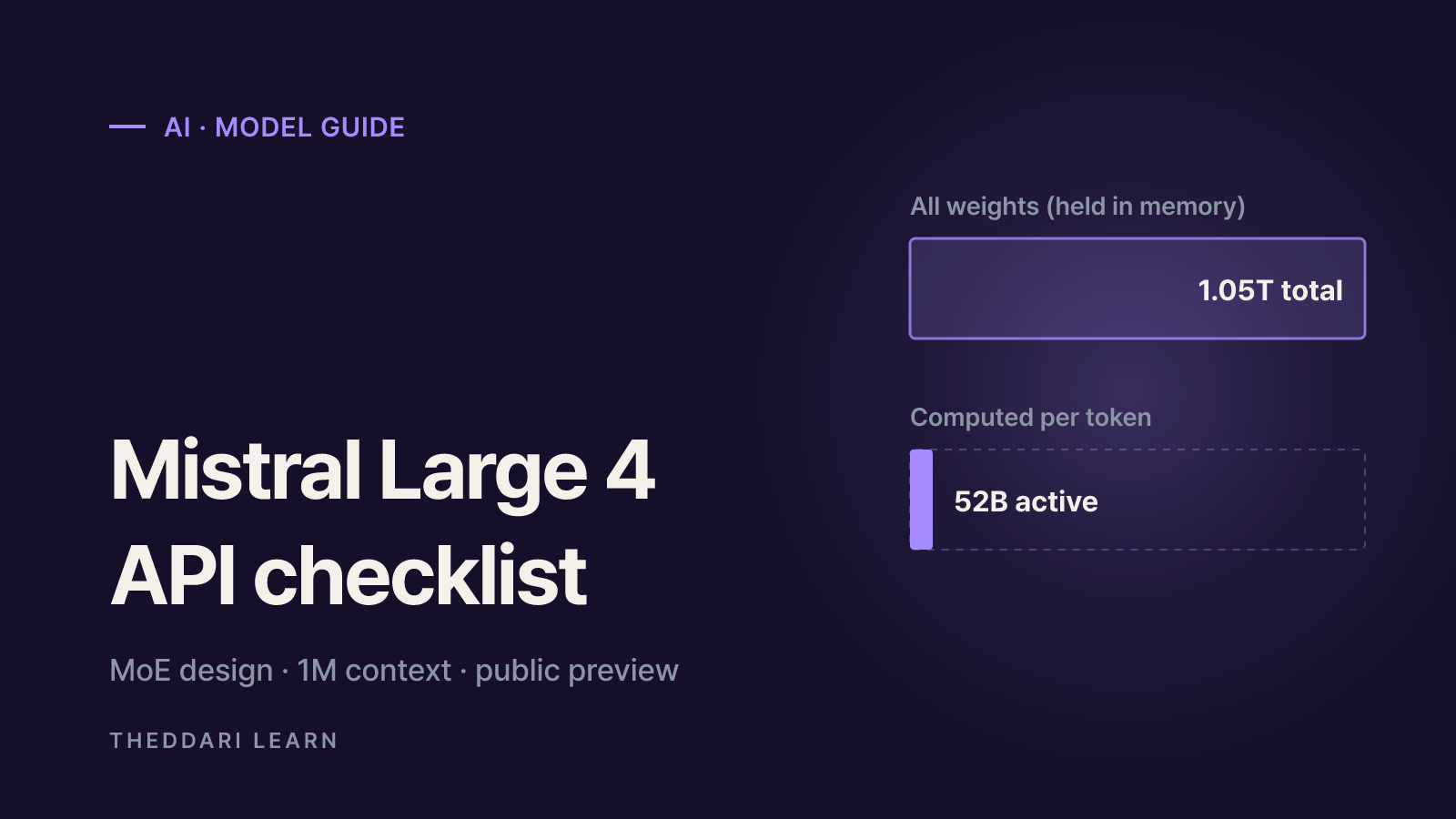
Mistral Large 4 is the newest and largest model from Paris-based Mistral AI, released as a paid public preview on October 6, 2026. According to the official docs, it is a multimodal mixture-of-experts (MoE) model with 1.05T total parameters, of which 52B are active per token, and a 1M-token context window. Mistral pitches it for coding, agentic workflows, image understanding and cybersecurity. You can call it today through the Mistral Studio API; the weights are promised for the end of October. This guide is based on official pages checked on October 22, 2026 and covers the specs, how it compares with Mistral Large 3, and what to verify about pricing, context, licensing and preview status before you integrate it.
What is Mistral Large 4? The official specs
In its launch post, Mistral describes Large 4 as its largest and most capable model to date. It accepts text and image input natively and combines standard instruction following with reasoning in a single hybrid model. Mistral says a large share of the training data was multilingual, covering more than 160 languages including every official EU language, and that the model was trained from scratch on 3,800 NVIDIA Grace Blackwell GPUs in its own European data centers. The preview API runs on that same infrastructure.
The parameter figures differ slightly by source. The official model page lists 52B active, 1.05T total and a 1.6B vision encoder, while the Hugging Face placeholder says 49B active parameters per token, or 52B including embeddings and output layers. That is a counting convention, not two different models. In an MoE design only a subset of experts runs for each token, so latency and serving cost track the active count more closely. Memory requirements for self-hosting, however, follow the total parameter count, because all weights must be loaded.
| Item | Official listing (checked October 22, 2026) |
|---|---|
| Stage | Public Preview, v26.10, released October 6, 2026 |
| Architecture | Granular mixture-of-experts, multimodal input |
| Parameters | 1.05T total, 52B active, 1.6B vision encoder |
| Context window | 1M tokens |
| API price per million tokens | $1.36 input, $0.14 cached input, $4.18 output |
| Listed features | Structured outputs, function calling, document Q&A, batching, Agents and Conversations APIs, built-in tools |
| Weights and license | Not yet published; Hugging Face shows October 31 as expected release |
The model supports the same endpoints as other Mistral models, including /v1/chat/completions, /v1/conversations, /v1/agents and /v1/batch. If you already use the Mistral API, switching the model identifier is enough for a first test, but rebuild your cost estimate because response length and reasoning token usage can change.
Mistral Large 4 vs Large 3: pricing, context and license
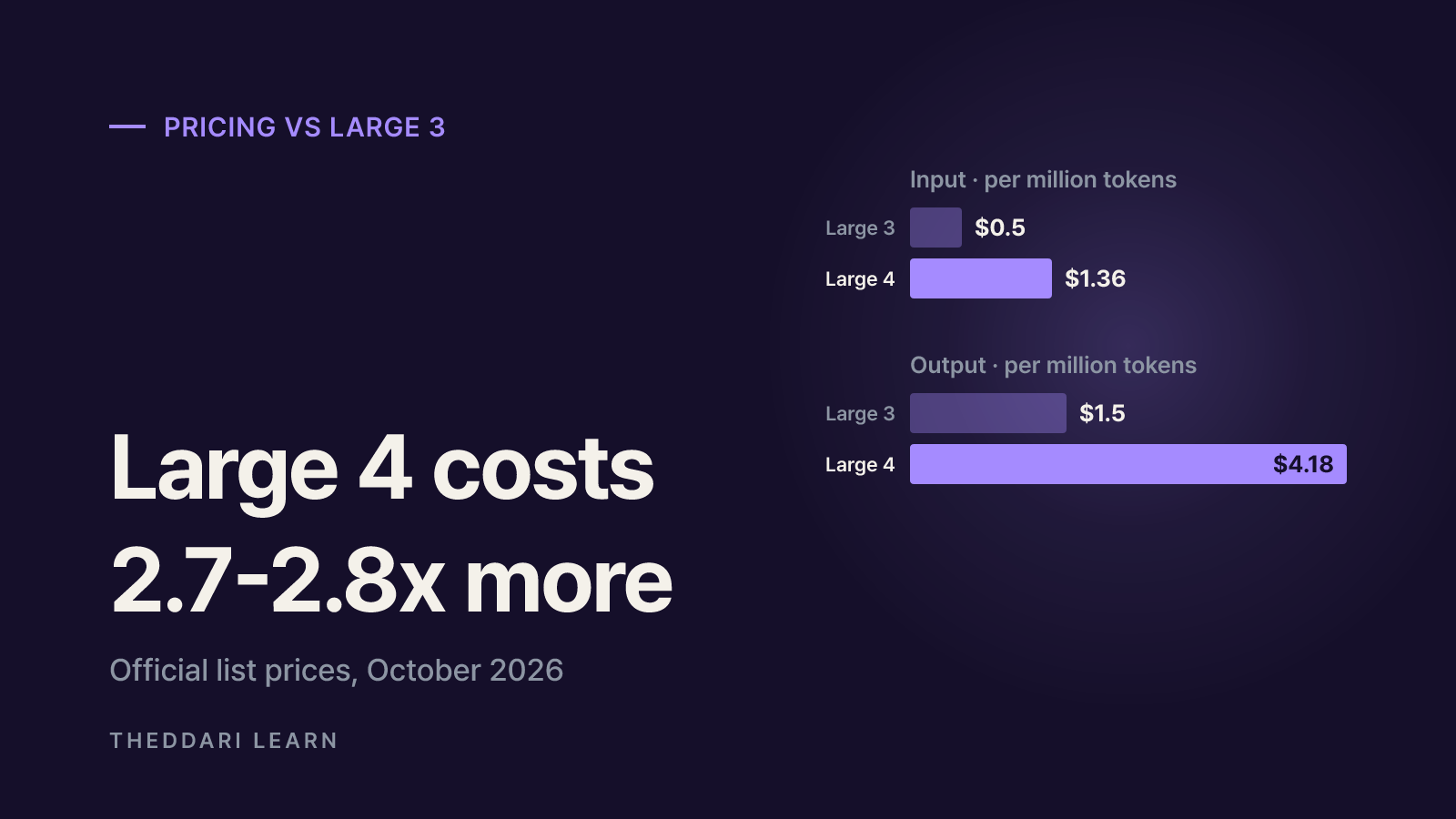
The most practical comparison is Mistral's previous flagship. The Large 3 model page lists it as generally available since December 2, 2025, with 675B total and 41B active parameters, a 256k context window and an Apache 2.0 license. The table below uses each official page's own figures.
Lifecycle stage
- Mistral Large 3
- General Availability
- Mistral Large 4
- Public Preview
Total / active parameters
- Mistral Large 3
- 675B / 41B
- Mistral Large 4
- 1.05T / 52B
Context window
- Mistral Large 3
- 256k
- Mistral Large 4
- 1M
Input price per million tokens
- Mistral Large 3
- $0.5
- Mistral Large 4
- $1.36
Output price per million tokens
- Mistral Large 3
- $1.5
- Mistral Large 4
- $4.18
License
- Mistral Large 3
- Apache 2.0
- Mistral Large 4
- Not yet published
Silent updates
- Mistral Large 3
- No
- Mistral Large 4
- Allowed
On list price, Large 4 costs about 2.7 times more for input (1.36 divided by 0.5) and about 2.8 times more for output (4.18 divided by 1.5). A single request with 100,000 input tokens and 2,000 output tokens works out to roughly $0.144 on Large 4 (0.1 × 1.36 + 0.002 × 4.18). If you resend the same long document repeatedly, whether the $0.14 cached-input rate applies will matter a lot. Reasoning mode can also add billed output tokens you never see in the final answer, so measure average tokens per request on real traffic before projecting a monthly bill.
Treat the context window the same way. Mistral's page says 1M tokens, but The Frontier reported that Artificial Analysis and Vals AI both listed 512k at launch. If you reach the model through a router or cloud marketplace rather than Mistral directly, confirm the limit on that specific endpoint.
How to read the benchmark claims
Mistral's launch post reports 61.7% on DeepSWE v1.1, 59.4% on SWE-Atlas-QnA, 28.3% on Terminal-Bench 4 and 59.9% on AutomationBench, and claims Large 4 is the strongest open-weight model developed in the US or Europe. On a cybersecurity test that asks a model to reproduce and then patch a real vulnerability, it reports 82%. Those figures are a useful starting point, but check a few things before relying on them.
- Who is on the chart: vendors choose which rivals appear. The Frontier found other open-weight models scoring higher on several independent indexes on launch day.
- When it was measured: preview models can be updated silently, so the same model name may not produce the same score a few weeks later.
- Who ran the test: separate self-reported results, vendor-commissioned third-party runs and independent leaderboards. Safety figures such as 93.3% prompt-injection resistance are self-reported.
- How close it is to your work: strong legal, finance or coding scores do not mean you will see the same quality on your documents, languages or output formats.
Interpretations of a big launch diverge quickly. Theddari's AI Telegram trends and blog trends pages show which claims are being shared most, which helps you spot the debates worth checking. Popularity is not evidence of quality, so verify what you read against the official docs and independent evaluations.
 theddari.comTrendsBlog PostsSummarized Naver blog posts
Five things to check before using the API
- 1
Understand the preview terms
Mistral's model lifecycle policy says Public Preview models are priced like GA models, allow silent updates and may be retired before ever reaching general availability. The deprecation notice for a preview model is one month, compared with six months for GA models.
- 2
Pin the model identifier
The docs warn that aliases such as latest can move to a new version and change both behavior and pricing. In production, pin a major-minor identifier and promote new versions only after testing.
- 3
Set spending controls first
Model input, cached input and output costs separately, and measure how reasoning mode inflates output tokens on sample requests. Configure workspace spending limits and billing alerts before opening traffic.
- 4
Check data location and terms
Mistral says the model will be offered in multiple regions, including a European deployment it operates end to end under European law. If you send personal data or internal documents, confirm the processing region and data retention and training terms in the terms of service and data processing addendum.
- 5
Evaluate on your own tasks
Send the same realistic prompt set to Large 3, Large 4 and any other candidates, then compare accuracy, format compliance and token usage. Record the date and exact model identifier so you can detect regressions after an update.
Open-weight promise and self-hosting risks
Large 4 is marketed as open-weight, but as of October 22, 2026 neither the official model page nor Hugging Face offered weight files or a license text. The Hugging Face placeholder lists October 31, 2026 as the expected release. The Frontier reported that Mistral's EU AI Act technical documentation for downstream providers currently classifies the available distribution channels, meaning the terms of service, partner-served deployments and a confidential self-deployment agreement, as proprietary or bespoke licenses, and says it will be updated if the weights are released openly.
Until the license is published, avoid committing to redistribution, publishing fine-tuned derivatives or commercial self-hosting. Even once it ships, running 1.05T parameters means distributed multi-GPU serving plus your own security patching and monitoring. Mistral says it is red-teaming the model with cybersecurity firms, vetted partners and state authorities before release, and that it will publish architecture details, more benchmarks and its post-training method alongside the weights.
In short, Mistral Large 4 is worth testing if you need long context together with coding, agent and vision capabilities, but today it is a higher-priced preview API rather than a stable, downloadable model. Start with pinned versions, spending limits and your own evaluation set, and revisit self-hosting or redistribution plans once the weights and license text are actually available.