Contents7 sections
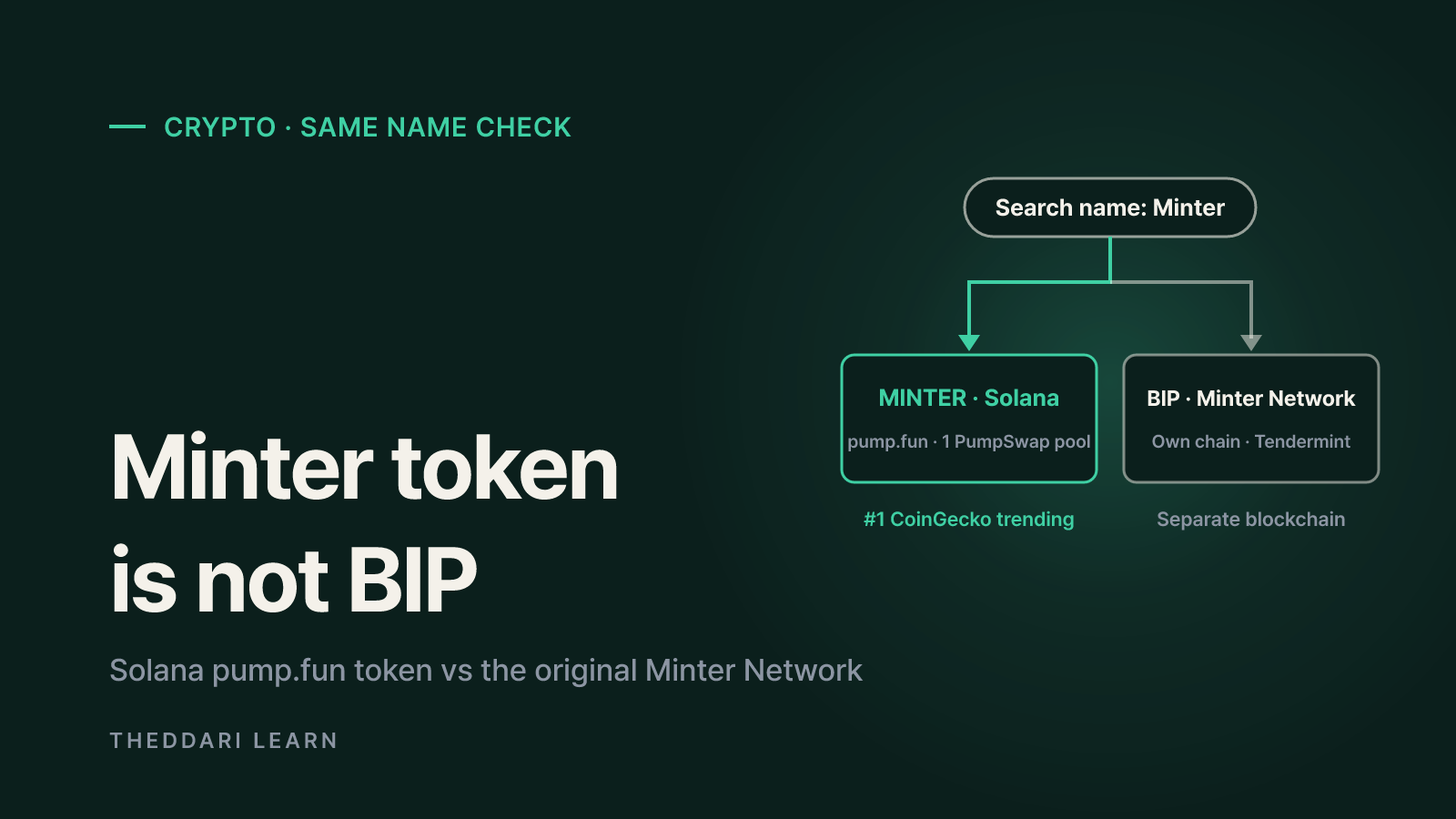
The Minter coin that reached #1 on CoinGecko trending on October 18, 2026 is MINTER, a Solana token from the pump.fun ecosystem. It is not BIP, the native coin of the older Minter Network blockchain, even though many people search for the two together. This guide uses public data checked on October 18, 2026 (around 14:40 UTC) to explain how the two assets differ and what to verify before trading a freshly trending token that borrows a familiar name.
Same name, different asset. The CoinGecko 'Minter' page points to a Solana token, not to Minter Network. The chain, issuance model, and team behind each are different, so match the contract address before you swap.
Minter on CoinGecko trending is not Minter Network's BIP
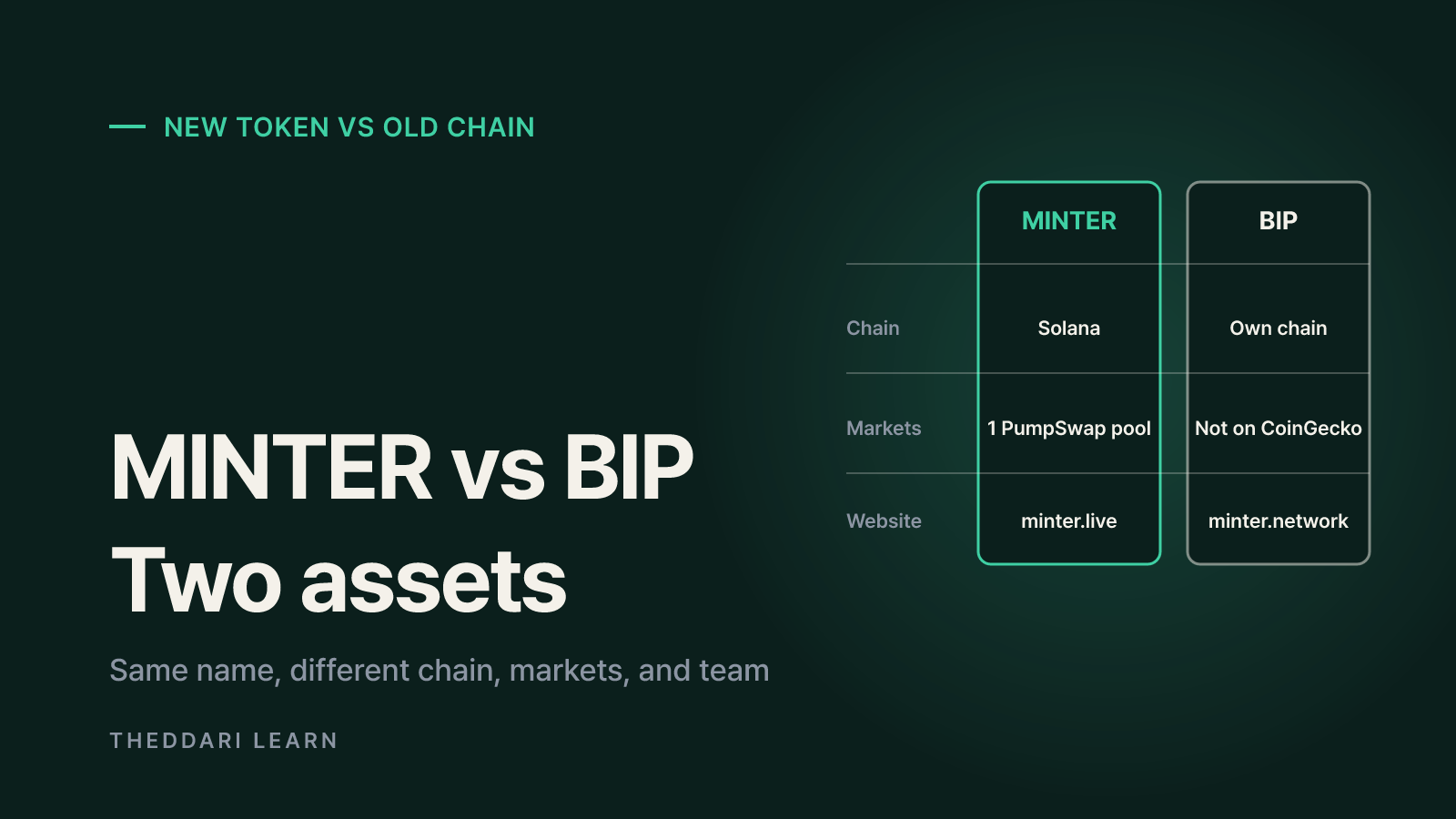
CoinGecko's coins/minter API data lists Solana as the asset platform and tags the token with the Solana Ecosystem, Launchpad, and Pump.fun Ecosystem categories. The linked homepage is minter.live and the linked X account is MinterXSOL. The GitHub and whitepaper fields were empty.
BIP, by contrast, is the mainnet base coin described in the Minter Network docs. A CoinGecko search for 'bip' on the same day returned no Minter Network entry. In practice, that means the price and volume you see on the trending 'Minter' page say nothing about BIP.
Chain
- MINTER (CoinGecko trending)
- Solana (SPL token)
- BIP (Minter Network)
- Own blockchain (Tendermint-based)
Origin
- MINTER (CoinGecko trending)
- pump.fun-style launchpad
- BIP (Minter Network)
- Native coin used for fees and staking
Website
- MINTER (CoinGecko trending)
- minter.live
- BIP (Minter Network)
- minter.network
Markets tracked by CoinGecko
- MINTER (CoinGecko trending)
- 1 (PumpSwap MINTER/SOL)
- BIP (Minter Network)
- Not found in CoinGecko search
Price (Oct 18, 2026)
- MINTER (CoinGecko trending)
- About $0.0143
- BIP (Minter Network)
- About $0.000254 (explorer figure)
Market cap shown
- MINTER (CoinGecko trending)
- About $14.21M
- BIP (Minter Network)
- About $2.69M (explorer figure)
The BIP price and market cap come from the Minter explorer API, which calculates them differently from CoinGecko. Use the table to confirm that these are two separate assets rather than to compare valuations directly.
How the MINTER token works
The minter.live site pitches the project in one line: launch a coin on pump.fun and get an 'engine' that collects its fees. According to the site, there are 999 pixel engines, and each keeps 20% of its coins' creator fees for good. CoinGecko's description frames MINTER as the community token tied to that idea and states that it does not promise returns.
Note the gap between those two statements. An engine collecting creator fees is not the same as MINTER holders receiving those fees. The public material we read did not spell out how, or whether, fees flow to token holders, or how engine ownership relates to the token. If fee sharing or buybacks are part of your thesis, confirm that path in the smart contract and in official documentation first.
First-day price action
CoinGecko recorded MINTER's all-time low (about $0.00367) at 01:19 UTC on October 18, 2026 and its all-time high (about $0.0219) at 09:10 UTC the same day. That is close to a 6x move in about eight hours. At the time of checking, the price (about $0.0143) sat roughly 35% below the high, and the one-hour change was about -16%. In other words, the token had less than a day of trading history.
Supply and market structure
- Supply: about 995.26 million tokens circulating out of a 1 billion maximum, so roughly 99.5% is already counted as circulating.
- Market cap and FDV: both about $14.21M. Little future dilution is left, which makes the question of who holds the existing supply more important.
- 24-hour volume: about $46.07M, roughly 3.2x market cap, meaning the float changed hands several times in a day.
- Markets: one pool, MINTER/SOL on PumpSwap, with a bid-ask spread of about 0.60%.
What Minter Network and BIP actually are
Per the Minter Network documentation, Minter is a blockchain built on the Tendermint consensus engine with delegated proof of stake (DPoS). It targets one block every five seconds, prices fees in US dollars, and lets users pay those fees in any liquid coin. The docs also describe bridges to Ethereum and BNB Smart Chain.
Custom coins backed by BIP reserves
Minter's signature feature is that anyone can issue a custom coin backed by a BIP reserve. The creator picks a constant reserve ratio (CRR) between 10% and 100% and must lock at least 10,000 BIP. Buying a coin adds to its reserve and selling draws it down, a bonding-curve design meant to allow instant swaps without a counterparty. A higher CRR means lower price volatility.
- Coins: backed by a BIP reserve, CRR 10-100%, minimum reserve of 10,000 BIP.
- Tokens: no reserve; they can only be bought or sold through a liquidity pool.
- Liquidity pools: automated market maker (AMM) pools that pay providers 0.2% of each swap.
- Ticker fees: $10 to $100,000 depending on symbol length, distributed to validators and delegators.
On-chain activity today
At 14:40 UTC on October 18, 2026, the explorer API reported block height 40,226,101. Blocks were still being produced, but the average block time was about 12.2 seconds, throughput was about 0.0008 transactions per second, and lifetime transactions totaled about 18.89 million. Older networks often keep running long after real usage fades, so a revived name is no substitute for checking activity data.
Due diligence checklist before trading the Minter token
- 1
Match the chain and contract address
CoinGecko's MINTER points to Solana address 3NxfWMHmfQg8NJFW5AG1ti2xACdczWz24e9SKyk1pump. If a token in your wallet or DEX search differs by even one character, it is a different asset. If you are looking for BIP, you need a Minter Network wallet, not a Solana token.
- 2
Count markets and measure liquidity
With only one PumpSwap pool, that pool's liquidity is effectively your exit. Get a quote at your intended size to see the slippage, and check whether pool liquidity has been shrinking.
- 3
Compare volume with market cap
Daily volume above 3x market cap points to speculative churn. When volume dries up, prices can retrace quickly, so watch the trend over several days rather than one snapshot.
- 4
Check holder concentration and dev wallets
Use a Solana explorer to see the share held by top wallets and whether the deployer or early buyers have been selling. A fully circulating supply can still be concentrated in a few wallets.
- 5
Verify official channels and the fee model
Make sure minter.live and the official X account link to each other, and find written documentation on how engine fees relate to token holders. Treat 'revenue share' claims from chats as unverified until the contract confirms them.
To see where the sudden attention came from, it helps to watch community chatter. TheDdari's Telegram crypto trends page shows when mentions of new tokens like MINTER start to climb.

Comparing how blogs and news cover the name can also show whether a story is about the old Minter Network or the new Solana token.
Risks of trending tokens that reuse an old name
- Name confusion: when a new token reuses an older project's name, search results and news blend together, and the older project's history can look like credentials for the new one.
- Launch-day volatility: a token that moved nearly 6x between its low and high in one day can swing by tens of percent within hours.
- Single-pool liquidity: if one DEX pool holds all the liquidity, a liquidity withdrawal or one large sell can crash the price.
- Thin disclosure: empty GitHub and whitepaper fields leave few ways to verify code or the team.
- Jurisdiction: tokens that trade only on offshore DEXs sit outside most exchange-level investor protections. Whether you can trade them, and how gains are taxed, depends on where you live.
Bottom line: the 'Minter' that topped CoinGecko trending on October 18, 2026 is MINTER, a Solana pump.fun token, and it is a different asset from Minter Network's BIP. A trending rank only measures attention. Work through address, markets and liquidity, volume trend, holder distribution, and official documentation, in that order, and size any position to what you can afford to lose.