Contents7 sections
Ethereum staking yield is not a set interest rate. It is the sum of two income streams, divided across everyone who stakes: consensus-layer issuance, which the protocol mints for validators, and execution-layer rewards, meaning priority fees and MEV paid to whoever proposes a block. Subtract your provider's fee and you have the number that actually reaches you. This explainer uses official documentation and public data checked on November 5, 2026. It describes how the yield is built; it does not forecast what any product will pay.
What makes up Ethereum staking yield
Validators earn consensus rewards for attesting to blocks, proposing blocks and serving on sync committees. According to ethereum.org's rewards and penalties page, every one of these rewards is derived from a base_reward that is proportional to a validator's effective balance and inversely proportional to the square root of the total active balance. This is newly issued ETH.
Execution rewards come from users and block builders. Priority fees (tips) are paid by people who want their transactions included, and MEV is the extra value from ordering, including or excluding transactions. ethereum.org's MEV documentation explains how the Builder API, implemented by MEV-Boost, lets a proposer accept the highest bid from external block builders. The base fee, by contrast, is burned and never reaches validators.
Consensus issuance
- Who pays
- Protocol (new ETH)
- What drives it
- Total stake, participation
- Per-ETH effect as stake grows
- Falls roughly as 1/√S
Priority fees
- Who pays
- Transaction senders
- What drives it
- Network congestion
- Per-ETH effect as stake grows
- Diluted roughly as 1/S for a fixed pool
MEV
- Who pays
- Block builder bids
- What drives it
- DeFi trading, liquidations, arbitrage
- Per-ETH effect as stake grows
- Diluted roughly as 1/S for a fixed pool
Provider fee
- Who pays
- The staker
- What drives it
- Provider terms
- Per-ETH effect as stake grows
- Deducted as a share of rewards
Issuance behaves like a predictable floor; fees and MEV are the volatile top layer. Before comparing any two APR figures, check whether each one covers consensus rewards only or includes execution rewards, and over what period it was averaged.
Why more ETH staked means a lower issuance APR
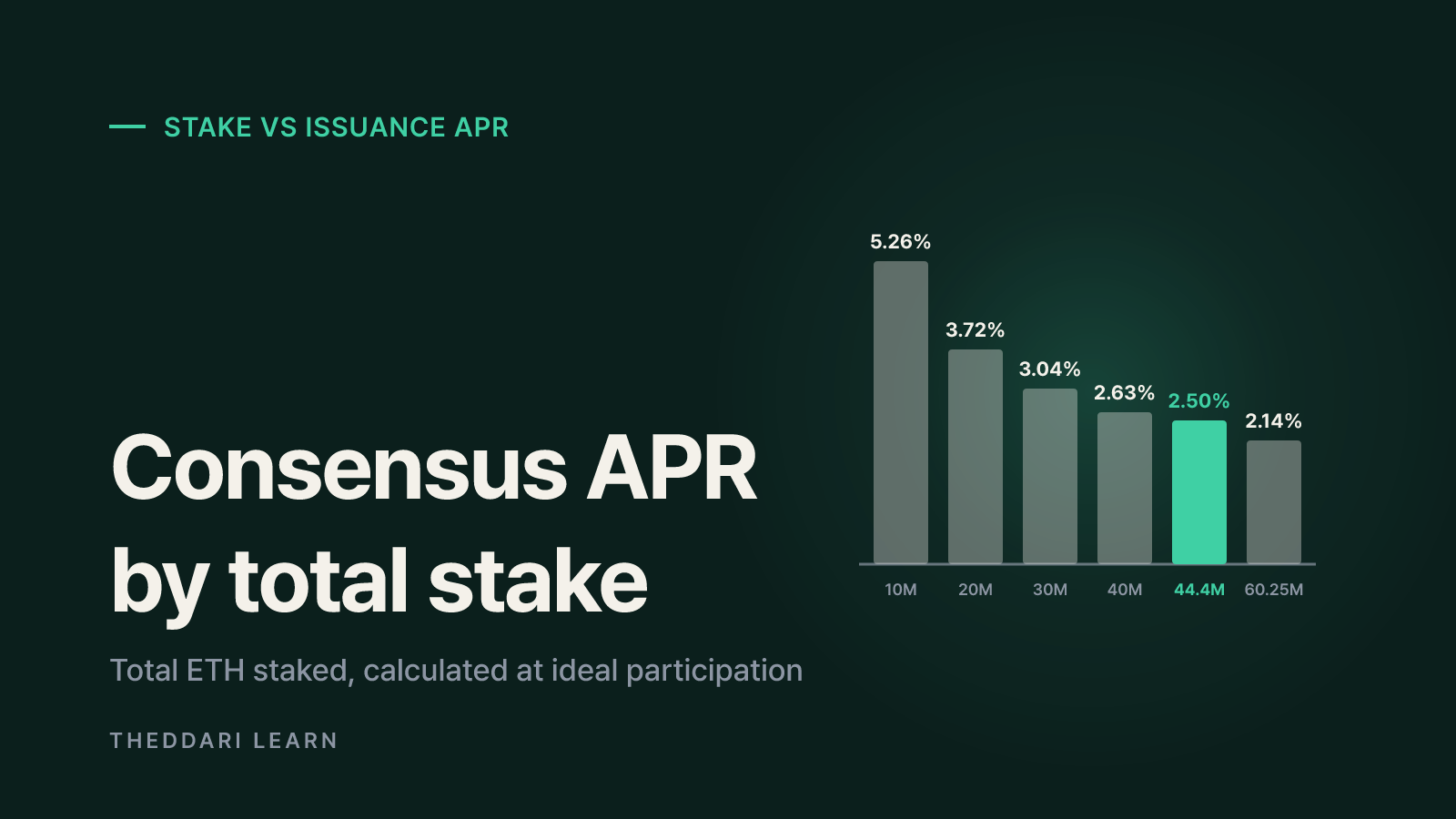
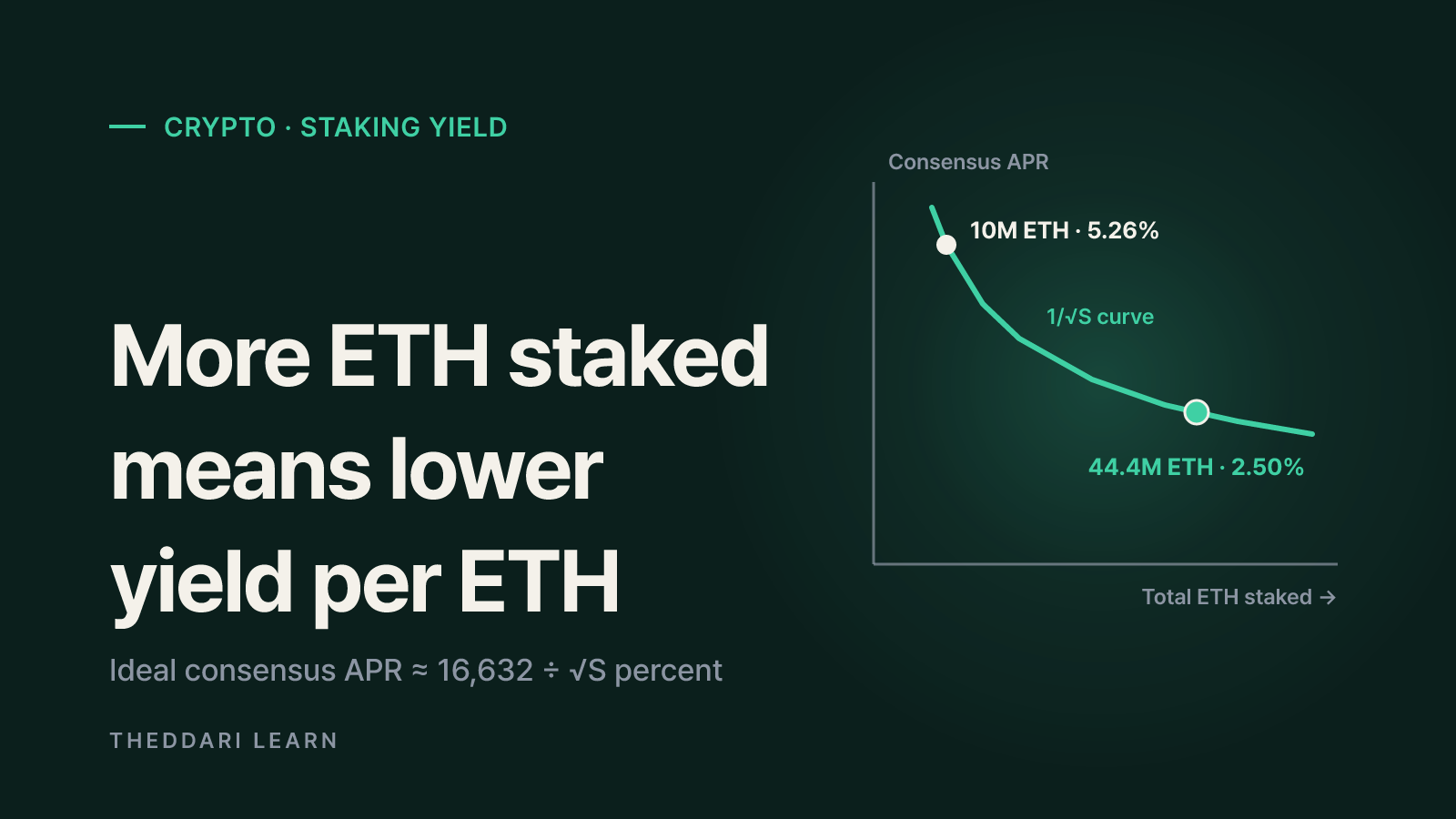
Ben Edgington's Upgrading Ethereum book gives the expected APR under perfect participation as 2940.21 ÷ √N percent, where N is the number of 32 ETH validators. Rewriting it in terms of total ETH staked, S, gives APR ≈ 16,632 ÷ √S percent. Maximum annual issuance, meanwhile, grows with √S. More stakers means the protocol pays out more in total, but each staked ETH earns less.
10M ETH
- Ideal consensus APR (calculated)
- ≈5.26%
- Note
- Range the design aimed to strongly incentivize
20M ETH
- Ideal consensus APR (calculated)
- ≈3.72%
- Note
- About 29% lower than at 10M
30M ETH
- Ideal consensus APR (calculated)
- ≈3.04%
40M ETH
- Ideal consensus APR (calculated)
- ≈2.63%
44.4M ETH
- Ideal consensus APR (calculated)
- ≈2.50%
- Note
- Stake on November 5, 2026
60.25M ETH
- Ideal consensus APR (calculated)
- ≈2.14%
- Note
- EIP-8363's full-burn saturation balance
Real-world numbers sit a little below these because participation is never perfect. On November 5, 2026, validatorqueue.com showed 44.4M ETH staked, 36.32% of supply, and a 7-day APR of 2.44%, close to the 2.50% the formula predicts. Note the square-root shape: doubling the stake cuts the issuance rate by about 29%, not by half. Halving it would take four times as much ETH staked.
Why a square root?
The book explains the trade-off. A fixed rate would need repeated hard forks to retune, because set too low it drives everyone out and set too high it overpays for security. A 1/N curve, where each validator's reward falls in proportion to the validator count, would make it profitable for some validators to push others out, a so-called discouragement attack. The inverse square root sits between the two. The same chapter adds that since the Merge, fees and MEV make real income behave more like the 1/N case, an open research problem.
Priority fees and MEV rise and fall with demand
Execution income depends on how busy Ethereum is. Heavy DeFi activity, volatile markets and waves of liquidations push tips and builder bids up; quiet periods pull them down. Because that pool is set by usage rather than by the amount staked, every new staker takes a slice of the same pie. During periods of rapid stake growth, the execution share per ETH can shrink faster than issuance does.
Variance matters too. Proposers are selected at random, so a solo validator may wait a long time between proposals and then land a block carrying unusually large MEV. That lumpiness is one reason people use pooled staking, which averages rewards across many validators. ethereum.org also warns of the flip side: large pools with better MEV infrastructure gain economies of scale, which can push validators toward centralization.
The burned base fee is not staker income, but it does affect everyone holding ETH. When more ETH is burned than issued, total supply shrinks, offsetting dilution. ethereum.org's issuance page points to dashboards such as ultrasound.money for tracking issuance against burn.
From gross APR to what you actually keep
Providers take a cut. Lido's documentation defines user APR as protocol APR × (1 − protocol fee) and states a 10% fee split between node operators and the DAO treasury, changeable by DAO vote. So a 2.5% protocol APR becomes 2.25% for the user. Lido's protocol APR is a 7-day moving average of consensus and execution rewards.
- 1
Read the APR definition
Find out whether the figure includes execution rewards, which averaging window it uses, and whether fees have already been deducted.
- 2
Subtract the provider fee
Exchanges, liquid staking protocols and staking-as-a-service providers charge different shares. Note the rate and whether it can change.
- 3
Account for time earning nothing
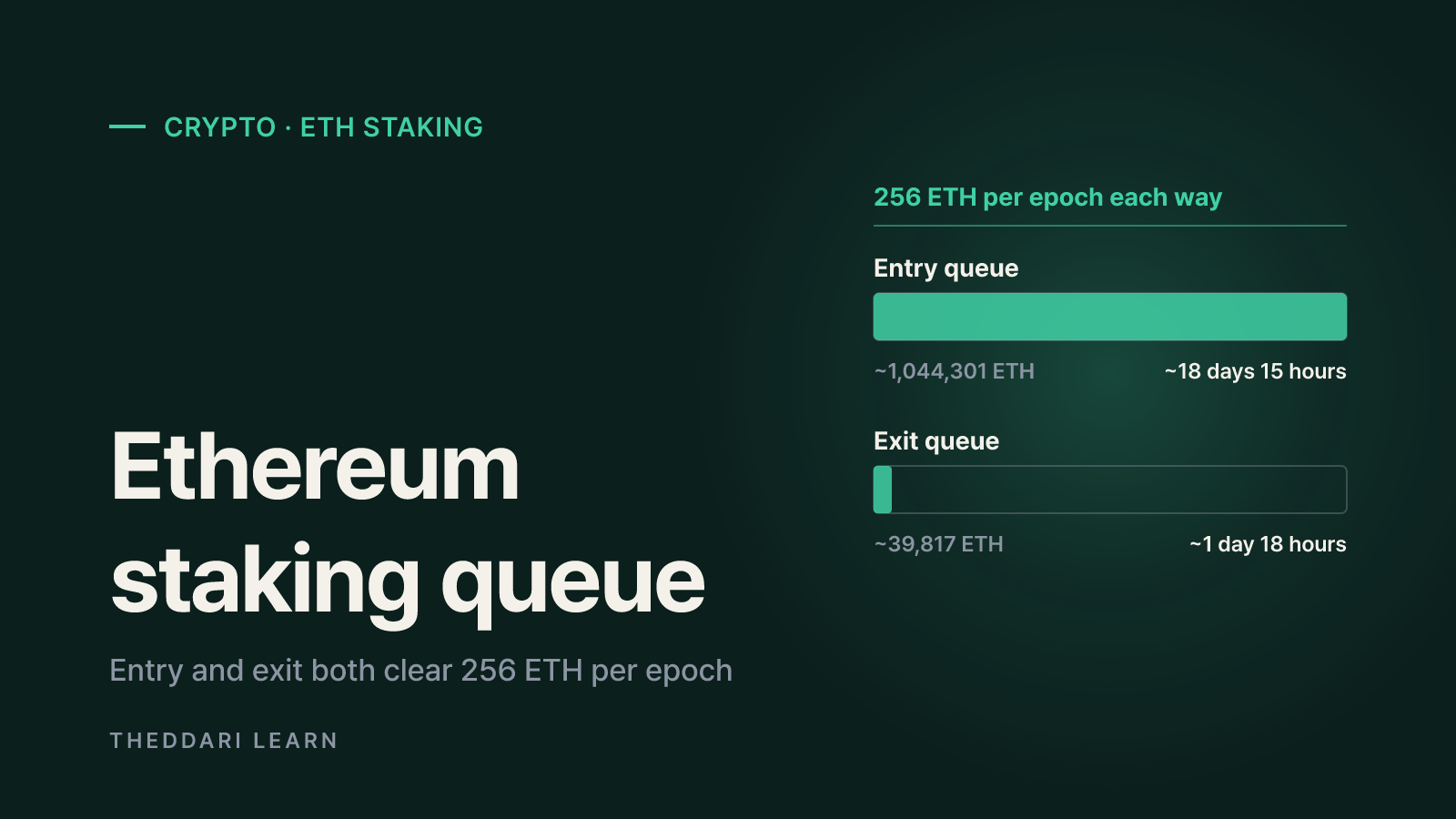
New validators must clear the entry queue before rewards start. On November 5, 2026, validatorqueue.com showed about 1.02M ETH waiting to enter, a wait of roughly 18 days. Exits face their own queue and a withdrawal sweep delay.
- 4
Separate price, dilution and tax
A positive ETH-denominated APR can still mean a loss in dollar terms if the price falls. Unstaked holders are diluted by issuance, and the tax treatment of rewards depends on where you live.
If you weigh staking against other ETH-based returns, perpetual futures funding rates are a different kind of income with different risks, but they show the opportunity cost of holding ETH in one place rather than another. For readers converting through Korean won, the price gap between Korean and global exchanges also changes the local-currency result. Both tools display data; neither predicts outcomes.

EIP-8363, the issuance debate and the risks to price in
Under today's curve the reward rate never reaches zero. The EIP-8363 draft notes that it keeps a floor of roughly 1.5% however much ETH is staked. Created on July 14, 2026, the Tapered Issuance Burn would burn a growing fraction of issuance as total active balance approaches 60.25M ETH, about half of supply. Its authors calculate that, fully applied at today's staking ratio, net consensus yield would fall from about 2.6% to 1.2%, so they proposed phasing it in over 18 months. The burn targets issuance only; priority fees and MEV are untouched.
The Block reported that the authors withdrew the proposal from Hegota upgrade consideration on October 1, 2026, accepting the argument that fork scoping is the wrong venue for monetary policy. They outlined a separate process starting with a Devcon forum in November and running to EthCC in April. The current curve stands, but a long-term change to issuance remains possible.
- Slashing: provable misbehavior burns part of the stake and forces a 36-day exit, with a correlation penalty that grows when many validators are slashed together.
- Inactivity penalties: missed source and target votes cost what they would have earned, so a poorly run operator can underperform the headline APR.
- Liquidity: queues delay exits, and a liquid staking token can trade away from ETH.
- Smart contract, governance and custody risk: pooled and exchange products add risks outside the protocol.
Issuance proposals, provider announcements and queue swings tend to spread quickly on social channels. Use the crypto Telegram trend tracker to see what is gaining attention, then confirm anything that matters against the EIP text or the provider's own notice.
In short, Ethereum staking yield is an issuance floor that falls with the square root of total stake, a fee and MEV layer that follows network demand, and a provider fee taken off the top. When comparing numbers, record the period, the components included, whether fees are netted out, and which risks you accept in exchange.