Contents7 sections
- What is the DENIM token, and how does it relate to Base Denim?
- What a CoinGecko trending rank does and does not tell you
- DENIM by the numbers: market cap, liquidity and holders
- New token checklist: six checks before buying DENIM
- Altcoin risks to weigh: copycats, crashes and network caveats
- Frequently asked questions
- Sources and references
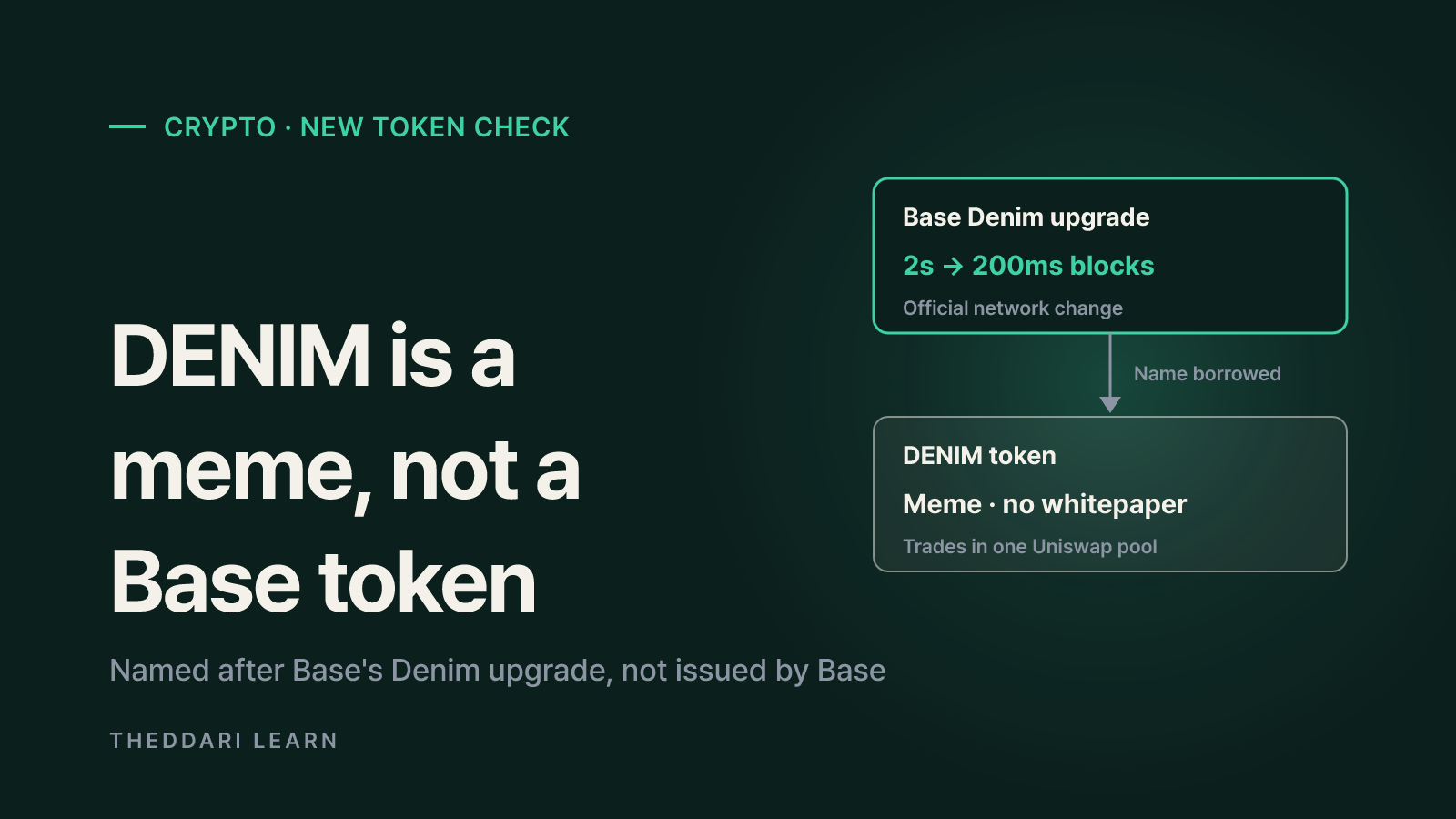
The DENIM token is a meme coin on Base, the Ethereum layer-2 network incubated by Coinbase. It borrows its name from Base's Denim upgrade, which went live on mainnet on November 5, 2026, and it jumped to the top of CoinGecko's trending list shortly after. The short answer for anyone searching "denim crypto": it is a community meme token, not an official Base asset, and nearly all of its trading happens in one decentralized exchange pool. Everything below uses CoinGecko and GeckoTerminal data captured around 20:30 UTC on November 6, 2026.
What is the DENIM token, and how does it relate to Base Denim?
Start by separating the upgrade from the token. According to the Base blog, Denim is Base's fourth network upgrade. It moves the chain from one block every two seconds to one canonical block every 200 milliseconds, or five per second. It also retires Flashblocks, the preview stream that used to fill the gap between blocks, and adds BaseTime so contracts can read time in milliseconds. Base says regular users do not need to do anything.
The DENIM token is a meme built on top of that news. Its CoinGecko listing carries a promotional blurb mixing tight-jeans jokes with the 2-second-to-200ms story, and the categories are Meme, Base Ecosystem and Base Meme. There is no whitepaper and no code repository on file. The only official links are a website (denimcoin.fun) and an X account (@denimbasecoin). In other words, this is an attention-driven memecoin, not a product or protocol token.
| Item | DENIM details (as of November 6, 2026) |
|---|---|
| Chain | Base (Ethereum layer 2) |
| Contract address | 0x0bddfa9a0a1eb326593262c7af47ee091db9cb70 |
| Decimals | 18 |
| Total / circulating supply | 1 billion, all shown as circulating |
| CoinGecko categories | Meme, Base Ecosystem, Base Meme |
| Whitepaper / repo | None listed |
| Listed market | Uniswap V4 (Base) |
The Base Denim upgrade is a protocol change, not a token giveaway. Any link promising a Denim airdrop or upgrade reward in exchange for a wallet connection or signature should be treated as phishing until proven otherwise.
What a CoinGecko trending rank does and does not tell you
CoinGecko's trending list ranks coins by how much users are searching for and viewing them. Big price swings and news hooks like a network upgrade push coins onto the list fast, and they fall off just as fast. When we pulled the trending endpoint again on November 7, 2026, a different coin was already at number one. A trending rank means people are looking. It is not a quality score, an audit or a fair-value signal.
CoinGecko itself attaches a notice to the DENIM page saying the pools are newly created, may carry associated risks, and that you should do your own research. If you want a sense of how loud the hype is, watching mention spikes across crypto Telegram channels is a useful sanity check alongside the on-chain numbers.

DENIM by the numbers: market cap, liquidity and holders
The figures below come from CoinGecko and GeckoTerminal pool data around 20:30 UTC on November 6, 2026. Memecoin numbers move by the minute, so reload the live pages before acting on any of them.
Price
- Value
- About $0.0172
- What it means
- Up about 46.5% over 24 hours
Market cap = FDV
- Value
- About $17.2 million
- What it means
- Full supply circulating, no unlock schedule shown
CoinGecko market cap rank
- Value
- #910
- What it means
- Far smaller than major altcoins
24h volume (all markets)
- Value
- About $7.85 million
- What it means
- Mostly from one DENIM/ETH pool
Main pool liquidity
- Value
- About $387,000
- What it means
- Uniswap V4 DENIM/ETH pool created November 4, 2026
All-time low to high
- Value
- $0.00926 to $0.0194
- What it means
- Roughly 2.1x from November 4 low to November 6 high
Holder wallets
- Value
- 5,029
- What it means
- GeckoTerminal count
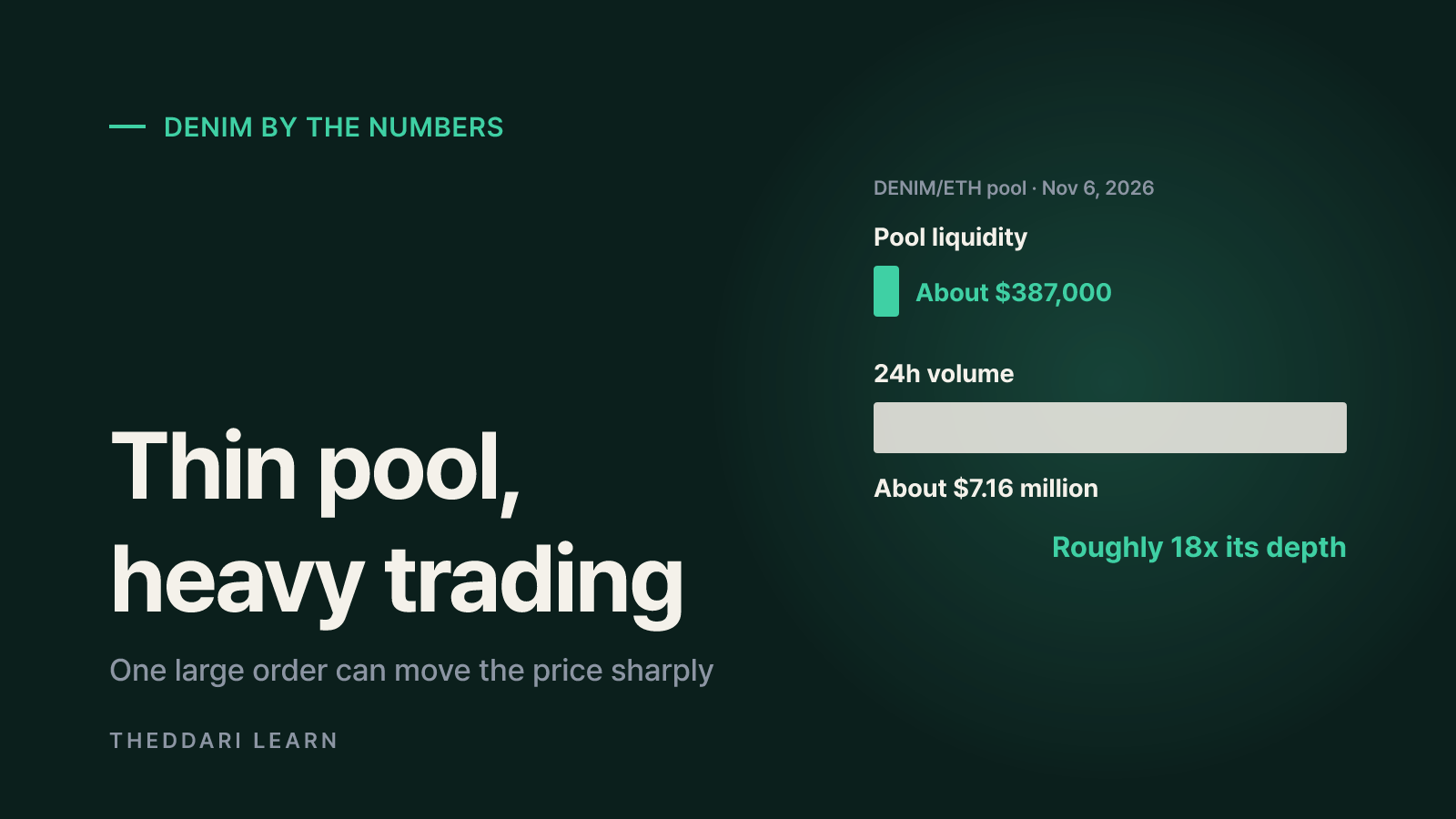
The number that matters most is the gap between liquidity and volume. The main DENIM/ETH pool held about $387,000 in liquidity but traded about $7.16 million in 24 hours, roughly 18 times its own depth. That shows heavy short-term trading, and it also means a single large order can move the price sharply in either direction. A DENIM/USDC pool exists too, but with about $837 of liquidity it is not a meaningful place to trade.
How to read the holder distribution
GeckoTerminal's token data shows the top 10 wallets holding 3.96%, wallets 11 to 30 holding 6.16%, wallets 31 to 50 holding 5.94% and everyone else holding 83.94%. That looks unusually spread out for a memecoin, but the summary does not show how pool contracts or burn addresses are handled, and it cannot reveal one owner splitting tokens across many wallets. The same data flags the token as not a honeypot (a token you can buy but not sell). That is an automated check, not a guarantee.
- GeckoTerminal's GT Score was about 80.9, but its creation sub-score was 0, consistent with a token only days old.
- No developer address or developer holding percentage was disclosed in the public data.
- CoinGecko's community sentiment vote was close to even: 53.85% positive and 46.15% negative.
New token checklist: six checks before buying DENIM
- 1
Match the contract address
CoinGecko lists the Base contract as 0x0bddfa9a0a1eb326593262c7af47ee091db9cb70. Paste that address into your swap app instead of searching by name or ticker. Anyone can deploy a token called DENIM.
- 2
Confirm you are on Base
DENIM lives on Base. A token with the same name on Ethereum mainnet or Solana is a different asset. Make sure your wallet is set to Base and holds ETH on Base for gas.
- 3
Check pool depth and price impact
Look up pool liquidity on GeckoTerminal, then read the price impact and slippage settings on the swap screen before confirming. With liquidity in the hundreds of thousands of dollars, larger orders fill at noticeably worse prices.
- 4
Open the holder list yourself
On Basescan's Holders tab, click into the top addresses. Check whether each is a pool, an exchange, a burn address, or a cluster of wallets funded at the same time.
- 5
Know where you can exit
As of November 6, 2026 the only listed venue was Uniswap V4 on Base. With no centralized exchange listing, exiting to cash means swapping to ETH or a stablecoin and bridging or sending it to an exchange, with fees at each step.
- 6
Set a loss limit first
A memecoin a few days old moved tens of percent in a single day. Decide in advance how much you can afford to lose and when you would sell.
If you plan to fund a wallet by buying ETH on one exchange and moving it, compare spot prices across venues first. Price gaps between exchanges are a real cost on small trades, and checking them takes a minute.
Altcoin risks to weigh: copycats, crashes and network caveats
The first risk is copycat tokens. A viral upgrade name invites look-alike contracts, and the top search result in a swap app is not proof of authenticity. The second is sharp drawdowns. In a thin pool, early buyers or large holders selling at once can push the price down quickly. The third is a short attention span. DENIM rides a one-time news event, and volume can fade fast once the upgrade stops trending.
There are network caveats as well. Base notes that landing in a 200ms block does not make a transaction final. A transaction becomes safe when its batch is posted to Ethereum and final when Ethereum finalizes that batch. Base also describes itself as neutral infrastructure that does not control the assets built on it, which means being issued on Base does not make a token trustworthy.
Quick recap before touching DENIM: match the contract 0x0bdd…cb70, confirm the Base network, check pool liquidity and price impact, inspect the top holders, plan your exit route and fees, and set a loss limit. A trending rank does not replace any of these steps.