Meta Stock Offering: Dilution Math and Use of Proceeds
Meta's planned stock offering totals about $97.5 billion. See how much shareholders get diluted and how the forward sale, preferred and ATM work.
Contents8 sections
- What the Meta stock offering actually includes
- Stock dilution explained with Meta's numbers
- Where the money goes: Meta AI capex funding
- Buybacks, Class C and other share count changes
- How to check the META SEC filing yourself
- Risks and limits of the dilution math
- Frequently asked questions
- Sources and references
Key takeaways
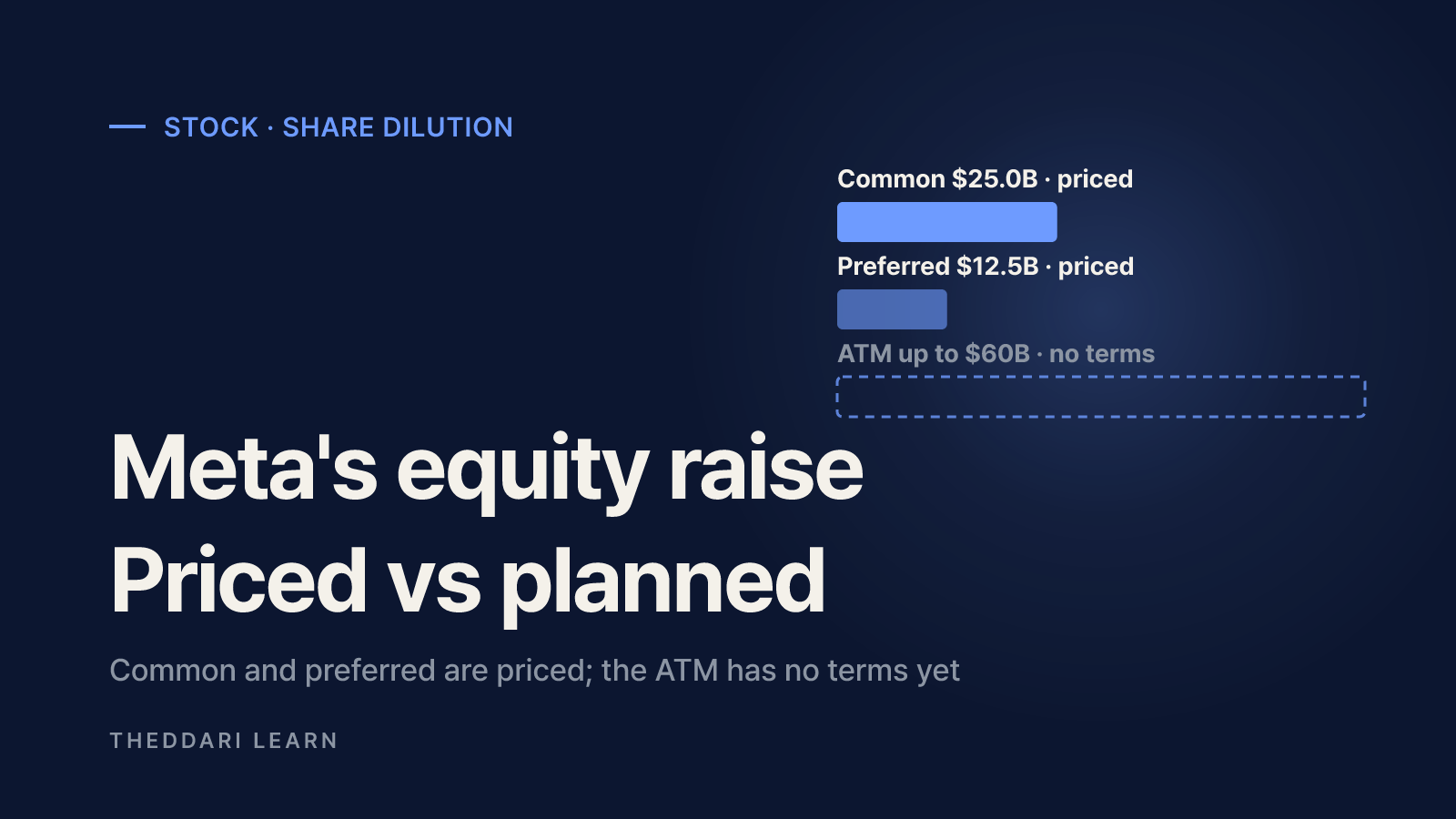
- Three parts: $25.0 billion of Class A common via forward sale, $12.5 billion of mandatory convertible preferred, and a planned ATM program of up to $60 billion.
- The 40 million common shares mean about 1.5% dilution versus 2,552 million Q3 2026 basic weighted-average shares; adding the preferred at maximum conversion makes it about 2.3%.
- The ATM has no signed agreement, timing or pricing yet, so its dilution is unknown. A lower share price means more shares for the same dollar amount.
- Meta says proceeds are for general corporate purposes, set against 2026 capex guidance of $135 billion to $145 billion and negative Q3 free cash flow.
- For long-term holders, the key question is whether the new capital earns enough to grow earnings per share faster than the share count grows.
The Meta stock offering is real, and it is bigger than the first headlines suggested. On October 26, 2026, Meta Platforms launched underwritten offerings of common stock and mandatory convertible preferred stock and said it plans a separate at-the-market program of up to $60 billion, according to its launch press release. Initial coverage cited about $95 billion. The next day's pricing release upsized the common stock piece from $22.5 billion to $25.0 billion, taking the full plan to roughly $97.5 billion.
For existing shareholders, the short answer is this: the deals already priced dilute ownership by roughly 1.5% to 2.3%, and the unpriced ATM program will decide the rest. This guide uses Meta's own disclosures as of October 29, 2026, and applies to anyone holding Nasdaq-listed META shares, whether directly or through a brokerage app.
What the Meta stock offering actually includes
The plan is three different instruments with different timing. Treat them separately, because the shares show up at different points and only two of the three are priced.
Class A common (forward sale)
- Size
- $25.0B, 40 million shares
- Terms
- $625.00 offering price; forward price about $622.92
- When new shares appear
- At settlement, on or before Nov 19, 2027
Mandatory convertible preferred
- Size
- $12.5B, 250 million depositary shares
- Terms
- $50 each; 6.50% annual dividend
- When new shares appear
- Automatic conversion around Aug 15, 2029
ATM program (planned)
- Size
- Up to $60B
- Terms
- No agreement; timing and terms undecided
- When new shares appear
- After Class C shares start trading, expected Q1 2027
How the forward sale works
In a forward sale, the banks (here, affiliates of Morgan Stanley and Goldman Sachs) borrow 40 million existing shares and sell them to investors now. Meta later issues new shares to the banks and gets paid at that point. Meta said it does not initially receive any proceeds, and expects about $24.9 billion before expenses when it settles, or about $28.7 billion if the underwriters exercise their full option, which would raise the share count to 46 million. This lets Meta lock in a price today while choosing when to take the cash.
How the convertible preferred works
Each of the 250 million depositary shares automatically converts around August 15, 2029, into between 0.0681 and 0.0800 Class A shares, depending on the average share price at that time. A lower stock price pushes conversion toward the maximum. Dividends can be paid in cash or, within limits, in stock, which is another possible source of new shares. Separately, Nvidia, AMD and Broadcom indicated interest in buying up to $5.0 billion of the common stock, but Meta stressed those indications are not binding.
Stock dilution explained with Meta's numbers
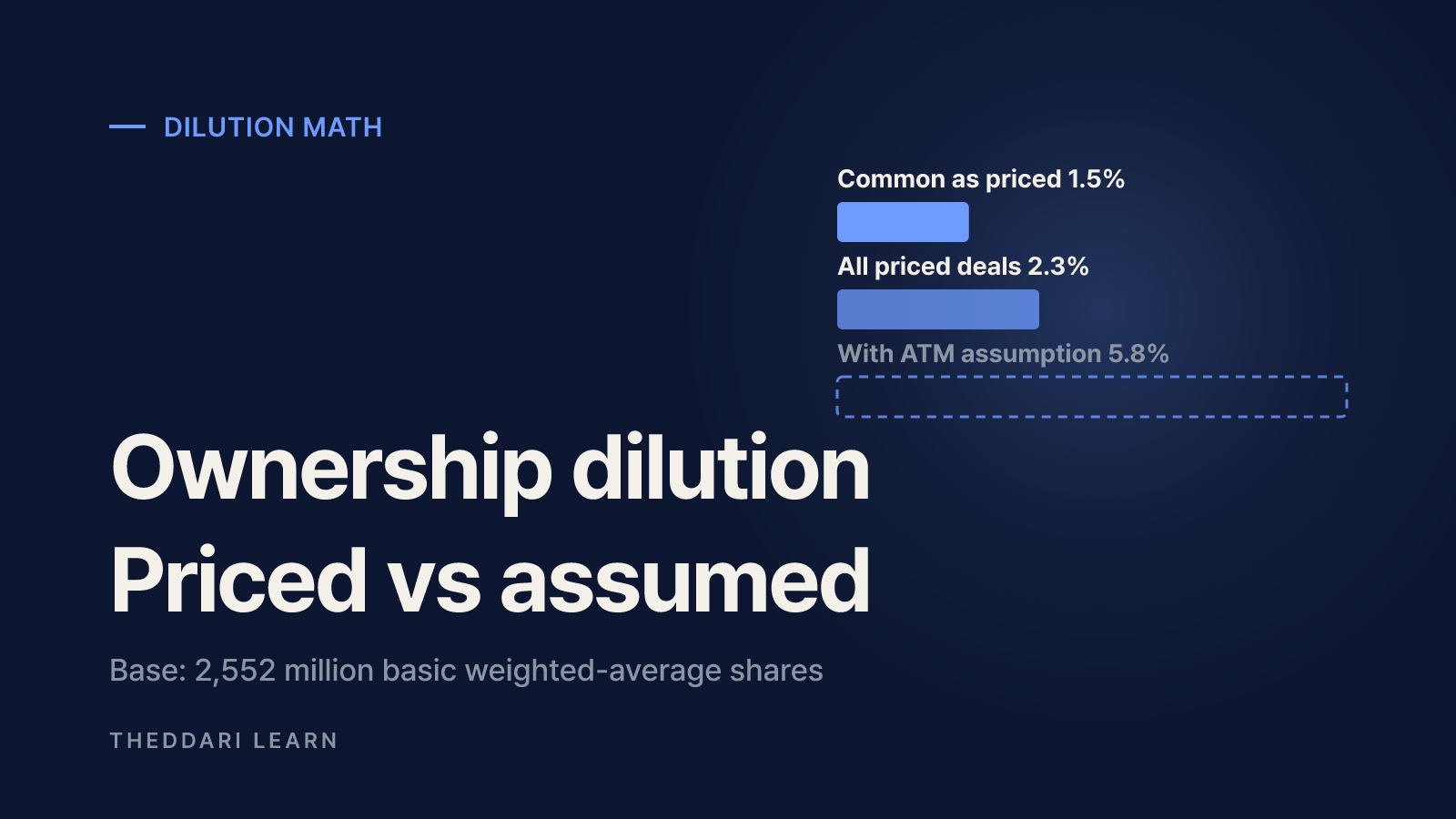
Ownership dilution is simple to compute: new shares divided by (existing shares plus new shares). For the existing count, use the cover page of the latest 10-Q or the weighted-average share count in the earnings release. Here we use 2,552 million basic weighted-average shares from Meta's Q3 2026 results.
Common stock as priced
- New shares
- 40 million
- Ownership dilution (approx.)
- 1.5%
Common stock with full option
- New shares
- 46 million
- Ownership dilution (approx.)
- 1.8%
Preferred at minimum conversion (0.0681 x 250M)
- New shares
- about 17 million
- Ownership dilution (approx.)
- 0.7%
Preferred at maximum conversion (0.0800 x 250M)
- New shares
- 20 million
- Ownership dilution (approx.)
- 0.8%
Priced deals combined (common + preferred max)
- New shares
- 60 million
- Ownership dilution (approx.)
- 2.3%
ATM: $60B sold at an assumed $625 per share
- New shares
- 96 million
- Ownership dilution (approx.)
- 3.6%
Priced deals plus ATM assumption
- New shares
- 156 million
- Ownership dilution (approx.)
- 5.8%
The ATM rows are an illustration, not guidance. Real ATM sales happen at market prices over time. After the Class C stock dividend, share counts double and per-share prices roughly halve, so the percentages stay the same whether you calculate on a pre-split or post-split basis, as long as you are consistent.
To translate this into earnings per share: if net income stayed flat, spreading it over 2,612 million shares instead of 2,552 million would cut EPS by about 2.3%. That is the hurdle. If the data centers and AI products funded by the raise add more profit than that, EPS can still grow. The preferred also carries a cost: 6.50% on $12.5 billion is about $812.5 million a year in dividends that rank ahead of common holders until conversion.
Where the money goes: Meta AI capex funding
The filings say proceeds are for general corporate purposes, which means the cash is not tied to a specific project. The context Meta gave alongside the offering explains why it wants more capital:
- Capex: Meta expects 2026 capital expenditures, including finance lease principal payments, of $135 billion to $145 billion. Q3 alone was $34.91 billion.
- Cash flow: operating cash flow was about $97 billion in the first three quarters, but Q3 free cash flow was negative $2.12 billion.
- Balance sheet: cash, cash equivalents and marketable securities were about $82.45 billion at the end of Q3, while long-term debt rose to about $80.9 billion from about $58.7 billion at the end of 2025.
- Funding mix: Meta says it will combine operating cash flow, investment-grade debt, strategic partnerships and equity, and describes the stock sales as a complementary source of capital.
Put simply, AI infrastructure spending has started to outrun operating cash flow, debt has already risen, and equity is the third lever. CNBC noted that after Q3 results, investors focused on negative free cash flow and the higher capex range rather than the revenue beat. Meta itself says its newer AI investments will take longer to generate returns than its core ad business. Track capex guidance and any AI revenue disclosures on each earnings call to judge whether the capital is paying off.

Buybacks, Class C and other share count changes
New share issuance
- Share count
- Up
- Your ownership %
- Down
- Meta in 2026
- Common and preferred offerings; ATM planned
Share buybacks
- Share count
- Down
- Your ownership %
- Up
- Meta in 2026
- $0 in the first nine months (about $26.2B in the same 2025 period)
Class C stock dividend
- Share count
- One new share per share, for everyone
- Your ownership %
- Unchanged
- Meta in 2026
- Effective date planned for Jan 19, 2027
Stock-based compensation
- Share count
- Up
- Your ownership %
- Slightly down
- Meta in 2026
- About $21.1B expense in the first nine months
Meta shrank its share count with buybacks in 2025, but its Q3 cash flow statement shows no repurchases so far in 2026. With buybacks paused, employee equity awards plus this raise push the share count up. The Class C shares carry no votes. Because the ATM is planned in Class C stock, it would dilute economic ownership while leaving the voting structure, and Mark Zuckerberg's control, largely unchanged.
How to check the META SEC filing yourself
- 1
Read the press releases
On investor.atmeta.com, confirm the instrument, size, price and expected closing date. Meta said both offerings were expected to close on October 29, 2026, subject to closing conditions.
- 2
Open the prospectus supplements on EDGAR
Search Meta Platforms on SEC EDGAR for 424B prospectus supplements and 8-K filings. Conversion rate adjustments, stock-paid dividends and forward price adjustments are detailed there.
- 3
Check shares outstanding on the 10-Q cover
The first page of each quarterly report lists shares outstanding by class with a date. Keep the pre-split or post-split basis consistent with the new share figures.
- 4
Watch for the ATM agreement
An equity distribution agreement should be disclosed if the ATM launches. Actual sales show up as share count changes in later quarterly filings.
- 5
Compare dilution with returns
Each quarter, line up the share count change, capex, free cash flow and any AI revenue commentary in one table.
Offerings often land during busy macro weeks; this one came alongside a Fed rate decision and big tech earnings. Our economic calendar lists upcoming rate decisions and data releases, and the stock trend feed collects how market Telegram channels are reacting. These tools organize schedules and chatter; they do not predict prices.
Risks and limits of the dilution math
- The headline number is not all committed: $60 billion of the roughly $97.5 billion is an ATM plan with no agreement and may change or never happen.
- Price drives share count: ATM sales and preferred conversion both produce more shares when the stock is lower.
- Overhang: forward settlement, ATM sales and preferred conversion are spread across 2027 to 2029, and some investors see that supply as a cap on the stock.
- Return uncertainty: if new AI spending does not earn enough, holders are left with dilution without matching profit growth.
- One day is not a verdict: the 1.6% morning drop on announcement day was a first reaction mixed with Fed and earnings news that week.
Bottom line: the priced portion of the Meta stock offering dilutes ownership by a little over 2%, and the ATM's actual size and price will decide how much more. A practical way to follow it is to track three things each quarter: how much the share count grew, how capex and free cash flow moved, and whether Meta shows evidence that AI spending is turning into revenue.
Frequently asked questions
How much will Meta's stock offering dilute existing shareholders?
Does a secondary stock offering always push the share price down?
Is Meta's Class C stock dividend dilutive?
Where can I read the actual Meta SEC filing for the offering?
Sources and references
- 1Meta press release: launch of preferred and common stock offerings and financing plan (Oct 26, 2026)(opens in a new tab)investor.atmeta.com
- 2Meta press release: pricing of the offerings (Oct 27, 2026)(opens in a new tab)investor.atmeta.com
- 3Meta Reports Third Quarter 2026 Results and new Class C common stock(opens in a new tab)investor.atmeta.com
- 4CNBC: Meta announces $95 billion stock offering to fund AI expansion(opens in a new tab)www.cnbc.com
Related articles
 Stocks
Samsung Special Dividend: Record Date, Ex-Date and Tax
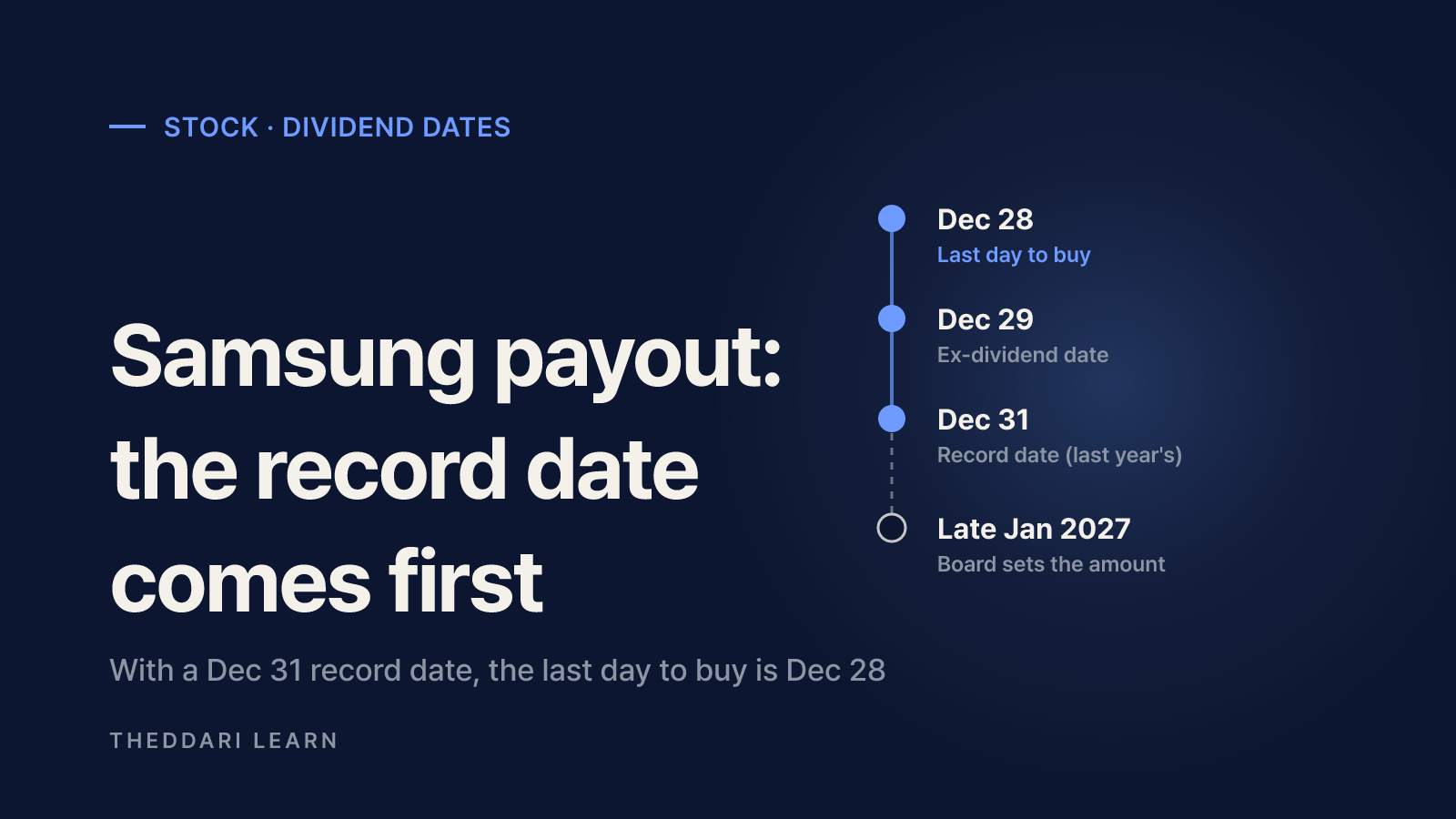
Samsung confirmed a KRW 4,601 per-share Q3 2026 dividend, but the next payout will only be set by its board in late January 2027. Here is how record dates, ex-dates and Korean withholding tax work.
 Stocks
Baidu AI Hype Warning: Metrics for China AI Stock Investors
At the APEC CEO Summit in Shenzhen on Nov. 17, 2026, Baidu's Robin Li and Xiaomi's Lei Jun said few companies are making money from AI yet. Here is how to test that claim against Baidu's own Q3 numbers.
 Stocks
Pre-Market Trading and After-Hours Moves, Explained
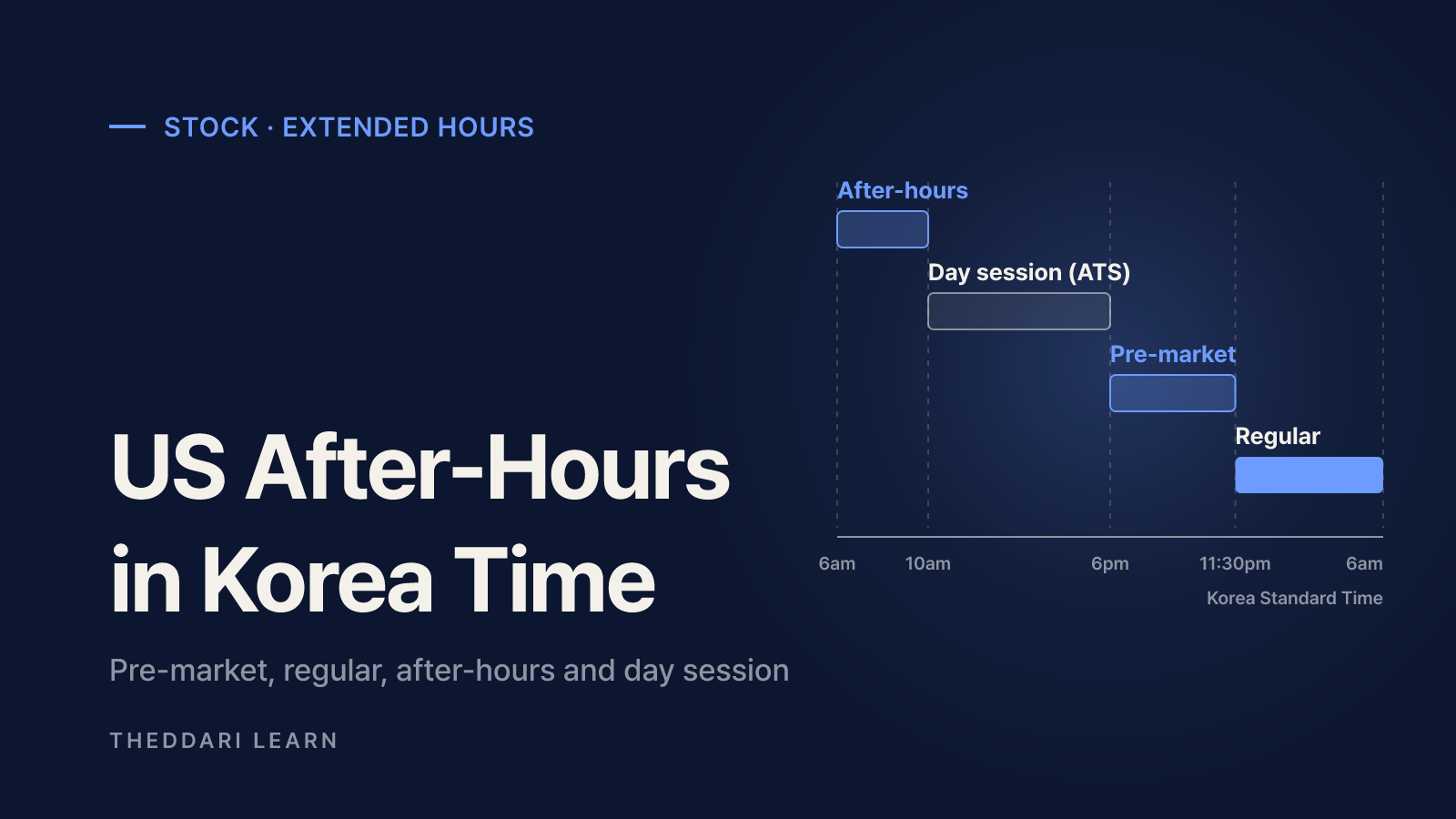
An after-hours drop is usually measured against the last official close, set by a small number of trades. Learn the session times, how to read the move, and what changes for investors trading US stocks from Korea.