Contents9 sections
- What is LFM3? Liquid AI's small model family in brief
- LFM3-1.7B vs LFM3-VL-2B vs LFM3-Omni-2B
- What you can actually do with LFM3 on a phone or laptop
- Memory and hardware: what 'about 1 GB' really means
- The LFM Open License: the $10 million revenue line
- How to evaluate LFM3 before you commit
- Limits and risks to keep in mind
- Frequently asked questions
- Sources and references
LFM3 is Liquid AI's new family of small, open-weight models, announced on October 27, 2026. The pitch is simple: models around 2 billion parameters that run on the phone or laptop where your data already lives, and that are cheap to fine-tune for one specific job. The text model, LFM3-1.7B, fits in about 1 GB of memory at 4-bit precision; LFM3-VL-2B adds image and video understanding; LFM3-Omni-2B can see, listen and talk back. This guide reflects the official Liquid AI announcement and the Hugging Face model cards as checked on November 3, 2026.
All three models hit the Hugging Face trending list in the same week, but they solve different problems. Below we cover how they differ, what on-device use actually looks like, what the memory numbers really mean, and the license and quality caveats worth knowing before you build on them.
What is LFM3? Liquid AI's small model family in brief
LFM stands for Liquid Foundation Model, and LFM3 is the third generation. Instead of one large general-purpose model, Liquid AI released six 2B-class models branched from a single LFM3-1.7B-Base backbone. Four target input types (text, vision, audio and omni). The other two, d1-2B and d1-Omni-2B, are decision models that read a document, screen or voice note and answer a fixed list of questions with calibrated probabilities instead of writing free text.
The architecture is not a plain transformer. According to the LFM3-1.7B model card, its 24 layers mix 13 gated short convolutions, 5 sliding-window attention layers and only 6 global attention layers. That mix keeps memory and compute low over long contexts. The base model was pre-trained on 22 trillion tokens, and Liquid AI says LFM3-1.7B beats its previous LFM2.5-2.6B with 35% fewer parameters.
- Availability: base and post-trained weights are on Hugging Face, plus Liquid AI's API and Playground.
- Text languages: 16, including English, Spanish, French, German, Japanese, Korean and Chinese.
- Formats: GGUF for llama.cpp, Ollama and LM Studio; 4-bit MLX for Apple Silicon; ONNX; and BF16 or FP8 for GPU serving.
- Customization: Liquid AI says every model can be fine-tuned on a single GPU, and publishes Colab notebooks for SFT, DPO and GRPO.
LFM3-1.7B vs LFM3-VL-2B vs LFM3-Omni-2B
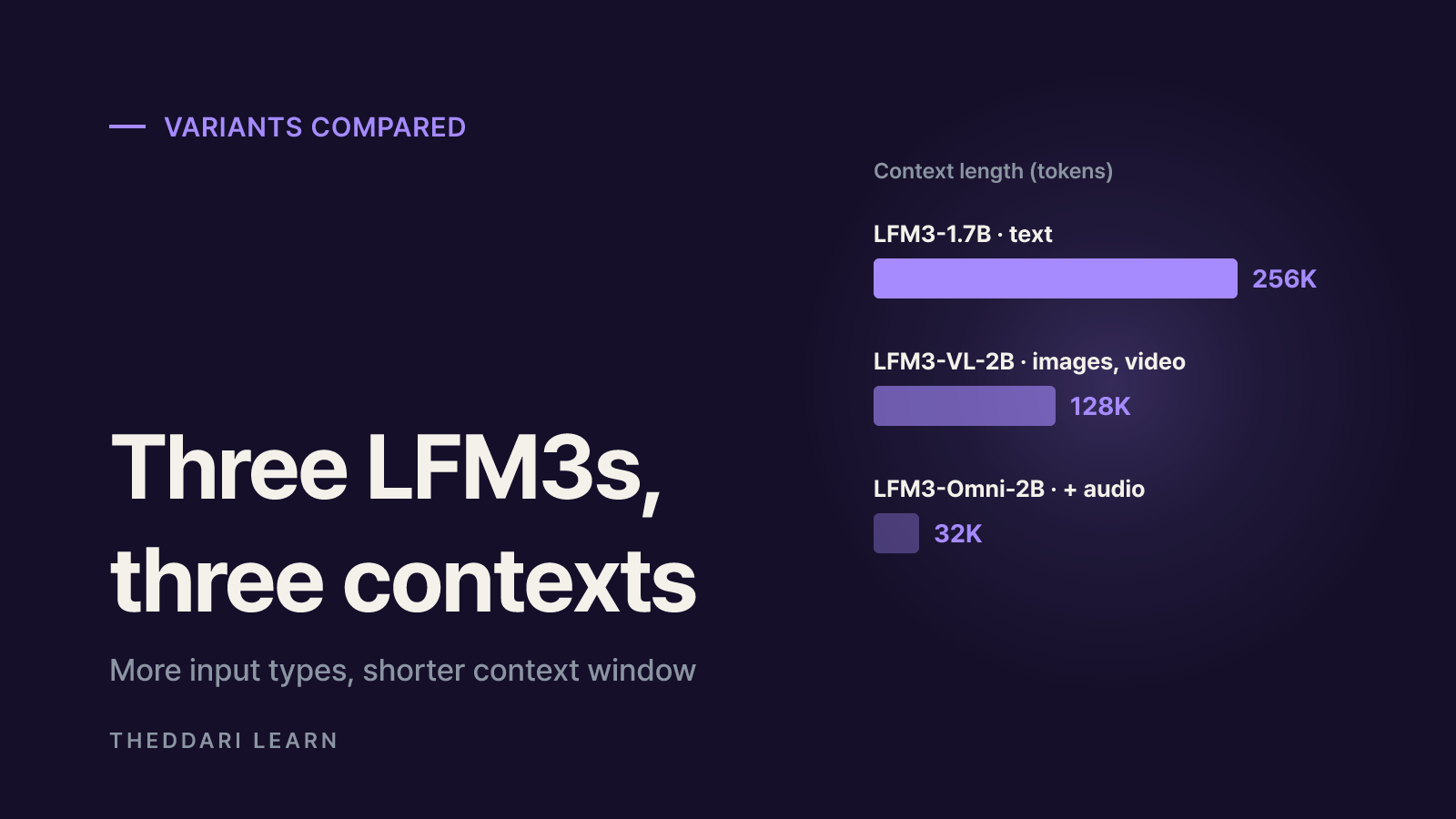
Parameter counts are close, but inputs, outputs, context length and reasoning behavior differ. Figures below come straight from each model card.
Parameters
- LFM3-1.7B
- 1.73B
- LFM3-VL-2B
- 1.92B (1.73B LM + 164M vision encoder + 25M projector)
- LFM3-Omni-2B
- 2.17B
Input
- LFM3-1.7B
- Text
- LFM3-VL-2B
- Text, images, video
- LFM3-Omni-2B
- Text, images, video with sound, 16 kHz audio
Output
- LFM3-1.7B
- Text
- LFM3-VL-2B
- Text
- LFM3-Omni-2B
- Text, 24 kHz speech, or both interleaved
Context
- LFM3-1.7B
- 256K tokens
- LFM3-VL-2B
- 128K tokens
- LFM3-Omni-2B
- 32K tokens
Reasoning
- LFM3-1.7B
- On by default
- LFM3-VL-2B
- Thinks before answering
- LFM3-Omni-2B
- Non-reasoning
Built for
- LFM3-1.7B
- Local agents, tool calling, structured output
- LFM3-VL-2B
- Video Q&A, documents, charts, app screens, grounding
- LFM3-Omni-2B
- Voice chat, transcription, translation, spoken visual Q&A
Not recommended for
- LFM3-1.7B
- Agentic coding, complex multi-step reasoning
- LFM3-VL-2B
- Coding, long multi-turn chat, complex reasoning
- LFM3-Omni-2B
- Tasks needing heavy reasoning
LFM3-1.7B: the text agent
This model is post-trained for agent harnesses such as Hermes Agent, Pi and OpenClaw. It emits XML tool calls and supports deferred tool loading, so a harness can keep hundreds of tool definitions out of the prompt until a search step needs them. In Liquid AI's own tests it scores 38.42 on WebArena-Verified against 28.94 for Qwen3.5-9B, yet trails that model badly on the GPQA Diamond knowledge test (63.37 vs 80.40). Small models can be good at format and tools while still knowing far less.
LFM3-VL-2B: images and video
This is the first LFM vision model to accept video, sampled at 2 frames per second with 4 to 768 frames by default. The VL-2B model card reports a 71.4 average across 62 vision benchmarks, close to Gemma 4 12B at 71.7. Note the serving caveat: vLLM support was still in progress and SGLang support under review when the card was written, so check versions before planning a GPU deployment.
LFM3-Omni-2B: see, hear and speak
Omni aims to replace a stack of separate speech recognition, vision-language, language and text-to-speech models with one network. You can ask about a photo by voice, transcribe or translate speech, or ask about a video and its soundtrack together. The trade-off is a short 32K context and no reasoning mode, so long videos need fewer frames.
What you can actually do with LFM3 on a phone or laptop
The main reasons to run a small model on-device are privacy, offline operation and zero per-request API cost. Examples drawn from the model cards and the announcement include:
- Structured extraction: turn messy documents or receipt photos into JSON fields.
- Device control: convert a spoken or typed request into a tool call, such as setting the speaker volume; Liquid AI shows a 108-tool phone app example.
- Inbox and calendar triage: background agents that sort email, manage meetings or send a morning briefing.
- Screen and document reading: answer questions about screenshots, charts or app interfaces (VL and Omni).
- Speech tasks: transcription and speech translation, with translation to or from English working best (Omni).
- Retrieval-backed answers: pair the model with search or RAG for anything knowledge-heavy.
For speed, Liquid AI tested an AMD Ryzen AI Max+ 395 laptop, an Apple M5 Max and an iPhone 17 Pro using llama.cpp, Q4_0 files and a 32K context. It reports LFM3-1.7B decoding 1.8 to 2.8 times faster than the next-fastest comparison model, but with one request at a time, so real app performance will vary. There is also a WebGPU demo on Hugging Face that runs Omni-2B inside a browser.
Open models move fast after launch. To see which ones developers are actually discussing, check the AI Telegram trends page alongside the model cards.

Memory and hardware: what 'about 1 GB' really means
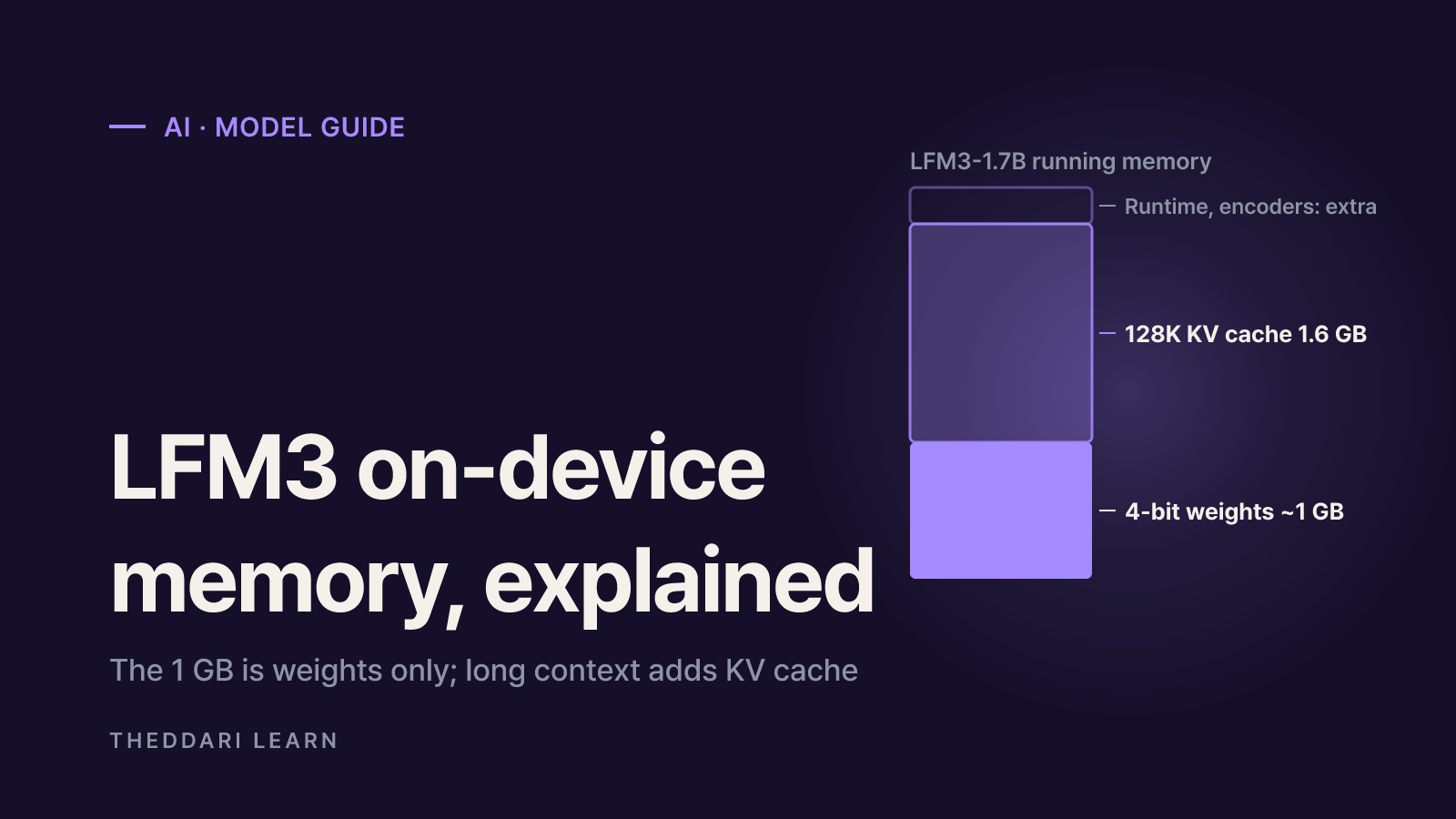
The headline 1 GB figure is the size of LFM3-1.7B's weights at 4-bit quantization, not the footprint of a running app. Budget for these on top:
- KV cache: working memory that grows with context. Liquid AI says a full 128K-token context needs 1.6 GB of KV cache, versus 4.3 GB for Qwen3.5-4B and 5.6 GB for MiniCPM5-2B.
- Runtime and app: llama.cpp, MLX or ONNX Runtime plus your own code.
- Encoders and media tokens: VL and Omni load vision or audio encoders, and every video frame adds tokens.
- OS headroom: phones share memory with other apps and will kill a background process that grows too large.
Start with a 4-bit GGUF and a modest context such as 8K to 32K tokens, measure peak memory, and only then raise the context. For video, lower the frame rate or frame cap where your runtime allows it; the model cards note that llama.cpp uses fixed frame settings for these models.
Runtime versions matter too. The 1.7B card asks for a llama.cpp build with LFM3 support, and the VL card recommends llama.cpp b11960 or newer. Loading with Transformers requires trust_remote_code=True, which executes code from the repository, so pull from the official LiquidAI organization. There are more than 90 community quantizations of the 1.7B model, and their quality and provenance vary.
The LFM Open License: the $10 million revenue line
Open weights do not mean a permissive license. The LFM Open License v1.0 is modeled on Apache-style terms but adds a commercial use limitation in Section 5.
Individuals, research, non-commercial
- Commercial use
- Allowed
- Notes
- Include the license and mark modified files when redistributing
Companies under $10M annual revenue
- Commercial use
- Allowed
- Notes
- Terms change once revenue crosses the threshold
Companies at $10M or more
- Commercial use
- Not licensed
- Notes
- Requires a separate agreement with Liquid AI
Qualified non-profits
- Commercial use
- Threshold waived for non-commercial or research use
- Notes
- US 501(c)(3) or a foreign equivalent
The license also terminates automatically on non-compliance, and you must then delete your copies. If LFM3 will ship inside a product, have counsel review it and plan for what happens when your company grows past the line.
How to evaluate LFM3 before you commit
- 1
Pick the variant
Text only: LFM3-1.7B. Images, documents or silent video: VL-2B. Voice in or out: Omni-2B. Pure classification or routing: consider the d1 decision models.
- 2
Pick the runtime
MLX on a Mac, GGUF with llama.cpp or LM Studio on Windows and Linux, ONNX for embedding inside an app. Confirm the version supports LFM3.
- 3
Build a small test set
Use 20 to 50 real inputs from your own workflow with known correct answers. That result, not the launch chart, should decide.
- 4
Measure memory and latency
Record peak memory and time to first token at the context length you plan to use. On phones, watch heat and battery drain.
- 5
Clear license and security
Check the revenue threshold, redistribution notices, remote-code loading and the source of any quantized file.
Limits and risks to keep in mind
- Vendor benchmarks: nearly every comparison was run by Liquid AI. Independent results are still thin.
- Knowledge and coding gaps: larger models still win on knowledge tests and agentic coding.
- Uneven languages: multilingual scores are averages, so verify quality in the exact languages you need.
- Early tooling: runtime and app support differs by version in launch weeks.
- Reasoning toggle: on LFM3-1.7B, disabling thinking can behave inconsistently, per the model card.
For a wider view of how the launch is being covered and debated, the blog trends dashboard tracks related keywords across blogs.
Bottom line: LFM3 is not a pocket replacement for frontier chatbots. It is a strong starting point for developers who want narrow, private, low-latency tasks to run on the device itself. Choose the variant by input type, measure real memory on your target hardware, and confirm the license threshold, and most early surprises go away.