Contents8 sections
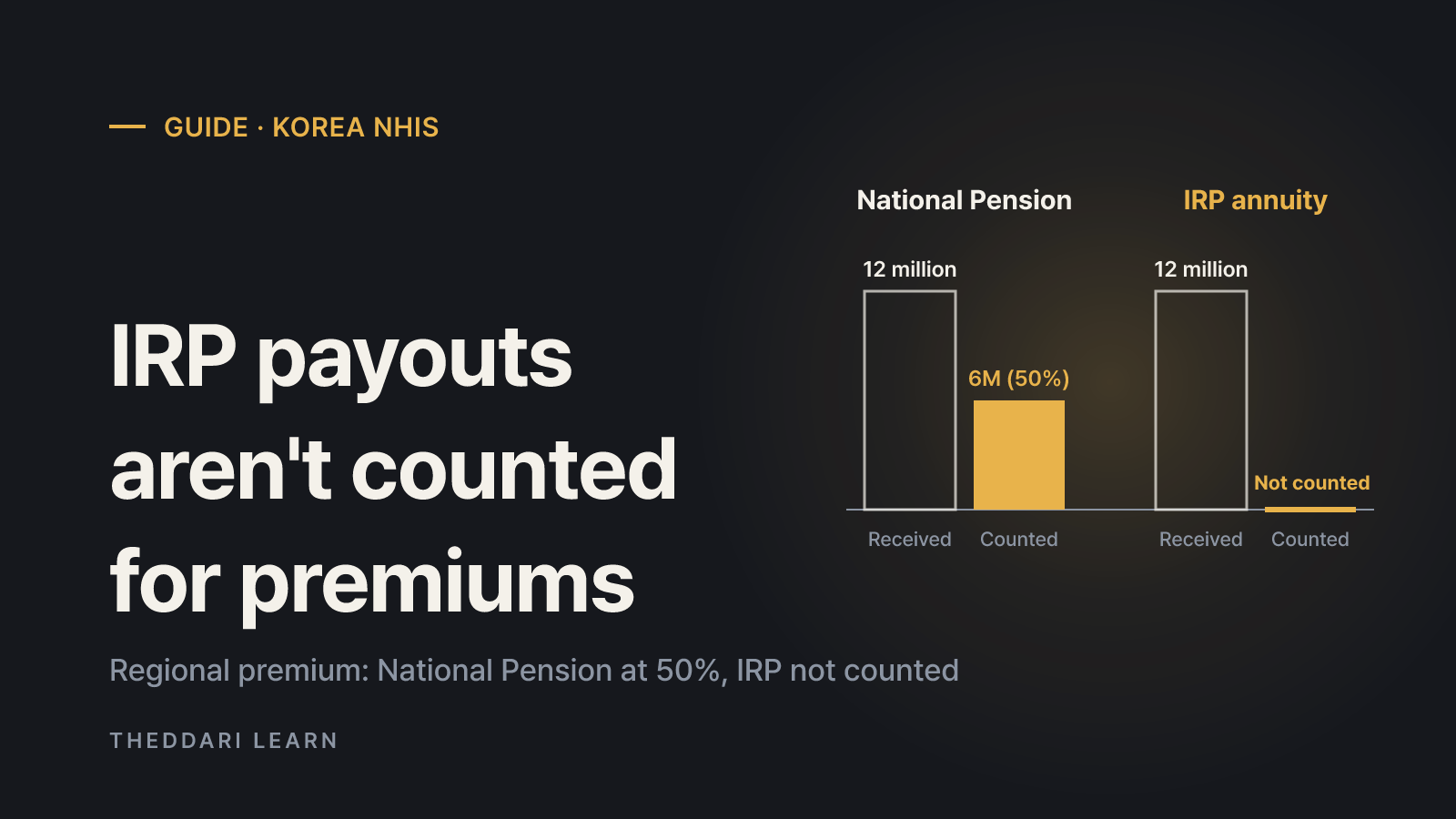
Short answer on Korea pension savings health insurance: as of November 5, 2026, annuity payouts from a Korean pension savings account (yeongeum jeochuk) or an Individual Retirement Pension (IRP) are not counted by the National Health Insurance Service (NHIS). They do not raise regional-subscriber premiums, do not trigger the extra-income premium for employees, and do not count toward the income test for dependents. Public pensions, such as the National Pension and civil service pensions, are counted. This guide applies to people covered by Korea's National Health Insurance, including foreign residents enrolled in it, and explains why the rule exists and how to follow the current reform debate.
A quick vocabulary note. A regional subscriber pays premiums based on their own income and property, typically retirees and the self-employed. An employee subscriber pays through payroll, plus an extra premium if non-salary income passes a threshold. A dependent is covered under a working family member without paying a separate premium, as long as income and property tests are met.
Korea pension savings health insurance rules at a glance
Regional subscriber income premium
- Public pensions (National Pension etc.)
- 50% of pension income is counted
- Pension savings and IRP annuities
- Not counted
Employee extra-income premium
- Public pensions (National Pension etc.)
- Counted at 50% within non-salary income; premium applies to the part above KRW 20 million a year
- Pension savings and IRP annuities
- Not counted
Dependent income test (KRW 20 million a year)
- Public pensions (National Pension etc.)
- Pension received counts toward the limit
- Pension savings and IRP annuities
- Not counted
What the law says
- Public pensions (National Pension etc.)
- Chargeable
- Pension savings and IRP annuities
- Wording covers it; excluded in practice
The 50% figure comes from Article 44 of the Enforcement Rule of the National Health Insurance Act, in the version in force from September 28, 2026: earned and pension income are counted at 50%, while interest, dividends, business and other income count in full. The rate rose from 30% to 50% in the September 2022 reform, which also cut the dependent income limit and the employee non-salary threshold to KRW 20 million a year.
Why private pensions are left out
Article 44 defines pension income as the total of every item in Article 20-3(1) of the Income Tax Act. That article covers public pensions and annuities drawn from pension accounts. So on paper, private pension income is chargeable. In practice the government has chosen not to charge it.
- In August 2022 the Ministry of Health and Welfare said the second-stage reform did not include premiums on private pensions and that the issue would be reviewed carefully over the medium to long term.
- In December 2022 it stated it was not reviewing premiums on private pension income.
- In August 2025 the NHIS described the exclusion as a policy exception given Korea's elderly poverty rate, the highest in the OECD, while a bill was filed to write an exemption into law for retirees with no other income below a set amount (Herald Business).
The Board of Audit and Inspection flagged the gap between the law and practice in 2022, arguing it hurts fairness between subscribers and NHIS finances. Critics of charging, in turn, point to possible double charging, because contributions were often made from income that already bore premiums, and to the risk that retirees would take lump sums instead of annuities.
Worked examples with simple numbers
These are hypothetical cases with no property, car or other income, and no reductions. Amounts are in Korean won.
Regional subscriber
Retiree A receives KRW 12 million a year from the National Pension and KRW 12 million a year from an IRP annuity. Only the public pension enters the income premium: 12 million x 50% = KRW 6 million, or KRW 500,000 a month, which is then multiplied by that year's premium rate. The IRP payouts add nothing.
Dependent
Retiree B receives KRW 18 million a year from the National Pension and KRW 15 million from a pension savings annuity, and is listed as a dependent of an employed child. For the income test, only the 18 million counts, which is under the KRW 20 million cap. B could still lose dependent status if other income adds more than KRW 2 million or if property exceeds the separate property test. Note that the dependent test does not apply the 50% discount; the ministry's 2022 explanation counted National Pension recipients whose payments alone exceeded KRW 20 million.
What changed in November 2026, and what did not
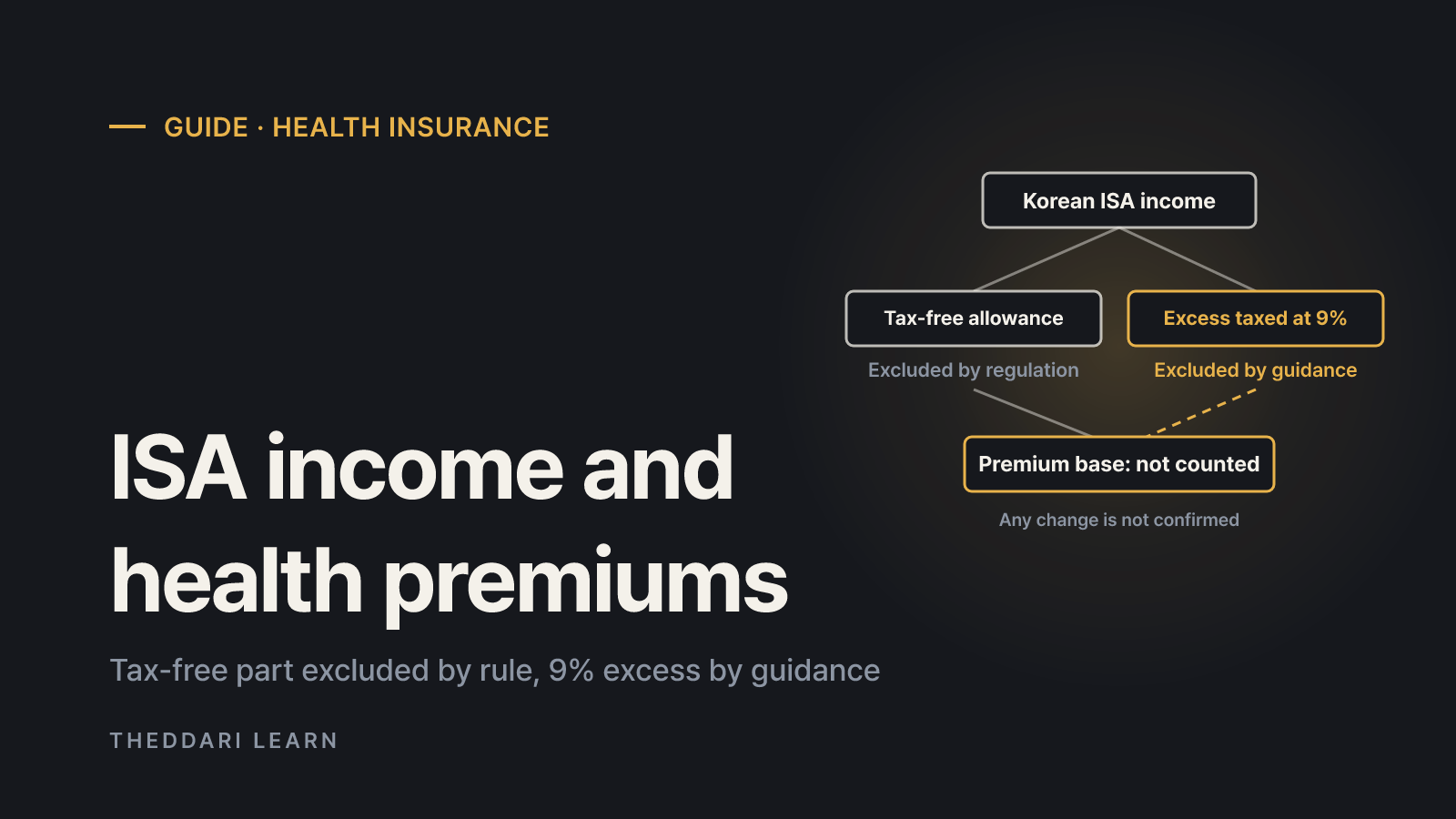
On November 4, 2026, the NHIS reported to the National Assembly's health committee that it would pursue premiums on separately taxed income that is currently exempt. That group includes private pensions of KRW 15 million or less a year, daily-wage income, and ISA returns above the tax-free limit (Etoday). The report gave no targets, thresholds or start date. The same day, the Ministry of Health and Welfare said the matter has not been specifically reviewed or decided.
Treat claims that a levy on pension accounts starts next year as unconfirmed. Treat claims that it can never happen as wrong too: the legal basis already exists, and the NHIS has put the issue on its agenda. Watch for draft amendments posted for public comment by the Ministry of Health and Welfare.
Checklist before you start drawing a pension
- Confirm whether you are an employee subscriber, a regional subscriber or a dependent.
- Add up your public pension income for the year. If you are a dependent, compare it plus other income with the KRW 20 million limit.
- Check other income: interest and dividends above KRW 10 million a year are counted in full, plus business, rental, earned and other income.
- Plan private pension withdrawals mainly around tax rules, such as the KRW 15 million threshold and the annual withdrawal limit for pension treatment.
- If you plan to elect comprehensive taxation above KRW 15 million, ask the NHIS (call center 1577-1000) how that income would be treated.
- Recheck official notices before your first payout and each November, when NHIS premiums are recalculated using the prior year's income data.
To see how often pension and premium rumors are spreading, you can follow stock-related Telegram channel trends and the blog trend dashboard on theddari. Volume of mentions is not evidence; verify any viral claim against the official sources listed below.

Common mix-ups to avoid
- The KRW 15 million figure is a tax rule for private pensions, not an NHIS rule.
- The 50% weighting is for premium calculation only; the dependent income test looks at the pension amount itself.
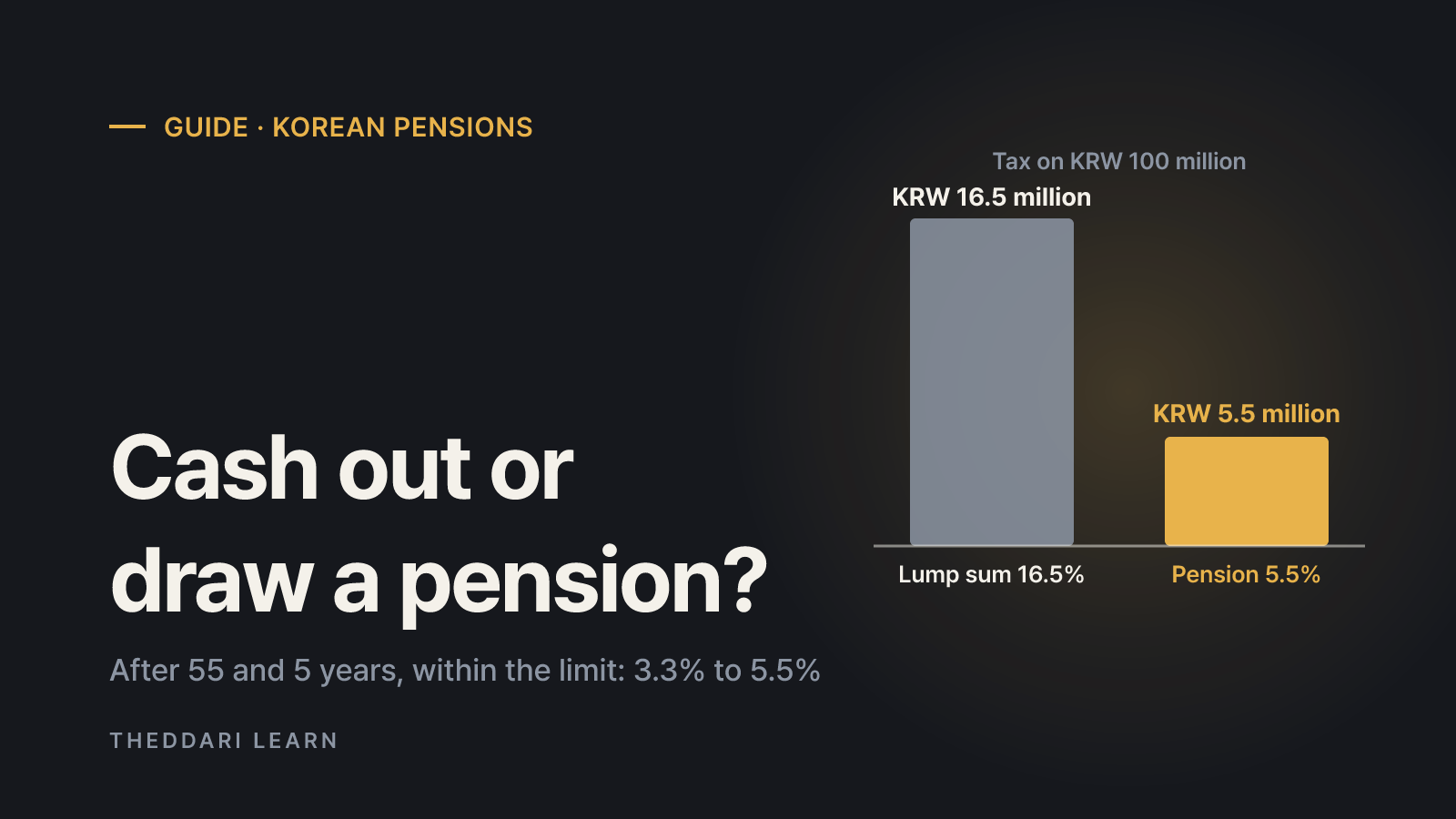
- A lump-sum retirement allowance is taxed as retirement income, which is not one of the six income types the NHIS charges. Early or non-qualifying withdrawals from pension accounts are taxed differently, so confirm their treatment with your provider and the NHIS.
- If private pensions are ever charged, taking a lump sum could look attractive, but it can cost more in tax. Do not base today's withdrawal plan only on a rule that does not exist yet.
Bottom line: as of November 2026, Korean pension savings and IRP annuities do not affect NHIS premiums or dependent status, while public pensions, financial income, business income and property do. Because the exemption rests on policy rather than statute and is now openly under discussion, check the official notices again before your first payout and at each annual premium update.