Contents8 sections
- Korea pension savings withdrawal basics: when payouts can start
- The annual pension receipt limit formula
- Pension income tax in Korea and the KRW 15 million threshold
- Lump sum vs annuity: how the tax compares
- Checklist before you request payouts
- Exceptions and risks to watch
- Frequently asked questions
- Sources and references
Korea pension savings withdrawal rules reward patience. If you are a Korean tax resident holding a pension savings account (yeongeum jeochuk, offered as a fund, insurance or trust account), you pay low pension income tax of 3.3% to 5.5% only when three things are true: you are 55 or older, the account is at least five years old, and each year's withdrawal stays within a statutory receipt limit. Take the money out any other way and a 16.5% rate generally applies. This guide reflects the Korean rules as published by the National Tax Service and the Korea Financial Investment Association, checked as of November 2026. It covers the payout stage only; it does not explain contribution tax credits, and it is not about US IRAs or other countries' pension plans.
Korea pension savings withdrawal basics: when payouts can start
Article 14 of the standard pension savings account terms sets two conditions for starting a pension. You must apply on or after age 55, and five years must have passed since the account was opened. The five-year rule is waived when the account holds deferred retirement income, which is severance pay rolled into a pension account instead of being taken as cash. Both conditions must be met, so the later of the two dates is your first eligible date.
Nothing happens automatically on that date. You submit a pension commencement request to the bank, brokerage or insurer and specify how often you want to be paid, for example monthly, quarterly or annually. In a fund-type account you can also name which funds or ETFs should be sold to make each payment. If you do not choose, the provider sells holdings in proportion to their weights, using any cash in the account first. Tax is withheld at source before the money reaches you.
The annual pension receipt limit formula
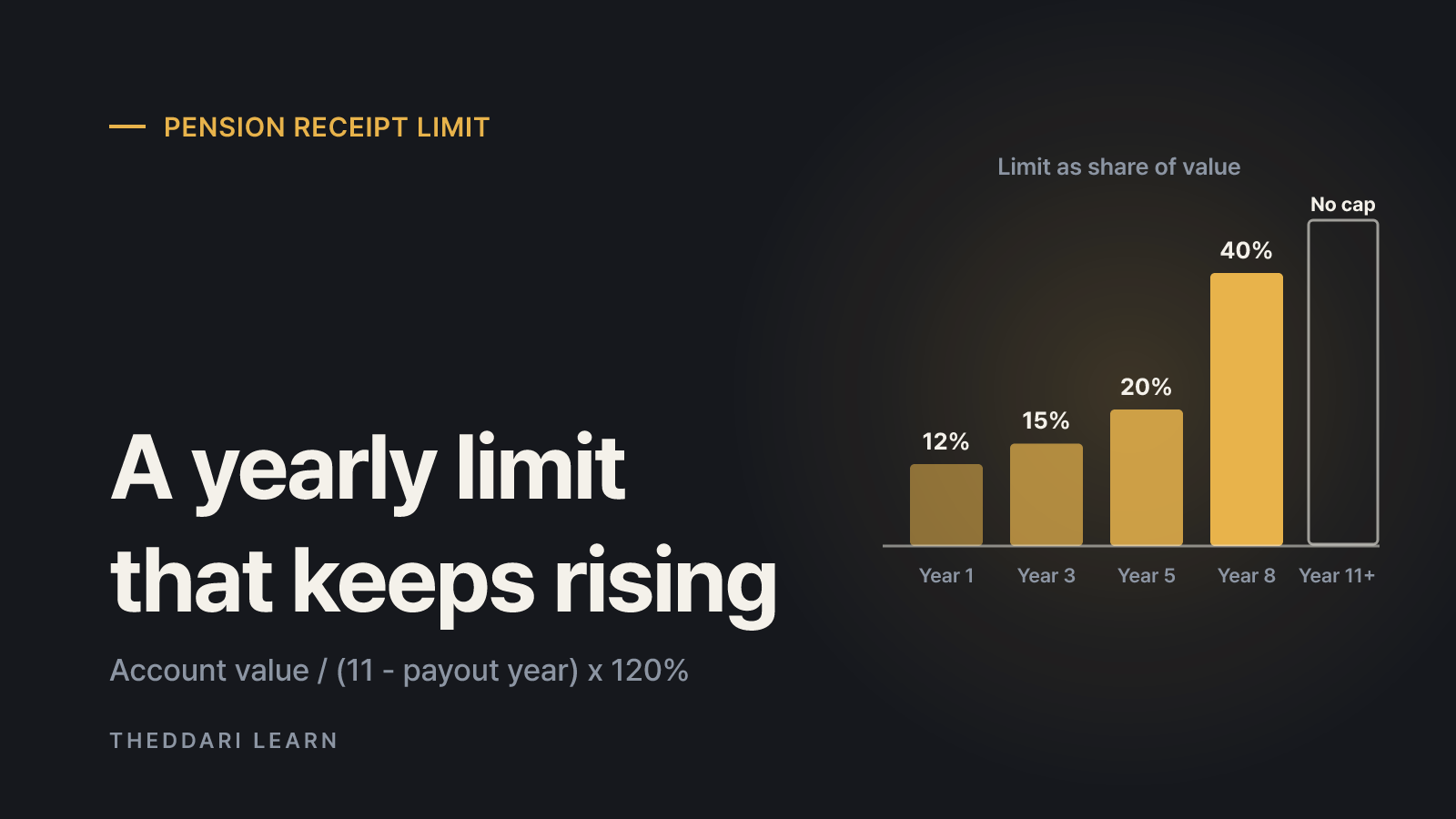
Each year the amount that counts as a pension is capped by this formula: account value / (11 - payout year) x 120%. The account value is measured on 1 January, or on the commencement date in the first year. The payout year is counted from the tax year that contains your first eligible date, which is year one, and rises by one each year. Once you reach payout year 11, the formula stops applying and there is no cap.
Year 1
- Limit as share of value
- 12%
- If the account is worth KRW 100 million
- KRW 12 million
Year 3
- Limit as share of value
- 15%
- If the account is worth KRW 100 million
- KRW 15 million
Year 5
- Limit as share of value
- 20%
- If the account is worth KRW 100 million
- KRW 20 million
Year 8
- Limit as share of value
- 40%
- If the account is worth KRW 100 million
- KRW 40 million
Year 10
- Limit as share of value
- 120% (effectively all)
- If the account is worth KRW 100 million
- Whole balance
Year 11 onward
- Limit as share of value
- No formula
- If the account is worth KRW 100 million
- No cap
The table assumes the value stays at KRW 100 million, which it will not in practice: earlier withdrawals and market movements change the balance every year. Accounts opened before 1 March 2013 start counting at year six, so their first-year limit is value / 5 x 120%, or 24%. For a newer account started at 55, the cap only disappears in year 11, which is why spreading withdrawals over roughly ten years is the usual baseline.
Pension income tax in Korea and the KRW 15 million threshold
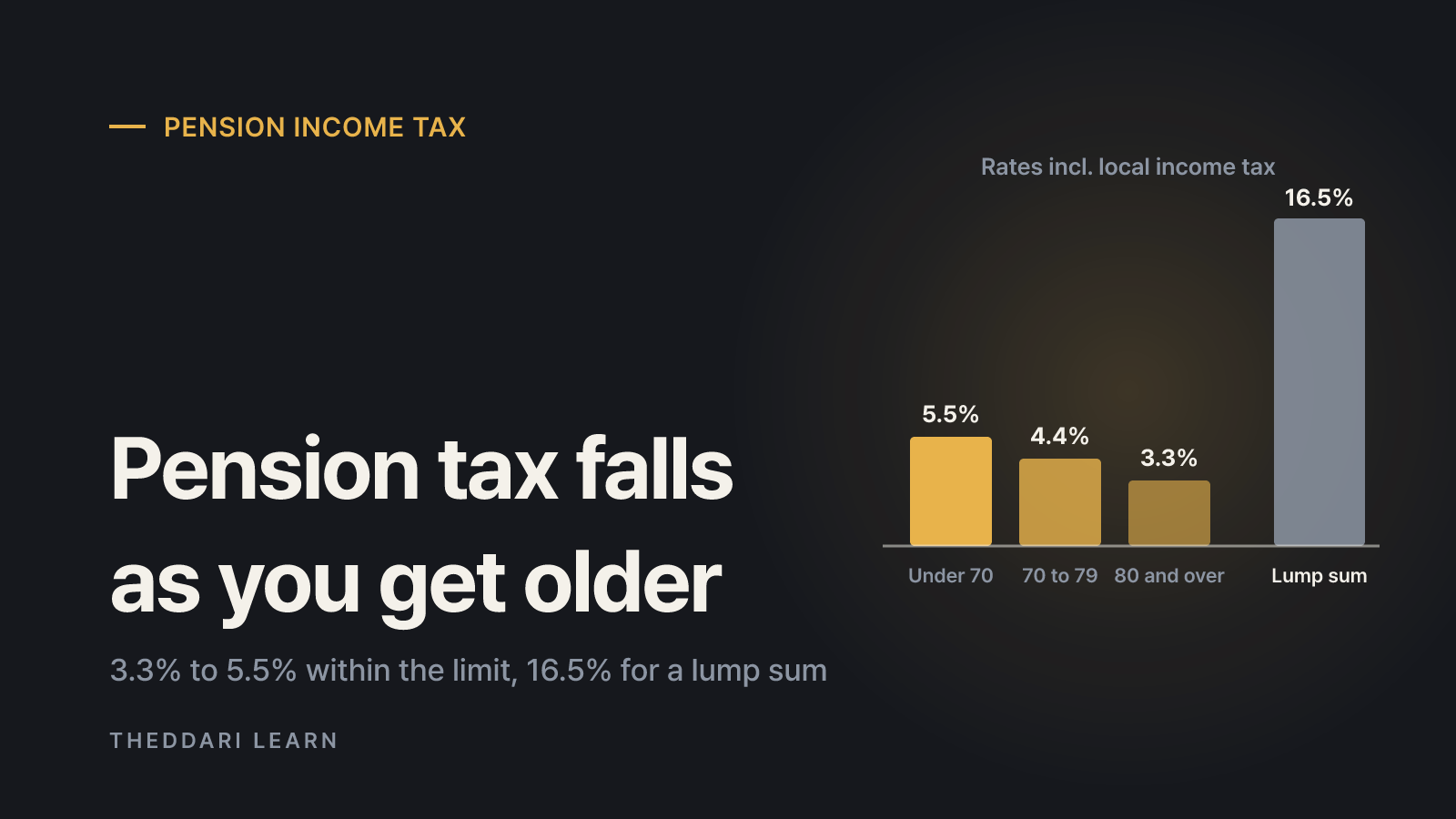
Within the limit, the portion that came from tax-credited contributions and investment gains is taxed as pension income. According to the National Tax Service withholding guide, the income tax rate depends on your age on the payment date: 5% under 70, 4% from 70 to 79 and 3% from 80. Local income tax adds a tenth, giving the familiar 5.5%, 4.4% and 3.3%. Life annuity contracts that pay until death and cannot be cancelled are taxed at 3% for payments received from 1 January 2026, down from 4%. When both the age test and the life annuity test apply, the lower rate wins.
Under age 70
- Income tax
- 5%
- Including local tax
- 5.5%
Age 70 to 79
- Income tax
- 4%
- Including local tax
- 4.4%
Age 80 and over
- Income tax
- 3%
- Including local tax
- 3.3%
Life annuity contract (from 2026 payments)
- Income tax
- 3%
- Including local tax
- 3.3%
Non-pension withdrawal (lump sum or over the limit)
- Income tax
- 15%
- Including local tax
- 16.5%
The second test is annual. The NTS pension income page explains that if your taxable private pension income, excluding deferred retirement income and hardship withdrawals, is KRW 15 million or less for the year, you may let the withholding settle the tax. Above that, the whole amount is either combined with your other income under progressive global taxation or taxed separately at 15% when you file. The threshold rose from KRW 12 million to KRW 15 million for income arising from 1 January 2024.
The threshold applies per person and adds up taxable payouts from every pension savings account and IRP you own, across providers. Korea's National Pension and other public pensions are not counted; they are taxed separately. Global taxation is not always worse. If you have little other income, pension income deductions and personal allowances can make it cheaper than the flat rate, so it is worth running both numbers.
Lump sum vs annuity: how the tax compares
A non-pension withdrawal includes cancelling before payouts start, taking a partial withdrawal, and taking more than the annual limit after payouts start. Tax-credited contributions and gains withdrawn this way are taxed as other income at 15%, or 16.5% with local tax, and the tax is final. Contributions that never received a credit are excluded from tax whichever way they leave. The withdrawal order is fixed: untaxed contributions first, deferred retirement income second, and tax-credited money plus gains last.
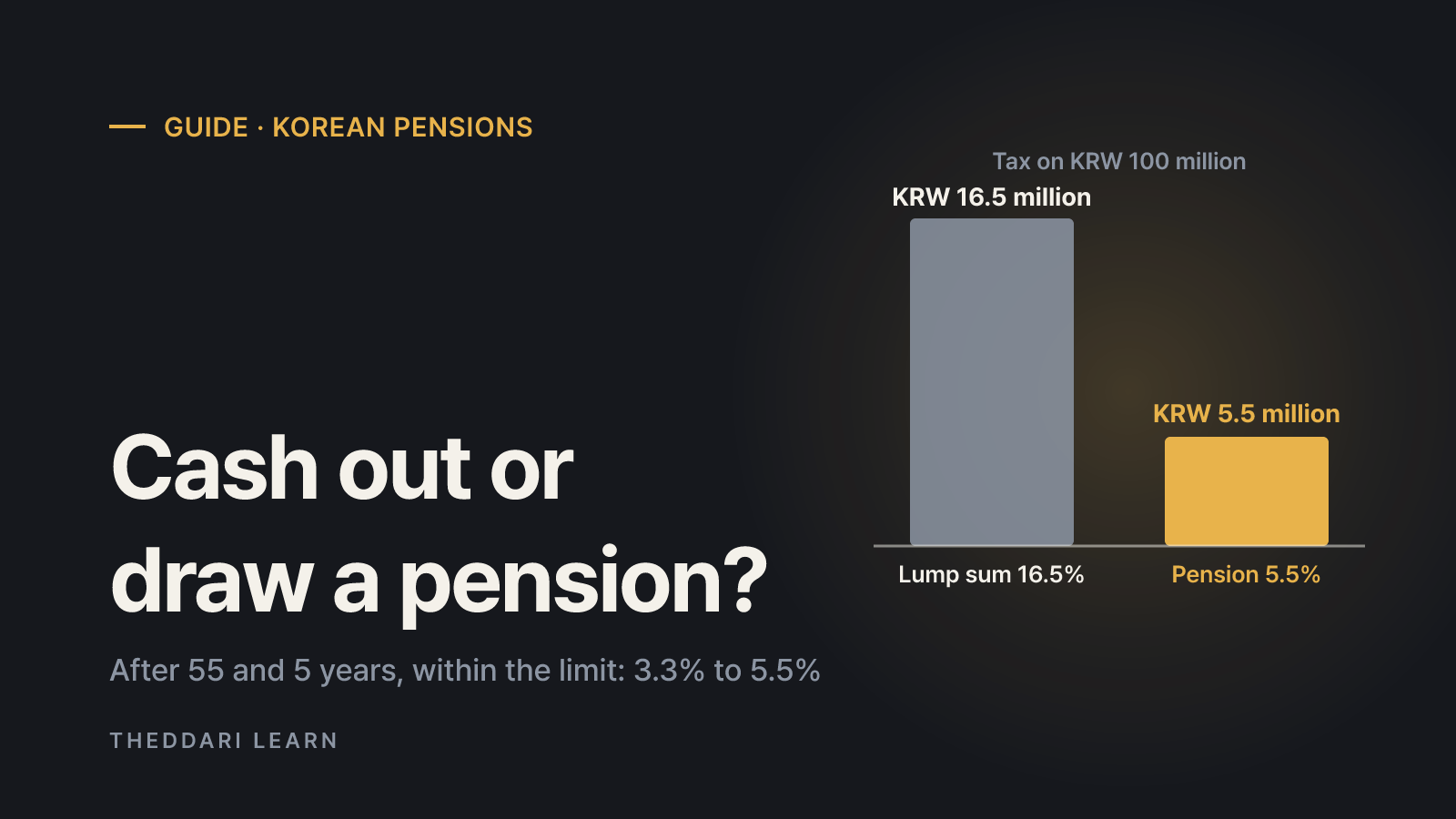
A simplified example shows the gap. Assume KRW 100 million of tax-credited contributions and gains, and an account holder aged 60. Taking it all as a lump sum means KRW 16.5 million withheld at 16.5%. Taking the same KRW 100 million as a pension in annual amounts of KRW 15 million or less means 5.5%, or KRW 5.5 million in total. The difference is KRW 11 million. This ignores investment returns during the payout years and the lower rate after age 70, and your real result depends on yearly limits and any other pension income.
Hardship withdrawals are taxed at the pension rates of 3.3% to 5.5% regardless of the limit. Qualifying events include natural disasters, the holder's death or emigration, medical care of three months or more for the holder or a dependant, bankruptcy or individual rehabilitation, and the provider's suspension or bankruptcy. You must apply with evidence within six months of the event being confirmed (General Insurance Association of Korea).
Checklist before you request payouts
- 1
Split the balance by source
Ask the provider for a breakdown into untaxed contributions, deferred retirement income, and tax-credited contributions plus gains. Each source follows different rates and only some count toward the KRW 15 million threshold.
- 2
Confirm your start date and payout year
Your first eligible date is the later of your 55th birthday and the fifth anniversary of the account. Check whether the account, or one transferred into it, dates from before 1 March 2013, since that changes the payout year count.
- 3
Set an annual amount
Add this year's limit to taxable payouts from your other pension accounts. If the total would exceed KRW 15 million, estimate tax under both global taxation and the 15% flat option, and consider a longer payout period.
- 4
Choose what to sell and when
In a fund or ETF account, nominate the holdings to sell for each payment. Building a cash buffer in advance can avoid selling everything during a volatile week.
If you plan to sell ETFs inside the account, central bank decisions and inflation releases can coincide with sharp price moves. The theddari economic calendar lists major release dates, and the stock Telegram trends page shows which market topics are being discussed most. Both tools organise schedules and conversation; neither predicts prices.

Exceptions and risks to watch
- Severance pay in the account: deferred retirement income is taxed at 70% of the retirement income tax that would have applied, falling to 60% after ten actual payout years and 50% after twenty for payments from 1 January 2026. It does not count toward the KRW 15 million threshold.
- Withdrawals over the limit: even after payouts start, anything above that year's limit is a non-pension withdrawal taxed at 16.5%. Check the remaining limit before taking a large amount.
- Spousal succession: if the holder dies, a spouse can take over the account and continues from the holder's payout year at the date of death.
- Rule changes: rates and thresholds can change, and the rules in force when you are paid apply, as the 2026 life annuity cut shows. Recheck the NTS guidance before you file.
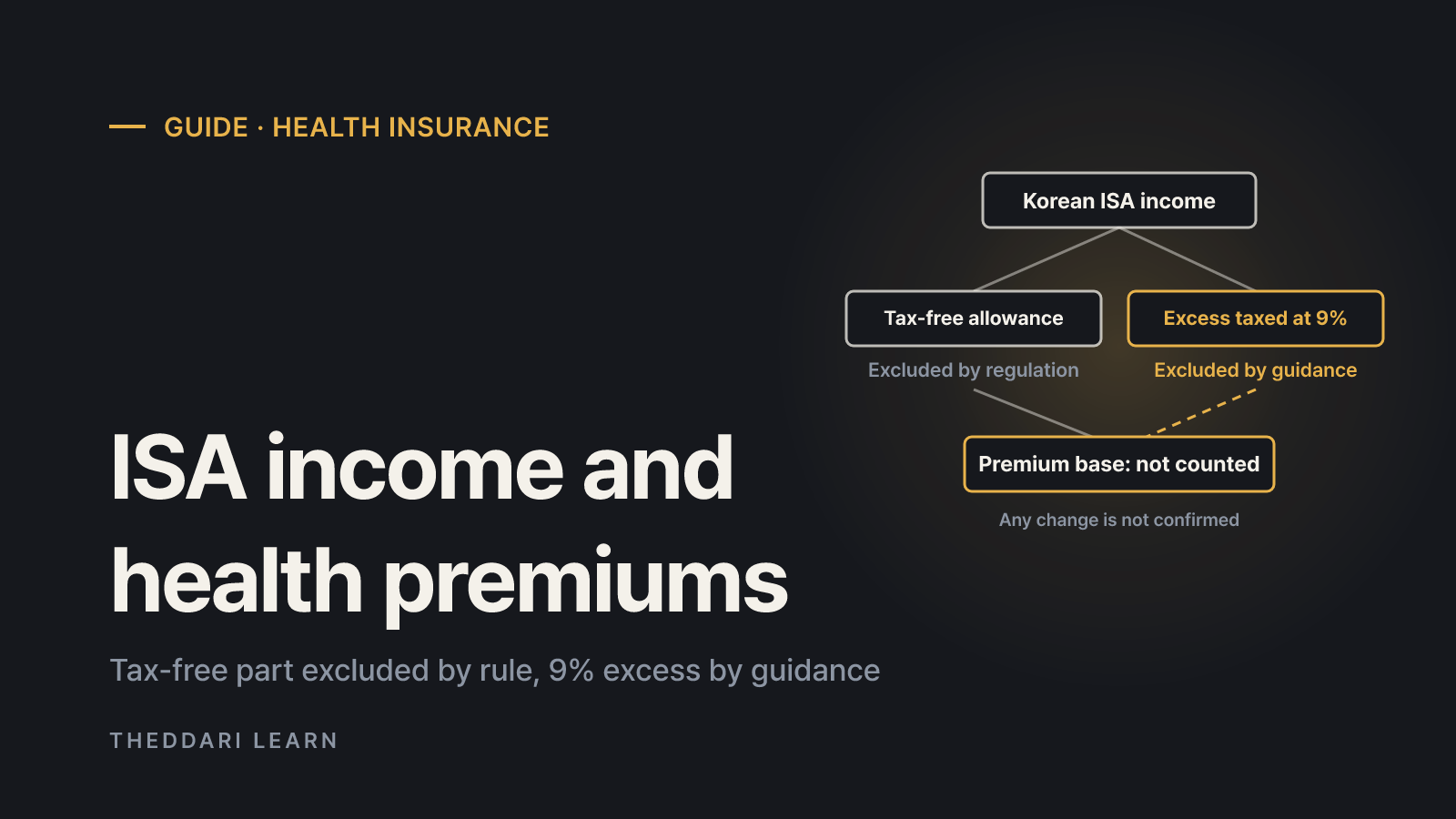
- Health insurance is separate: the KRW 15 million tax threshold is not the same as the National Health Insurance premium rules, which need to be checked on their own terms.
In short, a Korean pension savings account asks three questions: when you can start (age 55 and five years), how much you can take each year (the receipt limit), and at what rate (3.3% to 5.5% by age, subject to the KRW 15 million test). A lump sum is simpler but taxes credited money and gains at 16.5%, roughly three times the under-70 pension rate. Get the source breakdown and payout year from your provider before deciding on an annual amount.