Korean Pension Savings Fund Idle Cash: ETF Buying Guide
Money in a Korean pension savings fund account sits as cash until you buy. How to spot idle balances, buy eligible ETFs, set auto-buy and rebalance (Oct 2026).
Contents8 sections
Key takeaways
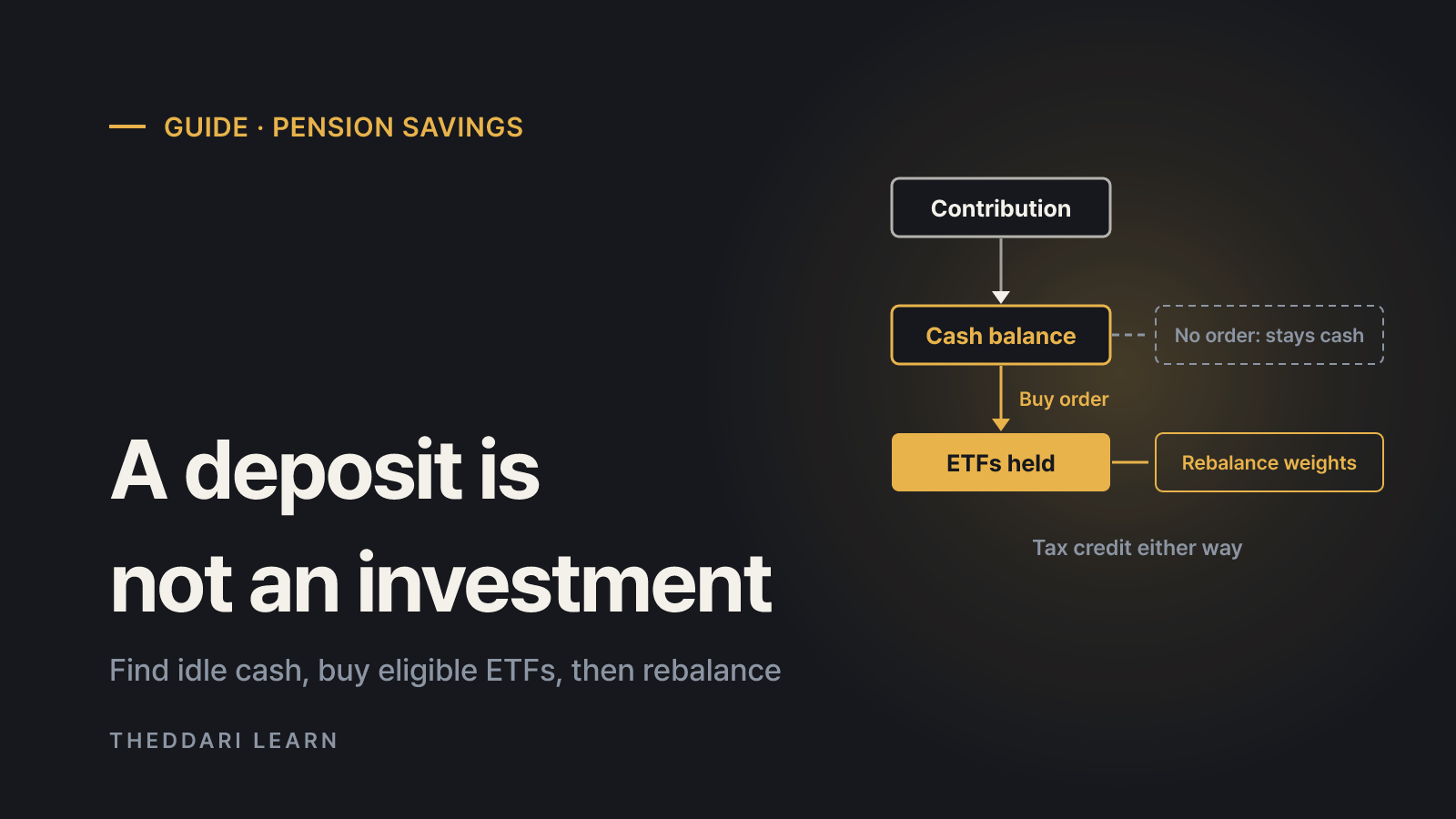
- In a Korean pension savings fund account at a brokerage, deposits stay as cash (yesuguem) until you place an order.
- The tax credit is based on contributions, so you get it even if the money never gets invested.
- Check three screens in order: cash balance, order and fill history, then holdings by ticker.
- Only Korea-listed ETFs are allowed; leveraged, inverse and US-listed ETFs, margin and short selling are blocked.
- Rebalance with new contributions first, then sell and buy inside the account if gaps remain.
If you hold a Korean pension savings fund account (yeongeum jeochuk, 연금저축) at a brokerage, the money you deposit stays as cash until you buy an ETF or fund yourself. Monthly transfers alone do not invest anything. This guide is for Korean tax residents using a brokerage pension savings account as of October 2026. It explains how to tell whether your balance is idle, which ETFs the account can hold, how automatic buying works, and a simple rebalancing routine. Pension savings insurance and the older bank trust version work differently and are not covered here.
People often miss this because the tax benefit and the investment are separate. According to the Financial Supervisory Service comparison page, pension savings contributions earn a tax credit on up to KRW 6 million a year (KRW 9 million combined with retirement pension accounts such as IRP). The rate is 16.5% for total salary of KRW 55 million or less, or comprehensive income of KRW 45 million or less, and 13.2% above that. Annual contributions across all pension accounts are capped at KRW 18 million plus certain ISA rollovers. Because the credit is based on contributions, you receive it even if every won sits in cash. A year-end tax refund is not evidence that your retirement money is working.
Why money in a Korean pension savings fund sits as cash
A brokerage pension savings account behaves like a regular trading account. A deposit fills the account with cash; a purchase is a separate order. Unlike an insurance product, nobody invests the premium for you. Cash builds up from four sources:
Contributions
- What arrives
- Your monthly deposits
- What to check
- Remain cash until you buy
Sales
- What arrives
- Proceeds from selling an ETF
- What to check
- Settle two business days later (T+2)
Distributions
- What arrives
- ETF payouts
- What to check
- Accumulate unless reinvested
Transfers in
- What arrives
- Money moved from another provider
- What to check
- Usually arrives as cash and needs a new order
Hana Securities' pension ETF trading guide notes that ETF trades settle on T+2, the same as stocks. It also says you must sign an ETF trading agreement before trading ETFs in the account, trading starts the next business day, and signing it stops any existing automatic fund purchases based on your allocation ratios. If cash started piling up after you switched from funds to ETFs, this is a likely cause.
Holding cash has one upside. Hana's pension savings account guide states that uninvested cash in the account is covered by Korean deposit insurance up to KRW 100 million per person, combined with your other protected products at the same firm. Once converted to ETFs, that protection no longer applies and you take on market risk. The cost of staying in cash is quieter: over the decades most people hold a pension account, cash tends to fall behind inflation.
Check three screens, not just the total
The 'total assets' figure in a broker app usually mixes cash and holdings. Work through these screens in order:
- 1
Confirm the account number
If the app shows a trading account, ISA, IRP and pension savings together, you may have deposited into one and ordered from another.
- 2
Cash balance
If the cash figure is close to what you contributed this year, most of it has not been invested.
- 3
Order and fill history
Separate 'received', 'unfilled', 'partly filled' and 'filled'. A limit order that never fills leaves the money as cash.
- 4
Holdings by ticker
Confirm the exact ETF name, ticker code and quantity. Many Korean ETFs have similar names.
Small leftovers are normal because ETFs trade in whole shares. Spending KRW 100,000 on an ETF priced at KRW 12,000 buys 8 shares and leaves about KRW 4,000. Worry when hundreds of thousands of won stay untouched for months.
Pension ETF investing: what you can buy and how
Decide your target mix of stock, bond and cash-like holdings before choosing tickers. With a written allocation, every new contribution or distribution follows the same rule. Then place orders in this order: confirm ETF trading is enabled for the account, check the product is eligible, choose a limit or market order (watch the spread on thinly traded ETFs), and compare fills with holdings afterwards.
Korea-listed ETFs
- Pension savings account
- Allowed
- Note
- Includes Korea-listed ETFs tracking overseas indexes
US-listed ETFs (SPY, QQQ)
- Pension savings account
- Not allowed
- Note
- Do not confuse with a regular overseas stock account
Leveraged and inverse ETFs
- Pension savings account
- Not allowed
- Note
- Korea Investment lists derivative ETFs as not tradable
Margin, credit, short selling
- Pension savings account
- Not allowed
- Note
- 100% cash required
Public mutual funds
- Pension savings account
- Allowed
- Note
- Can be held alongside ETFs
These limits come from Hana's guide ('only Korea-listed ETFs; leveraged and inverse ETFs excluded; 100% margin; no credit trading') and Korea Investment & Securities' auto-buy terms. Eligible ticker lists can differ slightly by broker, so confirm on the order screen.
Setting up automatic purchases
Korea Investment & Securities' recurring auto-buy service is one example. Pension savings accounts are eligible for ETFs only, excluding derivative ETFs. You can register up to 20 tickers at KRW 50,000 or more each in KRW 10,000 steps. Orders go out at 11:00 and 15:00 Korea time as market or best-price orders, with no extra service fee beyond normal commissions.
- Share counts are calculated using that day's upper price limit, so small amounts of cash can remain after each fill.
- If your cash is below the registered amount, the order may not be placed. Schedule the transfer before the buy date.
- Monthly plans retry once the next business day if underfilled; daily and weekly plans do not.
- Tickers flagged with investment warnings or trading halts are skipped that day.
Other brokers use different names, times and minimums. Whichever you use, check the first month's fills and the leftover cash.
Rebalancing a pension account step by step
Rebalancing returns drifted weights to your target. If equity ETFs rally, the account becomes riskier than planned. Because gains inside a Korean pension savings account are tax-deferred, trading inside it does not trigger immediate tax. Commissions and spreads still apply, so avoid trading too often.
Calendar
- Example rule
- Review once or twice a year
- Trade-off
- Simple, but can miss large moves in between
Threshold
- Example rule
- Adjust when a weight drifts 5 percentage points
- Trade-off
- Trades only when needed, but needs monitoring
Hybrid
- Example rule
- On review dates, fix only assets outside the band
- Trade-off
- Balances effort and trading
The numbers are illustrations, not recommendations. What matters is writing a rule down and sticking to it. A practical order: calculate current weights including cash; use new contributions and distributions to buy whatever is underweight; if gaps remain, sell part of the overweight asset and buy the underweight one once the T+2 settlement cash arrives; then record the date and weights.
Rate decisions and inflation releases can move bond ETFs and short-rate products. You can see upcoming release dates in theddari's economic calendar before a review day. It shows schedules, not price direction.

Withdrawals, risks and common exceptions
Idle cash is still pension money, and taking it out has tax consequences. Hana's account guide explains that this year's contributions and contributions that did not receive a credit can be withdrawn tax-free, but credited contributions and investment gains taken out other than as a pension face 16.5% other-income tax. Someone who received a 13.2% credit can pay back more than they saved.
- Pension savings and IRP follow different rules. The 70% risky-asset cap and strict early-withdrawal limits apply to IRP, not to pension savings.
- Short-rate ETFs and money market funds can hold waiting cash, but their value can still fall.
- Compare total expense ratios in the prospectus between ETFs tracking similar indexes.
- Low-volume ETFs can have wide bid-ask spreads that worsen fill prices.
To see which Korean ETFs and themes investors are discussing, theddari's stock Telegram trends page tracks mentions. Popularity is not a reason to change your allocation.
A quick checklist for today
- Confirm the pension savings account number and cash balance.
- Use fill history to see how much of this year's contributions became ETFs or funds.
- Check whether ETF trading is enabled and whether old automatic fund purchases stopped.
- Write down target weights for stocks, bonds and cash-like assets.
- Make sure transfers land before auto-buy orders, and check the first fills.
- Pick a calendar or threshold rebalancing rule and a place to log it.
Frequently asked questions
Do I still get the tax credit if my pension savings stay in cash?
Does idle cash in a Korean pension account earn interest?
Can I buy US-listed ETFs like SPY or QQQ in a pension savings account?
Is selling ETFs inside the account a taxable event?
If I set up an automatic transfer, will ETFs be bought automatically?
Sources and references
- 1Hana Securities: Pension ETF trading guide (Korean)(opens in a new tab)www.hanaw.com
- 2Hana Securities: Pension savings account guide (Korean)(opens in a new tab)www.hanaw.com
- 3Korea Investment & Securities: ETF/stock recurring auto-buy (Korean)(opens in a new tab)m.koreainvestment.com
- 4Financial Supervisory Service: Tax-advantaged financial products (Korean)(opens in a new tab)finlife.fss.or.kr
- 5ETFstyle: Investing idle cash in pension savings (Korean)(opens in a new tab)www.etfstyle.com
Related articles
 Investing
Stock Market Circuit Breakers and Sidecars: US vs Korea
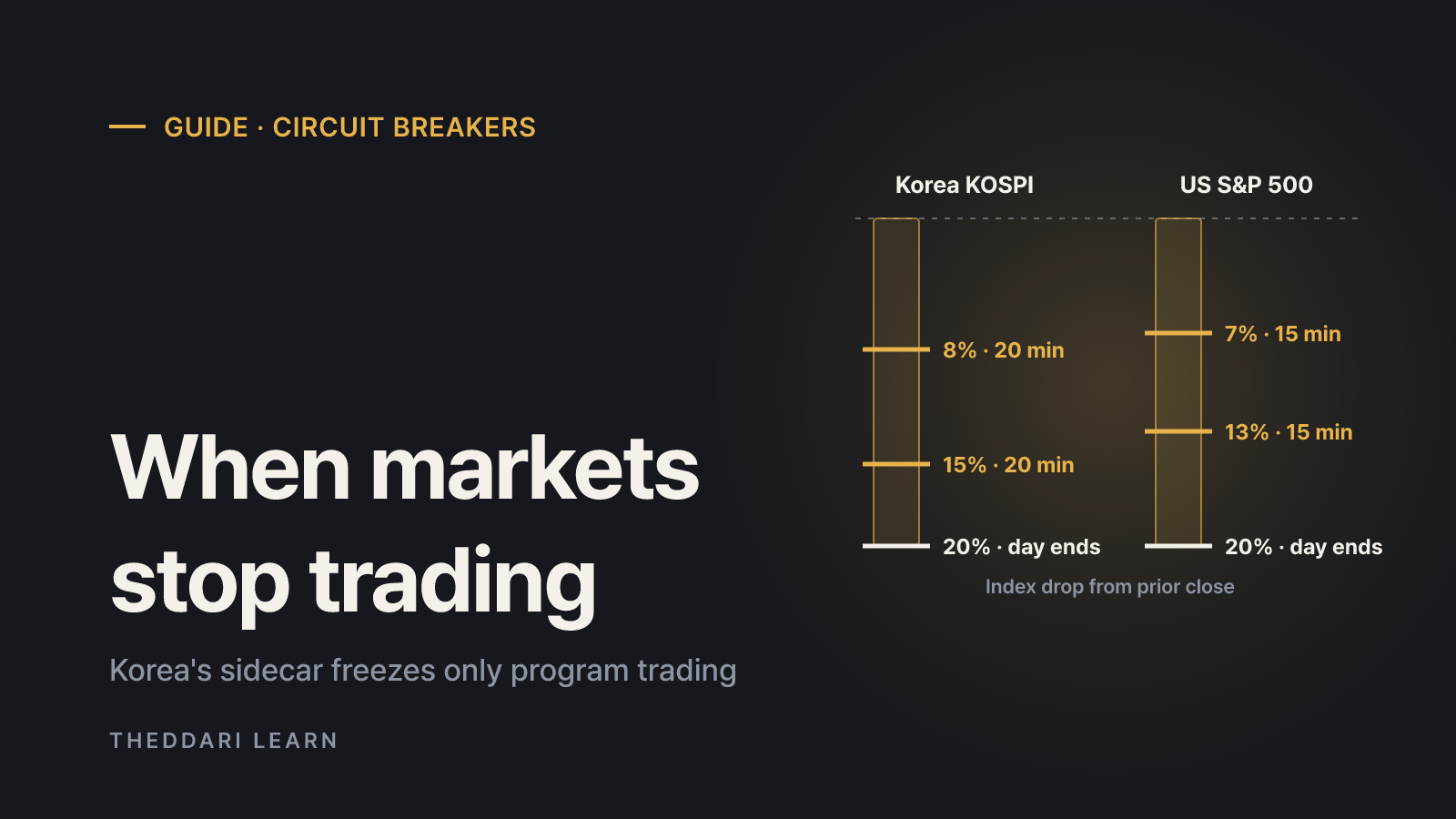
US market-wide circuit breakers halt all trading when the S&P 500 drops 7%, 13% or 20%. Korea uses 8%, 15% and 20% thresholds plus a sidecar that freezes only program trading. Here is how each rule works and what happens to your orders.
 Investing
Pension Withdrawal Order in Korea: How IRP Money Is Taxed
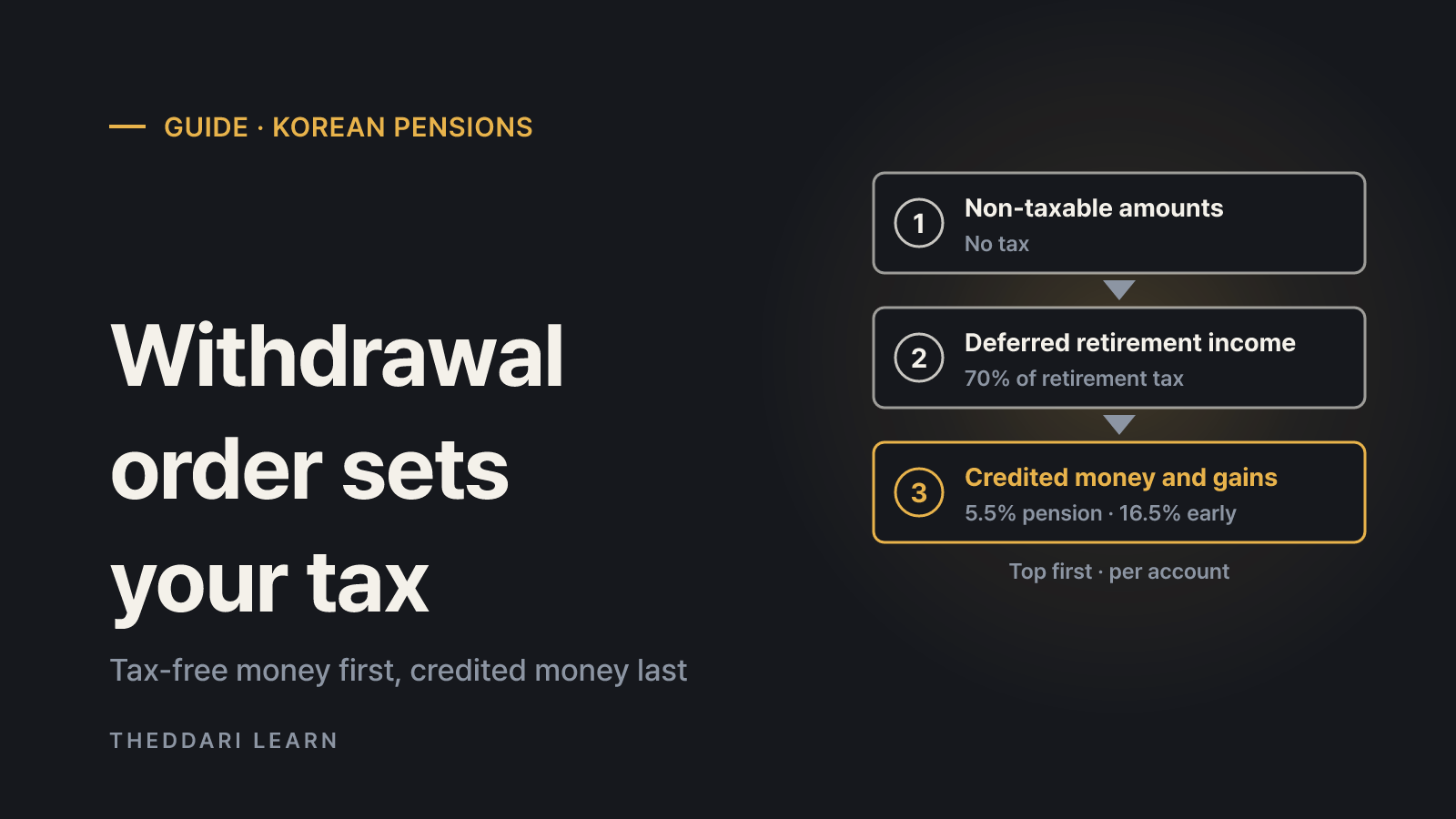
When you take part of the money out of a Korean pension savings account or IRP, the law decides which money left first, and each part is taxed differently. A November 2026 guide to the withdrawal order, rates and exceptions for Korean tax residents.
 Investing
How to Buy ETFs in Singapore: CDP vs Custodian and Fees
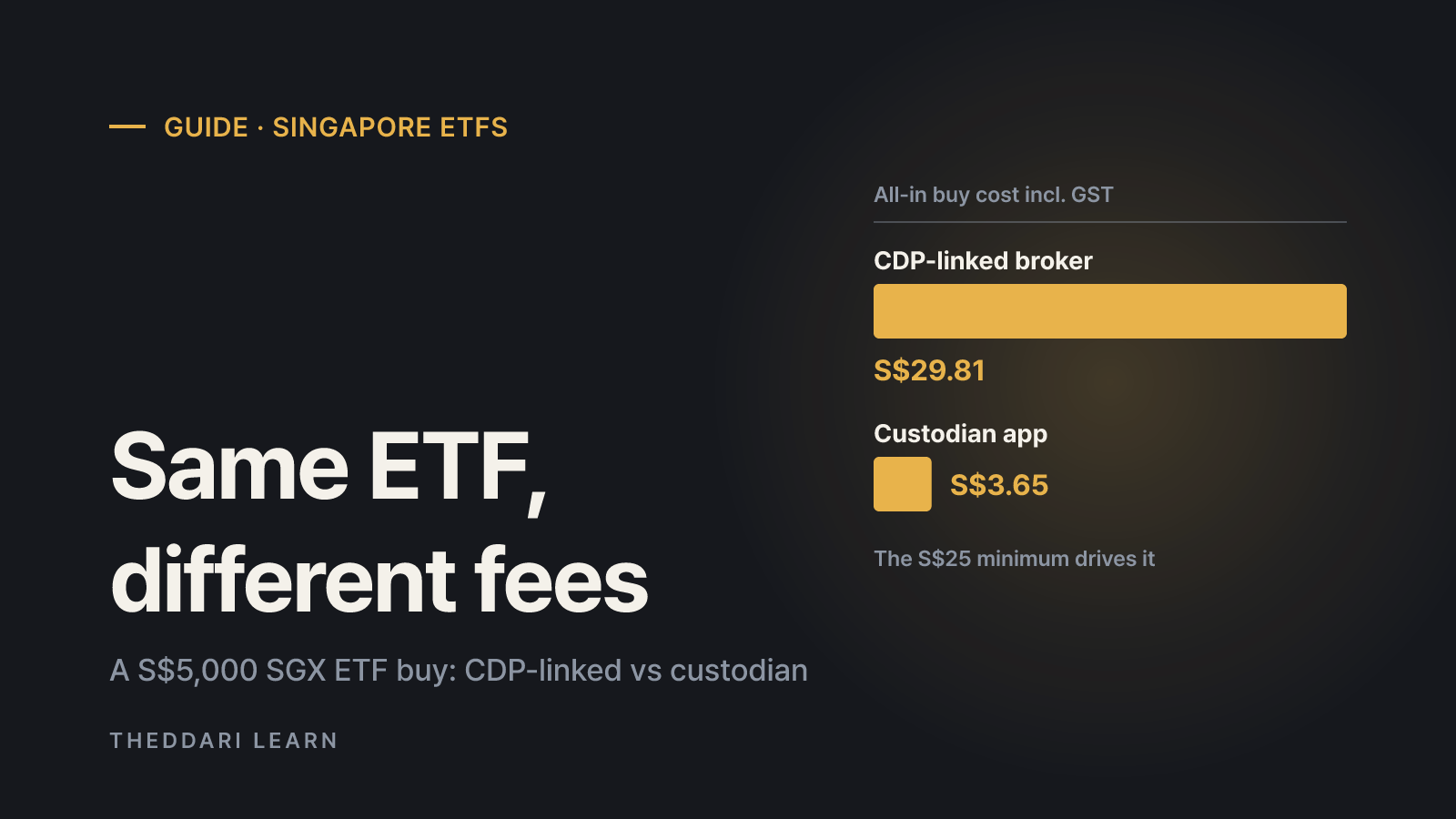
A practical guide for Singapore residents: how SGX-listed and US-listed ETFs are held, what the CDP rule changes of July 2026 mean for custodian accounts, and what a trade really costs at different order sizes.