Contents8 sections
- Why your Korea pension savings fund loss happened
- The real cost of cancelling or withdrawing early
- Should you keep contributing during a loss?
- Pension fund rebalancing inside the account
- Pension account transfer in Korea: when it fits
- A checklist and the dates to watch
- Frequently asked questions
- Sources and references
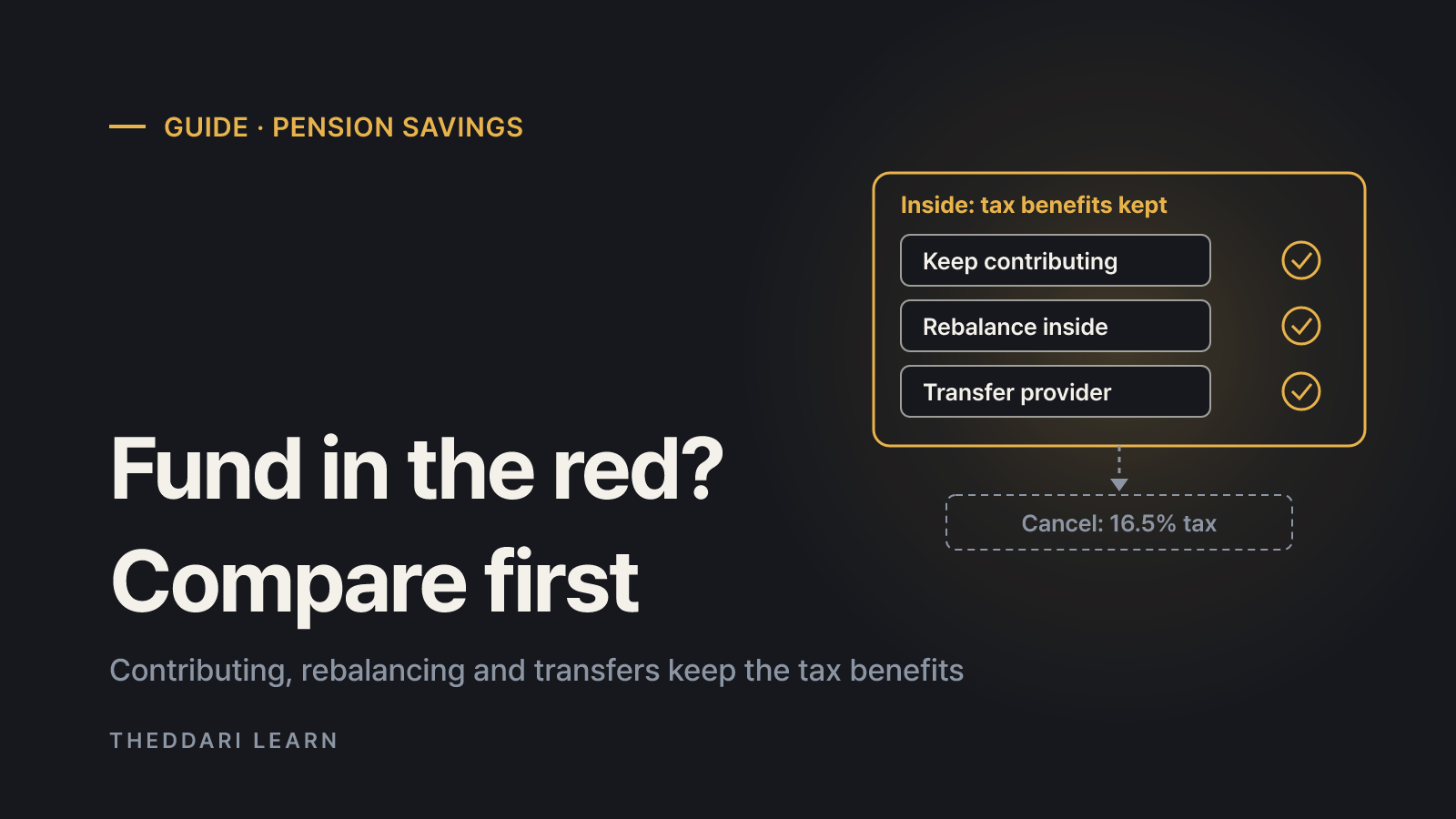
A Korea pension savings fund loss that has lasted several months is rarely a reason to cancel the account. The loss inside the account is usually unrealised, while cancelling locks it in and can add a 16.5% other-income tax on contributions you claimed a credit for and on any gains. That leaves three main choices: keep contributing, rebalance inside the account, or transfer to another product or provider. This guide applies to Korean tax residents holding a fund-type pension savings account (yeongeum jeochuk gyejwa) and reflects the rules as of November 2026. It explains how to compare the options; it does not predict when any fund will recover.
Why your Korea pension savings fund loss happened
Start by separating the causes. If the whole market fell, switching to a similar product will not avoid the decline. If your fund lagged its own benchmark, look at fees and strategy. If most of the account sits in one country, sector or theme, the problem is concentration, and rebalancing becomes the main task. Currency also matters: many Korean pension funds hold US or global assets, and a hedged (H) or unhedged (UH) share class can move very differently when the won strengthens or weakens.
Broad market decline
- How to check
- Compare with other products tracking the same index
- First response to consider
- Keep the account; review cash flow
Fund underperformance
- How to check
- Compare with benchmark, total fee and strategy
- First response to consider
- Switch inside the account or transfer
Concentration
- How to check
- Add up country, sector and asset-class weights
- First response to consider
- Rebalance to target weights
Currency effect
- How to check
- Check hedged versus unhedged class and the won rate
- First response to consider
- Adjust hedged exposure deliberately
Also check what the app is showing. A cumulative return and a three-month return tell different stories. In a monthly savings plan, recent contributions make up a larger share of the balance, so a recent drop can dominate the headline figure even though those same months bought more fund units at lower prices.
The real cost of cancelling or withdrawing early
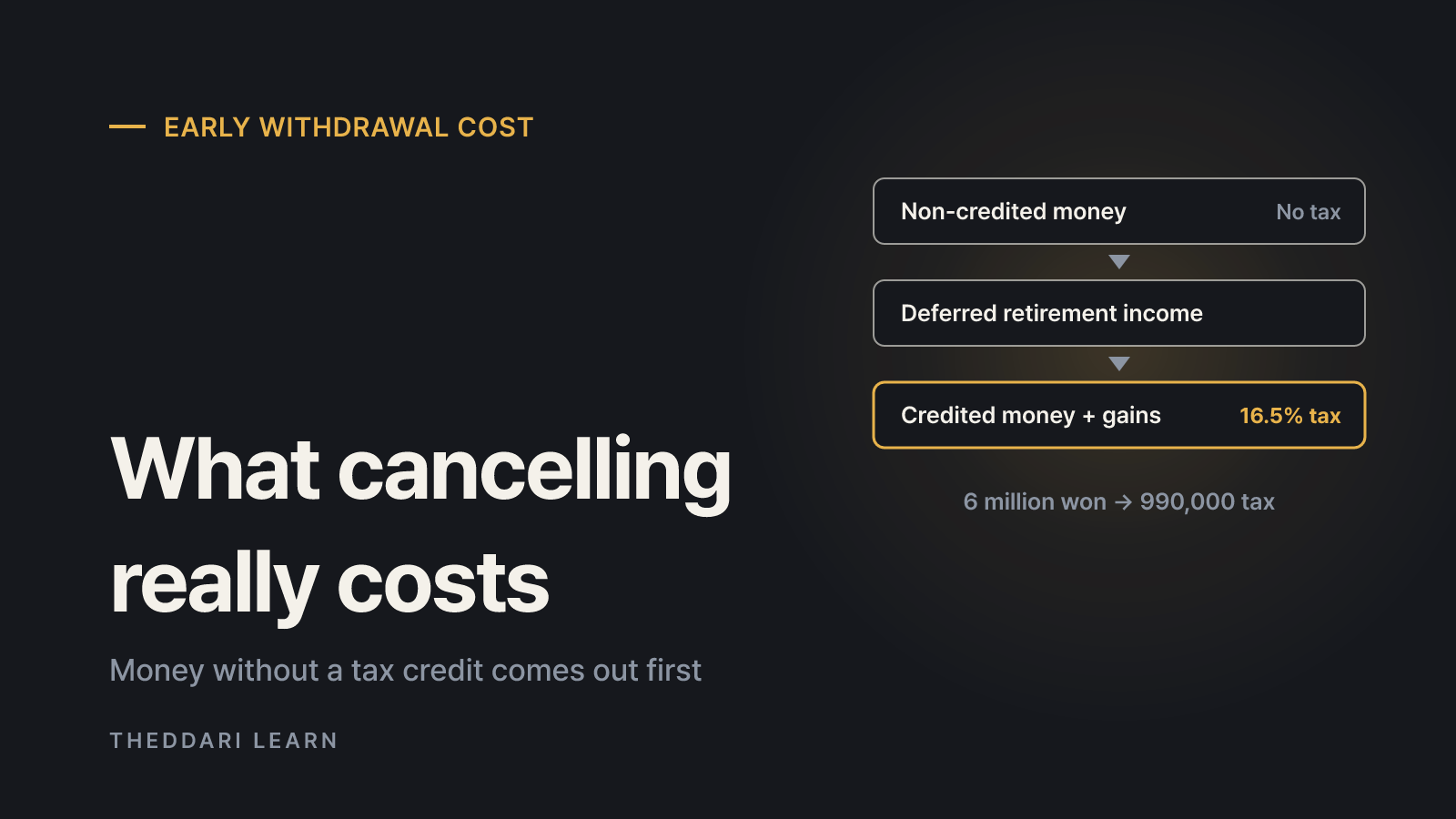
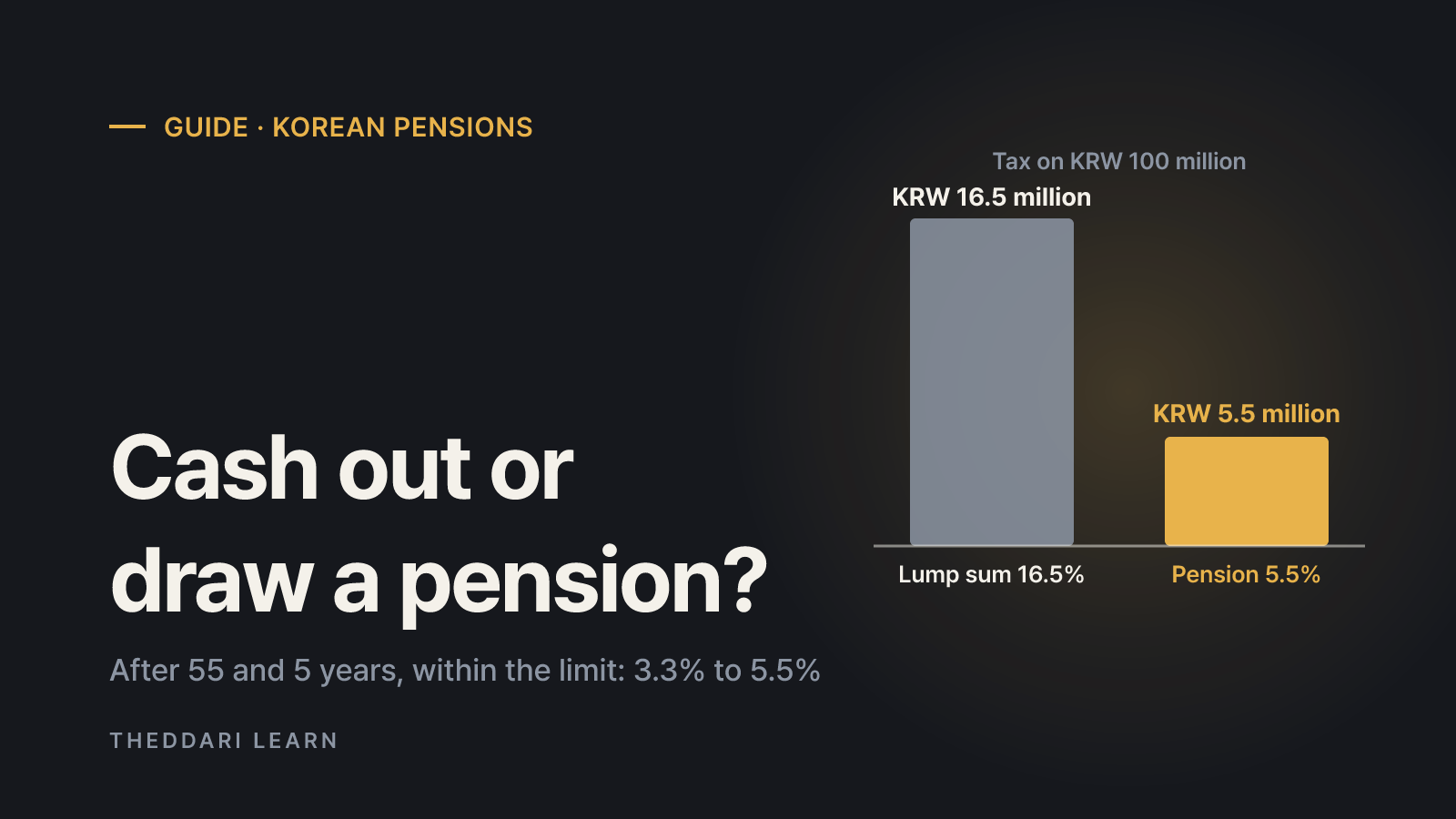
Pension savings receive low pension income tax only when withdrawals start after age 55, at least five years after opening, and stay within the annual pension withdrawal limit. Anything outside those rules is a non-pension withdrawal. Credited contributions and investment income are then taxed at 16.5% including local income tax. On 21 October 2026 the Financial Supervisory Service reminded savers that early withdrawal or cancellation can leave them with less than they paid in because of this tax (Money Today report).
Withdrawals follow a fixed order: first money that never received a tax credit, then deferred retirement income, and finally credited contributions plus earnings (Woori Investment Securities guide). If you need cash during a downturn, a partial withdrawal limited to non-credited money may cost far less than closing the account. In a simple example, cancelling an account holding 6 million won of credited contributions would mean 990,000 won of other-income tax at 16.5%, which effectively returns the credits you received, on top of the investment loss. Hardship cases such as death, emigration, bankruptcy or rehabilitation, or three months or more of medical care for you or a dependant can qualify for pension income tax of 3.3% to 5.5% if supporting documents reach the provider within six months.
Should you keep contributing during a loss?
According to the FSS FinLife comparison page, pension savings contributions of up to 6 million won a year (9 million won combined with retirement pension accounts) earn a 16.5% tax credit if your total salary is 55 million won or less or your comprehensive income is 45 million won or less, and 13.2% above those levels, local tax included. The combined annual contribution cap is 18 million won. A full 6 million won contribution therefore yields a credit of up to 990,000 won or 792,000 won.
That credit is fixed in the year you contribute, whatever the fund does, which is why contributions can still make sense in a falling market. The limits are practical: the credit is worth less if your tax bill is smaller, and the money stays locked until at least 55. Regular buying at lower prices adds more units, yet it does not guarantee a recovery. Base the decision on your cash flow rather than a market forecast.
- Do you have a separate emergency fund? If not, reducing contributions now may prevent a costly cancellation later.
- Will you owe enough Korean income tax this year to use the credit?
- Contributions above the credit limit become non-credited money that can be withdrawn tax-free later, but they earn no credit.
- Do new contributions deepen an existing concentration? If so, fix the allocation first.
Pension fund rebalancing inside the account
A Korean pension savings account defers tax until you draw a pension, so selling one fund or ETF and buying another inside the account is not a withdrawal and creates no tax at the time of the trade. The account value is unchanged; only future returns follow the new holding. Some brokers let you trade multiple pension funds without extra commission, but ETF trading fees, fund redemption fees and ongoing fees still vary by product, and some ETF types cannot be bought in a pension savings account at all.
Pension fund rebalancing means returning to a target mix, not chasing whatever fell least. If your plan is 70% equity and 30% bonds and the slump cut equity to a smaller share, moving part of the bond holding back to equity restores the plan. Selling every losing fund for last month's winner is a change of strategy, not rebalancing. Fund redemptions settle over several days, so part of the balance may sit uninvested during the switch.
- 1
Write down target weights
Set equity, bond and cash weights, plus domestic versus overseas exposure, in one line.
- 2
Measure the gap
Group holdings by asset class, merging products that track the same index, and compare with the target.
- 3
Check costs and settlement
Confirm redemption fees, total fees, ETF commissions and the settlement date before trading.
- 4
Rebalance on a schedule
Adjust quarterly, semi-annually or only when weights drift past a set band, so headlines do not drive trades.
Pension account transfer in Korea: when it fits
A transfer suits cases where the product range or provider is the real problem. The Financial Services Commission confirms that moving to another provider's pension savings account carries no tax penalty, and since 27 April 2015 you only need to apply at the receiving provider. Most brokers now accept applications through their apps. The old provider confirms your intention by recorded call before sending the money, and the transfer cannot be cancelled after that confirmation.
Cancel or withdraw
- Tax
- 16.5% on credited money and gains
- Main cost or limit
- Loss locked in, credits given back
- Best fit
- Hardship case or no alternative
Keep contributing
- Tax
- 13.2% or 16.5% credit on new money
- Main cost or limit
- Money locked until 55
- Best fit
- Emergency fund and tax bill in place
Rebalance inside
- Tax
- No tax at trade
- Main cost or limit
- Settlement gap, product fees
- Best fit
- Concentration or weak fund
Transfer provider
- Tax
- No tax penalty
- Main cost or limit
- Full balance only, transfer fees
- Best fit
- Limited choice or high fees
Know the limits before applying. Only the full balance can move, not part of it. Accounts already paying a pension, and accounts under seizure, provisional seizure or pledge, cannot be transferred. Insurance-type pension savings moved within seven years of joining transfer at surrender value. A fund account is redeemed into cash for the move, so the balance is out of the market until the transfer finishes; in a downturn that gap could miss a rebound or avoid a further drop, and nobody knows which in advance. The FSS pension savings disclosure service lets you compare past returns and fees across providers.
A checklist and the dates to watch
- Classify the cause: market-wide fall, weak fund, concentration or currency.
- Ask your provider for the estimated tax on cancellation and check whether a hardship rule applies.
- Set this year's contribution using your emergency fund and expected tax bill.
- Rebalance inside the account if weights have drifted far from target.
- Transfer only if choice or fees are the underlying issue and the transfer limits allow it.
- Put the next review date in your calendar and avoid revisiting the decision before then.
Long drawdowns are often shaped by rate decisions, inflation releases and major earnings reports. The theddari economic calendar and earnings calendar help you see what is scheduled around your next review, so a sudden move is less likely to push you into an impulsive cancellation. A calendar does not tell you which way prices will go, and important dates should be checked with the official publisher. You can follow market chatter on the Telegram stock trends page, but those opinions should not replace your allocation rules.

In short, months of negative returns alone rarely justify cancelling a Korean pension savings account. Cancelling combines a locked-in loss with other-income tax, while contributing, rebalancing and transferring all keep the tax treatment intact. None of these choices promises a recovery, so decide on the basis of the cause, your cash flow and your target allocation, and keep a note of why. Tax law can change, so confirm the latest rules and your estimated tax with your provider before acting.