Korean Pension Savings Double Tax: Uncredited Contributions
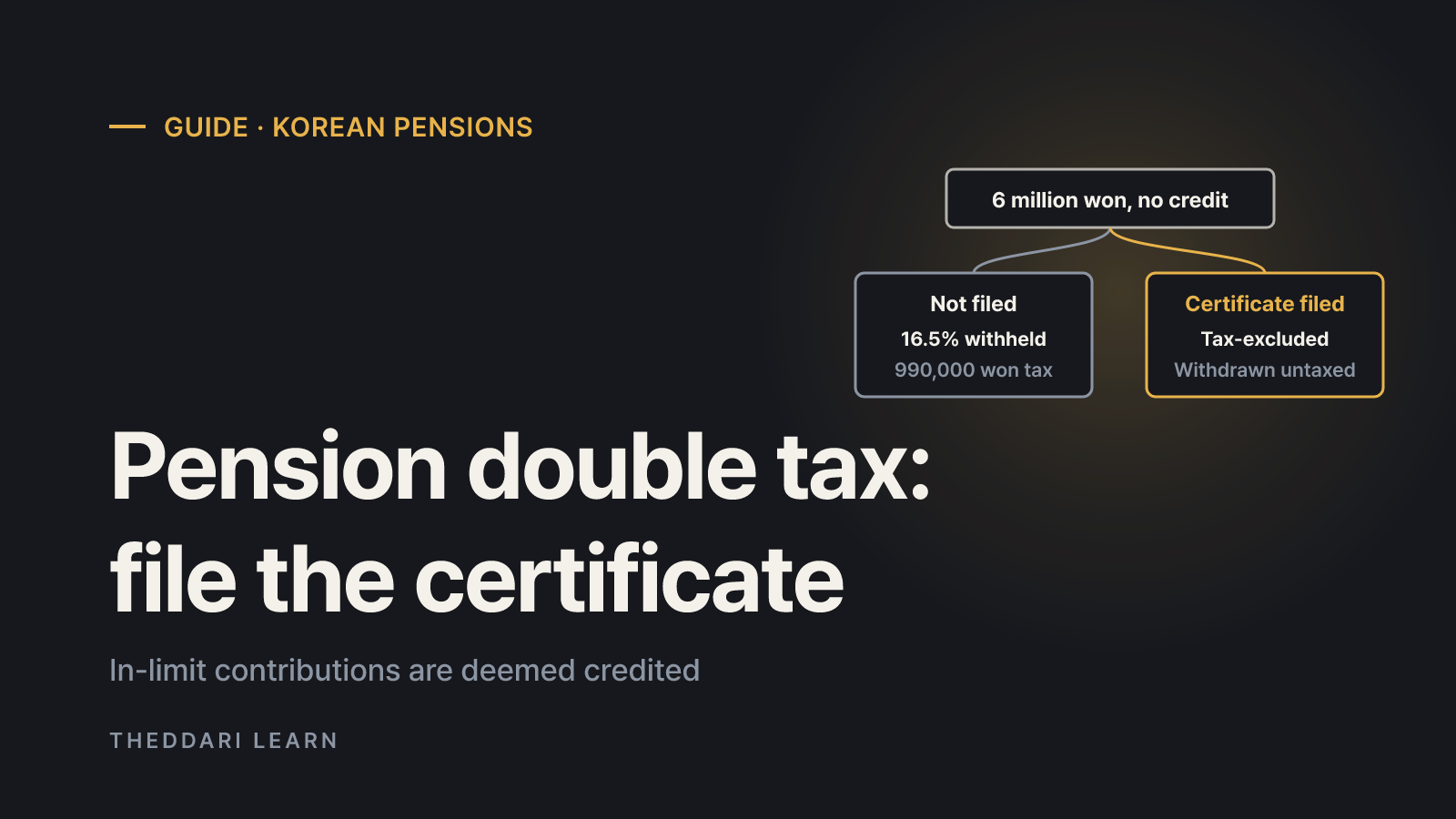
Money you put in a Korean pension savings account without a tax credit can still be taxed at 16.5% on withdrawal. Learn how the Hometax certificate stops it.
Contents7 sections
Key takeaways
- Korean rules treat pension savings contributions within the annual limit as credited from the next year, even if you never received the credit (Decree Article 40-3(4)).
- To have uncredited money recognized as a tax-excluded amount, you must get a pension contribution tax credit confirmation from Hometax and submit it to your financial institution.
- If you withdraw outside the pension route before registering it, the institution may withhold 16.5% other-income tax, which is 990,000 won on 6 million won.
- A Korean brokerage notes that the confirmation includes the prior year's data from July each year.
- If you split contributions across several accounts, each one can look within the limit, so the confirmation is also needed to combine them.
The Korean pension savings double tax problem is avoidable: if you put money into a Korean pension savings account (yeongeum jeochuk) and never received the tax credit for it, you need to get a tax credit confirmation from Hometax and file it with the institution that holds the account. Until you do, contributions within the annual limit are deemed to have been credited, and a non-pension withdrawal can be withheld at 16.5% even though you never got a tax benefit. This guide applies to Korean tax residents with pension savings trusts, funds or insurance accounts, as of October 2026. It is based on the Enforcement Decree of the Income Tax Act and guidance from the National Tax Service (NTS), the Financial Supervisory Service (FSS) and a Korean brokerage. It does not describe US IRAs, UK pensions or the tax rules of any other country.
Why Korean pension savings double tax happens
Korean pension savings work on a tax-deferral basis. You receive a tax credit when you contribute and pay tax when you withdraw. The NTS consultation center explains that pension savings qualify for a credit on up to 6 million won a year, and up to 9 million won combined with retirement pension accounts such as IRP. The credit rate is 15% if your total salary is 55 million won or less (or comprehensive income of 45 million won or less) and 12% above that.
The catch is that the bank or brokerage cannot see your year-end tax settlement. So the law presumes. Article 40-3(4) of the Enforcement Decree treats contributions within the credit limit as credited from the first day of the year after payment. If you never actually benefited, you would still be taxed when the money comes out. That mismatch is what Korean investors call double taxation.
Common ways contributions go uncredited
- Other credits had already reduced your determined tax to zero, so the pension credit had nothing to offset.
- You forgot to include the contributions in your year-end settlement or income tax return.
- You had little or no taxable income in the year you contributed.
- You held several pension savings accounts, each within the limit on its own, but together above 6 million won.
The last case is easy to miss. The institution assesses the excess as if that account were your only one. Put 6 million won into account A and another 6 million won into account B, and both may look fully credited, although only 6 million won in total could actually receive the credit.
The withdrawal order and tax-excluded amounts
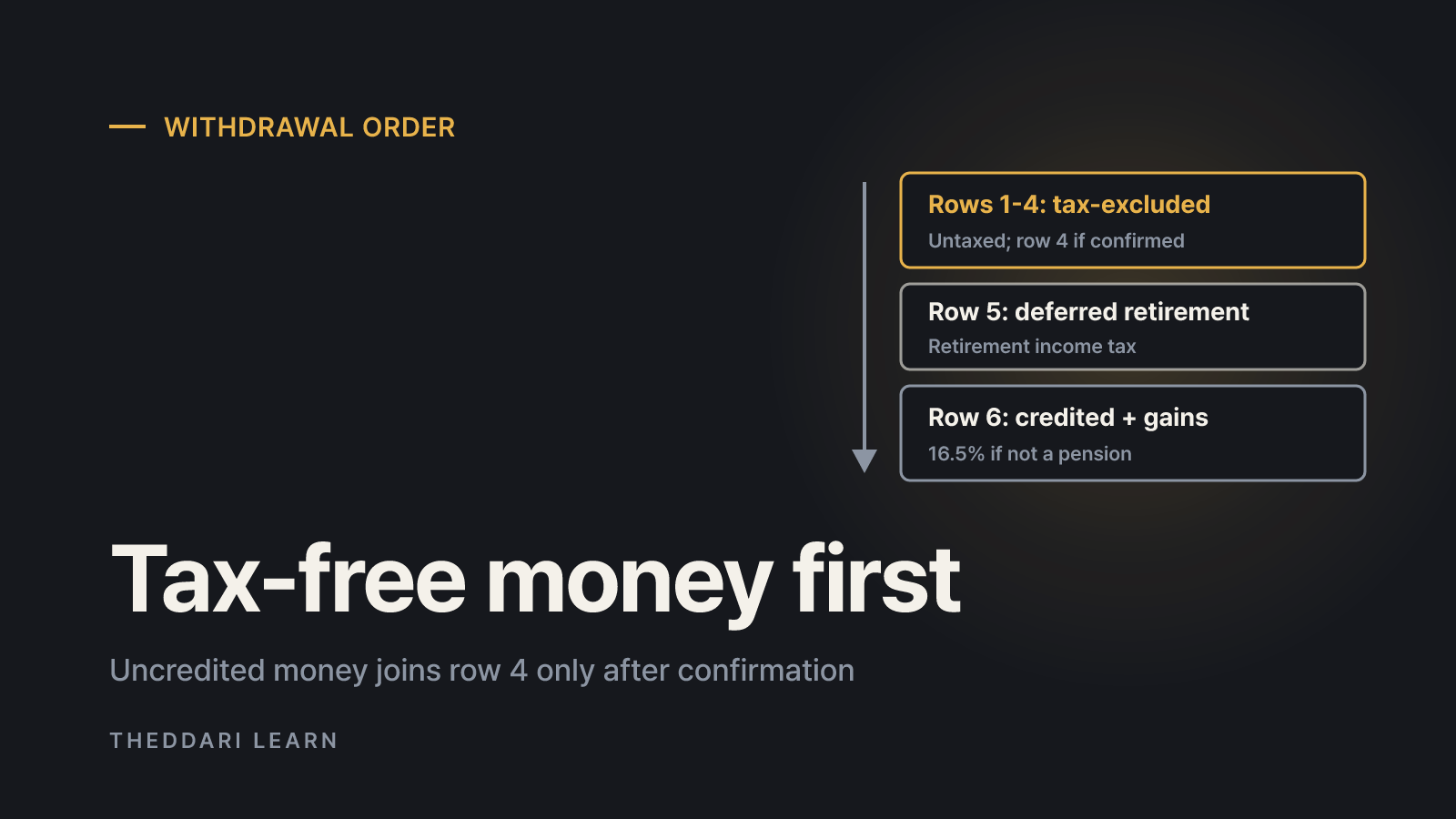
When you take part of the balance out, the law deems the money to leave in a fixed order, starting with the tax-free sources. Combining Article 40-3(1)-(2) with the FSS pension portal gives the order below.
1
- Source of money
- Contributions made in the year of withdrawal
- Taken as a pension
- Not taxed
- Taken outside the pension route
- Not taxed
2
- Source of money
- ISA maturity transfers made in that year
- Taken as a pension
- Not taxed
- Taken outside the pension route
- Not taxed
3
- Source of money
- Contributions above the limit, judged per account
- Taken as a pension
- Not taxed
- Taken outside the pension route
- Not taxed
4
- Source of money
- Other amounts confirmed as uncredited
- Taken as a pension
- Not taxed from the confirmation date
- Taken outside the pension route
- Not taxed from the confirmation date
5
- Source of money
- Deferred retirement income
- Taken as a pension
- 70% of retirement income tax
- Taken outside the pension route
- Retirement income tax
6
- Source of money
- Credited contributions and investment gains
- Taken as a pension
- 3.3%-5.5% separate tax up to 15 million won a year; above that, 16.5% separate tax or comprehensive taxation
- Taken outside the pension route
- 16.5% other-income tax
Row 4 is the one that matters here. The decree counts it only when confirmed under Article 201-10, and only from the date of confirmation. Not having claimed the credit is not enough on its own; until the institution records the amount, it can be treated as row 6 money.
A worked example: you contributed 6 million won in 2025, but your tax was already zero, so no credit applied. If you cancel the account in 2026 without filing a confirmation, the institution may withhold 16.5%, or 990,000 won. The NTS says that to avoid other-income tax withholding on termination you must prove the credit was not applied by submitting the confirmation.
How to get and file the tax credit confirmation
Article 201-10 requires anyone who wants a tax-excluded amount recognized to obtain the pension contribution income and tax credit confirmation from the tax office and submit it to the withholding agent, which is your financial institution. The institution must treat any contributions beyond the credits actually received as tax-excluded, and where it can see your other pension accounts through the central database, it compares the totals.
- 1
Pull your contribution history
In your provider's app, note each year's contributions, any excess already classified as tax-excluded and past withdrawals. If you have accounts at several firms, ask each for a pension contribution confirmation; the decree requires institutions to issue it immediately on request.
- 2
Issue the confirmation on Hometax
The NTS path is Hometax, then certificates and applications, then instant certificates, then the pension contribution income and tax credit confirmation. The form lists pension account deductions by year from 2001 and credit-eligible amounts from 2014. Follow your institution's submission method, which may be an app upload, a branch visit or quoting the issue number.
- 3
Check that the prior year is included
KB Securities states that the confirmation includes the previous year from July each year. To register last year's uncredited money, you may need a copy issued in July or later. If you need cash earlier, ask the institution first.
- 4
Submit, then verify before withdrawing
File the confirmation along with other accounts' contribution confirmations if needed. Wait until the tax-excluded figure in the app has increased, then request the withdrawal or pension start. Doing it the other way round may mean a separate process to recover tax already withheld.
Run the same check before you apply to begin pension payments. KB Securities notes that uncredited money should be reclassified before the pension start to avoid a tax disadvantage, because taxable money paid as a pension still carries 3.3% to 5.5% pension income tax.
Splitting credited and uncredited accounts
Korean investors often talk about a credited account and an uncredited account. This is a bookkeeping habit, not a legal category. Within a single account, the institution already classifies contributions above the annual limit as tax-excluded, so splitting is not required for that excess.
Separation still helps. Keep credit-claimed contributions in one account within 6 million won a year and send other money elsewhere, so you can see which balance is tax-free. If both accounts stay within the limit, file the confirmation and other accounts' contribution records early so the second account is registered as tax-excluded. At year-end settlement, claim only the credited account and keep a yearly record of what you claimed.
If you invest the account in ETFs or funds, it can help to track scheduled macro releases such as rates and inflation. The theddari economic calendar lists release dates, and the stock Telegram trends page shows which market topics are being discussed. Neither tool predicts prices or tells you your tax position.

Exceptions and risks to check
- Money contributed in the year you withdraw comes out first and untaxed. The NTS says contributions made in the year of cancellation cannot be credited and are not taxed as other income.
- Termination for unavoidable reasons such as natural disaster, death, emigration, illness or bankruptcy is taxed as pension income at 3.3% to 5.5% instead of 16.5%. The FSS says documents must be filed within six months of the event being confirmed.
- You can convert an uncredited amount into a current-year contribution to claim the credit, but that money then becomes taxable on withdrawal.
- If investment losses push the balance below principal, the principal is reduced in reverse withdrawal order (Article 40-3(5)), so losses come out of the taxable sources first.
- Pension savings insurance often does not allow partial withdrawals, so you may have to cancel the whole policy. The FSS asks you to review the institution's breakdown of tax-excluded money, deferred retirement income and other amounts before deciding.
In short, double taxation arises because Korean law presumes that in-limit contributions were credited, and the tax credit confirmation is the way to rebut that presumption. Before any withdrawal or pension start, compare each account's yearly contributions with the credits you actually claimed, file a confirmation issued from July onward together with other accounts' records if needed, and wait until the tax-excluded amount appears in your account. For unusual cases, take the year-by-year figures to your institution or the NTS consultation center.
Frequently asked questions
Is money I never claimed a tax credit for taxed when I withdraw it?
When should I request the confirmation from Hometax?
Do I still need this if I take the money as a pension?
Can I use an old uncredited amount for this year's tax credit instead?
Sources and references
- 1Korea Law Information Center: Enforcement Decree of the Income Tax Act, Article 40-3 (withdrawal order)(opens in a new tab)www.law.go.kr
- 2Korea Law Information Center: Enforcement Decree of the Income Tax Act, Article 201-10 (confirmation of tax-excluded amounts)(opens in a new tab)law.go.kr
- 3National Tax Service consultation center: year-end settlement Q&A, pension account tax credit(opens in a new tab)call.nts.go.kr
- 4Financial Supervisory Service pension portal: maintenance and termination notes(opens in a new tab)www.fss.or.kr
- 5KB Securities: pension savings tax credit check(opens in a new tab)www.kbsec.com
Related articles
 Investing
How to Buy ETFs in Singapore: CDP vs Custodian and Fees
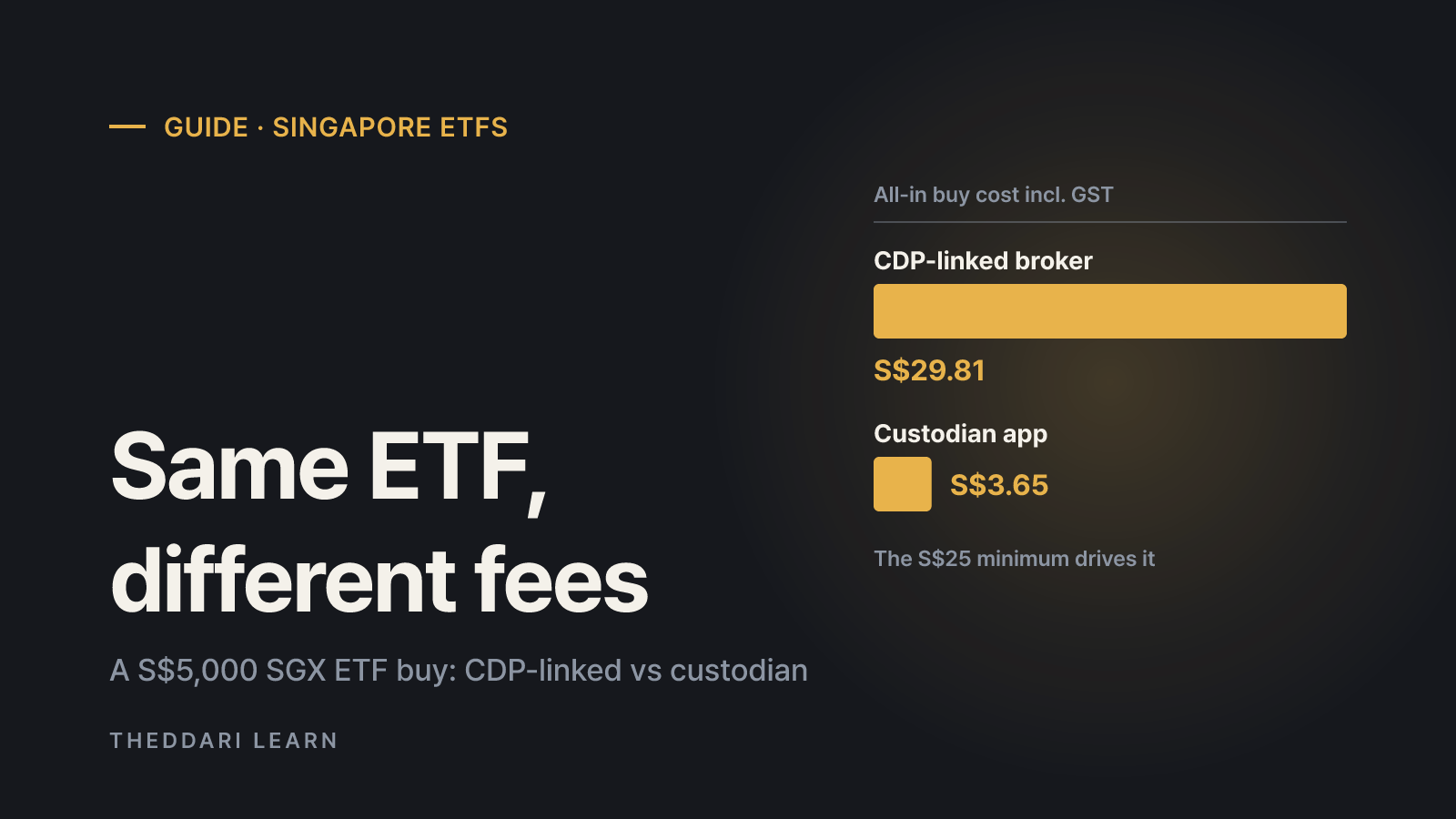
A practical guide for Singapore residents: how SGX-listed and US-listed ETFs are held, what the CDP rule changes of July 2026 mean for custodian accounts, and what a trade really costs at different order sizes.
 Investing
KOSPI 200 Covered Call ETF Tax: Tax-Free Option Premiums
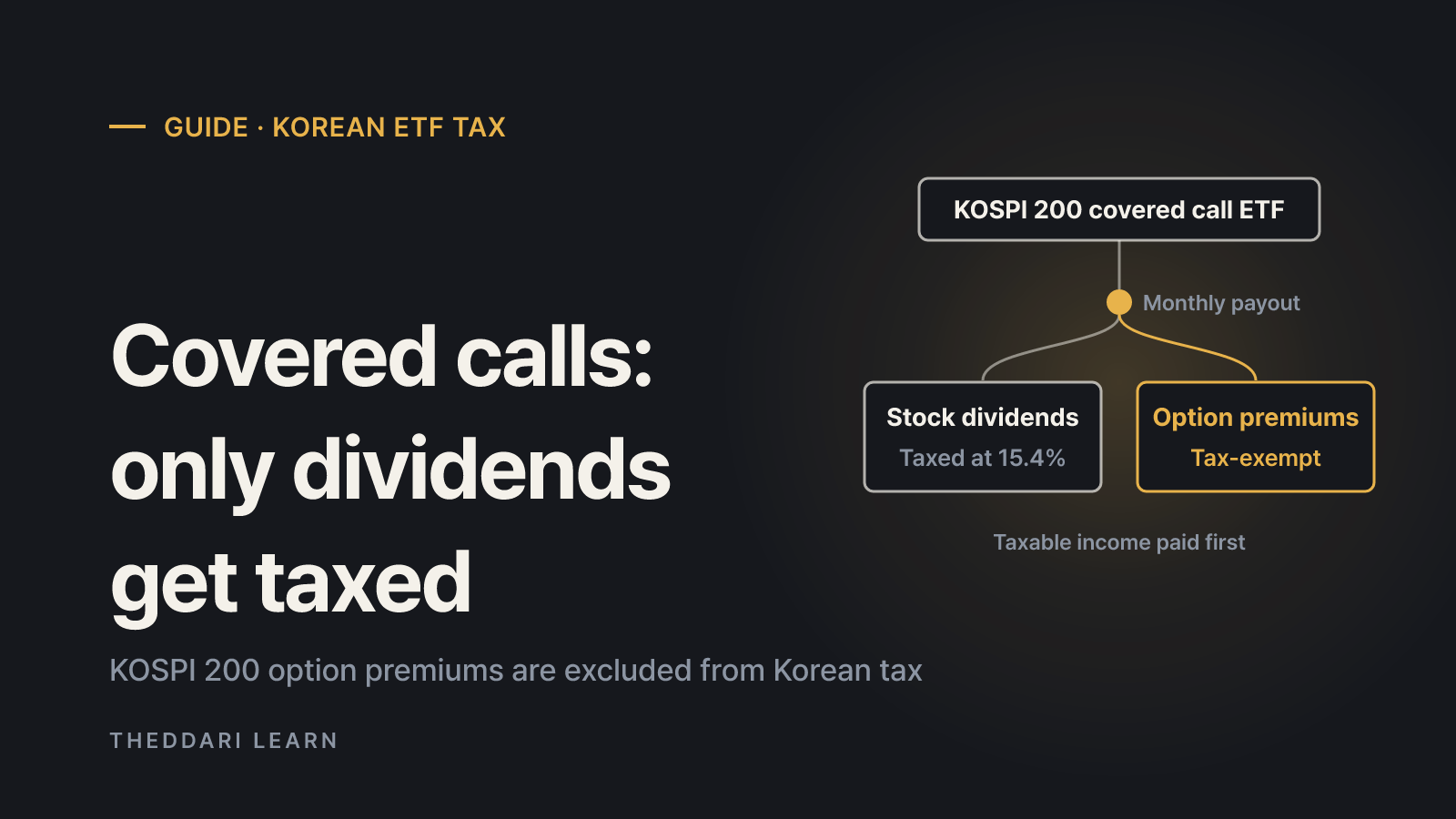
Korean managers pitch KOSPI 200 covered call ETFs as offering tax-free option premiums. What the rule covers for Korean residents, how payouts split between taxable dividends and exempt premiums, and why Korea-listed US-index covered call ETFs differ.
 Investing
Dollar-Cost Averaging Losses: Keep Buying ETFs or Bitcoin?
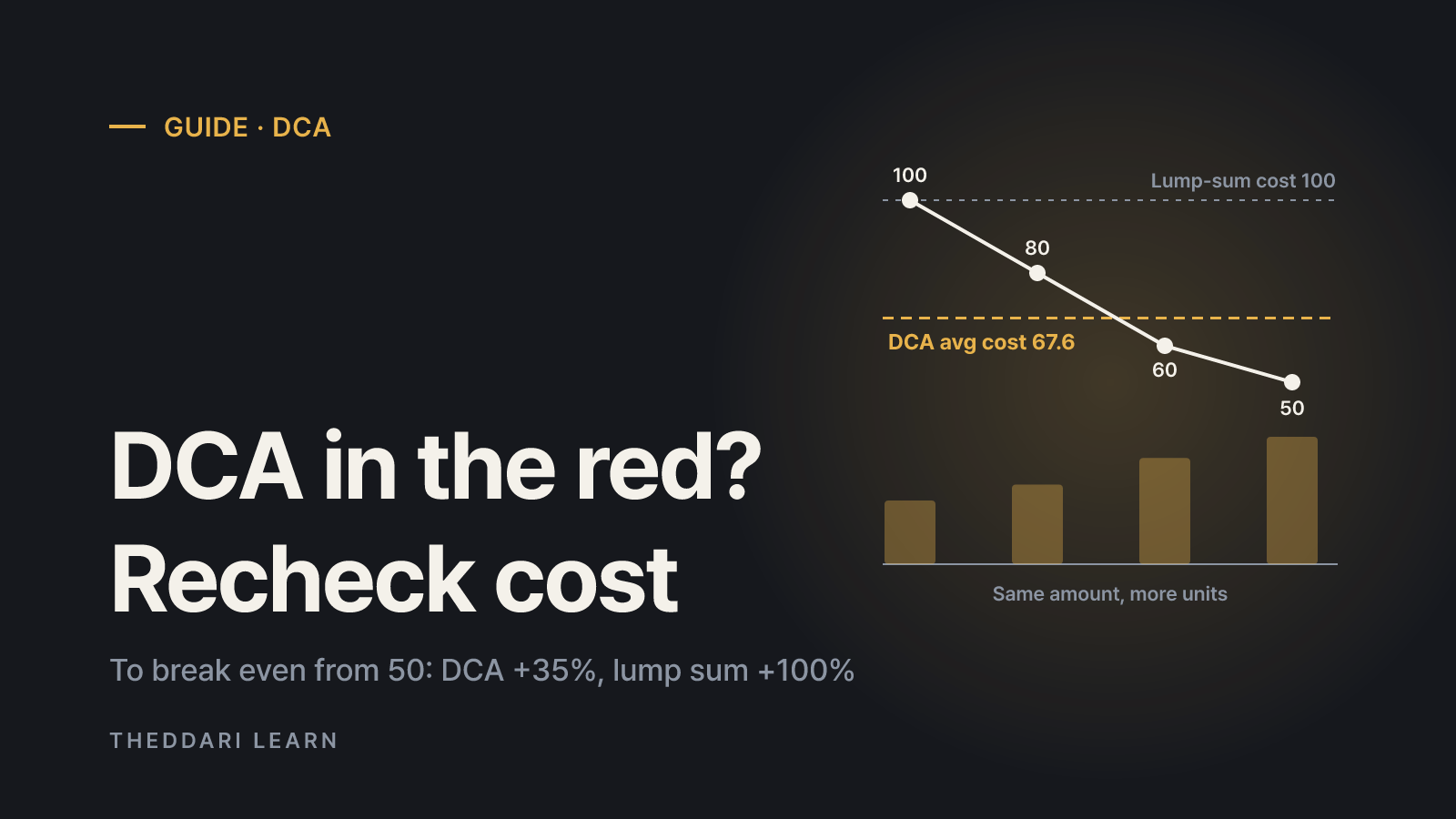
A red DCA account is not automatically a reason to stop or to double down. Check your average cost, why you own the asset, your cash cushion and your position size before changing the plan.