Contents7 sections
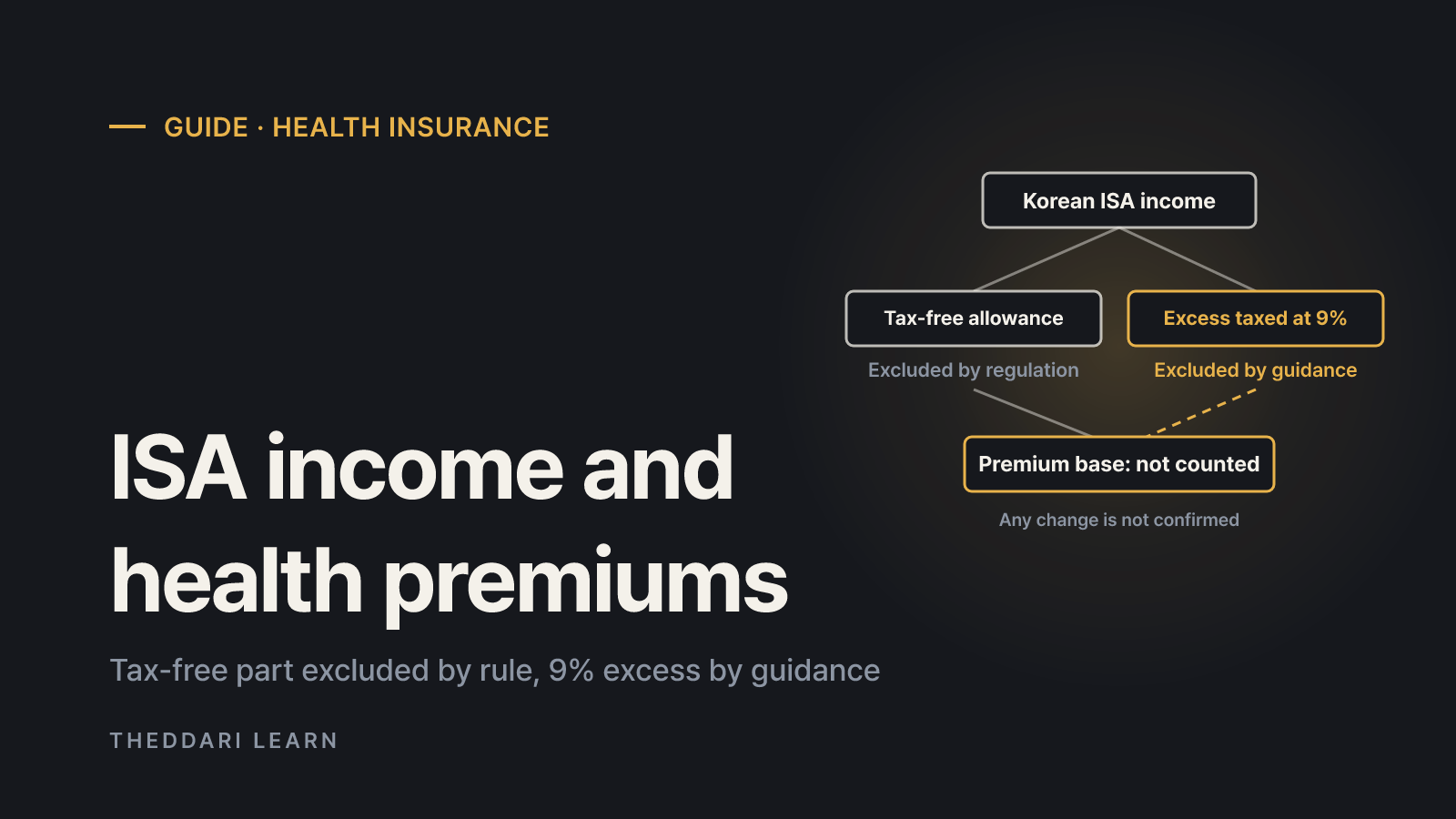
Short answer: as of November 2026, dividends and interest earned inside a Korean ISA (Individual Savings Account) do not count toward National Health Insurance premium calculations. The reason, however, is split in two. Income within the ISA tax-free allowance is excluded by regulation, while the portion above that allowance, taxed separately at 9%, is excluded only because of administrative guidance. That distinction matters because a late-October 2026 news report suggested the National Health Insurance Service (NHIS) might start charging premiums on this income. The NHIS denied it was reviewing the idea. This guide is for Korean residents and expats enrolled in Korea's National Health Insurance who hold or plan to open an ISA.
Korean ISA and health insurance premium rules today
A Korean ISA is a wrapper account that nets the gains and losses of deposits, funds and shares held inside it. According to the Financial Supervisory Service's FinLife comparison page, financial income in the account is tax-free up to 2 million won, and any excess is taxed separately at 9% (9.9% including local income tax). Contributions are capped at 20 million won a year and 100 million won over five years, under Article 91-18 of the Restriction of Special Taxation Act. Some account types for lower-income savers have a larger allowance, so confirm your account type with your bank or broker.
Premiums are governed by Article 41 of the Enforcement Decree of the National Health Insurance Act and Article 44 of its Enforcement Rules. As summarized by Financial News, based on a consultation with KB Securities tax specialists, these provisions explicitly exclude tax-free financial income from premiums, but they contain no matching exclusion for separately taxed financial income. On paper, then, the taxable part of an ISA could be counted.
In practice it is not. In a March 2026 Maeil Business report, a Ministry of Health and Welfare official explained that charging premiums on products created for a specific policy purpose could undermine that purpose, and that the NHIS's internal guideline was not to charge them. The same report said the NHIS does not even receive National Tax Service data for income separately taxed under the special taxation law. So ISA income is outside premium calculations because of guidance and data gaps, not because the law guarantees it.
Tax-free vs separately taxed vs ordinary financial income
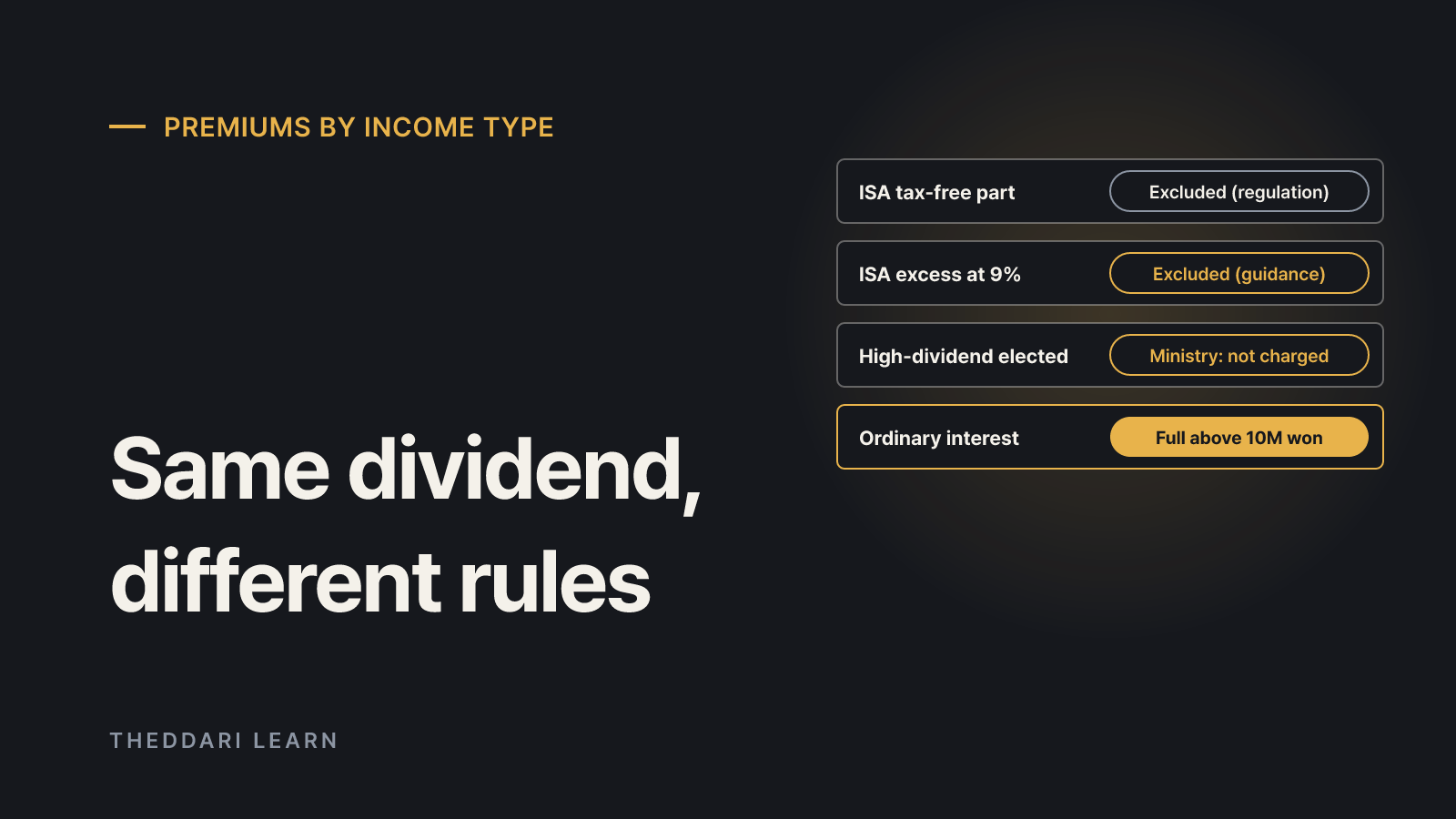
For premium purposes, the same dividend can be treated differently depending on the account and the tax method. The table summarizes what the sources above report as of November 2026. One detail surprises many people: for regional subscribers, ordinary financial income of 10 million won or less a year is ignored, but once it goes over that line the whole amount counts, not just the excess. Income of 10.01 million won means 10.01 million won is counted.
ISA income within allowance
- Tax treatment
- Tax-free
- Premium regulation
- Explicitly excluded
- Current practice
- Not counted
ISA income above allowance
- Tax treatment
- Separate tax at 9%
- Premium regulation
- No exclusion clause
- Current practice
- Not counted under guidance
High-dividend company payouts (elected)
- Tax treatment
- Separate tax chosen at filing
- Premium regulation
- No exclusion clause
- Current practice
- Ministry says it will not charge
Ordinary interest and dividends
- Tax treatment
- Withheld if 20M won or less
- Premium regulation
- Counted in full above 10M won
- Current practice
- Counted for regional subscribers above 10M won
The new separate taxation for high-dividend companies looks similar but works differently. ISA tax is settled by withholding when the income is paid. The high-dividend option, by contrast, is elected by the taxpayer on the following May's income tax return. Financial News noted that investors with financial income of 20 million won or less, who normally do not file, might need to file just to keep that income out of premiums. ISA holders do not face that extra step.
How it affects employees, regional subscribers and dependents
Even with ISA income excluded, your other income still determines whether you cross a threshold, and the relevant threshold depends on how you are enrolled. According to Financial News, the November 2026 premium reflects 2025 income and property tax bases as of June 1, 2026, which is why premiums and status are reset each November.
- Employee subscribers: if non-salary income exceeds 20 million won a year, an extra income-based premium applies to the excess. Excluded ISA income does not enter this calculation.
- Regional (self-employed or retired) subscribers: premiums depend on income and property. Ordinary financial income above 10 million won a year is counted in full. If ISA excess income were ever added, that line would be easier to cross.
- Dependents: annual income above 20 million won can end dependent status and turn you into a regional subscriber. A separate property test also applies, so retirees with high-value homes are most exposed.
Retired dependents and regional subscribers have the most at stake. Maeil Business illustrated this in March with a retiree owning a home with a property tax base of 900 million won and receiving 12 million won of dividends a year. If that income stays excluded, the retiree keeps dependent status. If it were counted, the retiree could become a regional subscriber and pay roughly 440,000 won a month, of which about 360,000 won relates to the home and 80,000 won to financial income. That is the newspaper's illustration under its own assumptions; actual premiums depend on your assets, income and the year's rates.
The October 2026 report and the NHIS denial
On October 27, 2026, Maeil Business reported that the NHIS had listed charging premiums on currently exempt, separately taxed income as a key task in its report to the National Assembly's health and welfare committee. Items mentioned included separately taxed high-dividend payouts, interest on retail government bonds, National Growth Fund dividends, ISA income above the tax-free allowance and some real estate fund dividends. The article also cited the system's finances: a projected 2.8374 trillion won deficit this year and a National Assembly Budget Office forecast that accumulated reserves would run out in 2029.
The next day the NHIS issued a clarification. It said it was not true that the plan was under review, that nothing mentioned in the report had been confirmed, and that charging premiums on separately taxed income would require sufficient public discussion of the burden and fairness between subscribers. As of November 2, 2026, there is no confirmed policy and no effective date. Because the legal basis to charge still exists, though, the guidance could change without a new law.
To see how Korean retail investors are discussing the issue, theddari's stock Telegram trends and blog trends pages track the conversation, but treat them as a pulse check and confirm any change through official announcements.
 theddari.comTrendsBlog PostsSummarized Naver blog posts
A practical checklist for ISA holders
- 1
Confirm your enrollment type
Check on the NHIS website or app whether you are an employee subscriber, a regional subscriber or a dependent. That decides whether the 10 million won or 20 million won threshold matters to you.
- 2
Add up income outside the ISA
Total your bank interest, dividends from regular accounts and any overseas dividends for each year, plus pension, business or salary income. That is what currently drives premium decisions.
- 3
Plan the year you close the ISA
ISA income is netted and taxed when the account is closed or matures, so it lands in a single year. If the excess were ever counted, that year could push you over a threshold, so know your likely closing year.
- 4
Track official changes only
Follow Ministry of Health and Welfare and NHIS press releases and any amendment to the Enforcement Decree. Avoid closing an account early because of a viral premium bomb headline before a change is confirmed and dated.
Bottom line: as of November 2026, Korean ISA income, whether tax-free or separately taxed, is not counted for health insurance premiums. The tax-free part is protected by regulation; the taxable excess relies on guidance. If dependent status or regional premiums matter to you, watch your income outside the ISA, plan your closing year and verify any policy change through official channels.