Contents7 sections
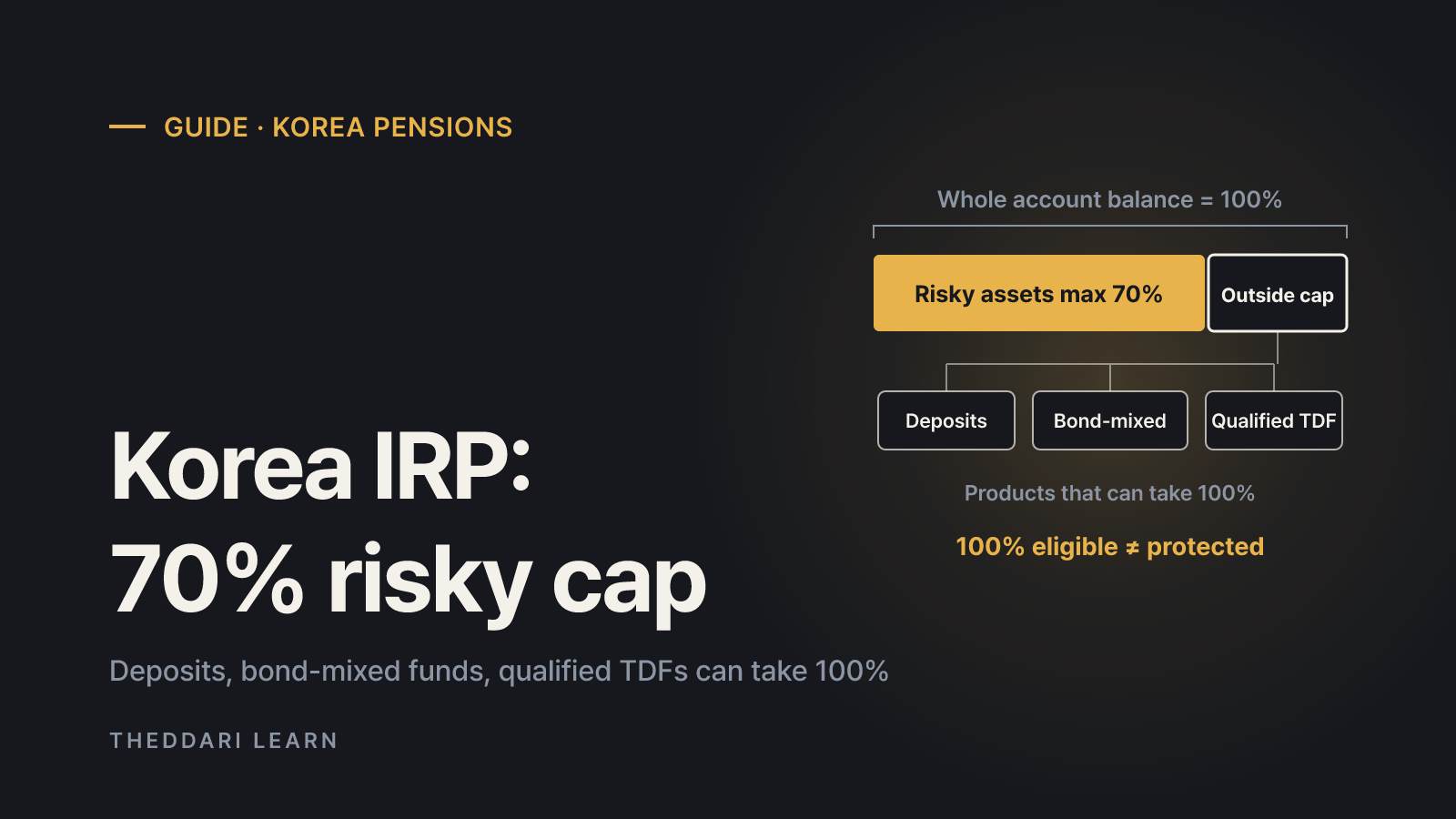
The Korea IRP 70% limit is a rule that caps risky assets, such as equity funds and equity ETFs, at 70% of a member's total balance in Korean defined contribution (DC) and individual retirement pension (IRP) accounts. The remaining share must sit in products that regulators treat as outside the cap: principal-protected deposits, bond and bond-mixed funds whose equity limit is below 50%, money market funds, or qualified target date funds (TDFs). This guide applies to Korea's workplace and individual retirement pension system as of October 2026, and reflects the Financial Supervisory Service (FSS) notice of October 28, 2026 and the April 2026 change to qualified TDF rules.
Two points matter most. First, a product labeled 100% is only exempt from the legal cap; its price can still fall. Second, a portfolio built entirely from 100%-eligible products can still carry a large equity exposure. If you are a Korean resident or an expat employee with a Korean DC plan or IRP, the sections below explain how the classification works and what to check before you buy.
How the Korea IRP 70% limit is calculated
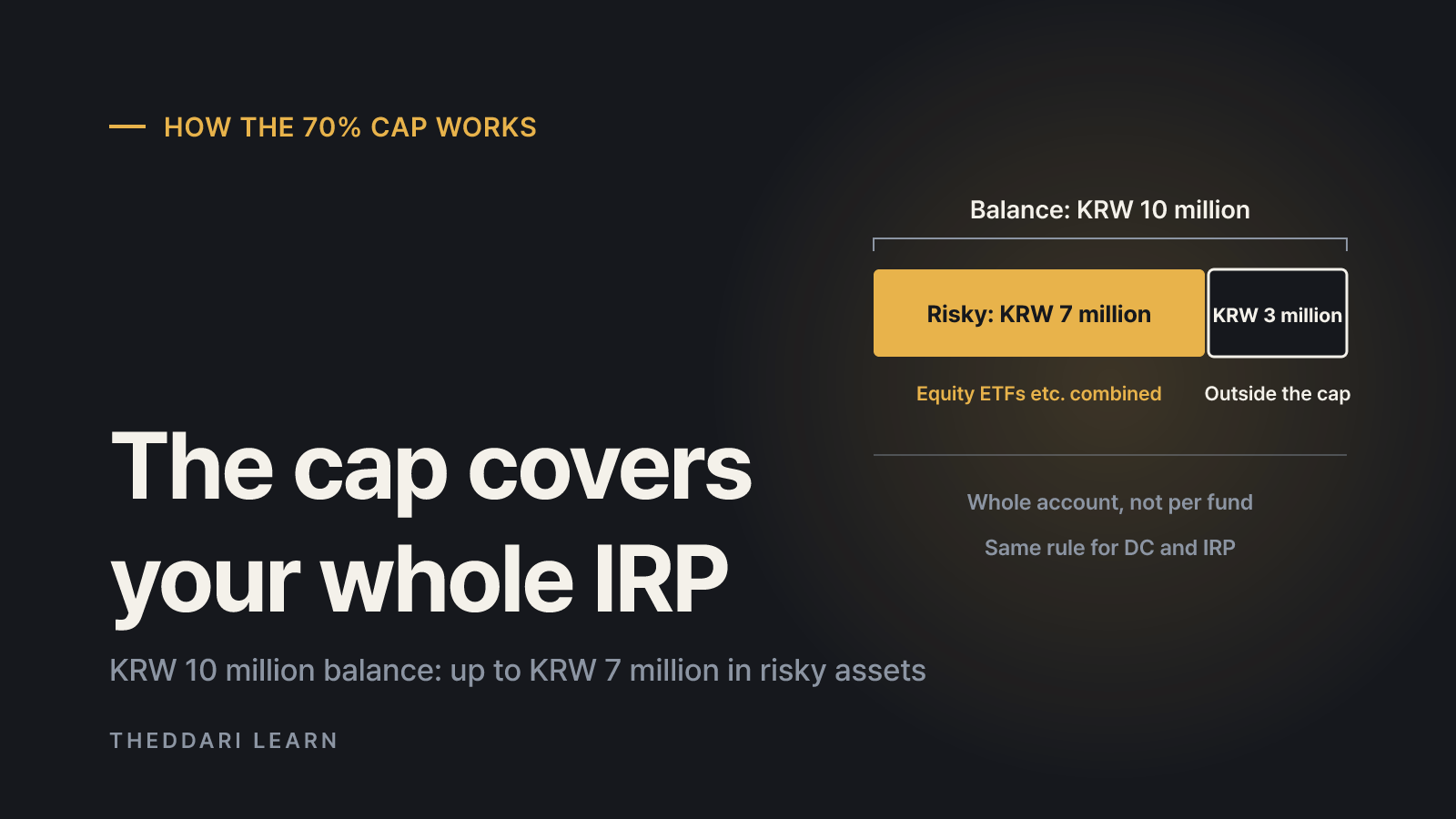
The cap is measured against your whole account balance, not each product. Its legal basis is Article 26 of the Enforcement Decree and Article 10 of the Enforcement Rules of the Employee Retirement Benefit Security Act, plus Article 11 of the Retirement Pension Supervisory Regulation issued by the Financial Services Commission (ETFstyle summary of the articles). Individual IRPs borrow the DC rules for investment choices, so both account types behave the same way.
- Who it applies to: DC plans, individual IRPs and corporate IRPs, where the member chooses the products.
- Who it does not apply to: DB (defined benefit) plans, because the employer invests the money. A DB member can still open a personal IRP, which follows the 70% rule.
- Simple example: with KRW 10 million in the account, risky assets can total up to KRW 7 million; at least KRW 3 million must be in products outside the cap.
Most Korean brokerage and bank apps show a 70% or 100% tag, or the remaining risky-asset buying capacity, on the order screen. The word bond or stable in a fund name does not decide the category; the fund's legal equity limit does. If a rally pushes risky assets above 70%, providers handle it differently, so check your provider's rules.
Which products can fill 100%, which count toward 70%, and which are banned
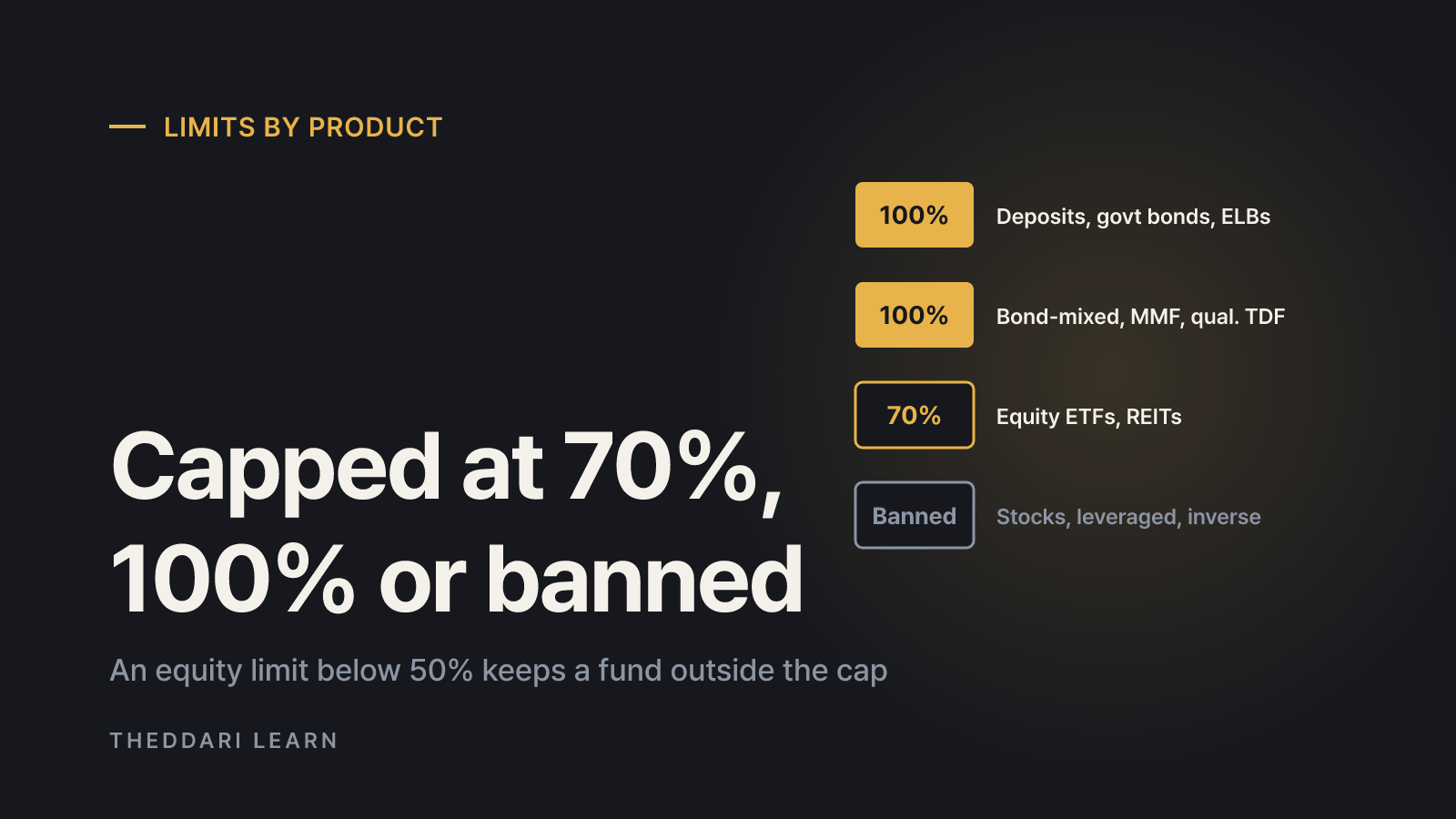
The FSS splits DC and IRP products into principal-protected products and performance-based products, and then splits performance-based products into reduced-risk products and risky products. The first two groups can reach 100%; risky products share the 70% cap (FSS notice).
Principal-protected
- Typical examples
- Time deposits, GICs, principal-protected ELBs, Korean government and central bank bonds
- DC and IRP limit
- 100%
Reduced-risk
- Typical examples
- Bond and bond-mixed funds or ETFs with an equity limit below 50%, MMFs, qualified TDFs, approved default options, variable insurance with a protection feature
- DC and IRP limit
- 100%
Risky
- Typical examples
- Equity funds and ETFs (including Korea-listed US index ETFs), equity-heavy mixed funds, REITs, investment-grade corporate bonds, ELS or DLS with max loss up to 40%
- DC and IRP limit
- 70% combined
Not allowed
- Typical examples
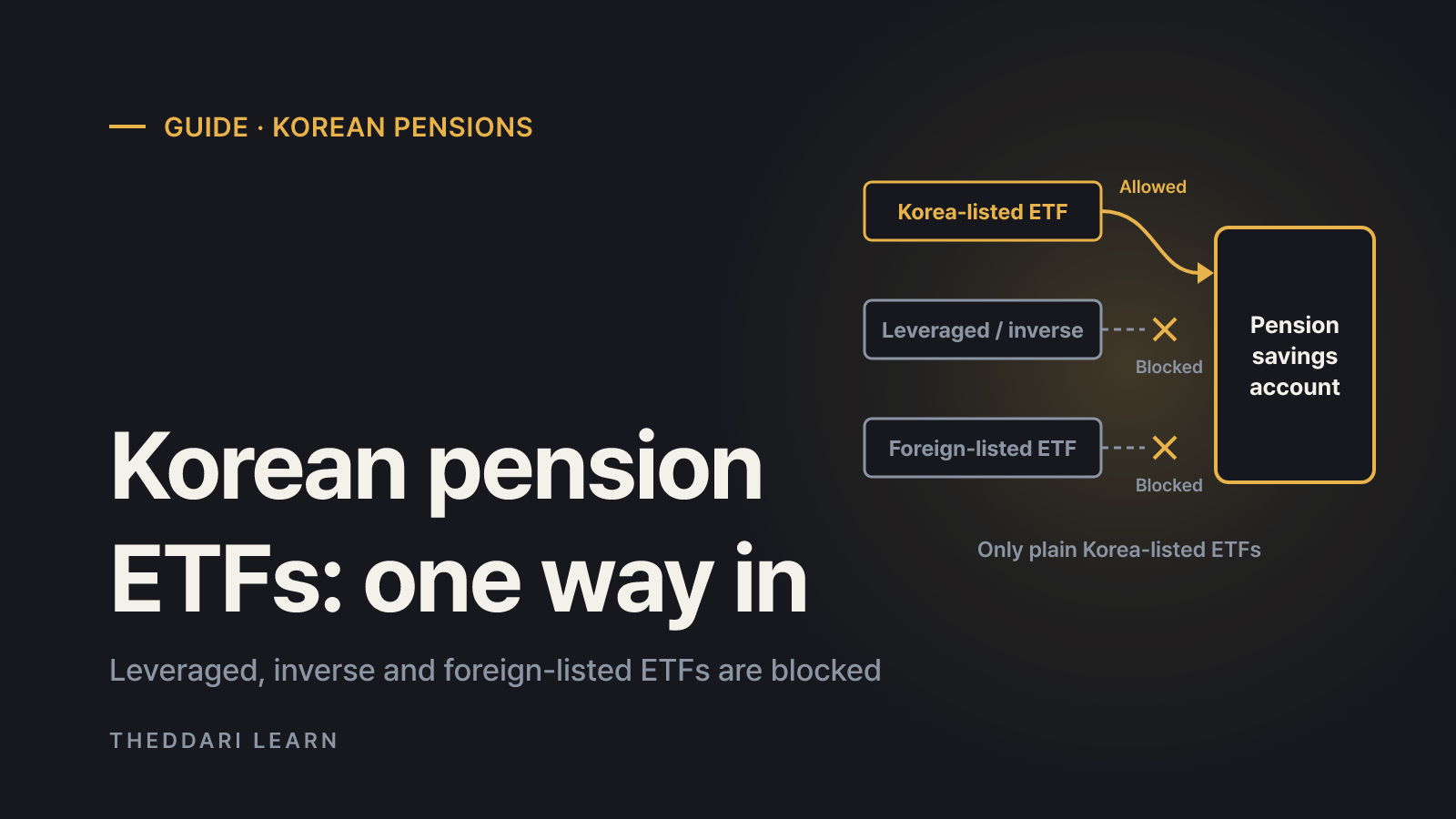
- Direct trading of individual stocks, leveraged or inverse ETFs, private funds, convertible and subordinated bonds, depositary receipts
- DC and IRP limit
- Cannot buy
When a bond-mixed ETF qualifies
Article 11(1)(5) of the supervisory regulation exempts securities funds whose legal equity limit is below 50% of total assets, unless the fund may hold more than 30% in below-investment-grade bonds. Some older broker guides still show earlier thresholds, so rely on the category shown on your order screen and on the fund's prospectus.
US index ETFs and government bond ETFs
Korea-listed ETFs tracking the S&P 500 or Nasdaq-100 are risky assets inside the 70% cap. ETFs listed directly on foreign exchanges are generally not tradable in these accounts. Most Korean government bond ETFs are shown as outside the cap, but confirm the label for each product with your provider.
Qualified TDFs: what changed in April 2026
A target date fund lowers its equity share as the target retirement year approaches. TDFs that meet FSS criteria can fill 100% of a DC or IRP account even though they hold a lot of equities. In its rule amendment notice, the FSS said it would switch the test from an equity ceiling to a mandatory safe-asset floor and add a single-country limit. The amended rules took effect on April 1, 2026 (NH-Amundi summary).
- Naming: a TDF eligible for 100% must include 'qualified' (jeokgyeok) in its Korean product name.
- Country limit: no more than 80% in any single country.
- Safe-asset floor: at least 20% before the target date and at least 60% after it.
- Credit quality: non-investment-grade bonds capped at 20% of total assets.
Qualified does not mean low risk. Before the target date a qualified TDF can hold up to 80% in risky assets, so putting the whole balance into a distant-vintage TDF can leave your account with more equity exposure than the 70% cap would normally allow. NH-Amundi's qualified TDF 2055, for example, is disclosed at risk grade 2 (high risk).
Fees matter too. Within one manager's qualified TDF range, total expense ratios ran from about 0.79% to 1.68% a year depending on vintage and share class, based on April 2026 disclosures. Over decades, a gap of around half a percentage point compounds into a meaningful amount.
Why a 100% label does not protect your principal
According to the FSS, Korean retirement pension assets reached KRW 558.3 trillion at the end of June 2026: KRW 360.3 trillion in principal-protected products and KRW 198.0 trillion in performance-based products. ETFs made up KRW 99.8 trillion of the latter, more than ten times the KRW 9 trillion held at the end of 2023 (Financial News). The regulator found that some providers showed only the 100% tag, without a risk grade, which could lead members to treat a bond ETF like a bank deposit.
Risk grades can change while you hold the fund
Korean funds are graded from 1 (very high risk) to 6 (very low risk). Reduced-risk ETFs start at grade 4 or lower, but after three years they are re-graded on actual volatility. In the FSS example, a 30-year government bond active ETF eligible for 100% went from grade 5 in August 2022 to grade 3 in August 2026, because long-duration bonds swing sharply when interest rates move.

If long government bond ETFs fill the safe part of your account, central bank decisions and inflation releases move their prices directly. The economic calendar above lists those release dates so you know when volatility is likely to rise.
What changes from January 2027
- Order screens and product search screens must show the investment limit and the risk grade together.
- Product proposals from pension providers must state the risk grade.
- Members' periodic asset management reports must list the risk grade of each holding.
- Some providers that need system work may implement it during the first half of 2027.
Checklist before you buy in a DC plan or IRP
- 1
Check your account and remaining cap
Confirm whether it is a DC plan or IRP, your current risky-asset ratio and the remaining buying capacity.
- 2
Read the limit and the risk grade together
Do not stop at the 100% tag. Find the grade from 1 to 6 in the prospectus or on the manager's site if the screen does not show it yet.
- 3
Look inside the fund
For bond-mixed funds, check the legal equity limit; for bond funds, check the mix of government and corporate bonds and the duration.
- 4
Add up your real equity exposure
70% in equity ETFs plus 30% in a bond-mixed fund holding just under 50% equities can push total equity exposure above 80%. Add each TDF's equity share separately.
- 5
Compare costs
Compare expense ratios, trading fees, trading volume and bid-ask spreads.
- 6
Review regularly
Use your periodic report to track grade changes and rebalance when needed.
News on pension rule changes and new ETF launches often circulates first in Korean market Telegram channels. The Telegram stock trends page above shows which topics are getting attention, but always confirm a product's category and risk grade on your provider's screen and in official disclosures.
In short, the Korea IRP 70% limit sets a ceiling on how much risk you may take; it does not make the other 30% safe. Reading the limit, the risk grade, your real equity exposure and the fees together helps you avoid leaning too heavily on a 100% label.