Contents7 sections
Dividends can raise Korean health insurance premiums, but only after they cross a clear line. As of October 2026, Korea's National Health Insurance Service (NHIS) leaves interest and dividends out of the premium income base when their combined total is KRW 10 million or less per year. Cross that line and the entire amount is counted (Enforcement Rule, Article 44). What happens next depends on how you are covered: dependents can lose free coverage, regional subscribers pay more, and employees pay extra only if their non-salary income tops KRW 20 million.
This guide is for people enrolled in Korea's National Health Insurance, including Korean investors and foreign residents who hold Korean brokerage accounts. It does not describe US, UK or other health systems, and foreign residents may face extra eligibility conditions. Figures were checked against NHIS pages and the current statutes in October 2026; individual bills also depend on property, household and reductions.
How dividends enter Korean health insurance premiums
NHIS looks at six income types: interest, dividends, business, wages, pensions and other income (Enforcement Decree, Article 41). Income that is tax-exempt under Korea's Income Tax Act is excluded, and capital gains (transfer income) are not on the list at all. Dividends are measured as dividend income under the tax law, which means the pre-tax amount, not the net cash that lands in your brokerage account after the 15.4% withholding.
The KRW 10 million cliff
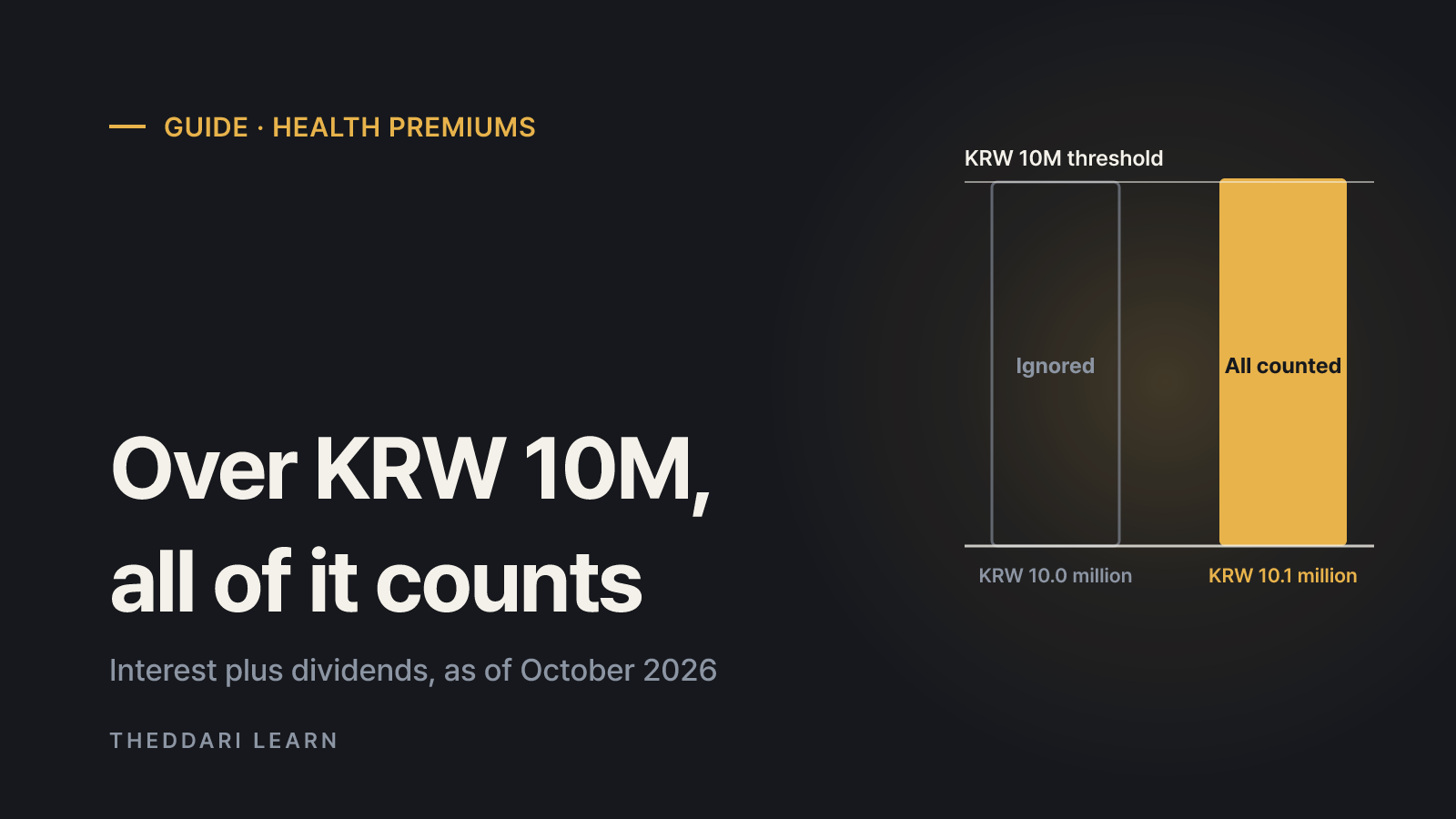
The rule is a cliff, not a deductible. Interest and dividends that are taxed separately through withholding are ignored up to KRW 10 million. One won more and the full total enters the calculation. KRW 10.0 million and KRW 10.1 million differ by KRW 100,000 in real life, but for NHIS purposes they mean zero versus KRW 10.1 million of counted income.
The threshold covers interest plus dividends. KRW 9 million of ETF distributions and KRW 1.5 million of deposit interest add up to KRW 10.5 million, all of which counts.
Dependents vs regional vs employee subscribers
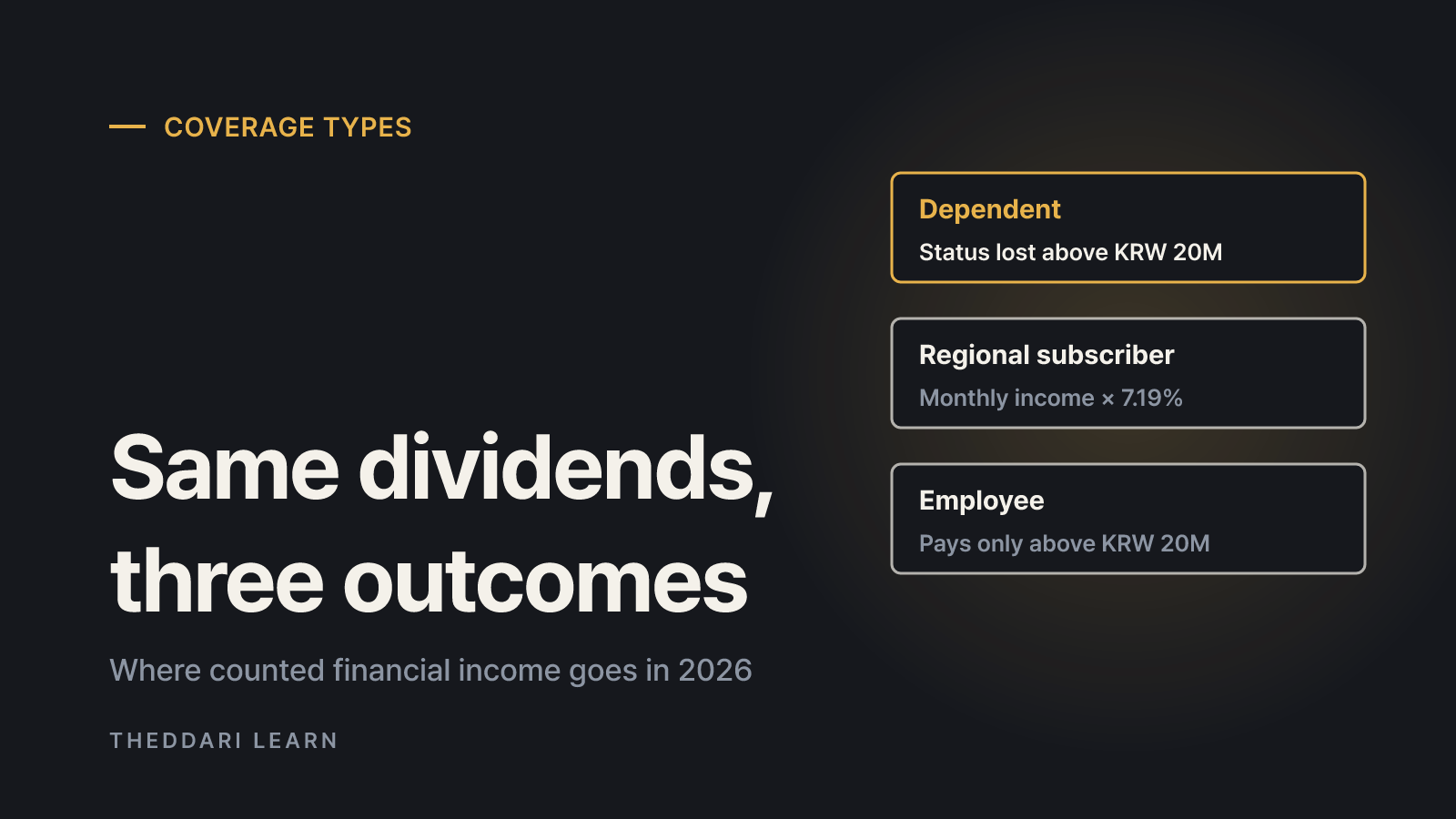
Once financial income is counted, a separate test applies to each type of coverage. The table summarises the 2026 rules from NHIS (dependent requirements, non-salary income premium, 2026 rates).
Dependent (pibuyangja)
- If financial income exceeds KRW 10M
- Full amount added to pension, wage and other income
- Result
- Status lost if total exceeds KRW 20M a year; moved to regional subscriber
Dependent with property tax base KRW 540M–900M
- If financial income exceeds KRW 10M
- Full amount added
- Result
- Status lost if total exceeds KRW 10M a year
Regional subscriber
- If financial income exceeds KRW 10M
- Full amount added to annual income
- Result
- Annual income ÷ 12 × 7.19%, plus property premium
Employee subscriber
- If financial income exceeds KRW 10M
- Added to non-salary income
- Result
- (Non-salary income − KRW 20M) ÷ 12 × 7.19%, paid entirely by the employee
Dependents: the KRW 20 million test
A dependent is someone, often a spouse or retired parent, covered through a working family member without paying premiums. To qualify, all income combined must be KRW 20 million or less per year, and a registered business must have no business income. Consider a parent with KRW 11 million of dividends and interest plus KRW 9.5 million of public pension: the total is KRW 20.5 million, so the parent fails the test. If the same parent kept financial income at KRW 9.9 million, it would be ignored, leaving only a KRW 19 million pension, which passes if the other conditions are met. Married dependents must both pass, so one spouse failing removes both.
Regional subscribers: 7.19% of monthly income
Regional subscribers, mainly self-employed people and retirees without employer coverage, pay monthly income (annual income ÷ 12) × 7.19% plus property points × KRW 211.5 in 2026. With KRW 12 million of dividends and no other income, monthly income is KRW 1 million, so the income part is about KRW 71,900. Long-term care insurance adds about KRW 9,448 (premium × 0.9448% ÷ 7.19%). At KRW 10 million of financial income, the dividends would add nothing, although the household minimum premium and property premium may still apply.
Employees: only above KRW 20 million
Employees already pay premiums on salary, split with the employer. On top of that, NHIS charges a non-salary income premium when other income exceeds KRW 20 million a year. Dividends and interest are rated at 100%, wages and pensions at 50%. With KRW 25 million of dividends as the only outside income: (KRW 25M − KRW 20M) ÷ 12 ≈ KRW 416,666, times 7.19% ≈ KRW 29,958 extra per month. With KRW 18 million of dividends, the KRW 10 million cliff is crossed but the total is still under KRW 20 million, so there is no extra charge.
Dividend ETF health premium: which payouts count
Marketing that promises a dividend ETF with "no tax or health premium worries" should be checked against tax classification, because NHIS follows it. According to the Korea Council for Investor Education, ETFs listed on the Korea Exchange are treated as trust-type funds, so distributions are taxed as dividend income, while gains on ETFs listed abroad are taxed separately as capital gains.
Distributions from Korea-listed ETFs (domestic or foreign stock)
- Tax classification
- Dividend income
- Counted toward the KRW 10M test?
- Yes
Trading gains on Korea-listed domestic stock ETFs
- Tax classification
- Tax-exempt
- Counted toward the KRW 10M test?
- No
Trading gains on Korea-listed foreign, bond or leveraged ETFs
- Tax classification
- Dividend income (lower of trading gain or tax-base NAV gain)
- Counted toward the KRW 10M test?
- Yes
Trading gains on ETFs listed abroad (e.g. US-listed)
- Tax classification
- Capital gains
- Counted toward the KRW 10M test?
- No, not an NHIS income type
The "no worries" claim may therefore hold for one investor and fail for another, depending on the account type, the form of the payout and other income. Tax rules change, so read the tax section of the fund prospectus before buying.
When the income shows up on your bill
NHIS uses tax data with a delay (Enforcement Decree, Article 41(3)). Bills for January to October use income from two years earlier (pensions from the prior year); bills for November and December use the prior year. Dividends received in 2026 therefore affect bills from November 2027 through October 2028.
- 1
1. Add up last year's financial income
Combine pre-tax interest and dividends from your bank and brokerage statements or the Hometax withholding records.
- 2
2. Compare with KRW 10 million
At or below it, financial income is ignored; above it, add the full amount to your other income.
- 3
3. Apply your coverage test
Dependents: KRW 20M (or KRW 10M with higher property). Employees: KRW 20M of non-salary income. Regional subscribers: monthly income × 7.19%.
- 4
4. Confirm with NHIS
Use the NHIS website's dependent check and premium simulator, or call the NHIS call center at 1577-1000.
Common mistakes to avoid
- Forgetting bank interest when checking the KRW 10 million line.
- Using net cash received instead of the pre-tax amount.
- Assuming one spouse's dividends cannot affect the other; dependents are assessed as a couple.
- Expecting immediate relief: lower dividends this year reduce premiums only one to two years later.
- Ignoring premium caps and reductions, which make simple estimates differ from actual bills.
To track when Korean and US companies report results and announce payouts, use the Theddari earnings calendar. To see how dividend ETFs and tax issues are being discussed, check the stock Telegram trends page.

In short, judge the impact with three checks: the KRW 10 million interest-plus-dividend cliff, the KRW 20 million test for your coverage type, and the one-to-two-year reporting lag. If a retired couple is near the line, list each spouse's financial and pension income side by side and run the NHIS simulator before choosing accounts or products.